

The DOI matches its Crossref record; 20 of the 21 references it cites were found in a registry or an index; 5 of the 7 sources its claims cite were checked for support.
BioModels Parameters: a treasure trove of parameter values from published systems biology models
Open accessAbstract
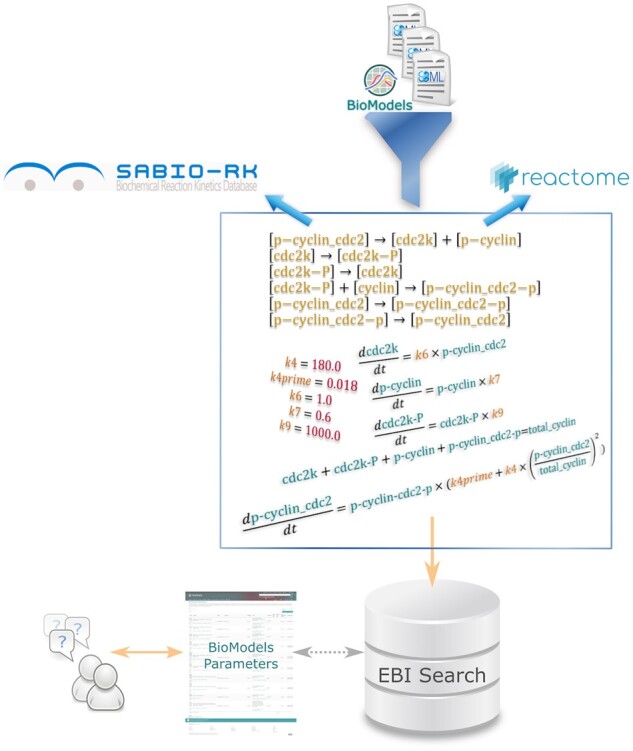
Motivation: One of the major bottlenecks in building systems biology models is identification and estimation of model parameters for model calibration. Searching for model parameters from published literature and models is an essential, yet laborious task. Results: We have developed a new service, BioModels Parameters, to facilitate search and retrieval of parameter values from the Systems Biology Markup Language models stored in BioModels. Modellers can now directly search for a model entity (e.g. a protein or drug) to retrieve the rate equations describing it; the associated parameter values (e.g. degradation rate, production rate, Kcat, Michaelis–Menten constant, etc.) and the initial concentrations. Currently, BioModels Parameters contains entries from over 84,000 reactions and 60 different taxa with cross-references. The retrieved rate equations and parameters can be used for scanning parameter ranges, model fitting and model extension. Thus, BioModels Parameters will be a valuable service for systems biology modellers. Availability and implementation: The data are accessible via web interface and API. BioModels Parameters is free to use and is publicly available at https://www.ebi.ac.uk/biomodels/parameterSearch. Supplementary information: Supplementary data are available at Bioinformatics online.
Overview
CoChat Summary
TL;DR
BioModels Parameters is a new search service that extracts reactions, rate equations, parameter values, and initial concentrations from kinetic SBML models in BioModels. It currently indexes about 1,370 models, over 84,000 reactions, more than 56,000 entities, and 95,000 parameters, with web and API access.
Key findings
- The resource contains data from 921 curated and 454 non-curated kinetic models, totaling 25,435 curated reactions and 58,716 non-curated reactions, with 40,041 curated parameters and 55,822 non-curated parameters.
- It covers over 60 taxa and includes parameters across biological regulation, response to stimulus, cellular and developmental processes, protein conformational change, signalling cascades, metabolic pathways, infection, pharmacokinetics, and population dynamics.
- Use cases show parameter reuse: TF concentrations from 0.005 to 300 nM were scanned in model BIOMD0000000332, and ERK Km values from 10 to 1,007,340 µM were scanned in BIOMD0000000010.
- A new model, MODEL1911140002, was built by extending TNF-NFkB model BIOMD0000000786 with ROS and SOD components extracted from BIOMD0000000560 via BioModels Parameters.
Methods
- The authors extracted reactions from about 920 curated and 450 non-curated kinetic SBML models in BioModels using a Java-based tool built on JSBML; custom function definitions were inlined using libSBML.
- Model entities were cross-referenced to external resources including UniProt, ChEBI, Gene Ontology, Reactome, and SABIO-RK, and the dataset was indexed by EMBL-EBI search for browsing and download.
- Data are accessible via a web interface and REST API, with results displayed in tabular format and downloadable as CSV; use cases applied extracted values in COPASI parameter scans and model extension.
Limitations
- The paper states that the parameter search is contingent on depositions available in the BioModels repository.
- The paper states that curated-model components are more reliable than non-curated ones because curated models are independently verified, but parameters are not individually curated to determine whether they were experimentally derived or estimated; users should consult the corresponding publications for context.
- Evident from the text: extraction is limited to kinetic SBML models in BioModels, so parameters from models not represented in that repository or format are not included.
Model-written summary. Check it against the paper before relying on it.
Integrity signals
Registry
Cites
Statistics
Figures


Verification
Claims the paper makes
3 Valid · 1 Not valid · 2 Not checked · 41 Own results and interpretations
The cited sources support only part of this claim — read each source’s verdict below.
In the paper
“In addition to the above example, parameters can be used as a source of initial values when fitting a model to the experimental data, as seen in BIOMD0000000734 (Parmar et al., 2017).”
§ BioModels Parameters: a treasure trove of parameter values from published systems biology models > 4 Use cases > 4.2 Parameter scanning
What the sources say
- Partly supportedcites Parmar et al., 2017 sourceExperimental — accuracy not yet measured
The Methods (Modeling framework and computations; page unavailable) say the authors estimated model parameters to fit experimental data, and the Results (Parameter estimation for adequate iron diet; page unavailable) list the resulting parameter sets. Our copy does not say those parameters supplied initial values for fitting; it describes reusing initial species concentrations after a fit. It also identifies the deposited models as MODEL1605030002–MODEL1605030005, not BIOMD0000000734. (LLM, conf=0.84)
plainstates a cause- Asserted: passes — The authors put it forward as true.
- Checkable: passes — It can be checked against evidence.
- Load-bearing: unclear — It is unclear whether the paper’s conclusions depend on it.
- Based: passes — The paper gives a reason why it holds.
- Rests on an assumption not shown here.
- Partly supported
A result the paper states — it cites no source for it, so there is none to check. The quote shows it is in the paper.
In the paper
“Similarly, TNF also induced SOD production by inducing NFkB activation.”
§ BioModels Parameters: a treasure trove of parameter values from published systems biology models > 4 Use cases > 4.3 Adding new components to extend an existing model
plainstates a cause- Asserted: passes — The authors put it forward as true.
- Checkable: passes — It can be checked against evidence.
- Load-bearing: unclear — It is unclear whether the paper’s conclusions depend on it.
- Based: passes — The paper gives a reason why it holds.
- Rests on an assumption not shown here.
A result the paper states — it cites no source for it, so there is none to check. The quote shows it is in the paper.
In the paper
“Reflecting the broad spectrum covered by BioModels submissions, BioModels Parameters provides quantitative information about biological processes including biological regulation, response to stimulus, as well as cellular and developmental processes (Fig. 2a).”
§ BioModels Parameters: a treasure trove of parameter values from published systems biology models > 3 Results > 3.1 BioModels Parameters content
plain- Asserted: passes — The authors put it forward as true.
- Checkable: passes — It can be checked against evidence.
- Load-bearing: unclear — It is unclear whether the paper’s conclusions depend on it.
- Based: passes — The paper gives a reason why it holds.
A result the paper reports from its own data — it cites no other source for it, so there is none to check. The quote shows it is in the paper.
In the paper
“MAP Kinase (MAPK) cascade is among the most modelled signalling pathways and hence, MAPK is the most frequent protein entity with entries from about 50 models (Fig. 2c).”
§ BioModels Parameters: a treasure trove of parameter values from published systems biology models > 3 Results > 3.1 BioModels Parameters content
plain- Asserted: passes — The authors put it forward as true.
- Checkable: passes — It can be checked against evidence.
- Load-bearing: unclear — It is unclear whether the paper’s conclusions depend on it.
- Based: passes — The paper gives a reason why it holds.
A result the paper reports from its own data — it cites no other source for it, so there is none to check. The quote shows it is in the paper.
In the paper
“As a majority of the kinetic models in BioModels represent biochemical reactions, UniProt is the most used resource to annotate model entities, followed by KEGG and ChEBI (Fig. 2b).”
§ BioModels Parameters: a treasure trove of parameter values from published systems biology models > 3 Results > 3.1 BioModels Parameters content
plainstates an association- Asserted: passes — The authors put it forward as true.
- Checkable: passes — It can be checked against evidence.
- Load-bearing: unclear — It is unclear whether the paper’s conclusions depend on it.
- Based: passes — The paper gives a reason why it holds.
12 more claims
Create a free account to see all 47 claims and every source verdict.
- Probably not a substantial claim. 20
- It may state two separate claims as one. 16
Citations
Cites
The Reactome pathway Knowledgebase
Fabregat, A., Sidiropoulos, K., Garapati, P., Gillespie, M., Hausmann, K., Haw, R., Jassal, B., Jupe, S., Korninger, F., McKay, S., et al. (2016) · Nucleic Acids Research · doi:10.1093/nar/gkv1351 · Cited by 5,605
Self-citationThe EMBL-EBI search and sequence analysis tools APIs in 2019
Madeira, F., Park, Y. M., Lee, J., Buso, N., Gur, T., Madhusoodanan, N., Basutkar, P., Tivey, A. R. N., Potter, S. C., Finn, R. D., et al. (2019) · Nucleic Acids Research · doi:10.1093/nar/gkz268 · Cited by 4,167
Hucka, M., Finney, A., Sauro, H. M., Bolouri, H., Doyle, J. C., Kitano, H., Arkin, A. P., Bornstein, B. J., Bray, D., Cornish-Bowden, A., et al. (2003) · Bioinformatics · doi:10.1093/bioinformatics/btg015 · Cited by 3,060
The Reactome Pathway Knowledgebase
Fabregat, A., Jupe, S., Matthews, L., Sidiropoulos, K., Gillespie, M., Garapati, P., Haw, R., Jassal, B., Korninger, F., May, B., et al. (2018) · Nucleic Acids Research · doi:10.1093/nar/gkx1132 · Cited by 2,855
Self-citationCOPASI—a COmplex PAthway SImulator
Hoops, S., Sahle, S., Gauges, R., Lee, C., Pahle, J., Simus, N., Singhal, M., Xu, L., Mendes, P., & Kummer, U. (2006) · Bioinformatics · doi:10.1093/bioinformatics/btl485 · Cited by 2,618
Kholodenko, B. N. (2000) · European Journal of Biochemistry · doi:10.1046/j.1432-1327.2000.01197.x · Cited by 643 · cited 2×
“We have searched for ‘ERK’ and extracted the values of Michaelis-Menten constant, Km for the extracellular signal-regulated kinase (ERK) phosphorylation reactions across different models, obtaining a range of 10–1,007,340 mM. Applying it to the ERK model BIOMD0000000010 (Kholodenko, 2000), we observed (Fig.”
MethodPhysicochemical modelling of cell signalling pathways
Aldridge, B. B., Burke, J. M., Lauffenburger, D. A., & Sorger, P. K. (2006) · Nature Cell Biology · doi:10.1038/ncb1497 · Cited by 592
Quantitative and logic modelling of molecular and gene networks
Le Novère, N. (2015) · Nature Reviews Genetics · doi:10.1038/nrg3885 · Cited by 430
LibSBML: an API Library for SBML
Bornstein, B. J., Keating, S. M., Jouraku, A., & Hucka, M. (2008) · Bioinformatics · doi:10.1093/bioinformatics/btn051 · Cited by 373
BioModels—15 years of sharing computational models in life science
Malik-Sheriff, R. S., Glont, M., Nguyen, T. V. N., Tiwari, K., Roberts, M. G., Xavier, A., Vu, M. T., Men, J., Maire, M., Kananathan, S., et al. (2019) · Nucleic Acids Research · doi:10.1093/nar/gkz1055 · Cited by 361
Self-citation
Cited by
Quantitative systems toxicology: modelling to mechanistically understand and predict drug safety
Goldring, C. E., Russomanno, G., Pin, C., Trairatphisan, P., Beattie, K. A., Fisher, C., Piñero, J., Brennan, R., Clausznitzer, D., Copple, I. M., et al. (2025) · Nature Reviews Drug Discovery · doi:10.1038/s41573-025-01308-z · Cited by 27
“Many systems biology models describe physiological cell and tissue functions, and these have been applied to elucidate biology and mechanisms of diseases 21,22 .”
Self-citationSego, T. J., Aponte-Serrano, J. O., Gianlupi, J. F., & Glazier, J. A. (2021) · BMC Biology · doi:10.1186/s12915-021-01115-z · Cited by 20
Dynamic models for metabolomics data integration
Lakrisenko, P., & Weindl, D. (2021) · Current Opinion in Systems Biology · doi:10.1016/j.coisb.2021.100358 · Cited by 15
“Additionally, the BioModels Parameters database [36] provides structured access to parameter values that are used in models contained in the BioModels repository.”
Systems Biology in ELIXIR: modelling in the spotlight
dos Santos, V. A. P. M., Anton, M., Szomolay, B., Ostaszewski, M., Arts, I. C. W., Benfeitas, R., Angel, V. D. D., Domínguez-Romero, E., Ferk, P., Fey, D., et al. (2022) · F1000Research · doi:10.12688/f1000research.126734.1 · Cited by 14
Self-citationFitzpatrick, R., & Stefan, M. I. (2022) · Neuroinformatics · doi:10.1007/s12021-022-09584-5 · Cited by 8
“There are databases of biochemical parameters (Glont et al., 2020; Jeske et al., 2019; Sivakumaran et al., 2003; Wittig et al., 2012), but at this point they suffer from incomplete coverage, especially when it comes to data on signalling pathways.”
Background
Metadata
- Authors
- Glont, M., Arankalle, C., Tiwari, K., Nguyen, T. V. N., Hermjakob, H., & Malik-Sheriff, R. S.
- Affiliations
- European Bioinformatics Institute (GB)
- Babraham Institute (GB)
- European Molecular Biology Laboratory-European Bioinformatics Institute (EMBL-EBI) , Wellcome Trust Genome Campus, Hinxton, Cambridge CB10 1SD, UK
- Venue
- Bioinformatics
- Publisher
- Oxford University Press (OUP)
- Published
- 2020-06-23
- Volume
- 36
- Issue
- 17
- Pages
- 4649-4654
- ISSN
- 1367-4803 (ISSN-L)
- 1367-4811
- PMC
- PMC7653554
- OpenAlex
- W3037410842
- Cited by
- 10
- References
- 21
- Citations by year
- 2026: 2 · 2025: 2 · 2024: 1 · 2022: 2 · 2021: 3
- FWCI
- 0.41
- Type
- journal article
- Language
- en
- Open access
- hybrid
- doi.org
- Licence
- Locations
- Bioinformatics (publishedVersion, cc-by)
- PubMed Central (publishedVersion, cc-by)
- PubMed (publishedVersion)
- Funders
- Innovative Medicines Initiative 2 Joint Undertaking (116030)
- European Union’s Horizon 2020 Research and Innovation Programme
- European Federation of Pharmaceutical Industries and Associations
- Biotechnology and Biological Sciences Research Council (BB/N019482/1, BB/N019474/1)
- European Molecular Biology Laboratory
- Topics
- Life Sciences › Biochemistry, Genetics and Molecular Biology › Molecular Biology › Gene Regulatory Network Analysis
- Life Sciences › Biochemistry, Genetics and Molecular Biology › Molecular Biology › Bioinformatics and Genomic Networks
- Life Sciences › Biochemistry, Genetics and Molecular Biology › Molecular Biology › Microbial Metabolic Engineering and Bioproduction
- Keywords
- model parameters, SBML, biomodels, parameter extraction, model calibration, rate equations, initial concentration, model fitting, parameter scanning
- MeSH terms
- Models, Biological, Software, Systems Biology
About these checks
Registry, retraction, Cites and statistics results are computed, not judged, with one exception: a printed reference that no index lists is read once by a model before it counts as a citation error. Claims are extracted by a model and kept only when their quote appears verbatim in the text; each cited source is then checked, with a model’s help, for whether it says what the claim relies on. Those verdicts can be wrong — read the claim’s quote and the cited source before relying on one.
The claim verdicts this report counts are experimental: their accuracy is not yet measured.
A language model drew the claims from the paper on 2026-10-10, under version 3 of the claim definition (model deepseek-v4.1-flash, prompt extract-v3).
A second model labelled each claim on 2026-10-10 (model jev-1.13-20260917, definition revision gold-guideline-v0.2).
Cited sources are checked with a language model’s help (gpt-6-sol).
Statistics and arithmetic are recomputed, not judged.
Confidence bands are shown only for fields calibrated on our annotated test set. None is calibrated yet, so no band is shown.
What counts as a claim ›How we measure confidence ›How we check this ›
Are you an author, or do you see a problem with this page? Request a review
How to cite
Cite CoChat for the checks on this page, and the paper for its own findings.
- This page
- CoChat. (2026). Citation check: BioModels Parameters: a treasure trove of parameter values from published systems biology models. https://app.cochat.ai/papers/10.1093/bioinformatics/btaa560
- The paper
- Glont, M., Arankalle, C., Tiwari, K., Nguyen, T. V. N., Hermjakob, H., & Malik-Sheriff, R. S. (2020). BioModels Parameters: a treasure trove of parameter values from published systems biology models. Bioinformatics. https://doi.org/10.1093/bioinformatics/btaa560
Data sources
Bibliographic data: Semantic Scholar, OpenAlex, Crossref.
Contains information from the Semantic Scholar Academic Graph Datasets, made available under the ODC Attribution License (ODC-BY 1.0).
Semantic Scholar’s data is described in: Kinney, R., et al. (2023). The Semantic Scholar Open Data Platform. arXiv:2301.10140.
