

ProteoWizard: open source software for rapid proteomics tools development
Open accessThe DOI matches its Crossref record; 5 of the 5 references it cites were found in a registry or an index.
Abstract
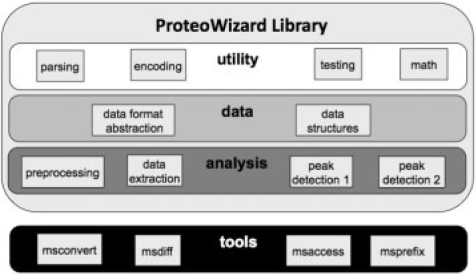
Summary: The ProteoWizard software project provides a modular and extensible set of open-source, cross-platform tools and libraries. The tools perform proteomics data analyses; the libraries enable rapid tool creation by providing a robust, pluggable development framework that simplifies and unifies data file access, and performs standard proteomics and LCMS dataset computations. The library contains readers and writers of the mzML data format, which has been written using modern C++ techniques and design principles and supports a variety of platforms with native compilers. The software has been specifically released under the Apache v2 license to ensure it can be used in both academic and commercial projects. In addition to the library, we also introduce a rapidly growing set of companion tools whose implementation helps to illustrate the simplicity of developing applications on top of the ProteoWizard library. Availability: Cross-platform software that compiles using native compilers (i.e. GCC on Linux, MSVC on Windows and XCode on OSX) is available for download free of charge, at http://proteowizard.sourceforge.net. This website also provides code examples, and documentation. It is our hope the ProteoWizard project will become a standard platform for proteomics development; consequently, code use, contribution and further development are strongly encouraged. Contact: darren@proteowizard.org; parag@ucla.edu Supplementary information: Supplementary data are available at Bioinformatics online.
Overview
The claims and statistics of this paper haven’t been checked yet.
Free: it reads the open-access text and checks the first 5 claims that cite a source we can check. Create a free account to check every claim.
Integrity signals
Registry
Cites
Statistics
Figures
Verification
Claims the paper makes
The claims and statistics of this paper haven’t been checked yet.
Free: it reads the open-access text and checks the first 5 claims that cite a source we can check. Create a free account to check every claim.
Claims other papers make about this one
Each is checked against this paper’s own text: does it say what the citing paper says it does?
The cited source says what the claim attributes to it.
In the citing paper
“Importing data obtained from different MS instruments is supported using ProteoWizard,12 DeconEngine,13 and vendor provided libraries.”
From MASH Explorer: A Universal Software Environment for Top-Down Proteomics (2020) · cites this paper as [12]
Self-check
Percentages, sums and reported differences re-computed from the paper’s own numbers.
The self-check needs the paper’s full text.
Citations
Cites
A common open representation of mass spectrometry data and its application to proteomics research
Pedrioli, P. G. A., Eng, J. K., Hubley, R., Vogelzang, M., Deutsch, E. W., Raught, B., Pratt, B., Nilsson, E., Angeletti, R. H., Apweiler, R., et al. (2004) · Nature Biotechnology · doi:10.1038/nbt1031 · Cited by 780
A uniform proteomics MS/MS analysis platform utilizing open XML file formats
Keller, A., Eng, J., Zhang, N., Li, X., & Aebersold, R. (2005) · Molecular Systems Biology · doi:10.1038/msb4100024 · Cited by 693
TOPP—the OpenMS proteomics pipeline
Kohlbacher, O., Reinert, K., Gröpl, C., Lange, E., Pfeifer, N., Schulz-Trieglaff, O., & Sturm, M. (2007) · Bioinformatics · doi:10.1093/bioinformatics/btl299 · Cited by 281
Rauch, A., Bellew, M., Eng, J., Fitzgibbon, M., Holzman, T., Hussey, P., Igra, M., Maclean, B., Lin, C. W., Detter, A., et al. (2006) · Journal of Proteome Research · doi:10.1021/pr0503533 · Cited by 215
Orchard, S. E., Montecchi‐Palazzi, L., Deutsch, E. W., Binz, P., Jones, A. R., Paton, N. W., Pizarro, A., Creasy, D. M., Wojcik, J., & Hermjakob, H. (2007) · PROTEOMICS · doi:10.1002/pmic.200700658 · Cited by 50
Cited by
Skyline: an open source document editor for creating and analyzing targeted proteomics experiments
MacLean, B., Tomazela, D. M., Shulman, N., Chambers, M., Finney, G. L., Frewen, B., Kern, R., Tabb, D. L., Liebler, D. C., & MacCoss, M. J. (2010) · Bioinformatics · doi:10.1093/bioinformatics/btq054 · Cited by 4,697
Self-citationA cross-platform toolkit for mass spectrometry and proteomics
Chambers, M. C., Maclean, B., Burke, R., Amodei, D., Ruderman, D. L., Neumann, S., Gatto, L., Fischer, B., Pratt, B., Egertson, J., et al. (2012) · Nature Biotechnology · doi:10.1038/nbt.2377 · Cited by 4,093
Self-citationPluskal, T., Castillo, S., Villar-Briones, A., & Orešič, M. (2010) · BMC Bioinformatics · doi:10.1186/1471-2105-11-395 · Cited by 3,845
A global genetic interaction network maps a wiring diagram of cellular function
Costanzo, M., VanderSluis, B., Koch, E. N., Baryshnikova, A., Pons, C., Tan, G., Wang, W., Usaj, M., Hanchard, J., Lee, S. D., et al. (2016) · Science · doi:10.1126/science.aaf1420 · Cited by 1,240
MS-GF+ makes progress towards a universal database search tool for proteomics
Kim, S., & Pevzner, P. A. (2014) · Nature Communications · doi:10.1038/ncomms6277 · Cited by 1,098
Metadata
- Authors
- Kessner, D., Chambers, M., Burke, R., Agus, D., & Mallick, P.
- Affiliations
- Cedars-Sinai Medical Center (US)
- Corresponding author
- Kessner, Darren
- Mallick, Parag
- Venue
- Bioinformatics
- Publisher
- Oxford University Press (OUP)
- Published
- 2008-07-07
- Volume
- 24
- Issue
- 21
- Pages
- 2534-2536
- ISSN
- 1367-4803 (ISSN-L)
- 1367-4811
- PMC
- PMC2732273
- OpenAlex
- W2027974246
- Cited by
- 2,024
- References
- 5
- Citations by year
- 2026: 111 · 2025: 139 · 2024: 166 · 2023: 146 · 2022: 167 · 2021: 170 · 2020: 164 · 2019: 147 · 2018: 137 · 2017: 141 · 2016: 118 · 2015: 116 · 2014: 97 · 2013: 81 · 2012: 61
- FWCI
- 9.10
- Type
- journal article
- Language
- en
- Open access
- hybrid
- doi.org
- Licence
- Locations
- Bioinformatics (publishedVersion, cc-by-nc)
- PubMed Central (publishedVersion, cc-by-nc)
- PubMed (publishedVersion)
- Funders
- National Institutes of Health (5r01ca126218-05)
- National Heart, Lung, and Blood Institute
- National Cancer Institute (R01-CA-126218, CA126479, U24CA126479, CA-126218)
- Topics
- Physical Sciences › Chemistry › Spectroscopy › Advanced Proteomics Techniques and Applications
- Social Sciences › Decision Sciences › Information Systems and Management › Scientific Computing and Data Management
- Life Sciences › Biochemistry, Genetics and Molecular Biology › Molecular Biology › Genomics and Phylogenetic Studies
- Keywords
- proteomics data analysis, open source software, LC-MS data processing, cross-platform software, C++ library
- MeSH terms
- Proteins, Software, User-Computer Interface, Proteome, Databases, Protein, Proteomics
About these checks
Registry, retraction, Cites and statistics results are computed, not judged, with one exception: a printed reference that no index lists is read once by a model before it counts as a citation error. Claims are extracted by a model and kept only when their quote appears verbatim in the text; each cited source is then checked, with a model’s help, for whether it says what the claim relies on. Those verdicts can be wrong — read the claim’s quote and the cited source before relying on one.
Statistics and arithmetic are recomputed, not judged.
Confidence bands are shown only for fields calibrated on our annotated test set. None is calibrated yet, so no band is shown.
What counts as a claim ›How we measure confidence ›How we check this ›
Are you an author, or do you see a problem with this page? Request a review
Data sources
Bibliographic data: Semantic Scholar, OpenAlex, Crossref.
Contains information from the Semantic Scholar Academic Graph Datasets, made available under the ODC Attribution License (ODC-BY 1.0).
Semantic Scholar’s data is described in: Kinney, R., et al. (2023). The Semantic Scholar Open Data Platform. arXiv:2301.10140.
