

Enabling Green and Blue Infrastructure to Improve Contributions to Human Well-Being and Equity in Urban Systems
Open accessThe DOI matches its Crossref record; 74 of the 75 references it cites were found in a registry or an index.
Abstract
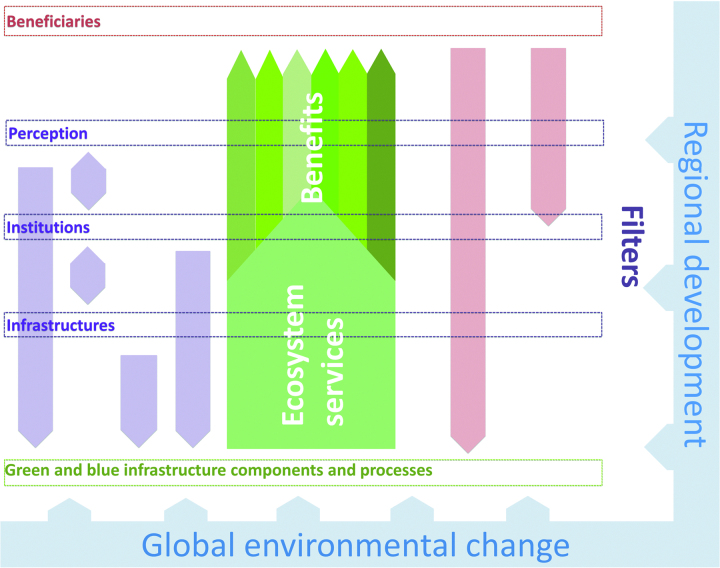
The circumstances under which different ecosystem service benefits can be realized differ. The benefits tend to be coproduced and to be enabled by multiple interacting social, ecological, and technological factors, which is particularly evident in cities. As many cities are undergoing rapid change, these factors need to be better understood and accounted for, especially for those most in need of benefits. We propose a framework of three systemic filters that affect the flow of ecosystem service benefits: the interactions among green, blue, and built infrastructures; the regulatory power and governance of institutions; and people's individual and shared perceptions and values. We argue that more fully connecting green and blue infrastructure to its urban systems context and highlighting dynamic interactions among the three filters are key to understanding how and why ecosystem services have variable distribution, continuing inequities in who benefits, and the long-term resilience of the flows of benefits.
Overview
The claims and statistics of this paper haven’t been checked yet.
Free: it reads the open-access text and checks the first 5 claims that cite a source we can check. Create a free account to check every claim.
Integrity signals
Registry
Cites
Statistics
Figures
Verification
Claims the paper makes
The claims and statistics of this paper haven’t been checked yet.
Free: it reads the open-access text and checks the first 5 claims that cite a source we can check. Create a free account to check every claim.
Claims other papers make about this one
Each is checked against this paper’s own text: does it say what the citing paper says it does?
The source backs part of the claim, not all of it — or backs it for a different population, condition or comparison.
In the citing paper
“Although the adoption of NbS for climate adaptation and resilience is widespread globally, effective NbS function in any given location depends on a diverse set of social, ecological, economic, and infrastructural factors (5, 16, 76).”
From Global synthesis and regional insights for mainstreaming urban nature-based solutions (2025) · cites this paper as [16]
Experimental — accuracy not yet measured
Self-check
Percentages, sums and reported differences re-computed from the paper’s own numbers.
The self-check needs the paper’s full text.
Citations
Cites
A General Framework for Analyzing Sustainability of Social-Ecological Systems
Ostrom, E. (2009) · Science · doi:10.1126/science.1172133 · Cited by 8,656
North, D. C. (1991) · Journal of Economic Perspectives · doi:10.1257/jep.5.1.97 · Cited by 5,232
SEN, A. (2009) · Harvard University Press eBooks · doi:10.2307/j.ctvjnrv7n · Cited by 3,430 · cited 1×
“Even when there are no formal restrictions, differences in knowledge, education, available information, and individual circumstances may privilege some voices and interests more than others (Schlosberg 2009, Sen 2009).”
BackgroundAccessibility evaluation of land-use and transport strategies: Review and research directions
Geurs, K. T., & van Wee, B. (2004) · Journal of Transport Geography · doi:10.1016/j.jtrangeo.2003.10.005 · Cited by 3,353
Defining and classifying ecosystem services for decision making
Fisher, B., Turner, R. K., & Morling, P. (2009) · Ecological Economics · doi:10.1016/j.ecolecon.2008.09.014 · Cited by 3,158
Assessing nature's contributions to people
Díaz, S., Pascual, U., Stenseke, M., Martín-López, B., Watson, R. T., Molnár, Z., Hill, R., Chan, K. M. A., Baste, I. A., Brauman, K. A., et al. (2018) · Science · doi:10.1126/science.aap8826 · Cited by 2,885
Haaland, C., & van den Bosch, C. K. (2015) · Urban Forestry & Urban Greening · doi:10.1016/j.ufug.2015.07.009 · Cited by 1,585
The links between biodiversity, ecosystem services and human well-being
Haines-Young, R., & Potschin, M. (2010) · Ecosystem Ecology · doi:10.1017/cbo9780511750458.007 · Cited by 1,514 · cited 1×
“2009, Haines-Young and Potschin 2010).”
Managing ecosystem services: what do we need to know about their ecology?
Kremen, C. (2005) · Ecology Letters · doi:10.1111/j.1461-0248.2005.00751.x · Cited by 1,411 · cited 1×
“Still, for other ES, such as active outdoor recreation and food production, it is land tenure and management (Kremen 2005, Langemeyer et al.”
BackgroundDefining environmental justice : theories, movements, and nature
Schlosberg, D. (2007) · Cited by 1,284
Cited by
Impacts of land use/land cover changes on ecosystem services in ecologically fragile regions
Fang, Z., Ding, T., Chen, J., Xue, S., Zhou, Q., Wang, Y., Wang, Y., Huang, Z., & Yang, S. (2022) · Science of The Total Environment · doi:10.1016/j.scitotenv.2022.154967 · Cited by 375
A social-ecological-technological systems framework for urban ecosystem services
McPhearson, T., Cook, E. M., Berbés-Blázquez, M., Cheng, C., Grimm, N. B., Andersson, E., Barbosa, O., Chandler, D. G., Chang, H., Chester, M. V., et al. (2022) · One Earth · doi:10.1016/j.oneear.2022.04.007 · Cited by 373
“25,26,97 We assert that using the SETS framework will broaden research and practice on ecosystem services.”
MethodSelf-citationKronenberg, J., Haase, A., Łaszkiewicz, E., Antal, A., Baravikova, A., Biernacka, M., Dushkova, D., Filčak, R., Haase, D., Ignatieva, M., et al. (2020) · Cities · doi:10.1016/j.cities.2020.102862 · Cited by 332
Self-citationRemote sensing in urban planning: Contributions towards ecologically sound policies?
Wellmann, T., Lausch, A., Andersson, E., Knapp, S., Cortinovis, C., Jache, J., Scheuer, S., Kremer, P., Mascarenhas, A., Kraemer, R., et al. (2020) · Landscape and Urban Planning · doi:10.1016/j.landurbplan.2020.103921 · Cited by 276
Self-citationAnguelovski, I., Brand, A. L., Connolly, J. J. T., Corbera, E., Kotsila, P., Steil, J., Garcia-Lamarca, M., Triguero-Mas, M., Cole, H., Baró, F., et al. (2020) · Annals of the American Association of Geographers · doi:10.1080/24694452.2020.1740579 · Cited by 309
Self-citationVári, Á., Podschun, S. A., Erős, T., Hein, T., Pataki, B., Iojă, I.-C., Adamescu, C. M., Gerhardt, A., Gruber, T., Dedić, A., et al. (2022) · Ambio · doi:10.1007/s13280-021-01556-4 · Cited by 206
Urbanization in and for the Anthropocene
Elmqvist, T., Andersson, E., McPhearson, T., Bai, X., Bettencourt, L., Brondizio, E., Colding, J., Daily, G., Folke, C., Grimm, N., et al. (2021) · npj Urban Sustainability · doi:10.1038/s42949-021-00018-w · Cited by 209
Self-citationWeaving notions of justice into urban ecosystem services research and practice
Langemeyer, J., & Connolly, J. J. T. (2020) · Environmental Science & Policy · doi:10.1016/j.envsci.2020.03.021 · Cited by 217
Self-citationWhose city? Whose nature? Towards inclusive nature-based solution governance
Tozer, L., Hörschelmann, K., Anguelovski, I., Bulkeley, H., & Lazova, Y. (2020) · Cities · doi:10.1016/j.cities.2020.102892 · Cited by 180
“nature held by residents (Andersson et al., 2014; Andersson et al., 2019) and for the inclusion of socially excluded and vulnerable groups within the governance of projects (Connolly et al.”
BackgroundIntegrating solutions to adapt cities for climate change
Lin, B. B., Ossola, A., Alberti, M., Andersson, E., Bai, X., Dobbs, C., Elmqvist, T., Evans, K. L., Frantzeskaki, N., Fuller, R. A., et al. (2021) · The Lancet Planetary Health · doi:10.1016/s2542-5196(21)00135-2 · Cited by 172
Self-citationCalderón‐Argelich, A., Benetti, S., Anguelovski, I., Connolly, J. J., Langemeyer, J., & Baró, F. (2021) · Landscape and Urban Planning · doi:10.1016/j.landurbplan.2021.104130 · Cited by 188
“At the same time, researchers increasingly acknowledge that the translation of ES into human benefits is deeply entangled with multiple perceptions, institutions, and infrastructures, especially in urban areas (Andersson et al., 2019; Elmqvist, GómezBaggethun, & Langemeyer, 2018; Ernstson, 2013).”
BackgroundInfluentialSelf-citationZhou, K., Kong, F., Yin, H., Destouni, G., Meadows, M. E., Andersson, E., Chen, L., Chen, B., Li, Z., & Su, J. (2024) · npj Urban Sustainability · doi:10.1038/s42949-024-00162-z · Cited by 180
“As in fl uenced by demographic and institutional factors, the bene fi ts derived from ecological measures are further distributed unevenly within 35 or between cities 36 , thereby exacerbating social inequality and environmental injustices 37 .”
Self-citationJones, L., Anderson, S. G., Læssøe, J., Banzhaf, E., Jensen, A., Bird, D. N., Miller, J. D., Hutchins, M. G., Yang, J., Garrett, J. K., et al. (2022) · Nature-Based Solutions · doi:10.1016/j.nbsj.2022.100041 · Cited by 183
Wellmann, T., Schug, F., Haase, D., Pflugmacher, D., & van der Linden, S. (2020) · Landscape and Urban Planning · doi:10.1016/j.landurbplan.2020.103857 · Cited by 167
Self-citationWhat is green infrastructure? A study of definitions in US city planning
Grabowski, Z. J., McPhearson, T., Matsler, A. M., Groffman, P., & Pickett, S. T. (2022) · Frontiers in Ecology and the Environment · doi:10.1002/fee.2445 · Cited by 152
“2018) all highlight the need to beneficially integrate social, technological, and ecological systems for improved urban sustainability and resilience (Andersson et al. 2019).”
BackgroundSelf-citationInclusive conservation and the Post-2020 Global Biodiversity Framework: Tensions and prospects
Raymond, C. M., Cebrián‐Piqueras, M. A., Andersson, E., Andrade, R., Schnell, A. A., Battioni, B., Filyushkina, A., Goodson, D. J., Horcea‐Milcu, A., Johnson, D. N., et al. (2022) · One Earth · doi:10.1016/j.oneear.2022.02.008 · Cited by 164
Self-citationUrban change as an untapped opportunity for climate adaptation
Egerer, M., Haase, D., McPhearson, T., Frantzeskaki, N., Andersson, E., Nagendra, H., & Ossola, A. (2021) · npj Urban Sustainability · doi:10.1038/s42949-021-00024-y · Cited by 154
Self-citationCoombes, M. A., & VILES, H. A. (2021) · Urban forestry & urban greening · doi:10.1016/j.ufug.2021.127192 · Cited by 144
Gardening can relieve human stress and boost nature connection during the COVID-19 pandemic
Egerer, M., Lin, B. B., Kingsley, J., Marsh, P., Diekmann, L. O., & Ossola, A. (2022) · Urban forestry & urban greening · doi:10.1016/j.ufug.2022.127483 · Cited by 129
Urban Green Infrastructure in the Global South
Pauleit, S., Vásquez, A. E., Maruthaveeran, S., Liu, L., & Cilliers, S. S. (2021) · Cities and nature · doi:10.1007/978-3-030-67650-6_5 · Cited by 147
Venter, Z. S., Barton, D. N., Martínez‐Izquierdo, L., Langemeyer, J., Baró, F., & McPhearson, T. (2021) · Ecosystem Services · doi:10.1016/j.ecoser.2021.101314 · Cited by 126
“Green infrastructure, precisely because of the multiple benefits it can provide from cooling, to stormwater absorption to sites for urban agriculture and recreation, has begun to go mainstream in policies, plans, and management strategies to improve urban livability (Andersson et al. 2019).”
BackgroundSelf-citationDas, M., Das, A., & Momin, S. (2022) · Sustainable Cities and Society · doi:10.1016/j.scs.2022.104062 · Cited by 124
Amorim‐Maia, A. T., Calcagni, F., Connolly, J. J., Anguelovski, I., & Langemeyer, J. (2020) · Environmental Science & Policy · doi:10.1016/j.envsci.2020.05.021 · Cited by 123
Self-citationBiernacka, M., Kronenberg, J., & Łaszkiewicz, E. (2020) · Applied Geography · doi:10.1016/j.apgeog.2020.102152 · Cited by 106
Self-citationSmarter greener cities through a social-ecological-technological systems approach
Branny, A., Møller, M. S., Korpilo, S., McPhearson, T., Gulsrud, N. M., Olafsson, A. S., Raymond, C. M., & Andersson, E. (2022) · Current Opinion in Environmental Sustainability · doi:10.1016/j.cosust.2022.101168 · Cited by 109
Self-citationImpact of summer heat on urban park visitation, perceived health and ecosystem service appreciation
Kabisch, N., Kraemer, R., Masztalerz, O., Hemmerling, J., Püffel, C., & Haase, D. (2021) · Urban forestry & urban greening · doi:10.1016/j.ufug.2021.127058 · Cited by 109
Self-citationUrban oases: the social-ecological importance of small urban green spaces
Egerer, M., Annighöfer, P., Arzberger, S., Burger, S., Hecher, Y., Knill, V., Probst, B. M., & Suda, M. (2024) · Ecosystems and People · doi:10.1080/26395916.2024.2315991 · Cited by 102
“Urban green spaces including, among others, urban parks and forests (Beatley 2017; Andersson et al. 2019), will continue to gain social-ecological importance for combating climate change and creating health-promoting strategies for current and future cities (Flies et al. 2017) – for example via…”
Kakderi, C., Oikonomaki, E., & Papadaki, I. (2021) · Sustainability · doi:10.3390/su13116486 · Cited by 103
Towards the intentional multifunctionality of urban green infrastructure: a paradox of choice?
Cook, L. M., Good, K. D., Moretti, M., Kremer, P., Wadzuk, B., Traver, R. G., & Smith, V. B. (2024) · npj Urban Sustainability · doi:10.1038/s42949-024-00145-0 · Cited by 100
“Haase et al. and Schwarz et al. also emphasized services related to food production and natural resources, which were also high-lighted by Anderson et al. 80 .”
Sustainable Land Management in a European Context: A Co-Design Approach
Weith, T., Barkmann, T., Gaasch, N., Rogga, S., Strauß, C., & Zscheischler, J. (2020) · Human-environment interactions · doi:10.1007/978-3-030-50841-8 · Cited by 103
Wang, W., Deng, X., Wang, Y., Peng, L., & Yu, Z. (2022) · Resources Conservation and Recycling · doi:10.1016/j.resconrec.2022.106376 · Cited by 90
Filho, W. L., Barbir, J., Sima, M., Kalbus, A. I., Nagy, G. J., Paletta, A., Villamizar, A., Martinez, R., Azeiteiro, U. M., Pereira, M. J., et al. (2020) · Journal of Cleaner Production · doi:10.1016/j.jclepro.2020.121338 · Cited by 91
Andersson, E., Haase, D., Anderson, P., Cortinovis, C., Goodness, J., Kendal, D., Lausch, A., McPhearson, T., Sikorska, D., & Wellmann, T. (2021) · npj Urban Sustainability · doi:10.1038/s42949-020-00008-4 · Cited by 95
Self-citationEstimating the Cooling Effect of Pocket Green Space in High Density Urban Areas in Shanghai, China
Wu, C., Li, J., Wang, C., Song, C., Haase, D., Breuste, J., & Finka, M. (2021) · Frontiers in Environmental Science · doi:10.3389/fenvs.2021.657969 · Cited by 94
“Currently, urban green space is widely employed as a vital natural element in sustainable urban development, as it could effectively improve urban local climate and outdoor thermal comfort (Erell, 2017; Andersson et al., 2019; Pauleit et al., 2019).”
BackgroundSelf-citationCheval, S., Popa, A., Sandric, I. C., & Iojă, C. (2020) · Urban Climate · doi:10.1016/j.uclim.2020.100696 · Cited by 82
Gender and sex differences in urban greenness’ mental health benefits: A systematic review
Núñez, M.-B. F., Suzman, L. C., Maneja, R., Bach, A., Marquet, O., Anguelovski, I., & Knobel, P. (2022) · Health & Place · doi:10.1016/j.healthplace.2022.102864 · Cited by 87
Korpilo, S., Kaaronen, R. O., Olafsson, A. S., & Raymond, C. M. (2022) · Applied Geography · doi:10.1016/j.apgeog.2022.102794 · Cited by 79
“Distributional justice considers the fair allocation of ecosystem services (Kabisch & Haase, 2014), as well as acknowledging the historic inequalities embedded in ecosystem services production and consumption (Andersson et al., 2019; Langemeyer & Connolly, 2020).”
BackgroundKimic, K., & Ostrysz, K. (2021) · Sustainability · doi:10.3390/su131911041 · Cited by 86
“They can also support the reduction of the biophysical and biochemical effects of land-cover changes in favor of the occurrence of natural ecological processes [27,29,75].”
BackgroundDushkova, D., Ignatieva, M. E., Hughes, M. P., Konstantinova, A., Vasenev, V., & Dovletyarova, E. A. (2021) · Sustainability · doi:10.3390/su13084148 · Cited by 81
“…human physical (e.g., through the opportunity for physical activity, recreation) and mental (e.g., ability to relax, stress reduction, spiritual enrichment, cognitive development, reflection, aesthetic experiences) health of urban dwellers prior to the pandemic is also thoroughly studied [7,9–14].”
Kronenberg, J., Andersson, E., Barton, D. N., Borgström, S. T., Langemeyer, J., Björklund, T., Haase, D., Kennedy, C. L., Koprowska, K., Łaszkiewicz, E., et al. (2021) · Ecology and Society · doi:10.5751/es-12445-260236 · Cited by 80
Self-citationLangemeyer, J., & Baró, F. (2021) · Nature-Based Solutions · doi:10.1016/j.nbsj.2021.100006 · Cited by 79
Self-citationAmaral, M., Lázaro, L. L. B., Sinisgalli, P. A. D. A., Alves, H. P. D. F., & Giatti, L. L. (2021) · Journal of Cleaner Production · doi:10.1016/j.jclepro.2021.125829 · Cited by 81
Lessons learned from implementing the ecosystem services concept in urban planning
Grunewald, K., Bastian, O., Louda, J., Arcidiacono, A., Brzoska, P., Jackson‐Bué, M., Çetin, N. İ., Dworczyk, C., Dubová, L., Fitch, A., et al. (2021) · Ecosystem Services · doi:10.1016/j.ecoser.2021.101273 · Cited by 78
Green space and subjective well-being in the Just City: A scoping review
Sharifi, F., Levin, I., Stone, W. M., & Nygaard, C. A. (2021) · Environmental Science & Policy · doi:10.1016/j.envsci.2021.03.008 · Cited by 74
Urban climate resilience through hybrid infrastructure
Andersson, E., Grimm, N. B., Lewis, J. A., Redman, C. L., Barthel, S., Colding, J., & Elmqvist, T. (2022) · Current Opinion in Environmental Sustainability · doi:10.1016/j.cosust.2022.101158 · Cited by 82
“While hybrid infrastructure may have a latent potential for multifunctionality, this is not necessarily recognized or realised [45].”
BackgroundSelf-citationWolff, M., Mascarenhas, A., Haase, A., Haase, D., Andersson, E., Borgström, S. T., Kronenberg, J., Łaszkiewicz, E., & Biernacka, M. (2022) · Ecology and Society · doi:10.5751/es-13180-270217 · Cited by 73
Self-citationAndersson, E., Borgström, S. T., Haase, D., Langemeyer, J., Mascarenhas, A., McPhearson, T., Wolff, M., Łaszkiewicz, E., Kronenberg, J., Barton, D. N., et al. (2021) · Ecology and Society · doi:10.5751/es-12411-260235 · Cited by 69
“Consistent with Andersson et al. (2019), we position the three steps of ES benefit realization as dependent on the social, ecological, and technological circumstances.”
BackgroundSelf-citationPlieninger, T., Thapa, P., Dhanya, B., Nagendra, H., Torralba, M., & Zoderer, B. M. (2022) · Landscape and Urban Planning · doi:10.1016/j.landurbplan.2022.104399 · Cited by 68
Wolff, M. (2021) · Ecological Indicators · doi:10.1016/j.ecolind.2021.107665 · Cited by 70
Biernacka, M., Łaszkiewicz, E., & Kronenberg, J. (2022) · Urban forestry & urban greening · doi:10.1016/j.ufug.2022.127585 · Cited by 64
Self-citationAdvancing environmental justice in cities through the Mosaic Governance of nature-based solutions
Buijs, A. E., Gulsrud, N. M., Rodela, R., Diduck, A. P., van der Jagt, A., & Raymond, C. M. (2024) · Cities · doi:10.1016/j.cities.2024.104799 · Cited by 64
“…allocation of ecosystem services (Kabisch & Haase, 2014); the historic inequalities embedded in ecosystem services production and consumption (Andersson et al., 2019; Langemeyer & Connolly, 2020); the differentiated social impacts of profound change and how to fairly include diverse actors…”
BackgroundSommese, F. (2024) · Buildings · doi:10.3390/buildings14072190 · Cited by 64
Aligning nature-based solutions with ecosystem services in the urban century
Remme, R. P., Meacham, M., Pellowe, K. E., Andersson, E., Guerry, A. D., Janke, B. D., Liu, L., Lonsdorf, E. V., Li, M., Mao, Y., et al. (2024) · Ecosystem Services · doi:10.1016/j.ecoser.2024.101610 · Cited by 61
Self-citationStange, E. E., Barton, D. N., Andersson, E., & Haase, D. (2021) · Landscape and Urban Planning · doi:10.1016/j.landurbplan.2021.104310 · Cited by 56
Self-citationThe role of nature-based solutions and senses of place in enabling just city transitions
Raymond, C. M., Stedman, R. C., & Frantzeskaki, N. (2023) · Environmental Science & Policy · doi:10.1016/j.envsci.2023.02.021 · Cited by 63
Giusti, M., & Samuelsson, K. (2020) · PLoS ONE · doi:10.1371/journal.pone.0227311 · Cited by 62
Wellmann, T., Andersson, E., Knapp, S., Lausch, A., Palliwoda, J., Priess, J. A., Scheuer, S., & Haase, D. (2022) · AMBIO · doi:10.1007/s13280-022-01801-4 · Cited by 55
“Urban vegetation and the ecological functions it provides are important for the wellbeing of people in cities (Andersson et al. 2014, 2019).”
BackgroundSelf-citationWang, Z. (2021) · Sustainable Cities and Society · doi:10.1016/j.scs.2021.103284 · Cited by 62
Luca, C. D., Libetta, A., Conticelli, E., & Tondelli, S. (2021) · Sustainability · doi:10.3390/su131911054 · Cited by 63
“While people perceived that nature helped them to cope with lockdown measures [38], and while the increasing importance of UGSs for recreation and stress relief has been acknowledged during the COVID-19 pandemic [54,55], at the same time, people living in dense urban areas may have experienced issues in accessing and…”
BackgroundLuca, C. D., Langemeyer, J., Vaňo, S., Baró, F., & Andersson, E. (2021) · Ecology and Society · doi:10.5751/es-12535-260438 · Cited by 58
Self-citationHow about water? Urban blue infrastructure management in Romania
Iojă, C., Badiu, D. L., Haase, D., Hossu, C.-A., & Niţă, M. R. (2021) · Cities · doi:10.1016/j.cities.2020.103084 · Cited by 56
Self-citationKraemer, R., & Kabisch, N. (2021) · Ecology and Society · doi:10.5751/es-12485-260245 · Cited by 55
Urban vacant lands impart hydrological benefits across city landscapes
Kelleher, C. A., Golden, H. E., Burkholder, S., & Shuster, W. D. (2020) · Nature Communications · doi:10.1038/s41467-020-15376-9 · Cited by 57
Gutiérrez-Vélez, V. H., Gilbert, M. R., Kinsey, D., & Behm, J. E. (2022) · Current Opinion in Environmental Sustainability · doi:10.1016/j.cosust.2022.101177 · Cited by 51
Making nature-based solutions climate-ready for the 50 °C world
Ossola, A., & Lin, B. B. (2021) · Environmental Science & Policy · doi:10.1016/j.envsci.2021.05.026 · Cited by 50
McNabb, T., Charters, F. J., Challies, E., & Dionisio, R. (2024) · Blue-Green Systems · doi:10.2166/bgs.2024.007 · Cited by 56
Air pollution abatement from Green-Blue-Grey infrastructure
Kumar, P., Corada, K., Debele, S. E., Emygdio, A. P. M., Abhijith, K. V., Hassan, H., Broomandi, P., Baldauf, R., Calvillo, N., Cao, S., et al. (2024) · The Innovation Geoscience · doi:10.59717/j.xinn-geo.2024.100100 · Cited by 51
Yi, R., Chen, Y., & Chen, A. (2025) · Journal of Environmental Management · doi:10.1016/j.jenvman.2025.124517 · Cited by 55
Mohammed, A., Khan, A., & Santamouris, M. (2022) · Building Simulation · doi:10.1007/s12273-022-0940-x · Cited by 52
“…technological, and ecological systems centered on the establishment of a network of natural and planted vegetation, such as street trees, cool roofs, rain gardens, community gardens, wetlands, and green walls (Akbari et al. 2001; Foster et al. 2011; Kolokotsa et al. 2018; Andersson et al. 2019).”
BackgroundExamining ecological justice within the social-ecological-technological system of New York City, USA
Pineda-Pinto, M., Herreros-Cantis, P., McPhearson, T., Frantzeskaki, N., Wang, J., & Zhou, W. (2021) · Landscape and Urban Planning · doi:10.1016/j.landurbplan.2021.104228 · Cited by 48
Self-citationGlobal synthesis and regional insights for mainstreaming urban nature-based solutions
McPhearson, T., Frantzeskaki, N., Ossola, A., Diep, L., Anderson, P. M. L., Blatch, T., Collier, M. J., Cook, E. M., Culwick Fatti, C., Grabowski, Z. J., et al. (2025) · Proceedings of the National Academy of Sciences · doi:10.1073/pnas.2315910121 · Cited by 47
“Indeed, a large part of the appeal of NbS is their multifunctionality and potential to address multiple Sustainable Development Goals simultaneously ( 2 , 7 , 9 , 16 ).”
Self-citationMahmoud, I. H., Morello, E., Vona, C., Benciolini, M., Sejdullahu, I., Trentin, M., & Herranz-Pascual, K. (2021) · Sustainability · doi:10.3390/su13179672 · Cited by 54
Łaszkiewicz, E., Wolff, M., Andersson, E., Kronenberg, J., Barton, D. N., Haase, D., Langemeyer, J., Baró, F., & McPhearson, T. (2022) · Ecology and Society · doi:10.5751/es-13453-270322 · Cited by 53
Self-citationAndersson, E., Haase, D., Scheuer, S., & Wellmann, T. (2020) · Landscape Ecology · doi:10.1007/s10980-020-01039-z · Cited by 48
“…‘blue’, i.e. water elements but otherwise used in the more restrictive sense as functionally connected larger green spaces of different types) is a widely recognized strategy for making cities more liveable, attractive and, in certain ways, resilient (Pauleit et al. 2018; Andersson et al. 2019).”
BackgroundSelf-citationShade, C., Kremer, P., Rockwell, J., & Henderson, K. G. (2020) · Ecology and Society · doi:10.5751/es-12076-250437 · Cited by 46
Samuelsson, K., Barthel, S., Giusti, M., & Hartig, T. (2021) · Landscape and Urban Planning · doi:10.1016/j.landurbplan.2021.104176 · Cited by 46
“Green-blue infrastructure that permeates urban space can better help to ensure equitable distribution of opportunities for beneficial place experiences (Andersson et al., 2019).”
BackgroundKomyakova, V., Jaffrés, J. B. D., Strain, E. M. A., Cullen‐Knox, C., Fudge, M., Langhamer, O., Bender, A., Yaakub, S. M., Wilson, E., Allan, B. J. M., et al. (2022) · The Science of The Total Environment · doi:10.1016/j.scitotenv.2022.154748 · Cited by 51
Users’ experiences of park accessibility and attractiveness based on online review analytics
Mohamed, A. A., & Kronenberg, J. (2025) · Scientific Reports · doi:10.1038/s41598-025-88500-8 · Cited by 52
Self-citationZwierzchowska, I., Haase, D., & Dushkova, D. (2020) · Landscape and Urban Planning · doi:10.1016/j.landurbplan.2020.103975 · Cited by 44
Self-citationSpatial and temporal urban air pollution patterns based on limited data of monitoring stations
Ding, J., Ren, C., Wang, J., Feng, Z., & Cao, S. (2023) · Journal of Cleaner Production · doi:10.1016/j.jclepro.2023.140359 · Cited by 40
Zhang, X., Li, X., Wang, Z., Liu, Y., & Yao, L. (2024) · Scientific Reports · doi:10.1038/s41598-024-51805-1 · Cited by 40
Schrammeijer, E. A., Zanten, B. T. V., & Verburg, P. H. (2021) · Sustainable Cities and Society · doi:10.1016/j.scs.2021.103249 · Cited by 42
Urban Green Spaces—An Underestimated Resource in Third-Tier Towns in Poland
Feltynowski, M., & Kronenberg, J. (2020) · Land · doi:10.3390/land9110453 · Cited by 41
“Meanwhile, in light of the broader analysis regarding urban green and blue space and enabling its benefits for inhabitants, it is crucial to strengthen the relevant institutions, including those formally responsible for the process [2].”
BackgroundSelf-citationMapping demand and supply of functional niches of urban green space
Schrammeijer, E. A., Malek, Ž., & Verburg, P. H. (2022) · Ecological Indicators · doi:10.1016/j.ecolind.2022.109031 · Cited by 40
Bühler, M. M., Hollenbach, P., Köhler, L., & Armstrong, R. (2024) · Frontiers in Built Environment · doi:10.3389/fbuil.2024.1385116 · Cited by 42
Ecosystem Services Justice: The Emergence of a Critical Research Field
Langemeyer, J., Benra, F., Laura Nahuelhual, M., & Zoderer, B. M. (2024) · Ecosystem Services · doi:10.1016/j.ecoser.2024.101655 · Cited by 42
Self-citationRelationship between Urban Green Spaces and Cancer: A Scoping Review
Porcherie, M., Linn, N., Gall, A. R. L., Thomas, M.-F., Faure, E., Rican, S., Simos, J., Cantoreggi, N., Vaillant, Z., Cambon, L., et al. (2021) · International Journal of Environmental Research and Public Health · doi:10.3390/ijerph18041751 · Cited by 43
Haase, D., & Владимировна, Г. Д. (2023) · People and Nature · doi:10.1002/pan3.10488 · Cited by 42
Self-citationLiu, C., Liu, Y., Giannetti, B. F., Almeida, C. M. V. B., Sevegnani, F., & Li, R. (2023) · Ecological Indicators · doi:10.1016/j.ecolind.2023.110733 · Cited by 42
Pineda-Pinto, M., Frantzeskaki, N., Chandrabose, M., Cantis, P. H., McPhearson, T., Nygaard, C. A., & Raymond, C. M. (2022) · Urban Policy and Research · doi:10.1080/08111146.2022.2093184 · Cited by 38
“Distributional justice considers the fair allocation of ecosystem services (Kabisch and Haase 2014), as well as acknowledging the historic inequalities embedded in ecosystem services production and consumption (Andersson et al .”
BackgroundSelf-citationCzyża, S., & Kowalczyk, A. M. (2024) · Sustainability · doi:10.3390/su16125187 · Cited by 37
“Highlighting the wealth of research confirmed the positive effects of BGI; the focus has been directed toward elements seamlessly connecting water and natural features, specifically bioswales, infiltration ditches, and green bus stops [28–30].”
BackgroundA Planning Support Tool for Layout Integral Optimization of Urban Blue–Green Infrastructure
Zhou, C., & Wu, Y. (2020) · Sustainability · doi:10.3390/su12041613 · Cited by 39
“In keeping with the requirements for the UBGI development [8,17,59], six variables are selected to assess land suitability, including policy-related [56,60] and physical factors [61].”
BackgroundHaase, D. (2020) · Human-environment interactions · doi:10.1007/978-3-030-50841-8_16 · Cited by 47
“Moreover, green spaces have a cooling impact on their direct urban surroundings (Andersson et al. 2019).”
BackgroundInfluentialSelf-citationQuantity assessment of urban green, blue, and grey spaces in Poland
Suligowski, R., Ciupa, T., & Cudny, W. (2021) · Urban forestry & urban greening · doi:10.1016/j.ufug.2021.127276 · Cited by 40
Zhang, H., Nijhuis, S., & Newton, C. (2022) · Environmental Impact Assessment Review · doi:10.1016/j.eiar.2022.106859 · Cited by 35
Długoński, A., Dushkova, D., & Haase, D. (2022) · Land · doi:10.3390/land11050677 · Cited by 37
Self-citationMartín-Muñoz, S., Elliott, S., Schoelynck, J., & Staes, J. (2024) · Land · doi:10.3390/land13111858 · Cited by 33
Łaszkiewicz, E., Czembrowski, P., & Kronenberg, J. (2020) · Land · doi:10.3390/land9060183 · Cited by 32
“After all, the users’ perceptions are one of the key filters which mediate the flow of benefits from urban ecosystems, along with the relevant infrastructure and institutions [26].”
BackgroundSelf-citationThe uptake of new concepts in urban greening: Insights from Poland
Baravikova, A. (2020) · Urban forestry & urban greening · doi:10.1016/j.ufug.2020.126798 · Cited by 32
Leave no one behind: A case of ecosystem service supply equity in Singapore
Law, A., Carrasco, L. R., Richards, D. R., Shaikh, S. F. E. A., Tan, C. L. Y., & Nghiem, L. T. P. (2022) · AMBIO · doi:10.1007/s13280-022-01735-x · Cited by 33
“…landscapes, much of these efforts are dependent on the willingness and financial priorities of the local authorities, and the communities’ motivation for environmental stewardship from the ground up (Ernstson 2013; Biernacka and Kronenberg 2018; Andersson et al. 2019; Langemeyer and Connolly 2020).”
Background
Metadata
- Authors
- Andersson, E., Langemeyer, J., Borgström, S., McPhearson, T., Haase, D., Kronenberg, J., Barton, D. N., Davis, M., Naumann, S., Röschel, L., & Baró, F.
- Affiliations
- Stockholm Resilience Centre (SE)
- Universitat Autònoma de Barcelona (ES)
- KTH Royal Institute of Technology (SE)
- The New School (US)
- Helmholtz Centre for Environmental Research (DE)
- University of Łódź (PL)
- Norwegian Institute for Nature Research (NO)
- Ecologic Institute (DE)
- Corresponding author
- Andersson, Erik
- ORCID
- Venue
- BioScience
- Publisher
- Oxford University Press (OUP)
- Published
- 2019-06-26
- Volume
- 69
- Issue
- 7
- Pages
- 566-574
- ISSN
- 0006-3568 (ISSN-L)
- 1525-3244
- PMC
- PMC6622445
- OpenAlex
- W2955002419
- Cited by
- 270
- References
- 75
- Citations by year
- 2026: 27 · 2025: 37 · 2024: 39 · 2023: 31 · 2022: 53 · 2021: 56 · 2020: 27
- FWCI
- 17.50
- Type
- journal article
- Language
- en
- Open access
- hybrid
- doi.org
- Licence
- Locations
- BioScience (publishedVersion, cc-by)
- Europe PMC (PubMed Central) (publishedVersion, cc-by)
- PubMed Central (publishedVersion, cc-by)
- PubMed (publishedVersion)
- Boloka Institutional Repository (North-west University) (submittedVersion)
- KTH Publication Database DiVA (KTH Royal Institute of Technology) (submittedVersion, other-oa)
- NORA - Norwegian Open Research Archives (submittedVersion, cc-by)
- Dipòsit Digital de Documents de la UAB (Universitat Autònoma de Barcelona) (submittedVersion, cc-by)
- LA Referencia (Red Federada de Repositorios Institucionales de Publicaciones Científicas) (submittedVersion, cc-by)
- Repositori digital de la UPF (Universitat Pompeu Fabra) (submittedVersion, cc-by)
- VUBIR (Vrije Universiteit Brussel) (submittedVersion)
- Topics
- Physical Sciences › Environmental Science › Global and Planetary Change › Land Use and Ecosystem Services
- Social Sciences › Urban Studies › Urban Green Space and Health
- Physical Sciences › Environmental Science › Environmental Engineering › Urban Stormwater Management Solutions
- Keywords
- green infrastructure, blue infrastructure, ecosystem services, urban systems, human well-being, equity, institutional governance, urban resilience
About these checks
Registry, retraction, Cites and statistics results are computed, not judged, with one exception: a printed reference that no index lists is read once by a model before it counts as a citation error. Claims are extracted by a model and kept only when their quote appears verbatim in the text; each cited source is then checked, with a model’s help, for whether it says what the claim relies on. Those verdicts can be wrong — read the claim’s quote and the cited source before relying on one.
Statistics and arithmetic are recomputed, not judged.
Confidence bands are shown only for fields calibrated on our annotated test set. None is calibrated yet, so no band is shown.
What counts as a claim ›How we measure confidence ›How we check this ›
Are you an author, or do you see a problem with this page? Request a review
Data sources
Bibliographic data: Semantic Scholar, OpenAlex, Crossref.
Contains information from the Semantic Scholar Academic Graph Datasets, made available under the ODC Attribution License (ODC-BY 1.0).
Semantic Scholar’s data is described in: Kinney, R., et al. (2023). The Semantic Scholar Open Data Platform. arXiv:2301.10140.
