

Enabling Green and Blue Infrastructure to Improve Contributions to Human Well-Being and Equity in Urban Systems
Open accessThe DOI matches its Crossref record; 74 of the 75 references it cites were found in a registry or an index.
Abstract
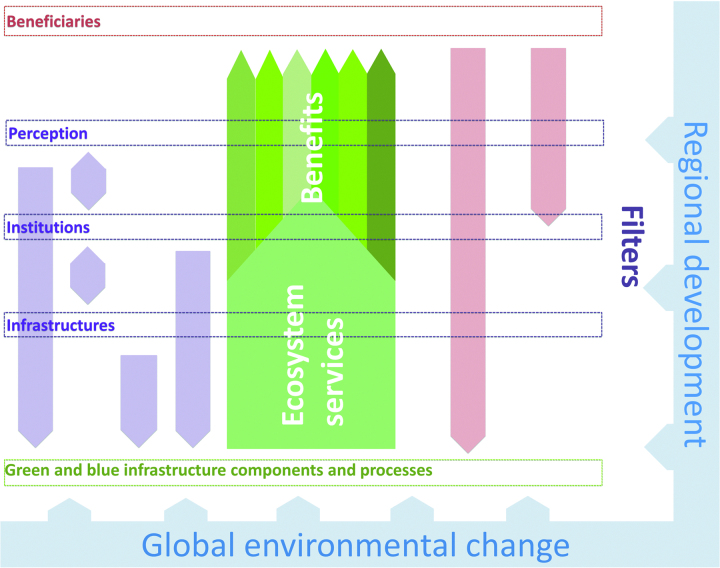
The circumstances under which different ecosystem service benefits can be realized differ. The benefits tend to be coproduced and to be enabled by multiple interacting social, ecological, and technological factors, which is particularly evident in cities. As many cities are undergoing rapid change, these factors need to be better understood and accounted for, especially for those most in need of benefits. We propose a framework of three systemic filters that affect the flow of ecosystem service benefits: the interactions among green, blue, and built infrastructures; the regulatory power and governance of institutions; and people's individual and shared perceptions and values. We argue that more fully connecting green and blue infrastructure to its urban systems context and highlighting dynamic interactions among the three filters are key to understanding how and why ecosystem services have variable distribution, continuing inequities in who benefits, and the long-term resilience of the flows of benefits.
Overview
The claims and statistics of this paper haven’t been checked yet.
Free: it reads the open-access text and checks the first 5 claims that cite a source we can check. Create a free account to check every claim.
Integrity signals
Registry
Cites
Statistics
Figures
Verification
Claims the paper makes
The claims and statistics of this paper haven’t been checked yet.
Free: it reads the open-access text and checks the first 5 claims that cite a source we can check. Create a free account to check every claim.
Claims other papers make about this one
Each is checked against this paper’s own text: does it say what the citing paper says it does?
The source backs part of the claim, not all of it — or backs it for a different population, condition or comparison.
In the citing paper
“Although the adoption of NbS for climate adaptation and resilience is widespread globally, effective NbS function in any given location depends on a diverse set of social, ecological, economic, and infrastructural factors (5, 16, 76).”
From Global synthesis and regional insights for mainstreaming urban nature-based solutions (2025) · cites this paper as [16]
Experimental — accuracy not yet measured
Self-check
Percentages, sums and reported differences re-computed from the paper’s own numbers.
The self-check needs the paper’s full text.
Citations
Cites
A General Framework for Analyzing Sustainability of Social-Ecological Systems
Ostrom, E. (2009) · Science · doi:10.1126/science.1172133 · Cited by 8,656
North, D. C. (1991) · Journal of Economic Perspectives · doi:10.1257/jep.5.1.97 · Cited by 5,232
SEN, A. (2009) · Harvard University Press eBooks · doi:10.2307/j.ctvjnrv7n · Cited by 3,430 · cited 1×
“Even when there are no formal restrictions, differences in knowledge, education, available information, and individual circumstances may privilege some voices and interests more than others (Schlosberg 2009, Sen 2009).”
BackgroundAccessibility evaluation of land-use and transport strategies: Review and research directions
Geurs, K. T., & van Wee, B. (2004) · Journal of Transport Geography · doi:10.1016/j.jtrangeo.2003.10.005 · Cited by 3,353
Defining and classifying ecosystem services for decision making
Fisher, B., Turner, R. K., & Morling, P. (2009) · Ecological Economics · doi:10.1016/j.ecolecon.2008.09.014 · Cited by 3,158
Assessing nature's contributions to people
Díaz, S., Pascual, U., Stenseke, M., Martín-López, B., Watson, R. T., Molnár, Z., Hill, R., Chan, K. M. A., Baste, I. A., Brauman, K. A., et al. (2018) · Science · doi:10.1126/science.aap8826 · Cited by 2,885
Haaland, C., & van den Bosch, C. K. (2015) · Urban Forestry & Urban Greening · doi:10.1016/j.ufug.2015.07.009 · Cited by 1,585
The links between biodiversity, ecosystem services and human well-being
Haines-Young, R., & Potschin, M. (2010) · Ecosystem Ecology · doi:10.1017/cbo9780511750458.007 · Cited by 1,514 · cited 1×
“2009, Haines-Young and Potschin 2010).”
Managing ecosystem services: what do we need to know about their ecology?
Kremen, C. (2005) · Ecology Letters · doi:10.1111/j.1461-0248.2005.00751.x · Cited by 1,411 · cited 1×
“Still, for other ES, such as active outdoor recreation and food production, it is land tenure and management (Kremen 2005, Langemeyer et al.”
BackgroundDefining environmental justice : theories, movements, and nature
Schlosberg, D. (2007) · Cited by 1,284
Cited by
Items 101–200 of 296
Caldas, E. Z., Calcagni, F., Baró, F., & Langemeyer, J. (2022) · Ecosystem Services · doi:10.1016/j.ecoser.2022.101445 · Cited by 32
Self-citationOrdóñez, C. (2021) · Nature-Based Solutions · doi:10.1016/j.nbsj.2021.100004 · Cited by 32
How Urban Forest Managers Evaluate Management and Governance Challenges in Their Decision-Making
Ordóñez, C., Kendal, D., Threlfall, C. G., Hochuli, D. F., Davern, M. T., Fuller, R. A., van der Ree, R., & Livesley, S. J. (2020) · Forests · doi:10.3390/f11090963 · Cited by 30
“A key concept in urban forest management is multifunctionality, which means that urban forests should be managed to meet various environmental, ecological, and social objectives that can facilitate the transition of urban treed spaces from single-function landscapes to multi-functional landscapes [8,13,14,17].”
BackgroundCalcagni, F., Batallé, J. N., Baró, F., & Langemeyer, J. (2022) · Ecosystem Services · doi:10.1016/j.ecoser.2022.101495 · Cited by 29
Self-citationMcCartan, C. J., Davidson, G., Bradley, L., Greer, K., Knifton, L., Mulholland, A., Webb, P., & White, C. (2023) · Health Expectations · doi:10.1111/hex.13773 · Cited by 30
Exploring perceptions of stakeholder roles in ecosystem services coproduction
Jericó-Daminello, C., Schröter, B., García, M. M., & Albert, C. (2021) · Ecosystem Services · doi:10.1016/j.ecoser.2021.101353 · Cited by 28
Use and design of public green spaces in Serbian cities during the COVID-19 pandemic
Gubić, I., & Wolff, M. (2022) · Habitat International · doi:10.1016/j.habitatint.2022.102651 · Cited by 28
Xu, Z., & Zhao, S. (2024) · Scientific Data · doi:10.1038/s41597-023-02844-2 · Cited by 29
“…a balanced approach to urban landscape construction necessitates the integration of all three space types, with a focus on increasing the quantity and quality of UGS and UBS, while also minimizing the negative impacts of UIS, which can lead to a more sustainable and livable urban environment 10 .”
BackgroundInfluentialGallez, E., Mujica, C. P. F., Gadeyne, S., Canters, F., & Baró, F. (2024) · Ecological Indicators · doi:10.1016/j.ecolind.2024.112374 · Cited by 30
“As a result, children who have less contact with nature are less prompted to receive the multiple wellbeing and health benefits delivered by GBI (Andersson et al., 2019), such as the reduction of stress and hyperactivity (McCormick, 2017; Squillacioti et al., 2022; Zare Sakhvidi et al., 2022),…”
BackgroundSelf-citationLi, X., Chen, W. Y., Hu, F. Z. Y., & Cho, F. H. T. (2021) · Landscape and Urban Planning · doi:10.1016/j.landurbplan.2021.104250 · Cited by 30
Baró, F., Langemeyer, J., Łaszkiewicz, E., & Kabisch, N. (2020) · Environmental Science & Policy · doi:10.1016/j.envsci.2020.10.008 · Cited by 27
Self-citationUrban resilience thinking in practice: ensuring flows of benefit from green and blue infrastructure
Andersson, E., Borgström, S. T., Haase, D., Langemeyer, J., Wolff, M., & McPhearson, T. (2021) · Ecology and Society · doi:10.5751/es-12691-260439 · Cited by 28
Self-citationPeng, L., Zhang, L., Li, X., Wang, P., Zhao, W., Wang, Z., Jiao, L., & Wang, H. E. (2022) · Remote Sensing · doi:10.3390/rs14174299 · Cited by 28
“The imbalance of UGS patterns leads to an uneven distribution of human well-being from urban ecosystems, which will further result in increasingly prominent social equity issues [11,16,17].”
BackgroundSustainability justice: a systematic review of emergent trends and themes
McCauley, D., Quintavalla, A., Prifti, K., Binder, C., Broddén, F., & van den Brink, H. (2024) · Sustainability Science · doi:10.1007/s11625-024-01565-8 · Cited by 28
“…potential for future research is clear from this sample through engagement with citizen assemblies or mini-publics (Reysen and Katzarska-Miller 2013; Fung 2015) or more radical assessments of burden and benefit re-distribution (Loos et al. 2014; Zwarteveen and Boelens 2014; Andersson et al. 2019).”
Köhler, M., & Kaiser, D. (2021) · Atmosphere · doi:10.3390/atmos12030382 · Cited by 25
“This report highlights some details of the construction (growing media and retention layer) as well some treatments to optimize the functionality of extensive green roofs in the future [17].”
BackgroundPalliwoda, J., Haase, A., Suppee, C., Rink, D., & Priess, J. A. (2022) · Ecology and Society · doi:10.5751/es-13129-270208 · Cited by 25
Dushkova, D., Ignatieva, M. E., Konstantinova, A., Vasenev, V., Dovletyarova, E. A., & Dvornikov, Y. A. (2022) · Land · doi:10.3390/land11060822 · Cited by 30
Ricart, S., Berizzi, C., Saurí, D., & Terlicher, G. N. (2022) · Land · doi:10.3390/land11091575 · Cited by 27
Study on landscape evaluation and optimization strategy of Central Park in Qingkou Town
Xiang, L., Tian, Y., & Pan, Y. (2022) · Scientific Reports · doi:10.1038/s41598-022-06006-z · Cited by 25
Andersson, E., Haase, D., Kronenberg, J., Langemeyer, J., Mascarenhas, A., Wolff, M., & Elmqvist, T. (2022) · Ecology and Society · doi:10.5751/es-13580-270418 · Cited by 26
Self-citationZhang, X., Zhou, Y., Long, L., Hu, P., Huang, M., Xie, W., Chen, Y., & Chen, X. (2023) · Environmental Science and Pollution Research · doi:10.1007/s11356-023-26238-4 · Cited by 24
Wang, L., Yan, X., Fang, M., Song, H., & Hu, J. (2023) · Sustainability · doi:10.3390/su15107975 · Cited by 25
“Higher education institutions use carbon foot-print calculation tools to analyze the results and compare them with the average values of other schools or industries to assess the school’s carbon performance and improvement space [72].”
MethodHuang, L., Yu, L., & Wang, J. (2023) · Journal of Environmental Management · doi:10.1016/j.jenvman.2023.119208 · Cited by 25
Ecosystem Services in Urban Blue-Green Infrastructure: A Bibliometric Review
Wang, X., Hu, Q., Zhang, R., Sun, C., & Wang, M. (2025) · Water · doi:10.3390/w17152273 · Cited by 24
Sustainable Urban Drainage Systems in Spain: Analysis of the Research on SUDS Based on Climatology
García, A. I. A., Cruz‐Pérez, N., & Cerezal, J. C. S. (2021) · Sustainability · doi:10.3390/su13137258 · Cited by 27
Assessing the learning process in transdisciplinary research through a novel analytical approach
Mascarenhas, A., Langemeyer, J., Haase, D., Borgström, S. T., & Andersson, E. (2021) · Ecology and Society · doi:10.5751/es-12631-260419 · Cited by 22
Self-citationRockwell, C. A., Crow, A., Guimarães, É. R., Recinos, E., & Belle, D. L. (2022) · Urban Planning · doi:10.17645/up.v7i2.5135 · Cited by 24
New paths for modelling freshwater nature futures
Kramer, L., Teurlincx, S., Rashleigh, B., Janssen, A. B. G., Janse, J. H., Brauman, K. A., Földesi, C., van Wijk, D., Domis, L. N. D. S., Patil, S. D., et al. (2023) · Sustainability Science · doi:10.1007/s11625-023-01341-0 · Cited by 22
“In the urban context, the concepts of Blue Infrastructure (Andersson et al. 2019) and Blue spaces (Garrett et al. 2019) are gaining traction, referring to freshwater systems in the landscape, and their functional connections, that have the potential to provide ecosystem services like moderating urban heat waves.”
Innovative Urban Blue Space Design in a Changing Climate: Transition Models in the Baltic Sea Region
Burda, I. M., & Nyka, L. (2023) · Water · doi:10.3390/w15152826 · Cited by 24
Otto, J., Borgström, S. T., Haase, D., & Andersson, E. (2024) · Urban forestry & urban greening · doi:10.1016/j.ufug.2024.128266 · Cited by 26
“Capturing the diversity of residents ’ perspectives on the recreational use of GBI into urban planning and management supports inclusivity essential to environmental justice (Andersson et al., 2019; Rall et al., 2019).”
BackgroundInfluentialSelf-citationBorgström, S. T., Andersson, E., & Björklund, T. (2021) · Ecology and Society · doi:10.5751/es-12432-260417 · Cited by 22
Self-citationFrom urban ecology to urban enquiry: How to build cumulative and context-sensitive understandings
Andersson, E., McPhearson, T., & Pickett, S. T. A. (2024) · AMBIO · doi:10.1007/s13280-023-01959-5 · Cited by 20
“In between are all the mediating factors influencing the real-isation of ecosystem service potential as different benefits (Haines-Young and Potschin 2010; Andersson et al. 2019; Keeler et al. 2019).”
Self-citationUrban Governance of and for Urban Green and Blue Infrastructure
Simon, D., Goodness, J., Lwasa, S., de Oliveira, J. A. P., de Macedo, L. V., Kavonic, J., Török, E. H., & Elmqvist, T. (2021) · Cities and nature · doi:10.1007/978-3-030-67650-6_16 · Cited by 24
Waterways transformation in the vulnerable port city of Alexandria
Fouad, S. S., Heggy, E., & Weilacher, U. (2023) · Cities · doi:10.1016/j.cities.2023.104426 · Cited by 24
Liao, Y., & Furuya, K. (2024) · Land · doi:10.3390/land13091522 · Cited by 19
Stijnen, C., Frantzeskaki, N., & Wijsman, K. (2024) · Urban forestry & urban greening · doi:10.1016/j.ufug.2024.128525 · Cited by 21
Andersson, E. (2021) · AMBIO · doi:10.1007/s13280-021-01515-z · Cited by 19
Self-citationPrinciples of Designing Water Elements in Urban Public Spaces
Langie, K., Rybak-Niedziółka, K., & Hubačíková, V. (2022) · Sustainability · doi:10.3390/su14116877 · Cited by 21
“The protection and resilience of the structure of water systems is one of the basic goals of the European Green Deal policy and the system of shaping modern cities based on it in the spirit of the Eco Smart City [8–10].”
BackgroundTreglia, M. L., McPhearson, T., Sanderson, E. W., Yetman, G., & Maxwell, E. N. (2022) · Ecology and Society · doi:10.5751/es-13303-270320 · Cited by 20
Self-citationClimate-sensitive planning. Opportunities through the study of LCZs in Chile
Smith, P., Trigo, O. P., Sarricolea, P., Cabrera, F. T., & Meseguer-Ruiz, Ó. (2023) · Building and Environment · doi:10.1016/j.buildenv.2023.110444 · Cited by 18
Lioubimtseva, E. (2022) · Discover Sustainability · doi:10.1007/s43621-022-00071-0 · Cited by 31
“However, only 4 plans received top score (3) for their sensitivity assessments, while 10 plans did not mention any sensitivity criteria at all.”
BackgroundSahay, S. (2024) · Sustainable Cities and Society · doi:10.1016/j.scs.2024.106037 · Cited by 19
Mapping mental barriers that prevent the use of neighborhood green spaces
Haase, D., Wolff, M., & Schumacher, N. (2021) · Ecology and Society · doi:10.5751/es-12675-260416 · Cited by 21
“Thus, and in line with what Andersson et al. (2019) have reported, the recreation and well-being that urban residents can enjoy from UGS—here understood as ecosystem services benefits flows—is decisively dependent on both its quality and the distributional pattern of UGS, on the one hand.”
BackgroundSelf-citationHaase, D., & Wolff, M. (2022) · Ecology and Society · doi:10.5751/es-12988-270122 · Cited by 20
Self-citationCooling Energy Benefits of Increased Green Infrastructure in Subtropical Urban Building Environments
Mohammed, A., Khan, A., Khan, H. S., & Santamouris, M. (2023) · Buildings · doi:10.3390/buildings13092257 · Cited by 16
Rolo, D. A. D. M. D. O., Gallardo, A. L. C. F., Ribeiro, A. P., & Siqueira‐Gay, J. (2021) · Environmental Management · doi:10.1007/s00267-021-01471-0 · Cited by 20
“Urban areas are among the most vulnerable to these negative impacts (Andersson et al. 2019) and their water network can help to accommodate these impacts.”
BackgroundInfluentialNassani, A. A., Yousaf, Z., Rãdulescu, M., Balsalobre‐Lorente, D., Hussain, H., & Haffar, M. (2023) · Energies · doi:10.3390/en16041944 · Cited by 24
Zhang, G., Roslan, S. N. A., Quan, L., & Yuan, P. (2023) · Frontiers in Environmental Science · doi:10.3389/fenvs.2023.1145626 · Cited by 16
“, 2021), limit the disorderly expansion of urban open space, actively build ecological corridors, stabilize the ecosystem structure (Andersson et al., 2019), and strictly observe the ecological protection red line.”
BackgroundSelmi, W., Selmi, S., Teller, J., Weber, C., Rivière, E., & Nowak, D. J. (2020) · AMBIO · doi:10.1007/s13280-020-01438-1 · Cited by 18
Virtual Reality in planning, design, and management of urban green and blue infrastructure
Schewenius, M., & Wallhagen, M. (2024) · Frontiers in Virtual Reality · doi:10.3389/frvir.2024.1432556 · Cited by 15
accessibility of public urban green space. A case study of Białystok city
Krzywnicka, I., & Jankowska, P. (2021) · Acta Scientiarum Polonorum Administratio Locorum · doi:10.31648/aspal.6794 · Cited by 15
“…affects the quality of urban life by enhancing the residents’ physical and mental well-being [Giles-Corti et al., 2005, Shin et al., 2011, Andersson et al., 2019, Nastran, 2020], promoting social integration [Kemperman & Timmermans, 2014], minimizing the discomfort associated with…”
BackgroundRomelli, C., Anderson, C. C., Fagerholm, N., Hansen, R., & Albert, C. (2025) · Ecosystems and People · doi:10.1080/26395916.2025.2454252 · Cited by 14
“…availability, and quality, including available facilities, maintenance, and absence of off-site and institutional barriers (Schipperijn et al. 2010; Andersson et al. 2019; Palliwoda and Priess 2021; Wolff et al. 2022) – or of ED – mismanagement or anthropogenic disturbances such as the presence…”
Gharbi, D., Neumann, F. H., Cilliers, S. S., Cornelius, S., Viviers, J., Drewes, E., Puren, K., Berman, D. M., Esterhuizen, N., Ajikah, L., et al. (2023) · Discover Sustainability · doi:10.1007/s43621-023-00151-9 · Cited by 16
“The building block approach relates well to specific UGI principles i.e., connectivity and multifunctionality in terms of the provision of various ES, the integration of green and grey infrastructure and relevance on multiple scales [3, 12, 14].”
BackgroundMethodLee, D.-K. (2024) · Ecosystem Services · doi:10.1016/j.ecoser.2024.101596 · Cited by 13
Analysis of Blue Infrastructure Network Pattern in the Hanjiang Ecological Economic Zone in China
He, P., & Chen, K. (2022) · Water · doi:10.3390/w14081234 · Cited by 14
Liu, L., Shi, L., Yang, M., Yang, F., & Lan, T. (2024) · Ecological Indicators · doi:10.1016/j.ecolind.2024.111609 · Cited by 13
Maurer, M. L. (2023) · Journal of Ethnobiology · doi:10.1177/02780771231221644 · Cited by 12
“Broader concerns about the equity of green infrastructure interventions are also relevant to conversations about steward-ship (Andersson et al. 2019; Nyelele and Kroll 2020).”
BackgroundKumar, P., Perez, K. C., Biswal, A., Sun, H., Dwivedi, A. K., Hama, S. M. L., Khalili, S., Ahlawat, A., Andrade, M. D. F., Alves, R. A., et al. (2025) · The Innovation · doi:10.1016/j.xinn.2025.101184 · Cited by 28
“4,206 However, the GBI tools comprise living organisms subject to physiological and metabolic limitations from climate extremes.”
The Role of Vegetation in Climate Adaptability: Case Studies of Lodz and Warsaw
Hanzl, M., Tofiluk, A., Zinowiec-Cieplik, K., Grochulska-Salak, M., & Nowak, A. P. (2021) · Urban Planning · doi:10.17645/up.v6i4.3931 · Cited by 12
“The three‐fold nature of social‐ecological systems in cities includes Urban Planning, 2021, Volume 6, Issue 4, Pages 9–24 9 infrastructures, institutions, and perceptions (Andersson et al., 2019).”
BackgroundMaity, B., Rudra, S., Mallick, S. K., & Pramanik, M. (2025) · Journal of the Indian Society of Remote Sensing · doi:10.1007/s12524-024-02088-6 · Cited by 11
“Recently, increasing green space GS has been widely used for mitigating UHI, heat stress, and thermal discomfort (Andersson et al., 2019).”
Dhanya, B., Ramananda, S., & Dhyani, S. (2022) · Springer eBooks · doi:10.1007/978-981-16-7128-9_23 · Cited by 14
Stålhammar, S. (2021) · Ecosystem Services · doi:10.1016/j.ecoser.2020.101239 · Cited by 13
Rosa, D. W. B., Silva, T., Chong, J., Giurco, D., & Nascimento, N. (2022) · Urban Water Journal · doi:10.1080/1573062x.2022.2066549 · Cited by 11
“In parallel with benefits related to stormwater management, and because of them, studies have been approaching the social and environmental co-benefits of GBI implementation (Alves et al. 2019; Andersson et al. 2019; CNT 2010).”
BackgroundUrban Green Spaces in a Post-Apartheid City: Challenges and Opportunities for Nature-based Solutions
Giombini, V., & Thorn, J. (2022) · Springer eBooks · doi:10.1007/978-3-031-01980-7_17 · Cited by 11
McNabb, T., Charters, F. J., Dionisio, R., & Challies, E. (2024) · Nature-Based Solutions · doi:10.1016/j.nbsj.2024.100192 · Cited by 10
Roversi, R., & Longo, D. (2025) · Sustainability · doi:10.3390/su17073175 · Cited by 12
Chen, H., Dong, N., Liang, X., & Huang, H. (2023) · Remote Sensing · doi:10.3390/rs15245749 · Cited by 10
Micro-climate of nature-based solutions in stockholm royal seaport
Branny, A., Andersson, E., & McPhearson, T. (2024) · Nature-Based Solutions · doi:10.1016/j.nbsj.2024.100206 · Cited by 11
Self-citationMacháč, J., Hekrle, M., Meyer, P., Stankova, N., Brabec, J., & Sykorova, M. (2020) · Smart City Symposium Prague (SCSP) · doi:10.1109/scsp49987.2020.9133798 · Cited by 10
“how elements of GBI are designed and equipped, such information will be valuable for better city planning [5], [15].”
BackgroundUrban green and blue space characteristics contributing to multiple perceived health benefits
Kajosaari, A., Arnberger, A., WENMAKERS, S., & Humer, A. (2025) · Urban forestry & urban greening · doi:10.1016/j.ufug.2025.129229 · Cited by 10
Šeduikytė, L., Gražulevičiūtė–Vileniškė, I., Povilaitienė, I., Fokaides, P. A., & Lingė, D. (2023) · Buildings · doi:10.3390/buildings13071764 · Cited by 9
Caetano, P. M. D., Pereira, H. M. S. B., Figueiredo, L. C. R., Sepe, P. M., & Giatti, L. L. (2021) · Frontiers in Sustainable Cities · doi:10.3389/frsc.2021.685875 · Cited by 14
Detecting changes in green and blue spaces: Modeling based on statistical approach
Noszczyk, T. (2023) · Ecological Indicators · doi:10.1016/j.ecolind.2023.110878 · Cited by 9
Das Ökosystemleistungskonzept in der räumlichen Planung – zehn Thesen
Albert, C., Hansen, R., Dehnhardt, A., Deppisch, S., Fürst, C., Geißler, G., Gerner, N. V., Marzelli, S., Poßer, C., Rathmann, J., et al. (2021) · Raumforschung und Raumordnung / Spatial Research and Planning · doi:10.14512/rur.76 · Cited by 9
Decision support factors evaluative model for affordable PPP public housing delivery in Ghana
Kwofie, T. E., Addy, M. N., Duah, D. Y. A., Aigbavboa, C. O., Owusu, E. B., & Olympio, G. F. (2024) · Journal of Engineering Design and Technology · doi:10.1108/jedt-05-2023-0198 · Cited by 8
Sommese, F. (2024) · Lecture notes in civil engineering · doi:10.1007/978-3-031-71863-2_42 · Cited by 9
Tornieri, S., Ma, J., & Rizzo, A. (2024) · European Planning Studies · doi:10.1080/09654313.2024.2349753 · Cited by 8
“…as fi shing, are considered important land and water use activities, and are associated with key societal bene fi ts, such as increased environmental awareness, public health, local development, and inclusive and cohesive community (Andersson et al. 2019; Emmelin et al. 2010; Ma and Haarho ff 2015).”
BackgroundGajdek, A., Ortyl, B., Martyka, A. M., & Kasprzyk, I. (2025) · Cities · doi:10.1016/j.cities.2025.105993 · Cited by 8
Engagement around risk, informality and Nature-based solutions in Nakuru, Kenya
Tuhkanen, H., Pateman, R. M., Opiyo, R. O., Muhoza, C., Cambridge, H. W., Archer, D., & Cinderby, S. (2025) · City and Environment Interactions · doi:10.1016/j.cacint.2025.100195 · Cited by 7
Cason, O., Maestre‐Andrés, S., Mas-Ponce, A., Romagosa, F., & Zaldo-Aubanell, Q. (2025) · Urban Ecosystems · doi:10.1007/s11252-025-01716-4 · Cited by 9
“As defined by Andersson et al. (2019), accessibility is shaped by perceived social norms and the emotional responses of potential users.”
Zhang, X., Zhou, Y., Long, L., Hu, P., Huang, M., Chen, Y., & Chen, X. (2023) · Environmental Monitoring and Assessment · doi:10.1007/s10661-023-11385-5 · Cited by 7
Richards, D. R., Polyakov, M., Brandt, A. J., Cavanagh, J., Diprose, G., Milner, G., Ramana, J. V., & Simcock, R. (2023) · Urban forestry & urban greening · doi:10.1016/j.ufug.2023.128044 · Cited by 7
Designing Urban Green Infrastructures Using Open-Source Data—An Example in Çiğli, Izmir (Turkey)
Salata, S., Erdoğan, B., & Ayruş, B. (2022) · Urban Science · doi:10.3390/urbansci6030042 · Cited by 6
“On the other hand, GI is a strategically planned network of natural and semi-natural areas with other environmental features designed and managed to deliver a wide range of ESs, such as water purification, air quality, space for recreation, climate mitigation, and adaptation [36,37].”
BackgroundPlural relational green space values for whom, when, and where? – A social media approach
Calcagni, F., Connolly, J. J., & Langemeyer, J. (2023) · Digital Geography and Society · doi:10.1016/j.diggeo.2023.100065 · Cited by 7
Self-citationGhira, Z. A., & Heilemann, J. (2025) · Discover Sustainability · doi:10.1007/s43621-025-00975-7 · Cited by 7
“The implementation followed a place-based approach with a small-scale intervention in the urban sphere [13].”
Nature-based solutions for urban waters in Romanian cities
Pânzaru, D. M. R., Iojă, C., Pleșoianu, A., Hossu, C.-A., & Diaconu, D. C. (2022) · Nature-Based Solutions · doi:10.1016/j.nbsj.2022.100036 · Cited by 6
Marken, M., Füller, H., & Haase, D. (2026) · Cities · doi:10.1016/j.cities.2026.106973 · Cited by 5
Self-citationZhang, J., & Chen, Y. (2026) · Urban forestry & urban greening · doi:10.1016/j.ufug.2026.129438 · Cited by 6
Breulmann, M., Müller, R., & van Afferden, M. (2024) · Blue-Green Systems · doi:10.2166/bgs.2024.101 · Cited by 5
Nóblega-Carriquiry, A., March, H., Saurí, D., & Hack, J. (2025) · Ecosystem Services · doi:10.1016/j.ecoser.2025.101701 · Cited by 5
Sahle, M., Lahoti, S. A., Mohamed, A., Tura, T. T., Degefa, S., Saitô, O., & Kumar, P. (2025) · Urban Science · doi:10.3390/urbansci9050161 · Cited by 5
Amin, M. A., & Machemehl, R. B. (2025) · Transportation Research Record Journal of the Transportation Research Board · doi:10.1177/03611981251341350 · Cited by 5
“Increased emergencies necessitate equity consideration in project assessments ( 22 , 69 , 90 – 95 ).”
Geng, H., Lin, T., van Bodegom, P. M., Hu, M., Zheng, Y., Jia, Z., Zhang, J., Guo, X., Chen, Y., Lin, M., et al. (2025) · Urban forestry & urban greening · doi:10.1016/j.ufug.2025.128826 · Cited by 4
Infraestructura verde. Conceptualización y análisis normativo de México
López, J. A. S., & Galván-Benítez, R. (2022) · Quivera Revista de Estudios Territoriales · doi:10.36677/qret.v24i1.16602 · Cited by 7
The Effects of Greening Cities on Climate Change Mitigation and Adaptation
Haase, D. (2022) · Springer eBooks · doi:10.1007/978-3-030-72579-2_120 · Cited by 4
Self-citationDas, S., & Das, S. K. (2022) · Current Urban Studies · doi:10.4236/cus.2022.104035 · Cited by 5
Budowanie prężności w kontekście kurczenia się miast europejskich
Pielesiak, I., Ogrodowczyk, A., & Marcińczak, S. (2021) · Wydawnictwo Uniwersytetu Łódzkiego eBooks · doi:10.18778/8220-411-7 · Cited by 6
Sponge city in existing housing stock – more of a dream or reality?
Haase, D. (2025) · Frontiers in Environmental Science · doi:10.3389/fenvs.2025.1653240 · Cited by 4
Self-citationDushkova, D., & Haase, D. (2023) · Springer eBooks · doi:10.1007/978-3-030-96778-9_133-1 · Cited by 7
Self-citationShilky, Ekka, P., Upreti, M., Kumar, A., & Saikia, P. (2024) · Elsevier eBooks · doi:10.1016/b978-0-323-99164-3.00005-7 · Cited by 6
Metadata
- Authors
- Andersson, E., Langemeyer, J., Borgström, S., McPhearson, T., Haase, D., Kronenberg, J., Barton, D. N., Davis, M., Naumann, S., Röschel, L., & Baró, F.
- Affiliations
- Stockholm Resilience Centre (SE)
- Universitat Autònoma de Barcelona (ES)
- KTH Royal Institute of Technology (SE)
- The New School (US)
- Helmholtz Centre for Environmental Research (DE)
- University of Łódź (PL)
- Norwegian Institute for Nature Research (NO)
- Ecologic Institute (DE)
- Corresponding author
- Andersson, Erik
- ORCID
- Venue
- BioScience
- Publisher
- Oxford University Press (OUP)
- Published
- 2019-06-26
- Volume
- 69
- Issue
- 7
- Pages
- 566-574
- ISSN
- 0006-3568 (ISSN-L)
- 1525-3244
- PMC
- PMC6622445
- OpenAlex
- W2955002419
- Semantic Scholar
- 53485718ff3b150659c571f039b3da15ed7f9218
- Cited by
- 270
- References
- 75
- Citations by year
- 2026: 27 · 2025: 37 · 2024: 39 · 2023: 31 · 2022: 53 · 2021: 56 · 2020: 27
- FWCI
- 17.50
- Type
- journal article
- Language
- en
- Open access
- hybrid
- doi.org
- Licence
- Locations
- BioScience (publishedVersion, cc-by)
- Europe PMC (PubMed Central) (publishedVersion, cc-by)
- PubMed Central (publishedVersion, cc-by)
- PubMed (publishedVersion)
- Boloka Institutional Repository (North-west University) (submittedVersion)
- KTH Publication Database DiVA (KTH Royal Institute of Technology) (submittedVersion, other-oa)
- NORA - Norwegian Open Research Archives (submittedVersion, cc-by)
- Dipòsit Digital de Documents de la UAB (Universitat Autònoma de Barcelona) (submittedVersion, cc-by)
- LA Referencia (Red Federada de Repositorios Institucionales de Publicaciones Científicas) (submittedVersion, cc-by)
- Repositori digital de la UPF (Universitat Pompeu Fabra) (submittedVersion, cc-by)
- VUBIR (Vrije Universiteit Brussel) (submittedVersion)
- Topics
- Physical Sciences › Environmental Science › Global and Planetary Change › Land Use and Ecosystem Services
- Social Sciences › Urban Studies › Urban Green Space and Health
- Physical Sciences › Environmental Science › Environmental Engineering › Urban Stormwater Management Solutions
- Keywords
- green infrastructure, blue infrastructure, ecosystem services, urban systems, human well-being, equity, institutional governance, urban resilience
About these checks
Registry, retraction, Cites and statistics results are computed, not judged, with one exception: a printed reference that no index lists is read once by a model before it counts as a citation error. Claims are extracted by a model and kept only when their quote appears verbatim in the text; each cited source is then checked, with a model’s help, for whether it says what the claim relies on. Those verdicts can be wrong — read the claim’s quote and the cited source before relying on one.
Statistics and arithmetic are recomputed, not judged.
Confidence bands are shown only for fields calibrated on our annotated test set. None is calibrated yet, so no band is shown.
What counts as a claim ›How we measure confidence ›How we check this ›
Are you an author, or do you see a problem with this page? Request a review
Data sources
Bibliographic data: Semantic Scholar, OpenAlex, Crossref.
Contains information from the Semantic Scholar Academic Graph Datasets, made available under the ODC Attribution License (ODC-BY 1.0).
Semantic Scholar’s data is described in: Kinney, R., et al. (2023). The Semantic Scholar Open Data Platform. arXiv:2301.10140.
