

Role of Central Serotonin in Anticipation of Rewarding and Punishing Outcomes: Effects of Selective Amygdala or Orbitofrontal 5-HT Depletion
Open accessThe DOI matches its Crossref record; 62 of the 62 references it cites were found in a registry or an index.
Abstract
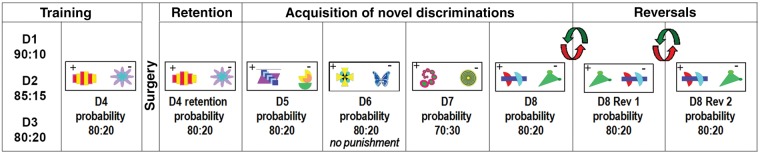
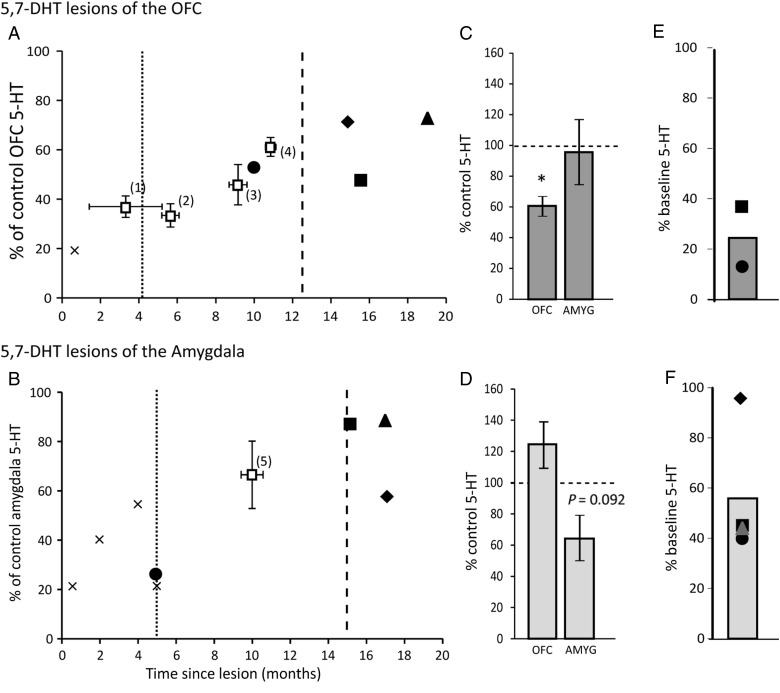
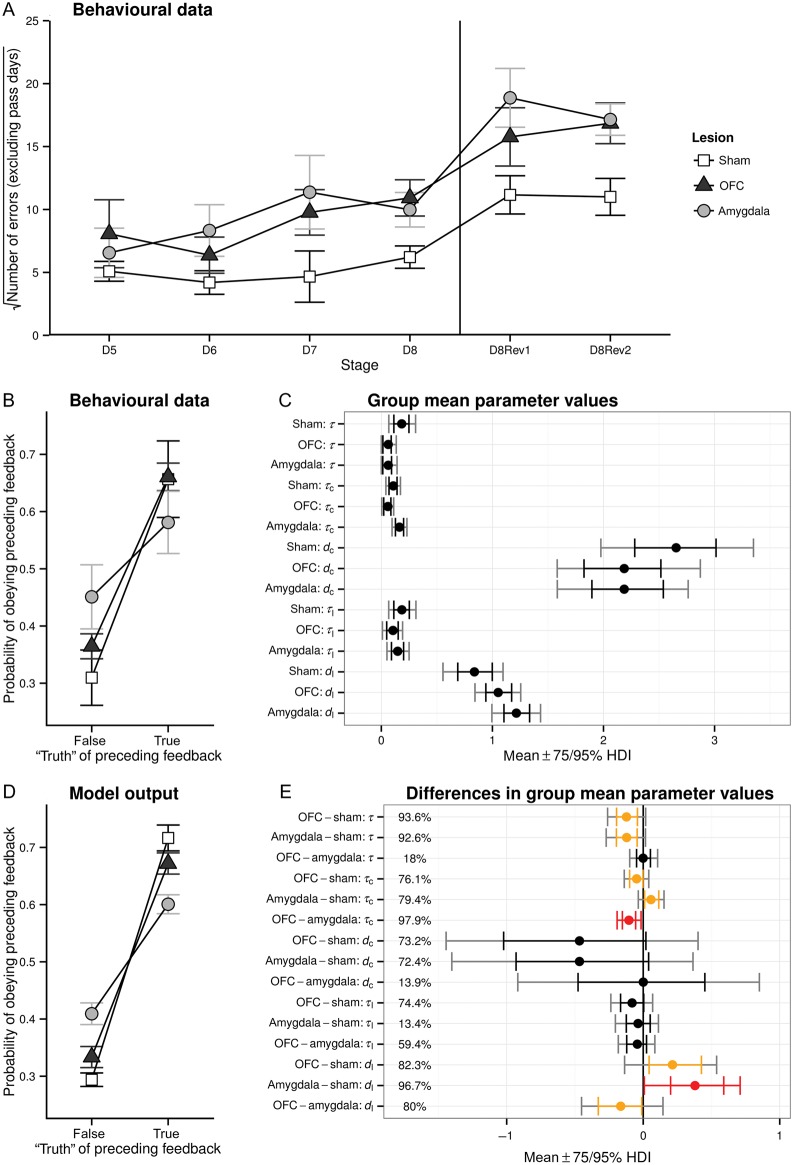
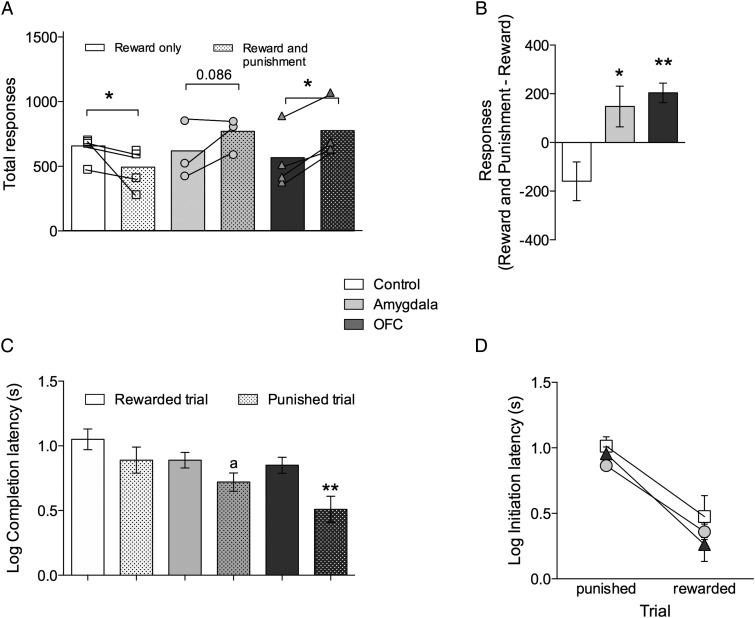
Understanding the role of serotonin (or 5-hydroxytryptamine, 5-HT) in aversive processing has been hampered by the contradictory findings, across studies, of increased sensitivity to punishment in terms of subsequent response choice but decreased sensitivity to punishment-induced response suppression following gross depletion of central 5-HT. To address this apparent discrepancy, the present study determined whether both effects could be found in the same animals by performing localized 5-HT depletions in the amygdala or orbitofrontal cortex (OFC) of a New World monkey, the common marmoset. 5-HT depletion in the amygdala impaired response choice on a probabilistic visual discrimination task by increasing the effectiveness of misleading, or false, punishment and reward, and decreased response suppression in a variable interval test of punishment sensitivity that employed the same reward and punisher. 5-HT depletion in the OFC also disrupted probabilistic discrimination learning and decreased response suppression. Computational modeling of behavior on the discrimination task showed that the lesions reduced reinforcement sensitivity. A novel, unitary account of the findings in terms of the causal role of 5-HT in the anticipation of both negative and positive motivational outcomes is proposed and discussed in relation to current theories of 5-HT function and our understanding of mood and anxiety disorders.
Overview
The claims and statistics of this paper haven’t been checked yet.
Free: it reads the open-access text and checks the first 5 claims that cite a source we can check. Create a free account to check every claim.
Integrity signals
Registry
Cites
Statistics
Figures
Verification
Claims the paper makes
The claims and statistics of this paper haven’t been checked yet.
Free: it reads the open-access text and checks the first 5 claims that cite a source we can check. Create a free account to check every claim.
Claims other papers make about this one
Each is checked against this paper’s own text: does it say what the citing paper says it does?
The source backs part of the claim, not all of it — or backs it for a different population, condition or comparison.
In the citing paper
“selective 5-HT depletion in the amygdala has been shown to increase sensitivity to aversive feedback in probabilistic learning and reversal tasks [5].”
From Dissociable effects of acute SSRI (escitalopram) on executive, learning and emotional functions in healthy humans (2018) · cites this paper as [5]
Experimental — accuracy not yet measuredThe cited source says what the claim attributes to it.
In the citing paper
“Marmosets have also shown reduced reinforcement sensitivity following serotonin depletion [7].”
From Chronic escitalopram in healthy volunteers has specific effects on reinforcement sensitivity: a double-blind, placebo-controlled semi-randomised study (2023) · cites this paper as [7]
Self-check
Percentages, sums and reported differences re-computed from the paper’s own numbers.
The self-check needs the paper’s full text.
Citations
Cites
Estimating the Dimension of a Model
Schwarz, G. (1978) · The Annals of Statistics · doi:10.1214/aos/1176344136 · Cited by 47,033 · cited 2×
“[Note that the original BIC was expressed as BIC = LL – 0.5 k ln(n), for which the largest is the best (Schwartz 1978; Burnham and Anderson 2004).]”
BackgroundInfluentialStatistical principles in experimental design.
Winer, B. J. (1962) · McGraw-Hill Book Company · doi:10.1037/11774-000 · Cited by 26,755
Multimodel Inference: Understanding AIC and BIC in Model Selection
Burnham, K. P., & Anderson, D. R. (2004) · Sociological Methods & Research · doi:10.1177/0049124104268644 · Cited by 11,648
Drevets, W. C., Price, J. L., & Furey, M. L. (2008) · Brain Structure and Function · doi:10.1007/s00429-008-0189-x · Cited by 2,241 · cited 2×
“…a core feature of these disorders is dysregulation within orbitofronto-amygdala circuitry (Phillips et al. 2003; Bishop 2007; Milad and Rauch 2007; Drevets et al. 2008; Clark et al. 2009), a neurobiological and psychological account of the role of 5-HT in these circuits will not only inform our…”
BackgroundNeurobiology of emotion perception II: implications for major psychiatric disorders
Phillips, M. L., Drevets, W. C., Rauch, S. L., & Lane, R. (2003) · Biological Psychiatry · doi:10.1016/s0006-3223(03)00171-9 · Cited by 1,736 · cited 2×
“Since a core feature of these disorders is dysregulation within orbitofronto-amygdala circuitry (Phillips et al. 2003; Bishop 2007; Milad and Rauch 2007; Drevets et al. 2008; Clark et al. 2009), a neurobiological and psychological account of the role of 5-HT in these circuits will not only inform…”
Background5-HT and mechanisms of defence
Deakin, J. F. W., & Graeff, F. G. (1991) · Journal of Psychopharmacology · doi:10.1177/026988119100500414 · Cited by 1,010 · cited 1×
“…Neurobiology and Drug Development, Institute of Pharmacology Polish Academy of Sciences, ul Smetna 12, 31-343 Krakow, Poland Address correspondence to Professor Angela Roberts, Department of Physiology, Development and Neuroscience, University of Cambridge, Downing Street, Cambridge CB2 3DY, UK.”
BackgroundNeurocognitive mechanisms of anxiety: An integrative account
Bishop, S. J. (2007) · Trends in Cognitive Sciences · doi:10.1016/j.tics.2007.05.008 · Cited by 976
Animal Discrimination Learning
Gilbert, R. M. (1969) · Medical Entomology and Zoology · Cited by 750
Serotoninergic regulation of emotional and behavioural control processes
Cools, R., Roberts, A. C., & Robbins, T. W. (2008) · Trends in Cognitive Sciences · doi:10.1016/j.tics.2007.10.011 · Cited by 656 · cited 3×
“Rafal Rygula1,2,6, Hannah F. Clarke2,3, Rudolf N. Cardinal2,4,5, Gemma J. Cockcroft1,2, Jing Xia1,2, Jeff W. Dalley1,2, Trevor W. Robbins1,2 and Angela C. Roberts2,3 1Department of Psychology, 2Behavioural and Clinical Neuroscience Institute, University of Cambridge, Cambridge CB2 3EB, UK, 3Department of Physiology, D…”
BackgroundInfluentialSelf-citationArtigas, F., Romero, L., de Montigny, C., & Blier, P. (1996) · Trends in Neurosciences · doi:10.1016/s0166-2236(96)10037-0 · Cited by 655 · cited 2×
“review, see (Artigas et al. 1996)), disrupted discrimination/reversal performance in both humans (Chamberlain et al.”
Background
Cited by
The neural basis of reversal learning: An updated perspective
Izquierdo, A., Brigman, J. L., Radke, A. K., Rudebeck, P. H., & Holmes, A. (2017) · Neuroscience · doi:10.1016/j.neuroscience.2016.03.021 · Cited by 670
“The relative balance between these effects may vary with the duration of serotonin alterations, with acute manipulations increasing the gain on negative feedback, whereas chronic treatments affect reward sensitivity (Bari et al., 2010; Rygula et al., 2014).”
BackgroundInfluentialPrefrontal cortex and depression
Pizzagalli, D. A., & Roberts, A. C. (2022) · Neuropsychopharmacology · doi:10.1038/s41386-021-01101-7 · Cited by 667
Self-citationThe basolateral amygdala in reward learning and addiction
Wassum, K. M., & Izquierdo, A. (2015) · Neuroscience & Biobehavioral Reviews · doi:10.1016/j.neubiorev.2015.08.017 · Cited by 306
“This aspect of the model may inform recent data showing that BLA (specifically serotonin in this region) is required in reward choices involving probabilistic, uncertain reward outcomes (Rygula et al., 2014) rather than deterministic ones (Ochoa et al.”
MethodAn Update on the Role of Serotonin and its Interplay with Dopamine for Reward
Fischer, A. G., & Ullsperger, M. (2017) · Frontiers in Human Neuroscience · doi:10.3389/fnhum.2017.00484 · Cited by 176
“Using a reversal learning task with both rewards (juice) and punishments (noise) in marmosets, Rygula et al. (2015) found that local depletion of 5-HT in the amygdala or frontal cortex reduced overall feedback sensitivity, independent of valence.”
BackgroundInfluence of reward motivation on human declarative memory
Miendlarzewska, E. A., Bavelier, D., & Schwartz, S. (2016) · Neuroscience & Biobehavioral Reviews · doi:10.1016/j.neubiorev.2015.11.015 · Cited by 174
“Therefore, serotonin released by dorsal raphe nucleus may provide an anticipatory signal for both rewarding and punishing motivational outcomes (Rygula et al., 2014).”
Background
Metadata
- Authors
- Rygula, R., Clarke, H. F., Cardinal, R. N., Cockcroft, G. J., Xia, J., Dalley, J. W., Robbins, T. W., & Roberts, A. C.
- Affiliations
- University of Cambridge (GB)
- ORCID
- Venue
- Cerebral Cortex
- Publisher
- Oxford University Press (OUP)
- Published
- 2014-05-30
- Volume
- 25
- Issue
- 9
- Pages
- 3064-3076
- ISSN
- 1047-3211 (ISSN-L)
- 1460-2199
- PMC
- PMC4537445
- OpenAlex
- W2154966614
- Cited by
- 85
- References
- 62
- Citations by year
- 2026: 3 · 2025: 3 · 2024: 5 · 2023: 7 · 2022: 6 · 2021: 11 · 2020: 7 · 2019: 7 · 2018: 7 · 2017: 6 · 2016: 12 · 2015: 10
- FWCI
- 4.26
- Type
- journal article
- Language
- en
- Open access
- hybrid
- doi.org
- Licence
- cc-by
- Locations
- Cerebral Cortex (publishedVersion, cc-by)
- Europe PMC (PubMed Central) (publishedVersion, cc-by)
- PubMed Central (publishedVersion, cc-by)
- PubMed (publishedVersion)
- Funders
- Wellcome Trust (089589/Z/09/Z, 104631/Z/14/Z, 104631, 093875)
- Medical Research Council (MR/J012084/1)
- Topics
- Life Sciences › Neuroscience › Cellular and Molecular Neuroscience › Neurotransmitter Receptor Influence on Behavior
- Life Sciences › Neuroscience › Cognitive Neuroscience › Neural and Behavioral Psychology Studies
- Life Sciences › Neuroscience › Cognitive Neuroscience › Memory and Neural Mechanisms
- Keywords
- serotonin, amygdala, orbitofrontal cortex, punishment sensitivity, reward anticipation, response suppression, reinforcement sensitivity, Callithrix jacchus, computational modeling of behavior, mood and anxiety disorders
- MeSH terms
- Amygdala, Analysis of Variance, Animals, Callithrix, Discrimination, Psychological, Female, Male, Motivation, Photic Stimulation, Probability, Punishment, Retention, Psychology, Reward, Serotonin, 5,7-Dihydroxytryptamine, Prefrontal Cortex, Serotonin Agents, Recognition, Psychology
About these checks
Registry, retraction, Cites and statistics results are computed, not judged, with one exception: a printed reference that no index lists is read once by a model before it counts as a citation error. Claims are extracted by a model and kept only when their quote appears verbatim in the text; each cited source is then checked, with a model’s help, for whether it says what the claim relies on. Those verdicts can be wrong — read the claim’s quote and the cited source before relying on one.
Statistics and arithmetic are recomputed, not judged.
Confidence bands are shown only for fields calibrated on our annotated test set. None is calibrated yet, so no band is shown.
What counts as a claim ›How we measure confidence ›How we check this ›
Are you an author, or do you see a problem with this page? Request a review
Data sources
Bibliographic data: Semantic Scholar, OpenAlex, Crossref.
Contains information from the Semantic Scholar Academic Graph Datasets, made available under the ODC Attribution License (ODC-BY 1.0).
Semantic Scholar’s data is described in: Kinney, R., et al. (2023). The Semantic Scholar Open Data Platform. arXiv:2301.10140.
