

The DOI matches its Crossref record; 11 of the 11 references it cites were found in a registry or an index.
Tirzepatide and prevention of chronic kidney disease
Abstract
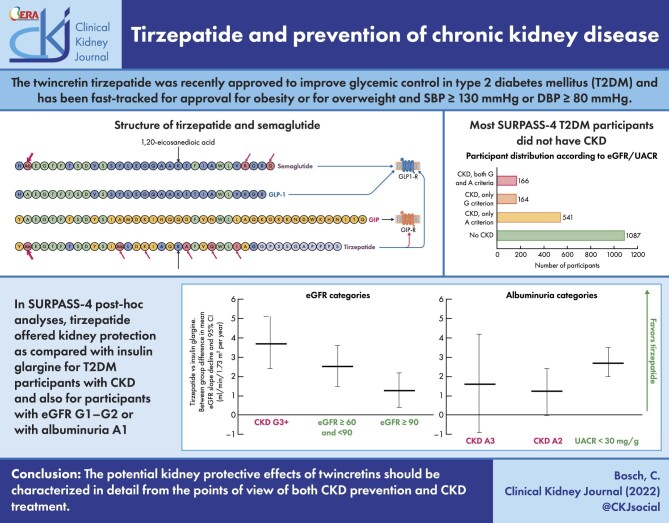
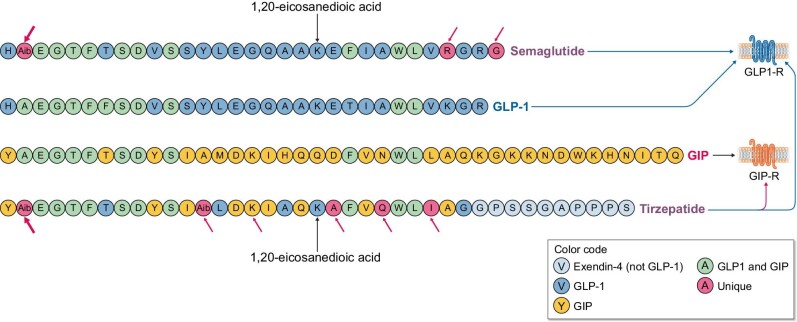
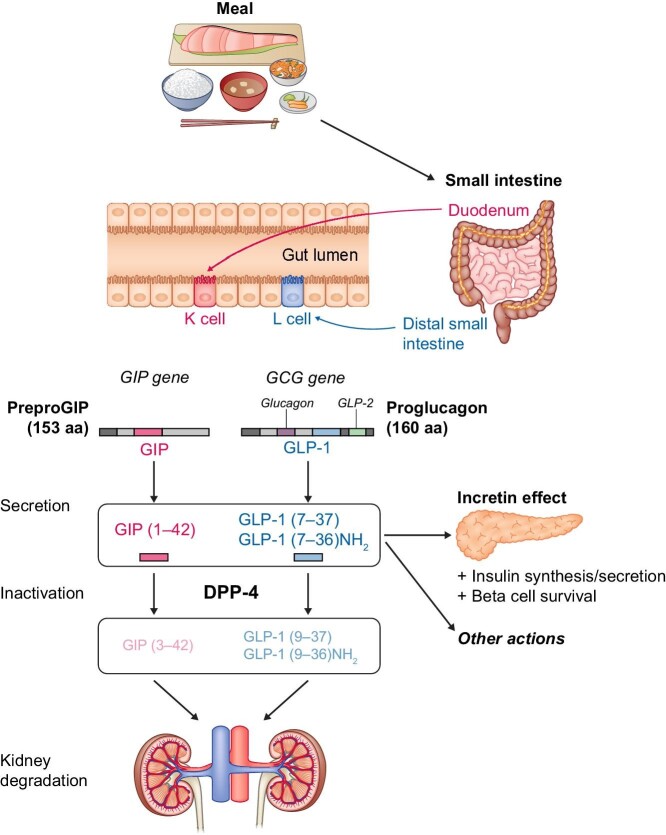
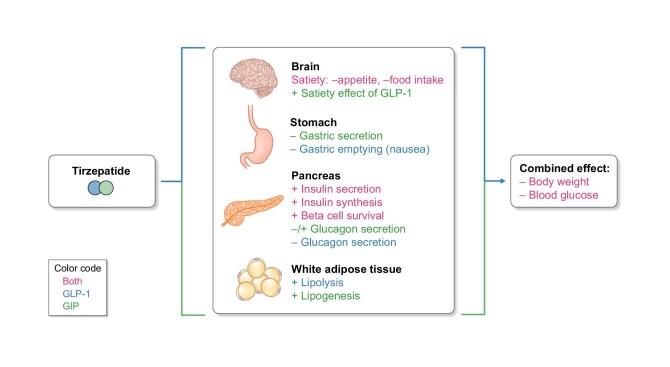
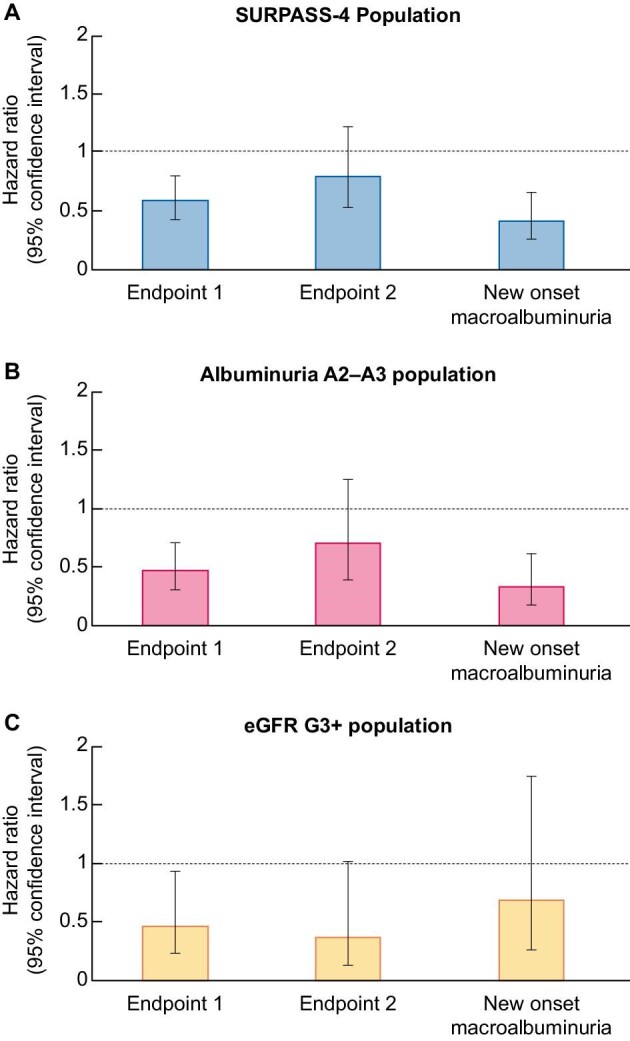
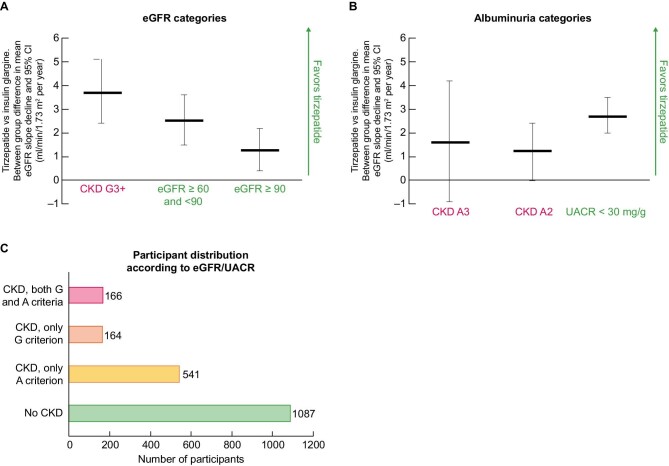
Tirzepatide is a twincretin recently approved to improve glycemic control in type 2 diabetes mellitus (T2DM). More specifically, tirzepatide is an agonist of both the glucose-dependent insulinotropic polypeptide (GIP) and the glucagon-like peptide-1 (GLP1) receptors. In recent clinical trials in persons with obesity or overweight with associated conditions, tirzepatide decreased body weight and other cardiorenal risk factors (blood pressure, low-density lipoprotein cholesterol, glycated hemoglobin and albuminuria). Moreover, in a post hoc analysis of the SURPASS-4 randomized clinical trial, tirzepatide decreased albuminuria and total estimated glomerular filtration rate (eGFR) slopes and nearly halved the risk of a pre-specified composite kidney endpoint (eGFR decline ≥40%, renal death, kidney failure or new-onset macroalbuminuria) in participants with T2DM and high cardiovascular risk when compared with insulin glargine. Similar to other kidney-protective drugs, tirzepatide, alone or combined with sodium-glucose co-transporter 2 inhibitors, caused an early dip in eGFR. Moreover, tirzepatide also decreased eGFR slopes in participants with eGFR >60 mL/min/1.73 m2 or with normoalbuminuria. We now review the potential kidney health implications of tirzepatide, addressing its structure and function, relationship to current GLP1 receptor agonists, impact of recent results for the treatment and prevention of kidney disease, and expectations for the future.
Overview
The claims and statistics of this paper haven’t been checked yet.
Run the check — free, no account needed. It reads the open-access text and checks the sources it cites.
Integrity signals
Registry
Cites
Statistics
Figures
Verification
Claims the paper makes
The claims and statistics of this paper haven’t been checked yet.
Run the check — free, no account needed. It reads the open-access text and checks the sources it cites.
Claims other papers make about this one
Each is checked against this paper’s own text: does it say what the citing paper says it does?
The source backs part of the claim, not all of it — or backs it for a different population, condition or comparison.
In the citing paper
“In patients with diabetes, GLP-1 receptor agonists have been reported to diminish eGFR during short-term treatment, but to improve glomerular function during long-term treatment,34,87,88 a biphasic effect that is similar to that observed with mineralocorticoid receptor antagonists and SGLT2 inhibitors.79,86”
From Interplay of Chronic Kidney Disease and the Effects of Tirzepatide in Patients With Heart Failure, Preserved Ejection Fraction, and Obesity (2025) · cites this paper as [88]
Experimental — accuracy not yet measured
Self-check
Percentages, sums and reported differences re-computed from the paper’s own numbers.
The self-check needs the paper’s full text.
Citations
Cites
Liraglutide and Cardiovascular Outcomes in Type 2 Diabetes
Marso, S. P., Daniels, G. H., Brown-Frandsen, K., Kristensen, P., Mann, J. F. E., Nauck, M. A., Nissen, S. E., Pocock, S., Poulter, N. R., Ravn, L. S., et al. (2016) · New England Journal of Medicine · doi:10.1056/nejmoa1603827 · Cited by 7,629
Semaglutide and Cardiovascular Outcomes in Patients with Type 2 Diabetes
Marso, S. P., Bain, S. C., Consoli, A., Eliaschewitz, F. G., Jódar, E., Leiter, L. A., Lingvay, I., Rosenstock, J., Seufert, J., Warren, M. L., et al. (2016) · New England Journal of Medicine · doi:10.1056/nejmoa1607141 · Cited by 6,900
Tirzepatide Once Weekly for the Treatment of Obesity
Jastreboff, A. M., Aronne, L. J., Ahmad, N. N., Wharton, S., Connery, L., Alves, B., Kiyosue, A., Zhang, S., Liu, B., Bunck, M. C., et al. (2022) · New England Journal of Medicine · doi:10.1056/nejmoa2206038 · Cited by 3,838 · cited 7×
“WHAT IS NEW ABOUT TIRZEPATIDE? The results of RCTs testing tirzepatide in overweight/obesity were recently reported [2].”
BackgroundInfluentialTirzepatide versus Semaglutide Once Weekly in Patients with Type 2 Diabetes
Frías, J. P., Davies, M. J., Rosenstock, J., Pérez Manghi, F. C., Fernández Landó, L., Bergman, B. K., Liu, B., Cui, X., & Brown, K. (2021) · New England Journal of Medicine · doi:10.1056/nejmoa2107519 · Cited by 2,096 · cited 1×
“per week semaglutide for both weight loss and glycemic control in patients with T2DM [12].”
BackgroundGerstein, H. C., Colhoun, H. M., Dagenais, G. R., Diaz, R., Lakshmanan, M., Pais, P., Probstfield, J., Botros, F. T., Riddle, M. C., Rydén, L., et al. (2019) · The Lancet · doi:10.1016/s0140-6736(19)31150-x · Cited by 638
Dahl, D., Onishi, Y., Norwood, P., Huh, R., Bray, R., Patel, H., & Rodríguez, Á. (2022) · JAMA · doi:10.1001/jama.2022.0078 · Cited by 597 · cited 1×
“6% more than placebo when used in combination with a long-acting insulin or as stand-alone therapy [18, 19], by 0.”
BackgroundTirzepatide cardiovascular event risk assessment: A pre-specified meta-analysis
Sattar, N., McGuire, D. K., Pavo, I., Weerakkody, G. J., Nishiyama, H., Wiese, R. J., & Zoungas, S. (2022) · Nature Medicine · doi:10.1038/s41591-022-01707-4 · Cited by 346
Heerspink, H. J. L., Sattar, N., Pavo, I., Haupt, A., Duffin, K. L., Yang, Z., Wiese, R. J., Tuttle, K. R., & Cherney, D. Z. I. (2022) · The Lancet Diabetes & Endocrinology · doi:10.1016/s2213-8587(22)00243-1 · Cited by 306
Glucagon-like peptide-1 receptor co-agonists for treating metabolic disease.
Baggio, L. L., & Drucker, D. J. (2021) · Molecular Metabolism · doi:10.1016/j.molmet.2020.101090 · Cited by 299
GIPR agonism mediates weight-independent insulin sensitization by tirzepatide in obese mice
Samms, R. J., Christe, M. E., Collins, K. A. L., Pirro, V., Droz, B. A., Holland, A. K., Friedrich, J. L., Wojnicki, S., Konkol, D. L., Cosgrove, R., et al. (2021) · Journal of Clinical Investigation · doi:10.1172/jci146353 · Cited by 256
Research works printed but not linked: 18
- Novikoff, 2021, Spatiotemporal GLP-1 and GIP receptor signaling and trafficking/recycling dynamics induced by selected receptor mono- and dual-agonists, Mol Metab, 49, 101181, 10.1016/j.molmet.2021.101181 · DOI
- Sun, 2022, Structural determinants of dual incretin receptor agonism by tirzepatide, Proc Natl Acad Sci USA, 119, e2116506119, 10.1073/pnas.2116506119 · DOI
- Nauck, 2021, The evolving story of incretins (GIP and GLP-1) in metabolic and cardiovascular disease: a pathophysiological update, Diabetes Obes Metab, 23, 5, 10.1111/dom.14496 · DOI · Paper page
- Zhao, 2022, Structural insights into multiplexed pharmacological actions of tirzepatide and peptide 20 at the GIP, GLP-1 or glucagon receptors, Nat Commun, 13, 1057, 10.1038/s41467-022-28683-0 · DOI · Paper page
- Wilson, 2020, The dual glucose-dependent insulinotropic peptide and glucagon-like peptide-1 receptor agonist, tirzepatide, improves lipoprotein biomarkers associated with insulin resistance and cardiovascular risk in patients with type 2 diabetes, Diabetes Obes Metab, 22, 2451, 10.1111/dom.14174 · DOI
- Bailey, 2021, Tirzepatide: a new low for bodyweight and blood glucose, Lancet Diabetes Endocrinol, 9, 646, 10.1016/S2213-8587(21)00217-5 · DOI
- Heise, 2022, Effects of subcutaneous tirzepatide versus placebo or semaglutide on pancreatic islet function and insulin sensitivity in adults with type 2 diabetes: a multicentre, randomised, double-blind, parallel-arm, phase 1 clinical trial, Lancet Diabetes Endocrinol, 10, 418, 10.1016/S2213-8587(22)00085-7 · DOI · Paper page
- Zhenyukh, 2018, Branched-chain amino acids promote endothelial dysfunction through increased reactive oxygen species generation and inflammation, J Cell Mol Med, 22, 4948, 10.1111/jcmm.13759 · DOI
- Kadowaki, 2022, Safety and efficacy of tirzepatide as an add-on to single oral antihyperglycaemic medication in patients with type 2 diabetes in Japan (SURPASS J-combo): a multicentre, randomised, open-label, parallel-group, phase 3 trial, Lancet Diabetes Endocrinol, 10, 634, 10.1016/S2213-8587(22)00187-5 · DOI · Paper page
- Inagaki, 2022, Efficacy and safety of tirzepatide monotherapy compared with dulaglutide in Japanese patients with type 2 diabetes (SURPASS J-mono): a double-blind, multicentre, randomised, phase 3 trial, Lancet Diabetes Endocrinol, 10, 623, 10.1016/S2213-8587(22)00188-7 · DOI · Paper page
- Rosenstock, 2021, Efficacy and safety of a novel dual GIP and GLP-1 receptor agonist tirzepatide in patients with type 2 diabetes (SURPASS-1): a double-blind, randomised, phase 3 trial, Lancet North Am Ed, 398, 143, 10.1016/S0140-6736(21)01324-6 · DOI · Paper page
- Del Prato, 2021, Tirzepatide versus insulin glargine in type 2 diabetes and increased cardiovascular risk (SURPASS-4): a randomised, open-label, parallel-group, multicentre, phase 3 trial, Lancet North Am Ed, 398, 1811, 10.1016/S0140-6736(21)02188-7 · DOI · Paper page
- Ludvik, 2021, Once-weekly tirzepatide versus once-daily insulin degludec as add-on to metformin with or without SGLT2 inhibitors in patients with type 2 diabetes (SURPASS-3): a randomised, open-label, parallel-group, phase 3 trial, Lancet North Am Ed, 398, 583, 10.1016/S0140-6736(21)01443-4 · DOI · Paper page
- Gerstein, 2019, Dulaglutide and cardiovascular outcomes in type 2 diabetes (REWIND): a double-blind, randomised placebo-controlled trial, Lancet North Am Ed, 394, 121, 10.1016/S0140-6736(19)31149-3 · DOI · Paper page
- Wanner, 2016, Empagliflozin and progression of kidney disease in type 2 diabetes, N Engl J Med, 375, 323, 10.1056/NEJMoa1515920 · DOI · Paper page
- Fernandez-Fernandez, 2020, SGLT2 inhibitors for non-diabetic kidney disease: drugs to treat CKD that also improve glycaemia, Clin Kidney J, 13, 728, 10.1093/ckj/sfaa198 · DOI
- Levin, 2020, Empagliflozin and cardiovascular and kidney outcomes across KDIGO risk categories: post hoc analysis of a randomized, double-blind, placebo-controlled, multinational trial, Clin J Am Soc Nephrol, 15, 1433, 10.2215/CJN.14901219 · DOI
- Mosenzon, 2022, Dapagliflozin and prevention of kidney disease among patients with type 2 diabetes: post hoc analyses from the DECLARE-TIMI 58 trial, Diabetes Care, 45, 2350, 10.2337/dc22-0382 · DOI
Cited by
Sorted by citations
Packer, M., Zile, M. R., Kramer, C. M., Murakami, M., Ou, Y., & Borlaug, B. A. (2025) · Journal of the American College of Cardiology · doi:10.1016/j.jacc.2025.03.009 · Cited by 49
Metadata
- Authors
- Bosch, C., Carriazo, S., Soler, M. J., Ortiz, A., & Fernandez-Fernandez, B.
- Affiliations
- Instituto Universitario CEMIC, Buenos Aires , Argentina
- Department of Nephrology and Hypertension, IIS-Fundacion Jimenez Diaz UAM , Madrid , Spain
- RICORS2040 , Madrid , Spain
- Venue
- Clinical Kidney Journal
- Publisher
- Oxford University Press (OUP)
- Published
- 2022-12-23
- Volume
- 16
- Issue
- 5
- Pages
- 797-808
- ISSN
- 2048-8505
- 2048-8513
- PMC
- PMC10157759
- Cited by
- 60
- References
- 11
- Language
- en
- Funders
- FEDER (PI18/01366, PI19/00588, PI19/00815, PI20/00744, DTS18/00032)
- PERSTIGAN (AC18/00071)
- ISCIII-RETIC (RD016/0009)
- Sociedad Española de Nefrología
- Sociedad Madrileña de Nefrología
- FRIAT (B2017/BMD-3686)
- Comunidad de Madrid en Biomedicina (CIFRA2-CM)
- Instituto de Salud Carlos III (RICORS2040-395, RD21/0005/0001, PMP21/00109)
- European Union (RD16/0009)
About these checks
Registry, retraction, Cites and statistics results are computed, not judged, with one exception: a printed reference that no index lists is read once by a model before it counts as a citation error. Claims are extracted by a model and kept only when their quote appears verbatim in the text; each cited source is then checked, with a model’s help, for whether it says what the claim relies on. Those verdicts can be wrong — read the claim’s quote and the cited source before relying on one.
Statistics and arithmetic are recomputed, not judged.
Confidence bands are shown only for fields calibrated on our annotated test set. None is calibrated yet, so no band is shown.
What counts as a claim ›How we measure confidence ›How we check this ›
Are you an author, or do you see a problem with this page? Request a review
