

Ultraprocessed foods and chronic kidney disease—double trouble
Open accessThe DOI matches its Crossref record; 85 of the 85 references it cites were found in a registry or an index.
Abstract
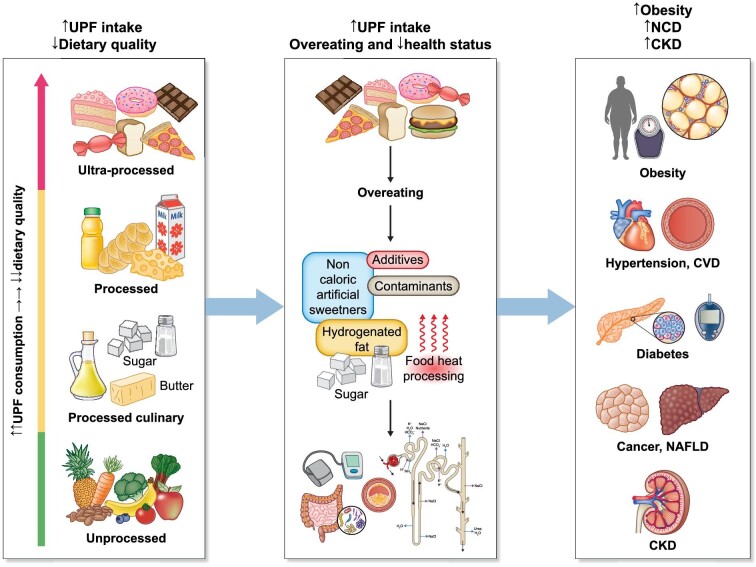
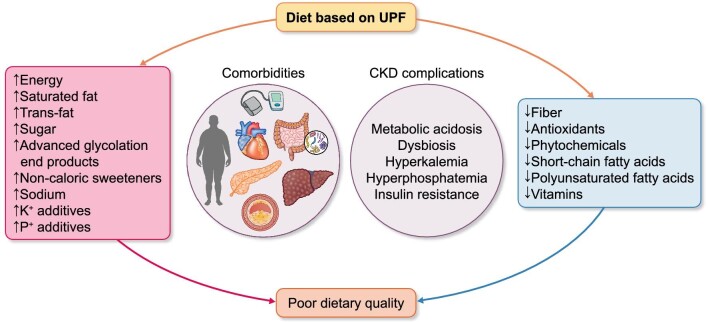
High energy intake combined with low physical activity generates positive energy balance, which, when maintained, favours obesity, a highly prevalent morbidity linked to development of non-communicable chronic diseases, including chronic kidney disease (CKD). Among many factors contributing to disproportionately high energy intakes, and thereby to the obesity epidemic, the type and degree of food processing play an important role. Ultraprocessed foods (UPFs) are industrialized and quite often high-energy-dense products with added sugar, salt, unhealthy fats and food additives formulated to be palatable or hyperpalatable. UPFs can trigger an addictive eating behaviour and is typically characterized by an increase in energy intake. Furthermore, high consumption of UPFs, a hallmark of a Western diet, results in diets with poor quality. A high UPF intake is associated with higher risk for CKD. In addition, UPF consumption by patients with CKD is likely to predispose and/or to exacerbate uraemic metabolic derangements, such as insulin resistance, metabolic acidosis, hypertension, dysbiosis, hyperkalaemia and hyperphosphatemia. Global sales of UPFs per capita increased in all continents in recent decades. This is an important factor responsible for the nutrition transition, with home-made meals being replaced by ready-to-eat products. In this review we discuss the potential risk of UPFs in activating hedonic eating and their main implications for health, especially for kidney health and metabolic complications of CKD. We also present various aspects of consequences of UPFs on planetary health and discuss future directions for research to bring awareness of the harms of UPFs within the CKD scenario.
Overview
The claims and statistics of this paper haven’t been checked yet.
Free: it reads the open-access text and checks the first 5 claims that cite a source we can check. Create a free account to check every claim.
Integrity signals
Registry
Cites
Statistics
Figures
Verification
Claims the paper makes
The claims and statistics of this paper haven’t been checked yet.
Free: it reads the open-access text and checks the first 5 claims that cite a source we can check. Create a free account to check every claim.
Claims other papers make about this one
Each is checked against this paper’s own text: does it say what the citing paper says it does?
The source backs part of the claim, not all of it — or backs it for a different population, condition or comparison.
In the citing paper
“The Western diet, in particular, is abundant in ultra‐processed sugar‐rich foods that can directly contribute to the predisposition and progression of the metabolic disease [53, 54].”
From Ignoring the planet: A critical blind spot for research on ageing (2025) · cites this paper as [54]
Experimental — accuracy not yet measured
Self-check
Percentages, sums and reported differences re-computed from the paper’s own numbers.
The self-check needs the paper’s full text.
Citations
Cites
Food in the Anthropocene: the EAT–Lancet Commission on healthy diets from sustainable food systems
Willett, W., Rockström, J., Loken, B., Springmann, M., Lang, T., Vermeulen, S., Garnett, T., Tilman, D., DeClerck, F., Wood, A., et al. (2019) · The Lancet · doi:10.1016/s0140-6736(18)31788-4 · Cited by 10,880
Ultra-processed foods: What they are and how to identify them
Monteiro, C. A., Cannon, G., Levy, R. B., Moubarac, J.-C., Louzada, M. L., Rauber, F., Khandpur, N., Cediel, G., Neri, D., Martinez-Steele, E., et al. (2019) · Public Health Nutrition · doi:10.1017/s1368980018003762 · Cited by 2,964 · cited 2×
“UPFs are packed with synthetic materials and the final product is palatable or highly palatable and can create an addictive eating pattern[9].”
BackgroundArtificial sweeteners induce glucose intolerance by altering the gut microbiota
Suez, J., Korem, T., Zeevi, D., Zilberman-Schapira, G., Thaiss, C. A., Maza, O., Israeli, D., Zmora, N., Gilad, S., Weinberger, A., et al. (2014) · Nature · doi:10.1038/nature13793 · Cited by 2,067 · cited 1×
“Alsoofimportance,thepresenceofnon-caloricarti-ficial sweeteners in UPFs, such as saccharin and aspartame, has been implicated in the development of glucose intolerance,central obesity and poor glucose control through changes of composition and function of the gut microbiota [39].”
BackgroundHall, K. D., Ayuketah, A., Brychta, R., Cai, H., Cassimatis, T., Chen, K. Y., Chung, S. T., Costa, E., Courville, A., Darcey, V., et al. (2019) · Cell Metabolism · doi:10.1016/j.cmet.2019.05.008 · Cited by 1,971
Baker, P., Machado, P., Santos, T., Sievert, K., Backholer, K., Hadjikakou, M., Russell, C., Huse, O., Bell, C., Scrinis, G., et al. (2020) · Obesity Reviews · doi:10.1111/obr.13126 · Cited by 1,194 · cited 4×
“UPFs have become more affordable in recent decades and,as a result,sales have increased tremendously over time [10–12].”
BackgroundInfluentialLichtenstein, A. H., Appel, L. J., Vadiveloo, M., Hu, F. B., Kris-Etherton, P. M., Rebholz, C. M., Sacks, F. M., Thorndike, A. N., Van Horn, L., Wylie-Rosett, J., et al. (2021) · Circulation · doi:10.1161/cir.0000000000001031 · Cited by 1,065 · cited 1×
“The Brazilian nutrition guidelines [88] and the 2021 dietary guidance to improve cardiovascular health [89] are examples of how to emphasize the importance of advocating healthy dietary patterns rather than recommendations based on advantages or restric-tionsofindividualnutrients.”
BackgroundFiolet, T., Srour, B., Sellem, L., Kesse-Guyot, E., Allès, B., Méjean, C., Deschasaux, M., Fassier, P., Latino-Martel, P., Beslay, M., et al. (2018) · BMJ · doi:10.1136/bmj.k322 · Cited by 1,057
Srour, B., Fezeu, L. K., Kesse-Guyot, E., Allès, B., Méjean, C., Andrianasolo, R. M., Chazelas, E., Deschasaux, M., Hercberg, S., Galan, P., et al. (2019) · BMJ · doi:10.1136/bmj.l1451 · Cited by 955 · cited 2×
“This means that the higher the proportion of UPFs, the worse the dietary quality [17, 28, 29], even among pesco-vegetarians, vegetarians and vegans that replace regular milk and meat for plant-based drinks and textured soy protein foods, respectively [30].”
BackgroundPotential Renal Acid Load of Foods and its Influence on Urine pH
REMER, T., & MANZ, F. (1995) · Journal of the American Dietetic Association · doi:10.1016/s0002-8223(95)00219-7 · Cited by 738 · cited 2×
“Duetothepreponderanceof animal-sourced food components, including many of the UPFs, the modern Western-type diet is considered H + -producing as compared with base-producing plant-sourced diets [63].”
BackgroundSalt Reduction to Prevent Hypertension and Cardiovascular Disease
He, F. J., Tan, M., Ma, Y., & MacGregor, G. A. (2020) · Journal of the American College of Cardiology · doi:10.1016/j.jacc.2019.11.055 · Cited by 589 · cited 1×
“Among the potential explanations behind these associations are the effect of a high sodium diet in altering the renal and vascular systems and by increasing oxidative stress regardless of changes in blood pressure [52, 53].”
Background
Research works printed but not linked: 5
- World Obesity Federation. World Obesity Atlas 2022. London: Ludgate House; 2022.
- Cai Q, Duan MJ, Dekker LH et al. Ultraprocessed food consumption and kidney function decline in a population-based cohort in the Netherlands. Am J Clin Nutr 2022; 116: 263– 73. 10.1093/ajcn/nqac073 35348601 PMC9257475 · DOI · Paper page
- Monteiro CA, Cannon G, Lawrence M et al. Ultra-processed foods, diet quality, and health using the NOVA classification system. Rome: Food and Agriculture Organization; 2019.
- EAT-Lancet Commission. Healthy diets from sustainable food systems. Food Planet Health. Summary report. 2020. https://eatforum.org/content/uploads/2019/01/EAT-Lancet_Commission_Summary_Report.pdf
- Ministry of Health of Brazil. Dietary guidelines for the Brazilian population. Brasilia: Ministry of Health, 2014.
Cited by
Pathological mechanisms of kidney disease in ageing
Yamamoto, T., & Isaka, Y. (2024) · Nature Reviews Nephrology · doi:10.1038/s41581-024-00868-4 · Cited by 113
“Although the adverse effects of phosphate over-consumption are largely overlooked, contemporary dietary habits often involve the consumption of phosphate-rich foods such as red meat and dairy products, along with the widespread use of phosphate-containing food additives in processed foods 98–100 .”
Çelik, Ö. M., Güler, Ü., Ekici, E. M., & Şahin, G. A. (2025) · BMC Public Health · doi:10.1186/s12889-025-23196-z · Cited by 33
Ultra-processed foods and cardio-kidney-metabolic syndrome: A review of recent evidence
Kanbay, M., Özbek, L., Güldan, M., Abdel‐Rahman, S. M., Narin, A. E., & Ortíz, A. (2025) · European Journal of Internal Medicine · doi:10.1016/j.ejim.2025.03.017 · Cited by 28
Biruete, A., Leal-Escobar, G., Espinosa-Cuevas, Á., Mojica, L., & Kistler, B. M. (2024) · Nutrients · doi:10.3390/nu16050574 · Cited by 32
“Consider sugar content [34].”
Kanbay, M., Özbek, L., Güldan, M., Abdel‐Rahman, S. M., Şişman, U., Mallamaci, F., & Zoccali, C. (2025) · European Journal of Clinical Investigation · doi:10.1111/eci.70045 · Cited by 22
“86,87 Overconsumption of UPFs can lead to transient satiety, reducing the intake of essential nutrients required for CKD management.”
Avesani, C. M., Cecchini, V., Sabatino, A., Lindholm, B., Stenvinkel, P., Canella, D. S., & Picard, K. (2025) · Clinical Journal of the American Society of Nephrology · doi:10.2215/cjn.0000000789 · Cited by 18
Self-citationHe, Y., Tang, W., Chen, J., Tang, J., Zheng, Y., Wang, X., Xing, B., Li, X., Xu, Y., & Wang, X. (2025) · BMC Nephrology · doi:10.1186/s12882-025-04386-8 · Cited by 32
“This was due to long-term nutritional imbalance, with high intake of processed meat, high-sodium, and high-sugar foods, and low intake of fruits, vegetables, and whole grains [53].”
Cecchini, V., Sabatino, A., Contzen, B., & Avesani, C. M. (2025) · European Journal of Clinical Nutrition · doi:10.1038/s41430-025-01600-6 · Cited by 26
“Increased consumption of UPFs is associated with a range of adverse health outcomes, such as type 2 diabetes, cardiovascular disease (CVD), obesity, cancer, chronic kidney disease (CKD), and mental health disorders [5, 6].”
Self-citationTorreggiani, M., Avesani, C. M., Contzen, B., Cupisti, A., Czaja-Stolc, S., D’Alessandro, C., Gârneaţă, L., Gutiérrez, A., Lippi, F., Mocanu, C.-A., et al. (2025) · Nutrients · doi:10.3390/nu17122002 · Cited by 18
Self-citationShateri, Z., Eskandarzadeh, S., Nouri, M., Jahromi, S. E., Mansouri, F., & Babajafari, S. (2024) · BMC Nephrology · doi:10.1186/s12882-023-03409-6 · Cited by 13
“…to sarcopenia and PEW associated with CKD that are exacerbated by consumption of UPFs include the following: developed insulin resistance, acidosis, vitamin D deficiency, and disruption of hormones like testosterone, insulin growth factor-1 (IGF-1), and growth hormone (GH) resistance [32, 33].”
BackgroundLeonberg, K. E., Maski, M. R., Scott, T. M., & Naumova, E. N. (2025) · Nutrients · doi:10.3390/nu17091560 · Cited by 18
“We also reviewed the reference lists of relevant review articles to avoid missing any relevant publications and identify additional studies [18].”
Sczip, A., Morais, J. G., Calegari, A., Krüger, T. S., Oliveira, J. C., Scatone, N., dos Santos, R. G., Barreto, F. C., & Nerbass, F. B. (2025) · Journal of Renal Nutrition · doi:10.1053/j.jrn.2025.07.007 · Cited by 10
Self-citationEffects of social determinants of health on the landscape of kidney disease
Zhang, L., dos Santos, A. C. S., Anandh, U., Saran, R., & Zhao, M. (2026) · Nature Reviews Nephrology · doi:10.1038/s41581-026-01052-6 · Cited by 10
Harnessing Evolution and Biomimetics to Enhance Planetary Health: Kidney Insights
Stenvinkel, P., Shiels, P. G., Kotanko, P., Evenepoel, P., & Johnson, R. J. (2024) · Journal of the American Society of Nephrology · doi:10.1681/asn.0000000582 · Cited by 7
Self-citationIgnoring the planet: A critical blind spot for research on ageing
Shiels, P., Neytchev, O., Borland, G., Germushkina, P., Johnson, R., Stenvinkel, P., & Woods, T. (2025) · Journal of Internal Medicine · doi:10.1111/joim.70032 · Cited by 4
“The Western diet, in particular, is abundant in ultra-processed sugar-rich foods that can directly contribute to the predisposition and progression of the metabolic disease [53, 54].”
Self-citationMoraes, M. C., Oliveira, L. B. F., Campos, M. R., Barahuna-Filho, P. F. R., Cardozo, P. L., Vieira, M. A. R., Ribeiro, F. M., Vieira, L. B., & Peruchetti, D. B. (2025) · European Journal of Pharmacology · doi:10.1016/j.ejphar.2025.178024 · Cited by 3
Mansouri, K., Storz, M. A., Hanh, T., & Hahn, A. (2025) · Food Science & Nutrition · doi:10.1002/fsn3.71183 · Cited by 3
“Additionally, minimizing highly processed foods is also beneficial given their high salt and phosphate-based additives content (Avesani et al. 2023; Monteiro et al. 2013).”
Ten tips on how to manage obesity in the presence of CKD
Kaesler, N., & Fleig, S. V. (2024) · Clinical Kidney Journal · doi:10.1093/ckj/sfae317 · Cited by 7
Seiman, D. M. D., Bucuras, P., Kundnani, N. R., Sharma, A., Rada, M., Albulescu, N., Buciu, V., Movila, D., Velimirovici, D. E., & Dinu, A. R. (2025) · Healthcare · doi:10.3390/healthcare13212671 · Cited by 2
“…and environmental exposures provide an additional pathway: individuals with lower education are more likely to consume high-sodium, processed diets and to experience greater exposure to occupational or environmental toxins, both of which worsen albuminuria and accelerate CKD progression [54–57].”
Karim, S., Alam, A. S., & Syed, A. M. (2025) · EMJ Gastroenterology · doi:10.33590/emjgastroenterol/ivvg9805 · Cited by 2
Real-World Snapshot of Dietary Patterns in Subjects Living with Chronic Kidney Disease
Lorenzo, M. D., Lonardo, M. S., Lauro, M. D., Chiurazzi, M., Severina, A. F. D. G. D. S., Capuano, M., Guida, B., Trio, R., Pacella, D., Memoli, A., et al. (2025) · Nutrients · doi:10.3390/nu17243864 · Cited by 3
“In addition, additives and low fiber content can contribute to systemic inflammation and intestinal dysbiosis, further accelerating renal function decline [40].”
Cunha, L. N. D. P., dos Santos, M. F., de Oliveira, S. V., Vieira, N. M., Preto, V. R. M., Schincaglia, R. M., Minicucci, M. F., & Costa, N. A. (2025) · Nutrire · doi:10.1186/s41110-025-00348-0 · Cited by 2
Ernährung bei chronischer Nierenerkrankung nach den Guidelines der KDOQI 2020/KDIGO 2024
Fleig, S. V., Zoellner, V., & Kuhlmann, M. K. (2025) · Die Nephrologie · doi:10.1007/s11560-025-00840-8 · Cited by 1
Schlueter, R., Cooke, J., Isaacson, K. L., & Calhoun, B. G. (2025) · Clinical Journal of the American Society of Nephrology · doi:10.2215/cjn.0000000785 · Cited by 1
The Exposome Era in Kidney Transplantation: A New Frontier in Graft Outcomes and Precision Medicine
Güldan, M., Al-Shiab, R., Rustamov, A., Özbek, L., Ferro, C. J., & Kanbay, M. (2025) · Clinical Transplantation · doi:10.1111/ctr.70384 · Cited by 1
“…in fruits, vegetables, legumes, whole grains, olive oil, fiber, and polyphenols have been linked to reduced levels of inflammatory markers, including CRP, IL-6, and TNF-α , alongside a reduction in oxidative stress, which could mitigate pathways of graft fibrosis and chronic rejection [94, 95].”
LISBOA, L. B., da Silva, L. P., Brum, I. D. S. D. C., Ribeiro-Alves, M., Cardozo, L., Mafra, D., & Alvarenga, L. (2025) · Nutrition · doi:10.1016/j.nut.2025.113073 · Cited by 1
Ultra-processed foods and CKD: a review of evidence, limitations, and future directions
Barbieri, G., Valle‐Hita, C., & Hantikainen, E. M. (2025) · Current Opinion in Lipidology · doi:10.1097/mol.0000000000001020 · Cited by 2
Wathanavasin, W., Kaewput, W., Thongprayoon, C., Tangpanithandee, S., Suppadungsuk, S., & Cheungpasitporn, W. (2026) · Nutrients · doi:10.3390/nu18010157 · Cited by 2
“Given that recently UPFs provide over 50% of total caloric intake in the U.S. and parallel the rise in obesity rates [30], it is plausible that high UPF consumption may predispose CKD patients to uremic metabolic derangements or exacerbate existing nutritional deficits [31].”
Vásquez, F., Tiscornia, C., Aicardi, V., & Vasquez, S. (2026) · Nutrients · doi:10.3390/nu18060911 · Cited by 2
“Beyond classic “metabolic CKD,” higher adiposity itself is increasingly recognized as a contributor to CKD risk even in the absence of overt metabolic disease, plausibly via hyperfiltration, adipokine dysregulation, RAAS activation, and inflammation [32].”
InfluentialBurstad, K. M., Fons, A., Kisch, A. R., Cladis, D. P., & Gallant, K. M. H. (2025) · bioRxiv (Cold Spring Harbor Laboratory) · doi:10.1101/2025.05.13.653545 · Cited by 2
“3,4,22,26,27 Overall, we found that most of the processed plant protein products evaluated in this pilot study had lower or similar phosphorus bioaccessibility compared with animal protein counterparts, which aligns with previous findings that plant sources generally have lower phosphorus…”
Ernährung bei Dialysepatienten
Kuhlmann, M. K., & Fleig, S. V. (2024) · DMW - Deutsche Medizinische Wochenschrift · doi:10.1055/a-2199-8816
“Man rechnet mit einer Aufnahme von etwa 20 – 40% [1, 2].”
Malik, A., Alamri, A., Altwaijry, N. A., Alamro, A. A., Alhomida, A. S., Ayub, R., & Odeibat, H. A. M. (2024) · ACS Omega · doi:10.1021/acsomega.4c08286
Ernährung bei Dialysepatienten
Kuhlmann, M. K., & Fleig, S. V. (2025) · Aktuelle Ernährungsmedizin · doi:10.1055/a-2500-8592
“Man rechnet mit einer Auf - nahme von etwa 20–40 % [1, 2].”
Sneddon, S. (2025) · Palgrave studies in green criminology. · doi:10.1007/978-3-031-87900-5_4
He, J. H., Du, S., Sullivan, V. K., Bernard, L., García-Larsen, V., Steele, E. M., Hallal, A. L. C., Wolfson, J. A., Matsuzaki, M., Wallace, A. S., et al. (2025) · Nutrients · doi:10.3390/nu17203294
“Greater ultra-processed food intake has been linked to higher risk of chronic kidney disease [40].”
Shateri, Z., Eskandarzadeh, S., Nouri, M., Jahromi, S. E., Mansouri, F., & Babajafari, S. (2024) · Figshare · doi:10.6084/m9.figshare.24940434
林, 咏. (2025) · Hans Journal of Food and Nutrition Science · doi:10.12677/hjfns.2025.146088
Diet Quality as a Determinant of Kidney-Related Complications of Diabetes and Hypertension
Russo, E., Garibotto, G., & Moore, L. W. (2026) · Journal of Renal Nutrition · doi:10.1053/j.jrn.2026.02.006 · Cited by 1
Espinosa, S. N., Zárate-Ortiz, A. G., Hadida, G., da Silva, J. T., Vonderschmidt, A., Esievo, E. M., Carr, T. W., Reuzé, A., & Scheelbeek, P. (2026) · Current Developments in Nutrition · doi:10.1016/j.cdnut.2026.107669
The Health Impacts of Chemicals in Ultra-Processed Foods: A Review
Ekechi, N. V., & Ohanebo, C. G. (2025) · International Journal of Scientific Research in Humanities and Social Sciences · doi:10.32628/ijsrhss2525141
Reimer, K. C., & Fleig, S. V. (2026) · Nephrologie aktuell · doi:10.1055/a-2749-2323
“Hingegen ist in hochprozessiertem Weiß-mehl nur der Mehlkörper enthalten, also Stärke rungsstoffe und Säureemulgatoren, die häufig viel Kalium und Phosphat enthalten und fast vollständig aufgenom-men werden [6].”
Ten tips for the first hemodialysis sessions
Hecking, M., Kolland, M., Theodorakopoulou, M., Niknam, J., Mussnig, S., Gülmez, D., Kirsch, A. H., Alfano, G., Combe, C., Kazancioglu, R., et al. (2026) · Clinical Kidney Journal · doi:10.1093/ckj/sfag270
Silva, M. Z. C., Gomes, V. S., Borges, S., do Nascimento, T. V. N., Costa, F. L., de Souza, S. F., Pires, M. P., Ponce, D., Guimarães, M. G. M., Cálice-Silva, V., et al. (2026) · Nutrire · doi:10.1186/s41110-026-00526-8
“Furthermore, a dietary pattern richer in minimally processed plant foods naturally reduces the intake of ultra-pro-cessed foods, which are typically high in sodium, phosphorus additives, and cosmetic ingredients, thereby offering addi - tional metabolic and cardiovascular benefits [ 18].”
Self-citationThe Impact of Ultra-Processed Foods on Chronic Kidney Disease Progression
Młynarska, E., Hossa, K., Kłosowicz, A., Krupińska, N., Kuzar, P., Majtas, A., Możdżan, Z., Prusak, A., Szymańska, P., Wieczorek, A., et al. (2026) · Nutrients · doi:10.3390/nu18183055
“Consequently, the synergistic cascade of ROS and pro-inflammatory cytokines and persistent metabolic dysregulation lead to the pathological remodeling of renal architecture [13,34,36].”
InfluentialLambert, K., Beer, J., Brauer, D., Conley, M. M., Dawson, J., Kariyawasam, D., Morris, A., Nash, C., Notaras, S., Trimingham, C., et al. (2026) · Seminars in Nephrology · doi:10.1016/j.semnephrol.2026.151728
Reducing Dietary Sodium Exposure in Chronic Kidney Disease: Challenges and Opportunities
Gonzalez, V., Brostow, D. P., & Perez, L. M. (2026) · Seminars in Nephrology · doi:10.1016/j.semnephrol.2026.151732 · Cited by 1
Garchitorena, J. M., Azeem, A., Sharma, A. C., Abu-Salah, M., & Nigro, N. N. (2026) · Cureus · doi:10.7759/cureus.118807
Metadata
- Authors
- Avesani, C. M., Cuppari, L., Nerbass, F. B., Lindholm, B., & Stenvinkel, P.
- Affiliations
- Division of Renal Medicine and Baxter Novum, Department of Clinical Science, Technology and Intervention, Karolinska Instituted , Stockholm , Sweden
- Division of Nephrology and Nutrition Program, Federal University of São Paulo and Sāo Paulo , Brazil
- Pró-Rim Foundation , Joinville, Santa Catarina , Brazil
- Karolinska Institutet (SE)
- Venue
- Clinical Kidney Journal
- Publisher
- Oxford University Press (OUP)
- Published
- 2023-05-04
- Volume
- 16
- Issue
- 11
- Pages
- 1723-1736
- ISSN
- 2048-8505 (ISSN-L)
- 2048-8513
- PMC
- PMC10616474
- OpenAlex
- W4382585614
- Cited by
- 46
- References
- 85
- Citations by year
- 2026: 11 · 2025: 27 · 2024: 8
- FWCI
- 2.27
- Type
- journal article
- Language
- en
- Open access
- gold
- doi.org
- Licence
- Locations
- Clinical Kidney Journal (publishedVersion, cc-by-nc)
- PubMed Central (publishedVersion, cc-by-nc)
- PubMed (publishedVersion)
- Funders
- European Union (2021-1-NL01-KA220-HED-000032029)
- The Stig and Gunborg Westman Foundation
- Martin Rind Foundation
- Conselho Nacional de Desenvolvimento Científico e Tecnológico (302765/2017-4)
- Karolinska Institutet
- Heart and Lung Foundation
- Njurfonden
- Swedish Medical Research Council
- Topics
- Health Sciences › Medicine › Public Health, Environmental and Occupational Health › Consumer Attitudes and Food Labeling
- Health Sciences › Medicine › Public Health, Environmental and Occupational Health › Global Public Health Policies and Epidemiology
- Health Sciences › Medicine › Endocrinology, Diabetes and Metabolism › Diet, Metabolism, and Disease
- Keywords
- ultra-processed foods, chronic kidney disease, energy intake, obesity, food processing, hyperpalatable foods, food addiction, Western diet, nutrition transition, insulin resistance, metabolic acidosis, dysbiosis, hyperkalemia, hyperphosphatemia, planetary health
About these checks
Registry, retraction, Cites and statistics results are computed, not judged, with one exception: a printed reference that no index lists is read once by a model before it counts as a citation error. Claims are extracted by a model and kept only when their quote appears verbatim in the text; each cited source is then checked, with a model’s help, for whether it says what the claim relies on. Those verdicts can be wrong — read the claim’s quote and the cited source before relying on one.
Statistics and arithmetic are recomputed, not judged.
Confidence bands are shown only for fields calibrated on our annotated test set. None is calibrated yet, so no band is shown.
What counts as a claim ›How we measure confidence ›How we check this ›
Are you an author, or do you see a problem with this page? Request a review
Data sources
Bibliographic data: Semantic Scholar, OpenAlex, Crossref.
Contains information from the Semantic Scholar Academic Graph Datasets, made available under the ODC Attribution License (ODC-BY 1.0).
Semantic Scholar’s data is described in: Kinney, R., et al. (2023). The Semantic Scholar Open Data Platform. arXiv:2301.10140.
