

The DOI matches its Crossref record; 53 of the 53 references it cites were found in a registry or an index.
Twelve weeks of supervised exercise improves self-reported symptom burden and fatigue in chronic kidney disease: a secondary analysis of the ‘ExTra CKD’ trial
Open accessAbstract
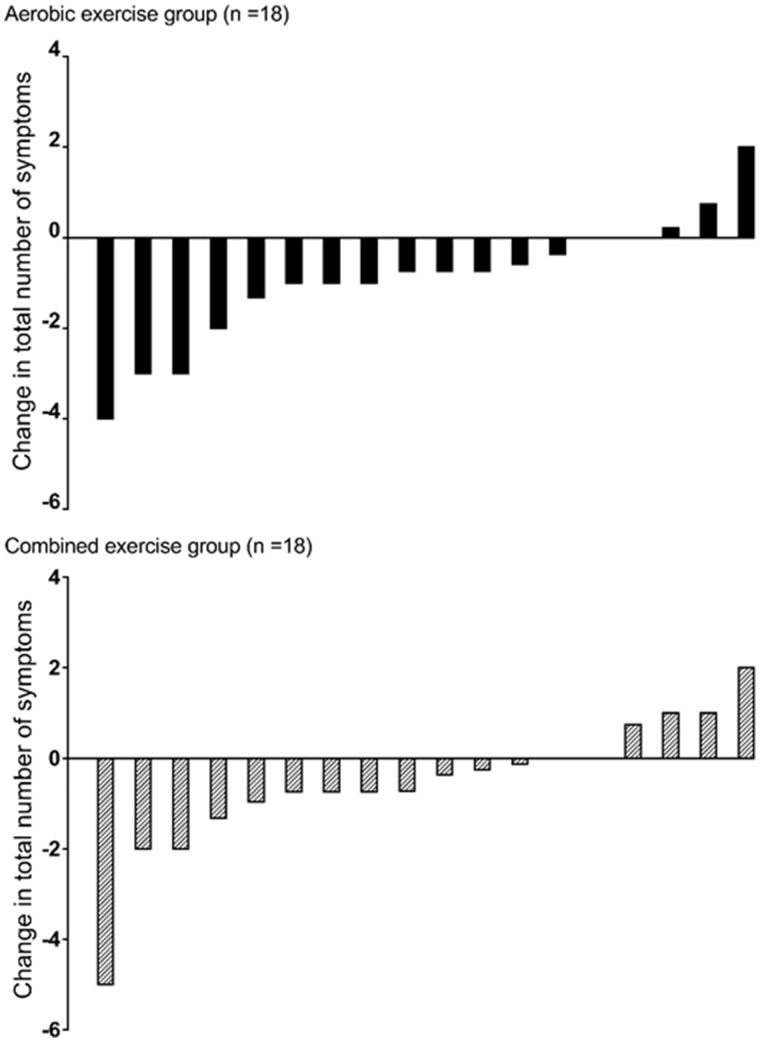
BACKGROUND: Chronic kidney disease (CKD) patients experience a high symptom burden including fatigue, sleep difficulties, muscle weakness and pain. These symptoms reduce levels of physical function (PF) and activity, and contribute to poor health-related quality of life (HRQoL). Despite the gathering evidence of positive physiological changes following exercise in CKD, there is limited evidence on its effect on self-reported symptom burden, fatigue, HRQoL and physical activity. METHODS: ] not requiring renal replacement therapy underwent 12 weeks (3 times/week) of supervised aerobic exercise (AE), or a combination (CE) of AE plus resistance training. Outcomes included self-reported symptom burden, fatigue, HRQoL and physical activity. RESULTS: Exercise reduced the total number of symptoms reported by 17% and had favourable effects on fatigue in both groups. AE reduced the frequency of 'itching', 'impotence' and 'shortness of breath' symptoms, and the intrusiveness for symptoms of 'sleep disturbance', 'loss of muscular strength/power', 'muscle spasm/stiffness' and 'restless legs'. The addition of resistance exercise in the CE group saw a reduction in 'loss of muscular strength/power'. No changes were seen in subjective PF or physical activity levels. AE increased self-efficacy for physical activity. CONCLUSIONS: Supervised exercise had favourable effects on symptom frequency and intrusiveness, including substantial improvements in fatigue. Although the intervention did not improve self-reported physical activity levels, AE increased patients' self-efficacy for physical activity. These favourable changes in self-reported outcomes support the important role of exercise in CKD.
Overview
The claims and statistics of this paper haven’t been checked yet.
Run the check — free, no account needed. It reads the open-access text and checks the sources it cites.
Integrity signals
Registry
Cites
Statistics
Figures
Verification
Claims the paper makes
The claims and statistics of this paper haven’t been checked yet.
Run the check — free, no account needed. It reads the open-access text and checks the sources it cites.
Self-check
Percentages, sums and reported differences re-computed from the paper’s own numbers.
The self-check needs the paper’s full text.
Citations
Cites
Self-efficacy: Toward a unifying theory of behavioral change
Bandura, A. (1977) · Psychological Review · doi:10.1037/0033-295x.84.2.191 · Cited by 43,925
Self-efficacy: Toward a unifying theory of behavioral change
Bandura, A. (1978) · Advances in Behaviour Research and Therapy · doi:10.1016/0146-6402(78)90002-4 · Cited by 10,586
Targeting Hypoxia-Inducible Factors for the Treatment of Anemia in Chronic Kidney Disease Patients
Locatelli, F., Fishbane, S., Block, G. A., & Macdougall, I. C. (2017) · American Journal of Nephrology · doi:10.1159/000455166 · Cited by 4,813
Overview of the SF-36 Health Survey and the International Quality of Life Assessment (IQOLA) Project
Ware, J. E., & Gandek, B. (1998) · Journal of Clinical Epidemiology · doi:10.1016/s0895-4356(98)00081-x · Cited by 2,605
Self-Efficacy and the Stages of Exercise Behavior Change
Marcus, B. H., Selby, V. C., Niaura, R. S., & Rossi, J. S. (1992) · Research Quarterly for Exercise and Sport · doi:10.1080/02701367.1992.10607557 · Cited by 1,860
(2003) · Health and Quality of Life Outcomes · doi:10.1186/1477-7525-1-79 · Cited by 1,506
Exercise for the management of cancer-related fatigue in adults
Cramp, F., & Byron-Daniel, J. (2012) · Cochrane Database of Systematic Reviews · doi:10.1002/14651858.cd006145.pub3 · Cited by 1,096
Estimation of minimally important differences in EQ-5D utility and VAS scores in cancer
Pickard, A. S., Neary, M. P., & Cella, D. (2007) · Health and Quality of Life Outcomes · doi:10.1186/1477-7525-5-70 · Cited by 929
The Godin-Shephard Leisure-Time Physical Activity Questionnaire
Godin, G. (2011) · Health & fitness journal of Canada · doi:10.14288/hfjc.v4i1.82 · Cited by 922
Mapes, D., Lopes, A. A., Satayathum, S. S., McCullough, K. P., Goodkin, D. A., Locatelli, F., Fukuhara, S., Young, E. W., Kurokawa, K., Saitō, A., et al. (2003) · Kidney International · doi:10.1046/j.1523-1755.2003.00072.x · Cited by 873
Cited by
Beetham, K. S., Krishnasamy, R., Stanton, T., Sacre, J. W., Douglas, B., Isbel, N. M., Coombes, J. S., & Howden, E. J. (2022) · Journal of the American Society of Nephrology · doi:10.1681/asn.2021050668 · Cited by 60
Metadata
- Authors
- Wilkinson, T. J., Watson, E. L., Gould, D. W., Xenophontos, S., Clarke, A. L., Vogt, B. P., Viana, J. L., & Smith, A. C.
- Affiliations
- University of Leicester (GB)
- Department of Infection, Immunity and Inflammation, University of Leicester, Leicester, UK
- Department of Clinical Medicine, Faculdade de Medicina de Botucatu, Universidade Estadual Paulista, UNESP, São Paulo, Brazil
- Loughborough University (GB)
- Corresponding author
- Wilkinson, Thomas J
- Venue
- Clinical Kidney Journal
- Publisher
- Oxford University Press (OUP)
- Published
- 2018-08-13
- Volume
- 12
- Issue
- 1
- Pages
- 113-121
- ISSN
- 2048-8505 (ISSN-L)
- 2048-8513
- PMC
- PMC6366144
- OpenAlex
- W2887885660
- Cited by
- 52
- References
- 53
- Citations by year
- 2026: 1 · 2025: 7 · 2024: 5 · 2023: 7 · 2022: 12 · 2021: 11 · 2020: 4 · 2019: 3 · 2018: 2
- FWCI
- 4.10
- Type
- journal article
- Language
- en
- Open access
- gold
- doi.org
- Licence
- Locations
- Clinical Kidney Journal (publishedVersion, cc-by-nc)
- Europe PMC (PubMed Central) (publishedVersion, cc-by-nc)
- PubMed Central (publishedVersion, cc-by-nc)
- PubMed (publishedVersion)
- Warwick Research Archive Portal (University of Warwick) (acceptedVersion)
- Americanae (AECID Library) (submittedVersion, other-oa)
- Figshare (submittedVersion, cc-by-nc)
- Leicester Research Archive (University of Leicester) (submittedVersion, cc-by-nc)
- Portuguese National Funding Agency for Science, Research and Technology (RCAAP Project by FCT) (submittedVersion, other-oa)
- LA Referencia (Red Federada de Repositorios Institucionales de Publicaciones Científicas) (submittedVersion, other-oa)
- Funders
- Stoneygate Trust
- National Institute for Health Research
- Leicester Biomedical Research Centre
- NHS
- NIHR
- BRC
- Kidney Research UK Post-Doctoral Fellowship
- Improvement of Higher Education Personnel
- Ministry of Education
- Topics
- Health Sciences › Medicine › Nephrology › Dialysis and Renal Disease Management
- Health Sciences › Medicine › Public Health, Environmental and Occupational Health › Physical Activity and Health
- Health Sciences › Medicine › Physiology (medical) › Cardiovascular and exercise physiology
- Keywords
- chronic kidney disease, supervised exercise, aerobic exercise, resistance training, fatigue, symptom burden, health-related quality of life, physical activity, self-efficacy, sleep disorders, muscle weakness
About these checks
Registry, retraction, Cites and statistics results are computed, not judged, with one exception: a printed reference that no index lists is read once by a model before it counts as a citation error. Claims are extracted by a model and kept only when their quote appears verbatim in the text; each cited source is then checked, with a model’s help, for whether it says what the claim relies on. Those verdicts can be wrong — read the claim’s quote and the cited source before relying on one.
Statistics and arithmetic are recomputed, not judged.
Confidence bands are shown only for fields calibrated on our annotated test set. None is calibrated yet, so no band is shown.
What counts as a claim ›How we measure confidence ›How we check this ›
Are you an author, or do you see a problem with this page? Request a review
Data sources
Bibliographic data: Semantic Scholar, OpenAlex, Crossref.
Contains information from the Semantic Scholar Academic Graph Datasets, made available under the ODC Attribution License (ODC-BY 1.0).
Semantic Scholar’s data is described in: Kinney, R., et al. (2023). The Semantic Scholar Open Data Platform. arXiv:2301.10140.
