

Incidence of Adverse Psychiatric Events During Treatment of Inflammatory Bowel Disease With Biologic Therapies: A Systematic Review
Open accessThe DOI matches its Crossref record; 39 of the 39 references it cites were found in a registry or an index.
Abstract
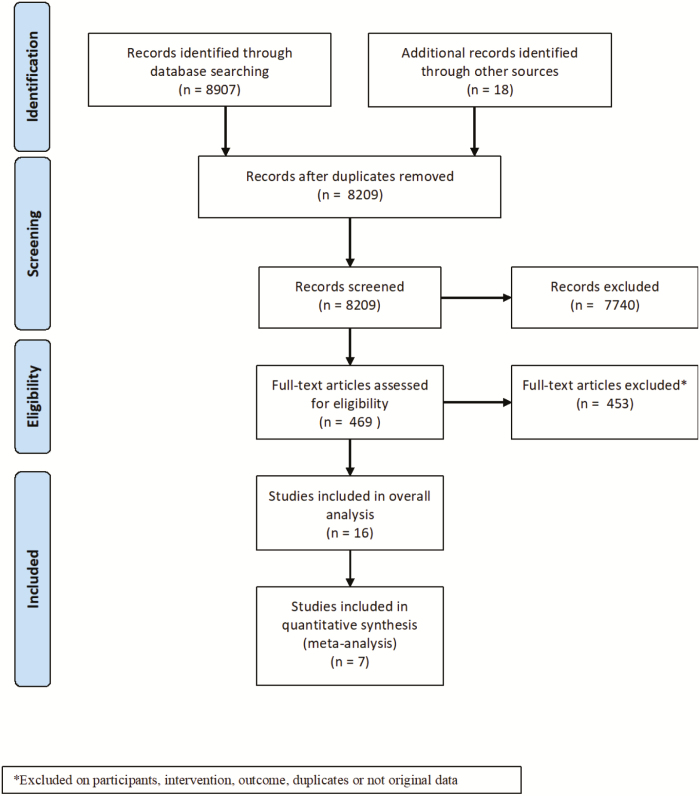
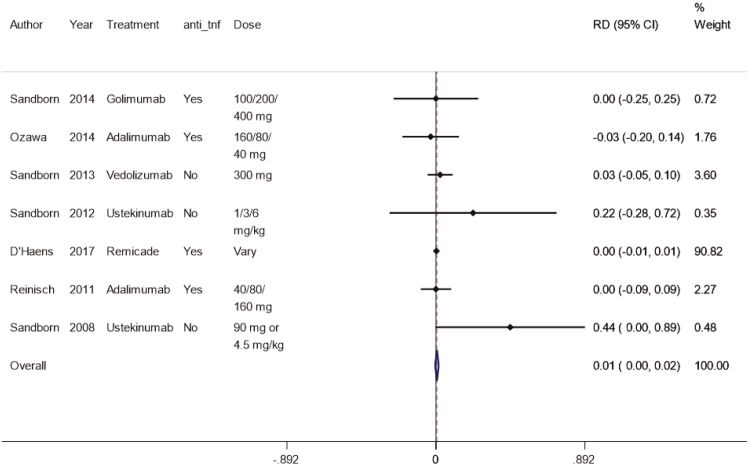
We conducted a systematic review and a fixed-effects meta-analysis to determine whether incident adverse psychiatric events (APE) including depression, anxiety, psychosis, or suicide were associated with biologic therapy in IBD. Six randomized controlled trials and a cohort study met criteria, reporting an incidence of APE in 4,882 patients. The risk difference per 100 person-months of any APE with a biologic medication was 0.01 (95% confidence interval = 0.00-0.02). There was insufficient evidence available in randomized controlled trials to conclude that biologic therapy in IBD is associated with an increased incidence of APE.
Overview
The claims and statistics of this paper haven’t been checked yet.
Free: it reads the open-access text and checks the first 5 claims that cite a source we can check. Create a free account to check every claim.
Integrity signals
Registry
Cites
Statistics
Figures
Verification
Claims the paper makes
The claims and statistics of this paper haven’t been checked yet.
Free: it reads the open-access text and checks the first 5 claims that cite a source we can check. Create a free account to check every claim.
Claims other papers make about this one
Each is checked against this paper’s own text: does it say what the citing paper says it does?
The cited source says what the claim attributes to it.
In the citing paper
“The study concluded that there was not sufficient evidence of any greater risk of depression, anxiety, psychosis, or suicide associated with the use of biologics, reporting a pooled risk difference of 0.01 (95% CI: 0.00, 0.02) comparing those with IBD on biologics to those not taking biologics.”
From The 2023 Impact of Inflammatory Bowel Disease in Canada: Mental Health and Inflammatory Bowel Disease (2023) · cites this paper as [18]
The cited source says what the claim attributes to it.
In the citing paper
“A recent systematic review and meta-analysis found only 15 reported incidences of an adverse psychiatric event for over 2,600 individuals with IBD receiving any of the currently available biologics, based on eligible randomized controlled trials (18).”
From The 2023 Impact of Inflammatory Bowel Disease in Canada: Mental Health and Inflammatory Bowel Disease (2023) · cites this paper as [18]
Self-check
Percentages, sums and reported differences re-computed from the paper’s own numbers.
The self-check needs the paper’s full text.
Citations
Cites
Measuring inconsistency in meta-analyses
Higgins, J. P. T., Thompson, S. G., Deeks, J. J., & Altman, D. G. (2003) · BMJ · doi:10.1136/bmj.327.7414.557 · Cited by 63,139
The Cochrane Collaboration's tool for assessing risk of bias in randomised trials
Higgins, J. P. T., Altman, D. G., Gotzsche, P. C., Juni, P., Moher, D., Oxman, A. D., Savovic, J., Schulz, K. F., Weeks, L., Sterne, J. A. C., et al. (2011) · BMJ · doi:10.1136/bmj.d5928 · Cited by 33,817
Dermyshi, E., Wang, Y., Yan, C., Hong, W., Qiu, G., Gong, X., & Zhang, T. (2017) · Neonatology · doi:10.1159/000454668 · Cited by 24,451
Loftus, E. V. (2004) · Gastroenterology · doi:10.1053/j.gastro.2004.01.063 · Cited by 3,117
Vedolizumab as Induction and Maintenance Therapy for Crohn's Disease
Sandborn, W. J., Feagan, B. G., Rutgeerts, P., Hanauer, S., Colombel, J.-F., Sands, B. E., Lukas, M., Fedorak, R. N., Lee, S., Bressler, B., et al. (2013) · New England Journal of Medicine · doi:10.1056/nejmoa1215739 · Cited by 2,719
D'Haens, G., Baert, F., van Assche, G., Caenepeel, P., Vergauwe, P., Tuynman, H., De Vos, M., van Deventer, S., Stitt, L., Donner, A., et al. (2008) · The Lancet · doi:10.1016/s0140-6736(08)60304-9 · Cited by 1,231
Ustekinumab Induction and Maintenance Therapy in Refractory Crohn's Disease
Sandborn, W. J., Gasink, C., Gao, L.-L., Blank, M. A., Johanns, J., Guzzo, C., Sands, B. E., Hanauer, S. B., Targan, S., Rutgeerts, P., et al. (2012) · New England Journal of Medicine · doi:10.1056/nejmoa1203572 · Cited by 1,134
Haapakoski, R., Mathieu, J., Ebmeier, K. P., Alenius, H., & Kivimäki, M. (2015) · Brain, Behavior, and Immunity · doi:10.1016/j.bbi.2015.06.001 · Cited by 1,129
Sandborn, W. J., Feagan, B. G., Marano, C., Zhang, H., Strauss, R., Johanns, J., Adedokun, O. J., Guzzo, C., Colombel, J.-F., Reinisch, W., et al. (2014) · Gastroenterology · doi:10.1053/j.gastro.2013.05.048 · Cited by 940
Reinisch, W., Sandborn, W. J., Hommes, D. W., D'Haens, G., Hanauer, S., Schreiber, S., Panaccione, R., Fedorak, R. N., Tighe, M. B., Huang, B., et al. (2011) · Gut · doi:10.1136/gut.2010.221127 · Cited by 892 · cited 2×
“24,28 One incident event of depression in the treated group was the only reported APE (0.23%).”
Influential
Research works printed but not linked: 3
- Sandborn WJ. et al. A study to evaluate safety of long term therapy of certolizumab pegol patients with crohn’s disease. Gastroenterology. 2011; 140(5): S– 262.
- Feagan et al. Follow-up to Welcome Study C87042 [ NCT00308581] examining Certolizumab Pegol (CDP870) in subjects with Crohn’s Disease (Welcome2). Crohn’s & Colitis Foundation of America Advances in Inflammatory Bowel Diseases. Inflamm Bowel Dis. 2013; 19(1): S82, abs P-145. Clinical trial available from: https://clinicaltrials.gov/ct2/show/NCT00333788.
- Ogata et al. Maintenance study including re-induction therapy for patients who did not show a clinical effect in study C87037 (NCT00291668). Gut. 2009; 58(2): A170. Available from: https://clinicaltrials.gov/ct2/show/NCT00329420.
Cited by
Ludvigsson, J. F., Olén, O., Larsson, H., Halfvarson, J., Almqvist, C., Lichtenstein, P., & Butwicka, A. (2021) · Journal of Crohn s and Colitis · doi:10.1093/ecco-jcc/jjab039 · Cited by 76
Graff, L. A., Geist, R., Kuenzig, M. E., Benchimol, E. I., Kaplan, G. G., Windsor, J. W., Bitton, A., Coward, S., Jones, J. L., Lee, K., et al. (2023) · Journal of the Canadian Association of Gastroenterology · doi:10.1093/jcag/gwad012 · Cited by 30
“A recent systematic review and meta-analysis found only 15 reported incidences of an adverse psychiatric event for over 2,600 individuals with IBD receiving any of the currently available biologics, based on eligible randomized controlled trials (18).”
BackgroundSelf-citationInflammatory Bowel Disease and Patients With Mental Disorders: What Do We Know?
Fousekis, F. S., Katsanos, A. H., Kourtis, G., Saridi, M., Albani, E., Katsanos, K. H., & Christodoulou, D. K. (2021) · Journal of Clinical Medicine Research · doi:10.14740/jocmr4593 · Cited by 28
“On the other hand, according to available data, treatment with biological agents does not seem to be associated with an increased risk of anxiety, depression, suicidality and psychosis [61].”
BackgroundThe emerging role of mood disorders in inflammatory bowel diseases
Kuźnicki, P., Kempiński, R., & Neubauer, K. (2020) · Advances in Clinical and Experimental Medicine · doi:10.17219/acem/127676 · Cited by 24
Wang, K., Zhu, Y., Liu, K., Zhu, H., & Ouyang, M. (2024) · Heliyon · doi:10.1016/j.heliyon.2024.e25357 · Cited by 21
“Unfortunately, long-term treatment with biomolecules can induce immunogenicity through the production of anti-drug antibodies [7], which can reduce the response of the patient to the drug [11,12].”
Background
Metadata
- Authors
- Jain, A., Marrie, R. A., Shafer, L. A., Graff, L. A., Patten, S. B., El-Gabalawy, R., Sareen, J., Bolton, J. M., Fisk, J. D., & Bernstein, C. N.
- Affiliations
- University of Manitoba (CA)
- University of Calgary (CA)
- Dalhousie University (CA)
- Corresponding author
- Bernstein, Charles N
- ORCID
- Venue
- Crohn's & Colitis 360
- Publisher
- Oxford University Press (OUP)
- Published
- 2019-12-19
- Volume
- 2
- Issue
- 1
- Pages
- otz053-otz053
- ISSN
- 2631-827X (ISSN-L)
- PMC
- PMC6977711
- OpenAlex
- W2995687733
- Cited by
- 16
- References
- 39
- Citations by year
- 2026: 3 · 2025: 1 · 2024: 2 · 2023: 3 · 2022: 3 · 2021: 3 · 2020: 1
- FWCI
- 0.23
- Type
- journal article
- Language
- en
- Open access
- gold
- doi.org
- Licence
- Locations
- Crohn s & Colitis 360 (publishedVersion, cc-by)
- PubMed Central (publishedVersion, cc-by)
- PubMed (publishedVersion)
- Funders
- Canadian Institutes of Health Research
- Topics
- Health Sciences › Medicine › Gastroenterology › Inflammatory Bowel Disease
- Health Sciences › Medicine › Rheumatology › Rheumatoid Arthritis Research and Therapies
- Life Sciences › Pharmacology, Toxicology and Pharmaceutics › Toxicology › Pharmacovigilance and Adverse Drug Reactions
- Keywords
- inflammatory bowel disease, biologic therapy, depression, anxiety, psychosis, suicide, drug safety, Crohn's disease, ulcerative colitis
About these checks
Registry, retraction, Cites and statistics results are computed, not judged, with one exception: a printed reference that no index lists is read once by a model before it counts as a citation error. Claims are extracted by a model and kept only when their quote appears verbatim in the text; each cited source is then checked, with a model’s help, for whether it says what the claim relies on. Those verdicts can be wrong — read the claim’s quote and the cited source before relying on one.
Statistics and arithmetic are recomputed, not judged.
Confidence bands are shown only for fields calibrated on our annotated test set. None is calibrated yet, so no band is shown.
What counts as a claim ›How we measure confidence ›How we check this ›
Are you an author, or do you see a problem with this page? Request a review
How to cite
Cite CoChat for the checks on this page, and the paper for its own findings.
- This page
- CoChat. (2026). Citation check: Incidence of Adverse Psychiatric Events During Treatment of Inflammatory Bowel Disease With Biologic Therapies: A Systematic Review. https://app.cochat.ai/papers/10.1093/crocol/otz053
- The paper
- Jain, A., Marrie, R. A., Shafer, L. A., Graff, L. A., Patten, S. B., El-Gabalawy, R., Sareen, J., Bolton, J. M., Fisk, J. D., & Bernstein, C. N. (2020). Incidence of Adverse Psychiatric Events During Treatment of Inflammatory Bowel Disease With Biologic Therapies: A Systematic Review. Crohn's & Colitis 360. https://doi.org/10.1093/crocol/otz053
Data sources
Bibliographic data: Semantic Scholar, OpenAlex, Crossref.
Contains information from the Semantic Scholar Academic Graph Datasets, made available under the ODC Attribution License (ODC-BY 1.0).
Semantic Scholar’s data is described in: Kinney, R., et al. (2023). The Semantic Scholar Open Data Platform. arXiv:2301.10140.
