

Inflammatory Bowel Disease and Patients With Mental Disorders: What Do We Know?
Open accessThe DOI matches its Crossref record; 72 of the 74 references it cites were found in a registry or an index, and 2 are not checked yet.
Abstract
Inflammatory bowel disease (IBD) is a multisystemic disease with a wide range of extraintestinal manifestations in both ulcerative colitis and Crohn's disease, while increasing evidence supports the interaction between gut and central nervous system, described as "gut-brain axis". According to epidemiological studies, it seems that patients with IBD present more frequently with impaired mental status compared to the general population, leading to diagnostic and management problems in this group of patients. The association between IBD and mental disorders, such as dementia and autism spectrum disorders, has not been fully clarified; genetic factors and the gut-brain axis seem to be involved. The purpose of this review is to present and analyze the epidemiological data about this issue, describe the possible pathogenetic mechanisms and discuss some considerations about the management of patients with IBD and impaired mental status.
Overview
The claims and statistics of this paper haven’t been checked yet.
Free: it reads the open-access text and checks the first 5 claims that cite a source we can check. Create a free account to check every claim.
Integrity signals
Registry
Cites
Statistics
Figures
Verification
Claims the paper makes
The claims and statistics of this paper haven’t been checked yet.
Free: it reads the open-access text and checks the first 5 claims that cite a source we can check. Create a free account to check every claim.
Claims other papers make about this one
Each is checked against this paper’s own text: does it say what the citing paper says it does?
The source backs part of the claim, not all of it — or backs it for a different population, condition or comparison.
In the citing paper
“Жінки, які страждають на ЗЗК у післяпологовому періоді, піддаються підвищеному ризику виникнення нового психіатричного діагнозу [18].”
From PSYCHO-EMOTIONAL STATUS IN PATIENTS WITH INFLAMMATORY BOWEL DISEASE (2024) · cites this paper as [18]
Experimental — accuracy not yet measured
Self-check
Percentages, sums and reported differences re-computed from the paper’s own numbers.
The self-check needs the paper’s full text.
Citations
Cites
Lai, M.-C., Lombardo, M. V., & Baron-Cohen, S. (2014) · The Lancet · doi:10.1016/s0140-6736(13)61539-1 · Cited by 2,371
Gut microbiota and IBD: causation or correlation?
Ni, J., Wu, G. D., Albenberg, L., & Tomov, V. T. (2017) · Nature Reviews Gastroenterology & Hepatology · doi:10.1038/nrgastro.2017.88 · Cited by 1,778 · cited 1×
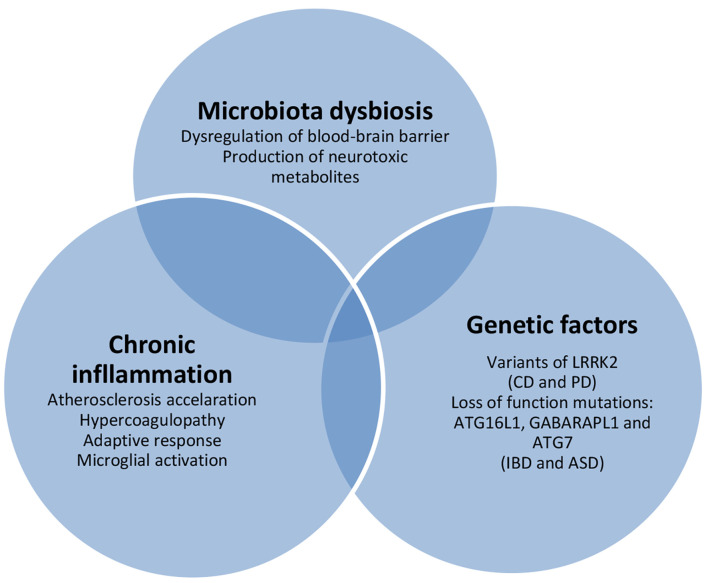
“Furthermore, dysbiosis of the gut microbiome seems to be present in patients with IBD [54] and many studies have suggested that dysregulation of the gut microbiota may play a role in the progression of dementia through alterations of the gut barrier, production of microbial neurotoxic metabolites in systemic circulati…”
BackgroundNeuroinflammation in Alzheimer's disease: current evidence and future directions
Calsolaro, V., & Edison, P. (2016) · Alzheimer's & Dementia · doi:10.1016/j.jalz.2016.02.010 · Cited by 1,726 · cited 1×
“Several studies have suggested that systemic chronic inflammation may accelerate the progression of Alzheimer’s disease via alterations of the blood-brain barrier and the microglial activation [49], indicating that IBD as a chronic inflammatory condition may contribute to Alzheimer’s disease progression.”
BackgroundCytokine-Associated Emotional and Cognitive Disturbances in Humans
Reichenberg, A., Yirmiya, R., Schuld, A., Kraus, T., Haack, M., Morag, A., & Pollmächer, T. (2001) · Archives of General Psychiatry · doi:10.1001/archpsyc.58.5.445 · Cited by 1,365
Alzheimer’s disease: pathogenesis, diagnostics, and therapeutics
Tiwari, S., Atluri, V., Kaushik, A., Yndart, A., & Nair, M. (2019) · International Journal of Nanomedicine · doi:10.2147/ijn.s200490 · Cited by 1,308 · cited 1×
“In particular, Alzheimer’s disease is the most frequent cause of dementia and the major pathogenetic mechanisms include the development of amyloid β plaques and neurofibrillary tangles [48].”
BackgroundO'Brien, J. T., & Thomas, A. (2015) · The Lancet · doi:10.1016/s0140-6736(15)00463-8 · Cited by 1,136
Autism spectrum disorder: Definition, epidemiology, causes, and clinical evaluation
Hodges, H., Fealko, C., & Soares, N. (2020) · Translational Pediatrics · doi:10.21037/tp.2019.09.09 · Cited by 1,127 · cited 1×
“opmental dis order not otherwise specified [29].”
Extraintestinal Manifestations of Inflammatory Bowel Disease
Vavricka, S. R., Schoepfer, A., Scharl, M., Lakatos, P. L., Navarini, A., & Rogler, G. (2015) · Inflammatory Bowel Diseases · doi:10.1097/mib.0000000000000392 · Cited by 909
ACG Clinical Guideline: Management of Irritable Bowel Syndrome
Lacy, B. E., Pimentel, M., Brenner, D. M., Chey, W. D., Keefer, L. A., Long, M. D., & Moshiree, B. (2021) · American Journal of Gastroenterology · doi:10.14309/ajg.0000000000001036 · Cited by 893 · cited 1×
“Patients with IBS report at least once weekly abdominal pain in association with a change in stool form, frequency and/or abdominal pain related to defecation, while IBS diagnosis requires exclusion of disorders, such as IBD and celiac disease [69].”
BackgroundGastrointestinal Symptoms in Autism Spectrum Disorder: A Meta-analysis
McElhanon, B. O., McCracken, C., Karpen, S., & Sharp, W. G. (2014) · Pediatrics · doi:10.1542/peds.2013-3995 · Cited by 831
Cited by
iPSC-derived organ-on-a-chip models for personalized human genetics and pharmacogenomics studies
Palasantzas, V. E. J. M., Tamargo-Rubio, I., Le, K., Slager, J., Wijmenga, C., Jonkers, I. H., Kumar, V., Fu, J., & Withoff, S. (2023) · Trends in Genetics · doi:10.1016/j.tig.2023.01.002 · Cited by 86
Inflammatory Bowel Disease and Neurodegenerative Diseases
Kim, J. S., Chen, M., Wang, H. E., Lu, C., Wang, Y., & Zhang, B. (2023) · Gut and Liver · doi:10.5009/gnl220523 · Cited by 57
“Increased risk of VTEs associated with chronic inflammation accompanying IBD may contribute to the unidirectional association between IBD patients and dementia via heightened risk for vascular dementia. https://doi.org/10.5009/gnl 501 While the phenotypes, clinical management and sequelae differ greatly among these ch…”
BackgroundInfluentialPrajapati, S. K., Shah, R., Alford, N., Mishra, S. P., Jain, S., HANSEN, B. C., Sanberg, P. R., Molina, A. J. A., & Yadav, H. (2023) · The Journals of Gerontology Series A · doi:10.1093/gerona/glad226 · Cited by 43
Feng, J., Wu, Y., Meng, M., Zeng, R., Ma, Y., Luo, D., Zhang, L., Zhang, Y., Li, Y., Huang, W., et al. (2024) · International Journal of Surgery · doi:10.1097/js9.0000000000001831 · Cited by 21
Vahedi‐Mazdabadi, Y., Shahinfar, H., Toushih, M., & Shidfar, F. (2023) · Phytotherapy Research · doi:10.1002/ptr.7998 · Cited by 18
“cancer (Fousekis et al., 2021; Ganz, 2019; Hirano, 2021).”
Metadata
- Authors
- Fousekis, F. S., Katsanos, A. H., Kourtis, G., Saridi, M., Albani, E., Katsanos, K. H., & Christodoulou, D. K.
- Affiliations
- University of Ioannina (GR)
- McMaster University (CA)
- Sotiria General Hospital (GR)
- University of Thessaly (GR)
- University of Patras (GR)
- Corresponding author
- Christodoulou, Dimitrios K.
- ORCID
- Venue
- Journal of Clinical Medicine Research
- Publisher
- Elmer Press, Inc.
- Published
- 2021-09
- Volume
- 13
- Issue
- 9
- Pages
- 466-473
- ISSN
- 1918-3003 (ISSN-L)
- 1918-3011
- PMC
- PMC8510650
- OpenAlex
- W3204586045
- Cited by
- 28
- References
- 39
- Citations by year
- 2026: 6 · 2025: 4 · 2024: 8 · 2023: 9 · 2022: 1
- FWCI
- 0.66
- Type
- journal article
- Language
- en
- Open access
- diamond
- doi.org
- Licence
- Locations
- Journal of Clinical Medicine Research (publishedVersion, cc-by-nc)
- PubMed Central (publishedVersion, cc-by-nc)
- PubMed (publishedVersion)
- University of Thessaly Institutional Repository (University of Thessaly) (submittedVersion, cc-by-nc)
- Topics
- Health Sciences › Medicine › Gastroenterology › Inflammatory Bowel Disease
- Life Sciences › Biochemistry, Genetics and Molecular Biology › Molecular Biology › Gut microbiota and health
- Life Sciences › Neuroscience › Biological Psychiatry › Tryptophan and brain disorders
- Keywords
- inflammatory bowel disease, Crohn's disease, ulcerative colitis, mental illness, dementia, autism spectrum disorder, gut-brain axis, extraintestinal manifestations, genetic factors, pathogenesis
About these checks
Registry, retraction, Cites and statistics results are computed, not judged, with one exception: a printed reference that no index lists is read once by a model before it counts as a citation error. Claims are extracted by a model and kept only when their quote appears verbatim in the text; each cited source is then checked, with a model’s help, for whether it says what the claim relies on. Those verdicts can be wrong — read the claim’s quote and the cited source before relying on one.
Statistics and arithmetic are recomputed, not judged.
Confidence bands are shown only for fields calibrated on our annotated test set. None is calibrated yet, so no band is shown.
What counts as a claim ›How we measure confidence ›How we check this ›
Are you an author, or do you see a problem with this page? Request a review
How to cite
Cite CoChat for the checks on this page, and the paper for its own findings.
- This page
- CoChat. (2026). Citation check: Inflammatory Bowel Disease and Patients With Mental Disorders: What Do We Know? https://app.cochat.ai/papers/10.14740/jocmr4593
- The paper
- Fousekis, F. S., Katsanos, A. H., Kourtis, G., Saridi, M., Albani, E., Katsanos, K. H., & Christodoulou, D. K. (2021). Inflammatory Bowel Disease and Patients With Mental Disorders: What Do We Know? Journal of Clinical Medicine Research. https://doi.org/10.14740/jocmr4593
Data sources
Bibliographic data: Semantic Scholar, OpenAlex, Crossref.
Contains information from the Semantic Scholar Academic Graph Datasets, made available under the ODC Attribution License (ODC-BY 1.0).
Semantic Scholar’s data is described in: Kinney, R., et al. (2023). The Semantic Scholar Open Data Platform. arXiv:2301.10140.
