

The DOI matches its Crossref record; 81 of the 81 references it cites were found in a registry or an index; none of the 101 sources its claims cite is checked for support yet.
Rosetta Statements: simplifying FAIR knowledge graph construction with a user-centred approach
Open accessAbstract
Knowledge graphs and ontologies are promising technologies for achieving FAIR (findable, accessible, interoperable, and reusable) data. We identify four challenges as high barriers for the effective use of knowledge graphs. Since the construction of knowledge graphs is a modelling task and every model serves a purpose against which it is optimized, we question the central paradigm of modelling a mind-independent reality. Instead, we propose the Rosetta Statement approach, which models English natural language statements and displays them as natural language sentences in its user interface. We suggest a Resource Description Framework (RDF)-native metamodel, from which semantic data schemata can be derived for any type of simple English statement. We provide a light and a full version, with the latter supporting versioning and a change-track. We implemented the full version in the Open Research Knowledge Graph (ORKG), an open, domain-agnostic, community-driven knowledge graph for documenting research findings from scholarly publications. The ORKG allows domain experts, with short training but without formal expertise in semantics, to define RDF schemata for new types of Rosetta Statements. We discuss how the Rosetta Statement approach contributes to addressing the four challenges and how its structural proximity to natural language supports the development of tools for data entry and summarization using Large Language Models. We further discuss how the Rosetta approach supports a three-step procedure for FAIR knowledge graph construction: (1) domain experts using Rosetta Statements and Wikidata terms to create a FAIR knowledge graph with basic search functionality; (2) the addition of semantic search capability by replacing Wikidata terms with ontology terms; and (3) the transformation of selected Rosetta Statement types into reasoning-capable graphs with support from ontology engineers. We argue that this three-step procedure is designed to substantially lower the entry barrier for knowledge graph construction while increasing their cognitive interoperability, consistent with the CLEAR Principle.
Overview
CoChat Summary
TL;DR
The paper proposes Rosetta Statements, an RDF-native metamodel that models simple English natural-language statements to lower barriers to FAIR knowledge graph construction, with light and full versioning variants implemented in the Open Research Knowledge Graph (ORKG). It argues this user-centred approach improves cognitive interoperability and outlines a three-step path from Wikidata-based statements to ontology-based semantic search and selective reasoning via schema cross-walks.
Key findings
- The paper identifies four barriers to knowledge graph use: cognitive interoperability, graph querying, semantic parsing burden, and dynamic knowledge graph construction; it proposes modelling natural language statements rather than a mind-independent reality.
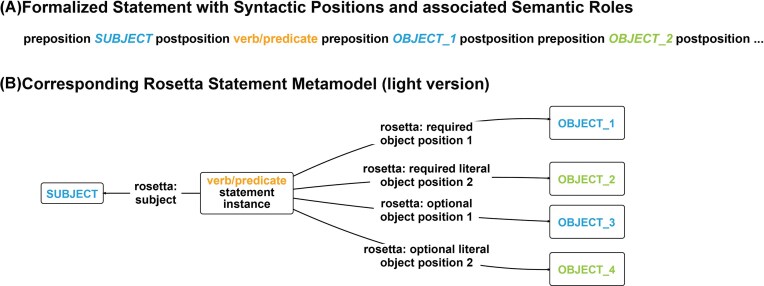
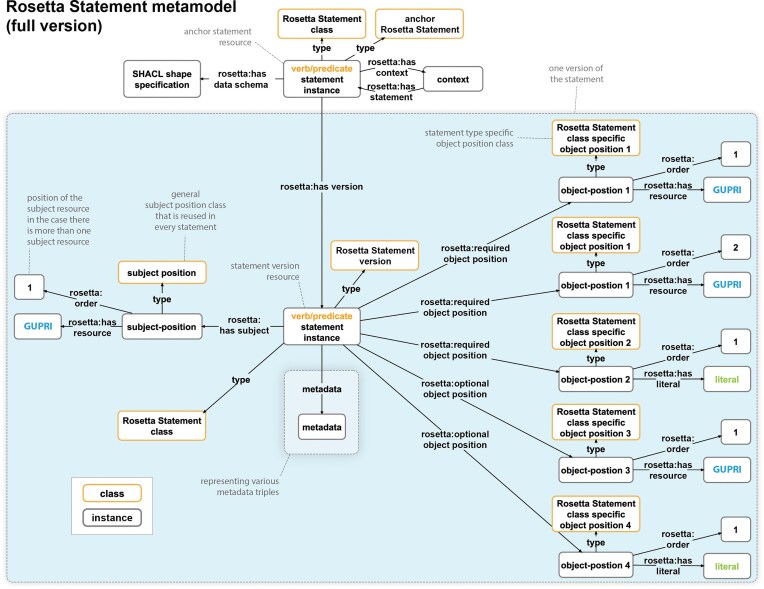
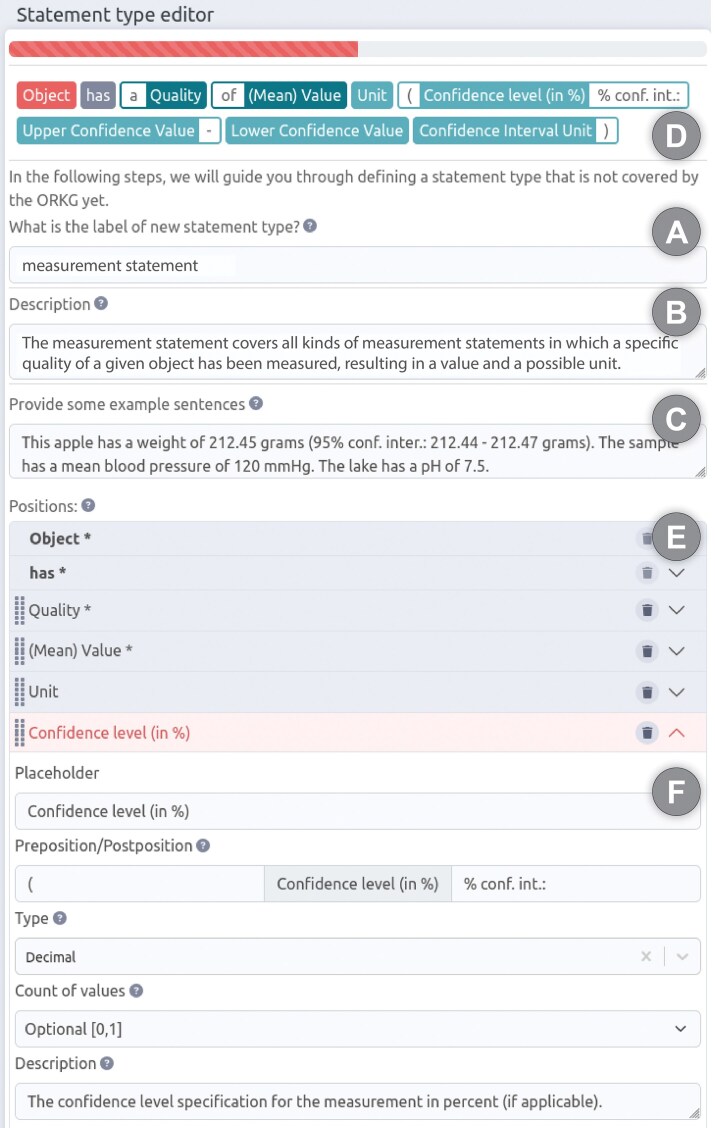
- It defines a light and a full RDF Rosetta Statement metamodel; the full version supports versioning and editing history and is implemented in ORKG, where domain experts can define new statement schemata after short training—preliminary workshops suggest a half-day guided session.
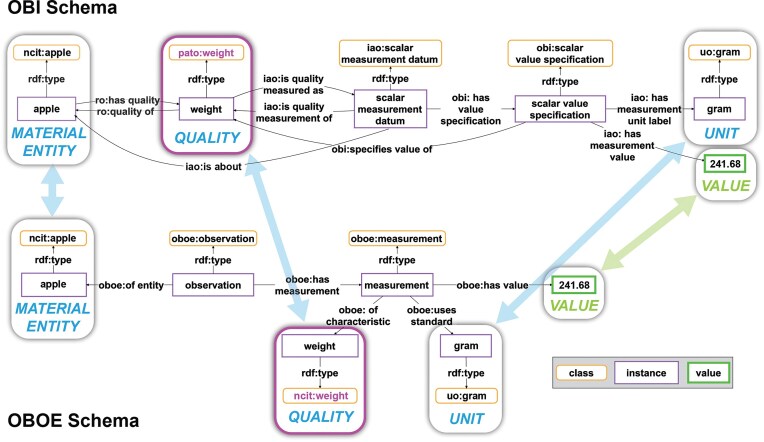
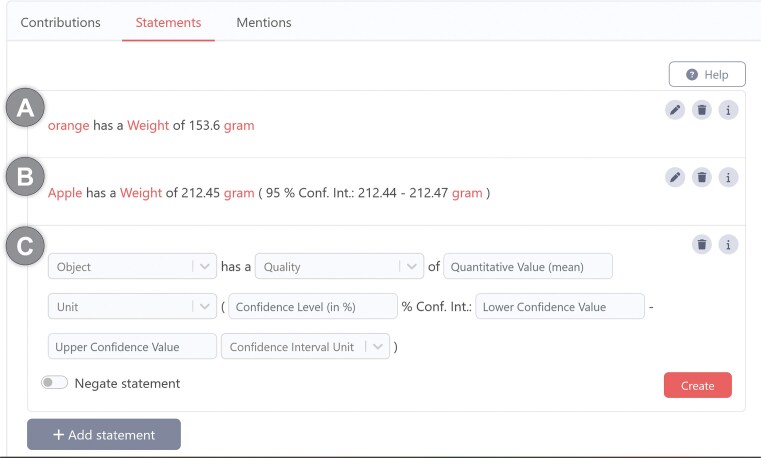
- In the ORKG example, a measurement statement with confidence interval would require 15 clicks in a semantic data browser but is displayed as a natural language statement by a single click; the Rosetta schema uses three triples instead of five or six in the compared OBO/OBOE examples.
- It proposes a three-step procedure: (1) domain experts use Rosetta Statements and Wikidata terms to create a FAIR knowledge graph with basic search; (2) replace Wikidata terms with ontology terms for semantic search; (3) transform selected statement types into reasoning-capable graphs with ontology engineers via schema cross-walks.
Methods
- Conceptual and design paper: introduces the Rosetta Statement approach, an RDF-native metamodel, light and full versions, display templates, and schema cross-walks; no controlled empirical study is reported.
- Implementation: the full version is deployed in ORKG, an open, domain-agnostic, community-driven knowledge graph; the ORKG type editor creates Rosetta Statement schemata and SHACL shapes, dynamic labels display statements, and statements can be published as nanopublications.
- Evidence and analysis: design rationale, worked examples (measurement and travel statements), comparisons to OBI, OBOE, QUDT, and relational schemata, plus qualitative feedback from ORKG users and workshops; no quantitative sample, statistical analysis, or user-study measures are reported.
Limitations
- Stated: the approach has not undergone a controlled empirical evaluation of usability, learnability, or efficiency compared with alternative knowledge graph construction approaches; claims rest on design rationale, ORKG deployment, and qualitative feedback, and systematic user studies are future work.
- Stated: the current implementation is English-centric; adapting to non-English languages may require modifications for different syntactic orders or morphologically rich structures, and multilingual templates are future work.
- Stated: the approach prioritizes cognitive interoperability over reasoning, so initial Rosetta graphs are not fully reasoning-capable; reasoning requires schema cross-walks to OWL-based schemata, which require semantic expertise and can be nontrivial. The paper also states that the proportion of scientific knowledge expressible as Rosetta Statements is not quantified and that schema proliferation or ambiguity is not eliminated.
Model-written summary. Check it against the paper before relying on it.
Integrity signals
Registry
Cites
Statistics
Figures





Verification
Claims the paper makes
0 Valid · 13 Not valid · 69 Not checked · 284 Own results and interpretations
A result the paper states — it cites no source for it, so there is none to check. The quote shows it is in the paper.
In the paper
“We implemented the full version in the Open Research Knowledge Graph (ORKG), an open, domain-agnostic, community-driven knowledge graph for documenting research findings from scholarly publications.”
§ Rosetta Statements: simplifying FAIR knowledge graph construction with a user-centred approach > Abstract
plain- Asserted: passes — The authors put it forward as true.
- Checkable: passes — It can be checked against evidence.
- Load-bearing: passes — The paper’s conclusions depend on it.
- Based: passes — The paper gives a reason why it holds.
The paper states this without a source or data behind it here, so there is nothing to check it against. The quote shows it is in the paper.
In the paper
“The ORKG allows domain experts, with short training but without formal expertise in semantics, to define RDF schemata for new types of Rosetta Statements.”
§ Rosetta Statements: simplifying FAIR knowledge graph construction with a user-centred approach > Abstract
plainstates a cause- Asserted: passes — The authors put it forward as true.
- Checkable: passes — It can be checked against evidence.
- Load-bearing: passes — The paper’s conclusions depend on it.
- Based: unclear — It is unclear why the paper says it holds.
In the paper
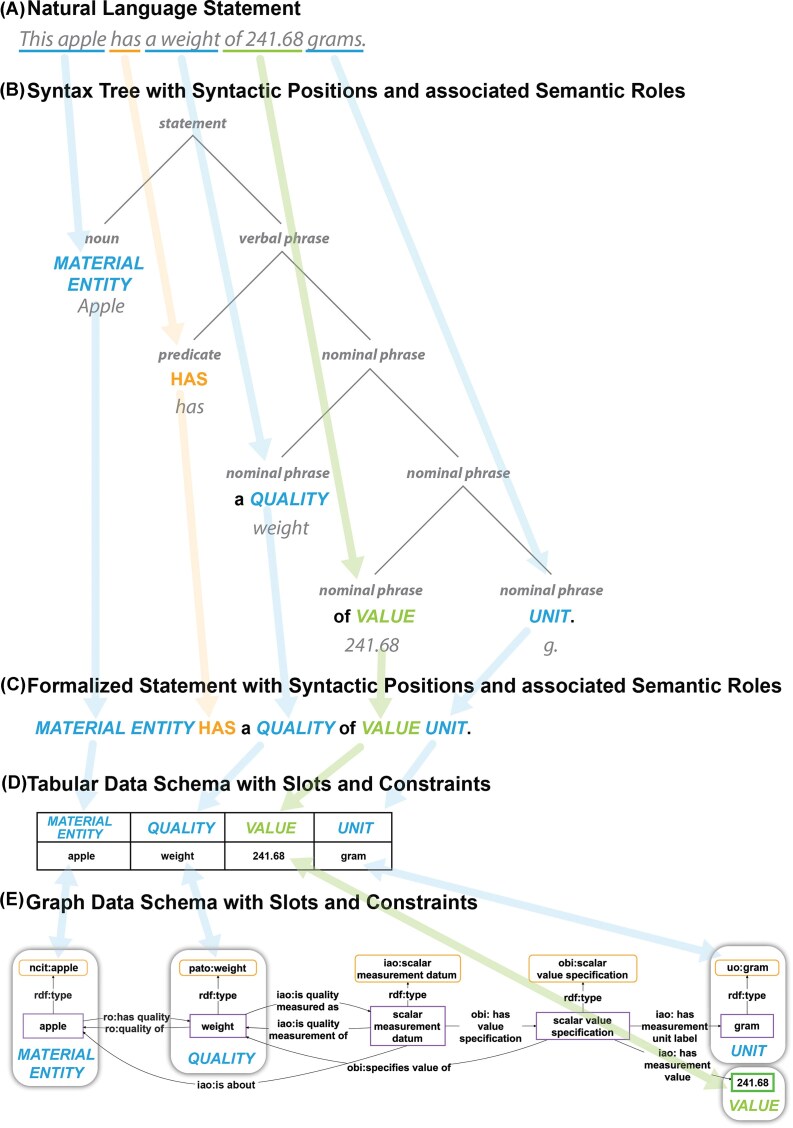
“For example, for extracting all relevant information of the apple measurement statement in Fig. 1 using a semantic data browser, a user would have to click 15 times [18].”
§ Rosetta Statements: simplifying FAIR knowledge graph construction with a user-centred approach > Problem statement > Cognitive interoperability challenge: understanding machine-actionable semantic data schemata requires knowledge and experience in semantics
What the sources say
- Not checked yetcites [18] Vogt, 2025, The CLEAR principle: organizing data and metadata into semantically meaningful types of FAIR Digital Objects to increase their human explorability and cognitive interoperability, J Biomed Semantics source
hedgedstates a causeSingle case- Asserted: passes — The authors put it forward as true.
- Checkable: passes — It can be checked against evidence.
- Load-bearing: passes — The paper’s conclusions depend on it.
- Based: passes — The paper gives a reason why it holds.
A result the paper states — it cites no source for it, so there is none to check. The quote shows it is in the paper.
In the paper
“In addition to textual display templates, it is also possible to specify graphical display templates for a mind-map-like representation of a statement using dynamic mind-map patterns (Fig. 7, bottom).”
§ Rosetta Statements: simplifying FAIR knowledge graph construction with a user-centred approach > Result > The Rosetta Statement approach to semantic parsing
hedged- Asserted: passes — The authors put it forward as true.
- Checkable: passes — It can be checked against evidence.
- Load-bearing: unclear — It is unclear whether the paper’s conclusions depend on it.
- Based: passes — The paper gives a reason why it holds.
A result the paper states — it cites no source for it, so there is none to check. The quote shows it is in the paper.
In the paper
“We implemented the Rosetta Statement approach in the ORKG”
§ Rosetta Statements: simplifying FAIR knowledge graph construction with a user-centred approach > Rosetta Statement use case: ORKG
plain- Asserted: passes — The authors put it forward as true.
- Checkable: passes — It can be checked against evidence.
- Load-bearing: passes — The paper’s conclusions depend on it.
- Based: passes — The paper gives a reason why it holds.
84 more claims
Create a free account to see all 366 claims and to verify the 97 references still open.
- It may state two separate claims as one. 129
- Probably not a substantial claim. 212
Self-check
Percentages, sums and reported differences re-computed from the paper’s own numbers.
Each contradiction between two passages listed here was confirmed by an independent check.
Rated minor: it would not touch a result — a value no result rests on, a p-value that stays on the same side of the significance level, or a conflict that is clerical, resolved elsewhere in the paper, or outside its own findings.
In the paper
§ Rosetta Statements: simplifying FAIR knowledge graph construction with a user-centred approach > Problem statement > Cognitive interoperability challenge: understanding machine-actionable semantic data schemata requires knowledge and experience in semantics
“The formal semantic representation of the statement ‘This apple has a weight of 212.45 grams, with a 95% confidence interval of 212.44 to 212.47 grams’ in a knowledge graph as displayed in Fig. 1”
§ Rosetta Statements: simplifying FAIR knowledge graph construction with a user-centred approach > Problem statement > Cognitive interoperability challenge: understanding machine-actionable semantic data schemata requires knowledge and experience in semantics
“Top: A human-readable statement about the observation that a particular apple weighs 241.68 g, with a 95% confidence interval of 241.31–242.05 g.”
Rated minor: it would not touch a result — a value no result rests on, a p-value that stays on the same side of the significance level, or a conflict that is clerical, resolved elsewhere in the paper, or outside its own findings.
In the paper
§ Rosetta Statements: simplifying FAIR knowledge graph construction with a user-centred approach > Problem statement > Dynamic knowledge graph construction challenge: knowledge graph construction and semantic interoperability
“A further consequence of the DKGC approach in domain-agnostic knowledge graphs is the practical and theoretical impossibility of supporting reasoning over the entire graph.”
§ Rosetta Statements: simplifying FAIR knowledge graph construction with a user-centred approach > Conclusion
“In the third level, parts of the graph or the graph as a whole can be transformed into reasoning-supporting semantic data schemata by specifying respective schemata and corresponding schema cross-walks (see Fig. 11).”
Citations
Cites
The FAIR Guiding Principles for scientific data management and stewardship
Wilkinson, M. D., Dumontier, M., Aalbersberg, I. J., Appleton, G., Axton, M., Baak, A., Blomberg, N., Boiten, J.-W., da Silva Santos, L. B., Bourne, P. E., et al. (2016) · Scientific Data · doi:10.1038/sdata.2016.18 · Cited by 18,423
The magical number seven, plus or minus two: Some limits on our capacity for processing information.
Miller, G. A. (1956) · Psychological Review · doi:10.1037/h0043158 · Cited by 17,812
The FAIR Guiding Principles for scientific data management and stewardship
Wilkinson, M. D., Dumontier, M., Aalbersberg, I. J., Appleton, G., Axton, M., Baak, A., Blomberg, N., Boiten, J.-W., Santos, L. B. D. S., Bourne, P. E., et al. (2016) · edoc (University of Basel) · doi:10.5451/unibas-ep53563 · Cited by 4,220
Wikidata: a free collaborative knowledgebase
Vrandečić, D., & Krötzsch, M. (2014) · Communications of the ACM · doi:10.1145/2629489 · Cited by 3,342
DBpedia – A large-scale, multilingual knowledge base extracted from Wikipedia
Lehmann, J., Isele, R., Jakob, M., Jentzsch, A., Kontokostas, D., Mendes, P. N., Hellmann, S., Morsey, M., van Kleef, P., Auer, S., et al. (2015) · Semantic Web · doi:10.3233/sw-140134 · Cited by 3,168
Grice, H. P. (1957) · The Philosophical Review · doi:10.2307/2182440 · Cited by 2,824
Baker, C. F., Fillmore, C. J., & Lowe, J. B. (1998) · Proceedings of the 36th annual meeting on Association for Computational Linguistics - · doi:10.3115/980845.980860 · Cited by 2,518
Yago: a core of semantic knowledge
Suchanek, F. M., Kasneci, G., & Weikum, G. (2007) · Proceedings of the 16th international conference on World Wide Web · doi:10.1145/1242572.1242667 · Cited by 2,512
The Proposition Bank: An Annotated Corpus of Semantic Roles
Palmer, M., Gildea, D., & Kingsbury, P. (2005) · Computational Linguistics · doi:10.1162/0891201053630264 · Cited by 2,273
Hogan, A., Blomqvist, E., Cochez, M., D’amato, C., Melo, G. D., Gutierrez, C., Kirrane, S., Gayo, J. E. L., Navigli, R., Neumaier, S., et al. (2022) · ACM Computing Surveys · doi:10.1145/3447772 · Cited by 1,904
Research works printed but not linked: 5
- Smith, 2003, Ontology, 155
- Booth, 2019, Session X: easyRDF [internet]
- Levin, 1993, English Verb Classes and Alterations: A Preliminary Investigation, 366
- Hartig, 2017, Foundations of RDF* and SPARQL*
- Mons, 2009, Nano-publication in the e-science era
Cited by
Vogt, L., & Mons, B. (2025) · arXiv (Cornell University) · doi:10.48550/arxiv.2509.26434 · Cited by 4
Self-citationVogt, L. (2026) · arXiv (Cornell University) · doi:10.48550/arxiv.2603.22136 · Cited by 2
Self-citationVogt, L., Fruehsteuckl, R., & Alamenciak, T. (2026) · arXiv (Cornell University) · doi:10.48550/arxiv.2605.01564
Self-citationOntology-Grounded RAG with SPARQL and Local Language Models for Technical Documentation
Andrade, J. R. C., Siguenza, E. A. S., Vasquez, A. S. C., Mejía, P. S. V., & Orellana, M. (2026) · Revista Tecnológica - ESPOL · doi:10.37815/rte.v38ne1.1603
Metadata
- Authors
- Vogt, L., Farfar, K. E., Karanth, P., Konrad, M., Oelen, A., Prinz, M., & Strömert, P.
- Affiliations
- Leibniz Institute for the Analysis of Biodiversity Change (DE)
- Technische Informationsbibliothek (TIB) (DE)
- Corresponding author
- Vogt, Lars
- ORCID
- Venue
- Database
- Publisher
- Oxford University Press (OUP)
- Published
- 2026
- Volume
- 2026
- ISSN
- 1758-0463 (ISSN-L)
- PMC
- PMC13227103
- OpenAlex
- W4401202450
- Semantic Scholar
- 94a3844b4b28411f93ba831f9b086b1b1f3ff0f8
- Cited by
- 4
- References
- 81
- Citations by year
- 2026: 3
- FWCI
- 3.24
- Type
- journal article
- Language
- en
- Open access
- gold
- doi.org
- Locations
- Database (publishedVersion, cc-by)
- PubMed Central (publishedVersion, cc-by)
- PubMed (publishedVersion)
- arXiv (Cornell University) (submittedVersion, cc-by)
- arXiv (Cornell University) (cc-by)
- Funders
- BMBF (13XP5126B)
- InSuKa (13XP5196F)
- Topics
- Physical Sciences › Computer Science › Artificial Intelligence › Semantic Web and Ontologies
- Physical Sciences › Computer Science › Information Systems › Research Data Management Practices
- Physical Sciences › Computer Science › Information Systems › Library Science and Information Systems
- Keywords
- knowledge graph construction, FAIR data, Open Research Knowledge Graph, semantic search, Wikidata, ontology engineering, large language models
- MeSH terms
- Biocuration, Semantics, User-Computer Interface, Biological Ontologies
About these checks
Registry, retraction, Cites and statistics results are computed, not judged, with one exception: a printed reference that no index lists is read once by a model before it counts as a citation error. Claims are extracted by a model and kept only when their quote appears verbatim in the text; each cited source is then checked, with a model’s help, for whether it says what the claim relies on. Those verdicts can be wrong — read the claim’s quote and the cited source before relying on one.
A language model drew the claims from the paper on 2026-11-18, under version 3 of the claim definition (model deepseek-v4.1-flash, prompt extract-v3).
A second model labelled each claim on 2026-11-18 (model jev-1.13-20260917, definition revision gold-guideline-v0.2).
Statistics and arithmetic are recomputed, not judged.
Confidence bands are shown only for fields calibrated on our annotated test set. None is calibrated yet, so no band is shown.
What counts as a claim ›How we measure confidence ›How we check this ›
Are you an author, or do you see a problem with this page? Request a review
How to cite
Cite CoChat for the checks on this page, and the paper for its own findings.
- This page
- CoChat. (2026). Citation check: Rosetta Statements: simplifying FAIR knowledge graph construction with a user-centred approach. https://app.cochat.ai/papers/10.1093/database/baag030
- The paper
- Vogt, L., Farfar, K. E., Karanth, P., Konrad, M., Oelen, A., Prinz, M., & Strömert, P. (2026). Rosetta Statements: simplifying FAIR knowledge graph construction with a user-centred approach. Database. https://doi.org/10.1093/database/baag030
Data sources
Bibliographic data: Semantic Scholar, OpenAlex, Crossref.
Contains information from the Semantic Scholar Academic Graph Datasets, made available under the ODC Attribution License (ODC-BY 1.0).
Semantic Scholar’s data is described in: Kinney, R., et al. (2023). The Semantic Scholar Open Data Platform. arXiv:2301.10140.
