

Monetary financing produces neither high inflation nor miraculous fiscal multipliers
Open accessThe DOI matches its Crossref record; 53 of the 53 references it cites were found in a registry or an index; 2 of the 48 sources its claims cite were checked for support.
Abstract
I investigate the macroeconomic impact of money-financed fiscal stimuli when they are financed by interest-paying central bank reserves. I do so in New Keynesian models where government bonds and reserves are imperfect substitutes. Despite reducing funding costs for the consolidated government, I analytically show for several models that there is zero impact from money-financed fiscal stimuli on inflation and the real economy (relative to debt-financed stimuli). Afterwards, I relax the conditions behind this ‘irrelevance result’, and show that money-financed fiscal stimuli barely increase inflation and output.
Overview
CoChat Summary
TL;DR
In New Keynesian models where money-financed fiscal stimuli are financed by interest-paying central bank reserves, the paper analytically proves an extended Ricardian equivalence: relative to debt-financed stimuli, money financing has zero effect on inflation and the real allocation. When the conditions for this irrelevance are relaxed, money-financed stimuli barely raise inflation and output, in sharp contrast to Galí (2020)-style financing via non-interest-paying money.
Key findings
- In the baseline model with interest-paying reserves and imperfect substitutability between bonds and reserves, money-financed fiscal stimuli have zero impact on inflation and the real economy relative to debt-financed stimuli; the central bank retains policy-rate control, and lower government funding costs are offset by lower household returns, so there are no wealth effects.
- In a Galí (2020) variant where reserves are fixed and the central bank cannot simultaneously control the policy rate and the monetary base, the maximum quarterly inflation difference is 1.4% for a tax cut and 1.3% for a spending stimulus; the discounted cumulative fiscal multiplier difference is 1.0 for a tax cut and 0.9 for a spending stimulus.
- When extended Ricardian equivalence is broken in more realistic models, the maximum quarterly inflation difference is 0.08% for the convenience-yield version and at most 0.01% for the other versions; the multiplier difference is at most 0.07 for the distortionary labour tax version. In the TANK model, debt-financed stimuli are slightly more effective than money-financed stimuli.
- The paper concludes that whether monetary financing produces high inflation depends on whether it is financed through non-interest-paying money or interest-paying reserves; when the central bank controls the policy rate, monetary financing has only a small effect on the real economy.
Methods
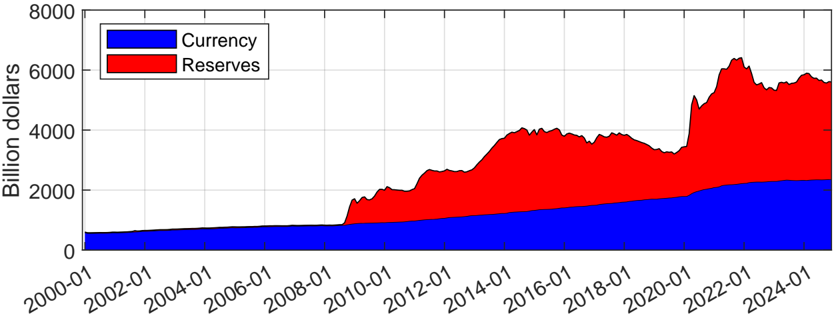
- Closed-economy New Keynesian DSGE model based on Galí (2020), extended with interest-paying reserves held by households and convex transaction costs on bond holdings that create imperfect substitutability between government bonds and reserves; the central bank controls the monetary base and sets the nominal interest rate on reserves via an active Taylor rule bounded by the zero lower bound, and a money-financed stimulus expands the monetary base by the amount of the stimulus.
- Analytical proofs of extended Ricardian equivalence (Propositions 1–2 and Corollary 1); quantitative analysis uses first-order perturbation around the non-stochastic steady state in Dynare, with quarterly calibration largely following Galí (2020), including government spending/output of 0.2, debt/annual output of 80%, monetary base equal to 3/4 of quarterly steady-state output, non-interest-paying money equal to 1/3 of quarterly steady-state output, reserves equal to 1.25 times non-interest-paying money, and bond duration of 20 quarters.
- Model variants break extended Ricardian equivalence: distortionary labour tax, TANK household heterogeneity, convenience yield on reserves, deposits-in-the-utility function, and financial intermediaries financing the capital stock; fiscal stimuli are either a tax cut or a spending increase of 1% of steady-state output on impact.
Limitations
- The paper states that extended Ricardian equivalence requires conditions unlikely to hold in reality: lump sum taxes responding to government debt, active monetary policy with passive fiscal policy, a representative household, no convenience yield on reserves, bond returns irrelevant for the real allocation, and rational expectations; it relaxes these conditions in quantitative variants.
- The paper states that empirical evidence on the impact of money-financed fiscal stimuli is scarce; because there is little evidence on monetary financing, it uses evidence on quantitative easing from Weale and Wieladek (2016) to pin down the transaction-cost parameter κ_b and performs robustness checks.
- The paper states that it abstracts from central bank insolvency and fiscal-support issues: it considers the consolidated government budget constraint and assumes the central bank can always follow the Taylor rule. The text also makes evident that the baseline is a closed economy with a representative household, with open-economy, HANK, and other frictions only partially explored through model variants.
Model-written summary. Check it against the paper before relying on it.
Integrity signals
Registry
Cites
Statistics
Figures



Verification
Claims the paper makes
1 Valid · 5 Not valid · 36 Not checked · 99 Own results and interpretations
The sources with a verdict support this claim; the rest weren’t checked yet, have no full text we could read, or their verdicts aren’t rated yet.
In the paper
“It is well known from the literature that the government's funding mix between bonds and reserves is irrelevant when they are perfect susbtitutes.”
§ Monetary financing produces neither high inflation nor miraculous fiscal multipliers Monetary financing > O R I G
What the sources say
- Supportedcites Reis (2017) matched to “QE in the Future: The Central Bank’s Balance Sheet in a Fiscal Crisis” (2017) source
Section 4.3 (p. 'QE during a fiscal crisis') states the benchmark directly: building on Wallace (1981), Chamley and Polemarchakis (1984) and Eggertsson and Woodford (2003), short-term bonds and reserves are 'just two forms of government liabilities', so that with no default 'in all the equilibrium conditions only the sum v_t + q_t b_t appears... Therefore, exchanging reserves for short-term bonds is neutral', an equivalence that breaks only when default is possible. Section 4.1 repeats it for normal times ('the two types of government liabilities are perfect substitutes, so that QE has no effect...'; 'Short-term bonds and reserves are perfectly equivalent'), which matches the citing sentence's 'well known from the literature' framing and its qualifier that irrelevance holds when the two are perfect substitutes. (LLM, conf=0.90)
- Not checked — no full text of the sourcecites Benigno and Nisticò (2020) matched to “Non-Neutrality of Open-Market Operations” (2020) source
- Supportedcites Reis and Tenreyro (2022) matched to “Helicopter Money: What Is It and What Does It Do?” (2022) source
Section 4.1 (A two-period formalization) states that, once bonds pay in full (δ1 = 1) and reserves earn the same return as bonds (i_v1 = i_1) — i.e. they are perfect substitutes — 'v1 does not appear anywhere in equation (25)', so the split of public liabilities between reserves and bonds drops out of the integrated government budget constraint and consumer choices do not change. Section 3.4 confirms the converse logic: the only ways the mix could matter are a lower interest rate on money than on bonds or seignorage on banknotes, and its note on quantitative easing adds that issuing reserves to buy bonds 'keeps unchanged the overall public liabilities that the private sector holds if the demand for reserves is satiated'. The paper does attach further conditions (satiated reserve demand, monetary policy able to hit the inflation target, no redistribution, unlimited fiscal backing — Sections 3.4 and 4), but the claim's own qualifier 'when they are perfect substitutes' matches the result the review reports. (LLM, conf=0.85)
boosted- Asserted: passes — The authors put it forward as true.
- Checkable: passes — It can be checked against evidence.
- Load-bearing: passes — The paper’s conclusions depend on it.
- Based: passes — The paper gives a reason why it holds.
- Supported
In the paper
“I find that the maximum quarterly difference in inflation between money-and debt-financed fiscal stimuli is at least 1.3%, while the difference in the discounted cumulative fiscal multiplier between money-and debt-financed stimuli is at least 0.9.”
§ Monetary financing produces neither high inflation nor miraculous fiscal multipliers Monetary financing > 1 Introduction
What the sources say
- Not matchedcites Galí (2020)
An author–year citation the paper’s reference list doesn’t settle. We don’t search these by name.
plain- Asserted: passes — The authors put it forward as true.
- Checkable: passes — It can be checked against evidence.
- Load-bearing: passes — The paper’s conclusions depend on it.
- Based: passes — The paper gives a reason why it holds.
- Not matched
A result the paper states — it cites no source for it, so there is none to check. The quote shows it is in the paper.
In the paper
“Corollary 1.In the economy of Section 2, an expansion of the monetary base m C t + m R t will entirely consist of an expansion in central bank reserves m R t with no change in non-interest-paying money m C t .”
§ Monetary financing produces neither high inflation nor miraculous fiscal multipliers Monetary financing > O R I
plainstates a cause- Asserted: passes — The authors put it forward as true.
- Checkable: passes — It can be checked against evidence.
- Load-bearing: passes — The paper’s conclusions depend on it.
- Based: passes — The paper gives a reason why it holds.
In the paper
“Unlike Wallace (1981), however, extended Ricardian equivalence also applies when the expected returns on bonds and reserves differ due to imperfect substitutability.”
§ Monetary financing produces neither high inflation nor miraculous fiscal multipliers Monetary financing > Literature review
What the sources say
- Not matchedcites Wallace (1981)
An author–year citation the paper’s reference list doesn’t settle. We don’t search these by name.
plain- Asserted: passes — The authors put it forward as true.
- Checkable: passes — It can be checked against evidence.
- Load-bearing: passes — The paper’s conclusions depend on it.
- Based: unclear — It is unclear why the paper says it holds.
- Rests on an assumption not shown here.
- Not matched
A result the paper states — it cites no source for it, so there is none to check. The quote shows it is in the paper.
In the paper
“A second extension is that bonds and reserves are imperfect substitutes as a result of convex transaction costs on housholds' holdings of government bonds.Therefore, money-financed fiscal stimuli reduce funding costs for the consolidated government (with respect to debt-financed stimuli).”
- Also stated in: § 1 Introduction · plain
“A money-financed fiscal stimulus, however, decreases funding costs for the consolidated government (with respect to a debt-financed stimulus).”
§ Monetary financing produces neither high inflation nor miraculous fiscal multipliers Monetary financing > 1 Introduction
plainstates a cause- Asserted: passes — The authors put it forward as true.
- Checkable: passes — It can be checked against evidence.
- Load-bearing: passes — The paper’s conclusions depend on it.
- Based: passes — The paper gives a reason why it holds.
- Rests on an assumption not shown here.
- Also stated in: § 1 Introduction · plain
83 more claims
Create a free account to see all 141 claims and to verify the 20 references still open.
- It may state two separate claims as one. 32
- Probably not a substantial claim. 28
Citations
Cites
Staggered prices in a utility-maximizing framework
Calvo, G. A. (1983) · Journal of Monetary Economics · doi:10.1016/0304-3932(83)90060-0 · Cited by 7,901
Are Government Bonds Net Wealth?
Barro, R. J. (1974) · Journal of Political Economy · doi:10.1086/260266 · Cited by 5,994
A model of unconventional monetary policy
Gertler, M., & Karadi, P. (2011) · Journal of Monetary Economics · doi:10.1016/j.jmoneco.2010.10.004 · Cited by 2,393
Equilibria under ‘active’ and ‘passive’ monetary and fiscal policies
Leeper, E. M. (1991) · Journal of Monetary Economics · doi:10.1016/0304-3932(91)90007-b · Cited by 2,058
Financial Intermediation and Credit Policy in Business Cycle Analysis
Gertler, M., & Kiyotaki, N. (2010) · Handbook of Monetary Economics · doi:10.1016/b978-0-444-53238-1.00011-9 · Cited by 1,966
Understanding the Effects of Government Spending on Consumption
Galí, J., López-Salido, J. D., & Vallés, J. (2007) · Journal of the European Economic Association · doi:10.1162/jeea.2007.5.1.227 · Cited by 1,922
When Is the Government Spending Multiplier Large?
Christiano, L., Eichenbaum, M., & Rebelo, S. (2011) · Journal of Political Economy · doi:10.1086/659312 · Cited by 1,837
The Behavior of U. S. Public Debt and Deficits
Bohn, H. (1998) · The Quarterly Journal of Economics · doi:10.1162/003355398555793 · Cited by 1,568
Some Unpleasant Monetarist Arithmetic
Sargent, T. J. (1981) · Quarterly Review · doi:10.21034/qr.531 · Cited by 1,511
What are the effects of fiscal policy shocks?
Mountford, A., & Uhlig, H. (2009) · Journal of Applied Econometrics · doi:10.1002/jae.1079 · Cited by 1,349
Research works printed but not linked: 3
- Buiter, W.H. (2014). 'The simple analytics of helicopter money: Why it works -always', Economics -The Open-Access, Open-Assessment E-Journal (2007-2020), vol. 8, pp. 1-51, doi:10.5018/economics-ejourna. · doi:10.5018/economics-ejourna
- Vissing-Jorgensen, A. (2023a). 'Balance sheet policy above the effective lower bound', Conference Proceedings, ECB Forum on Central Banking (Sintra).
- Wallace, N. (1981). 'A Modigliani-Miller Theorem for Open-Market Operations', American Economic Review, vol. 71(3), pp. 267-274.
Cited by
Long-Term Government Debt, Policy Rules, and Money-Financed Fiscal StimulusPreprint
Cao, C., & Ou, S. (2026) · SSRN Electronic Journal · doi:10.2139/ssrn.7471484
Metadata
- Authors
- van der Kwaak, C.
- Affiliations
- University of Groningen (NL)
- Corresponding author
- van der Kwaak, Christiaan
- Venue
- The Economic Journal
- Publisher
- Oxford University Press (OUP)
- Published
- 2026-05-30
- ISSN
- 0013-0133 (ISSN-L)
- 1468-0297
- OpenAlex
- W4415673866
- Cited by
- 1
- References
- 51
- Citations by year
- 2026: 1
- FWCI
- 4.00
- Type
- journal article
- Language
- en
- Open access
- hybrid
- doi.org
- Licence
- Locations
- The Economic Journal (publishedVersion, cc-by)
- SSRN Electronic Journal (submittedVersion)
- Funders
- London School of Economics and Political Science
- Rijksuniversiteit Groningen
- Nederlandse Organisatie voor Wetenschappelijk Onderzoek
- Topics
- Social Sciences › Economics, Econometrics and Finance › General Economics, Econometrics and Finance › Monetary Policy and Economic Impact
- Social Sciences › Economics, Econometrics and Finance › Economics and Econometrics › Economic theories and models
- Social Sciences › Economics, Econometrics and Finance › Economics and Econometrics › Fiscal Policies and Political Economy
- Keywords
- central bank reserves, inflation, fiscal multipliers, government bonds, debt financing, New Keynesian model, monetary policy, output effects
About these checks
Registry, retraction, Cites and statistics results are computed, not judged, with one exception: a printed reference that no index lists is read once by a model before it counts as a citation error. Claims are extracted by a model and kept only when their quote appears verbatim in the text; each cited source is then checked, with a model’s help, for whether it says what the claim relies on. Those verdicts can be wrong — read the claim’s quote and the cited source before relying on one.
A language model drew the claims from the paper on 2026-11-20, under version 3 of the claim definition (model deepseek-v4.1-flash, prompt extract-v3).
A second model labelled each claim on 2026-11-20 (model jev-1.13-20260917, definition revision gold-guideline-v0.2).
Cited sources are checked with a language model’s help (qwen3.8-omni-flash).
Statistics and arithmetic are recomputed, not judged.
Confidence bands are shown only for fields calibrated on our annotated test set. None is calibrated yet, so no band is shown.
What counts as a claim ›How we measure confidence ›How we check this ›
Are you an author, or do you see a problem with this page? Request a review
How to cite
Cite CoChat for the checks on this page, and the paper for its own findings.
- This page
- CoChat. (2026). Citation check: Monetary financing produces neither high inflation nor miraculous fiscal multipliers. https://app.cochat.ai/papers/10.1093/ej/ueag073
- The paper
- van der Kwaak, C. (2026). Monetary financing produces neither high inflation nor miraculous fiscal multipliers. The Economic Journal. https://doi.org/10.1093/ej/ueag073
Data sources
Bibliographic data: Semantic Scholar, OpenAlex, Crossref.
Contains information from the Semantic Scholar Academic Graph Datasets, made available under the ODC Attribution License (ODC-BY 1.0).
Semantic Scholar’s data is described in: Kinney, R., et al. (2023). The Semantic Scholar Open Data Platform. arXiv:2301.10140.
