

The DOI matches its Crossref record; 23 of the 23 references it cites were found in a registry or an index.
Cerebral mitochondrial dysfunction associated with deep hypothermic circulatory arrest in neonatal swine
Open accessAbstract
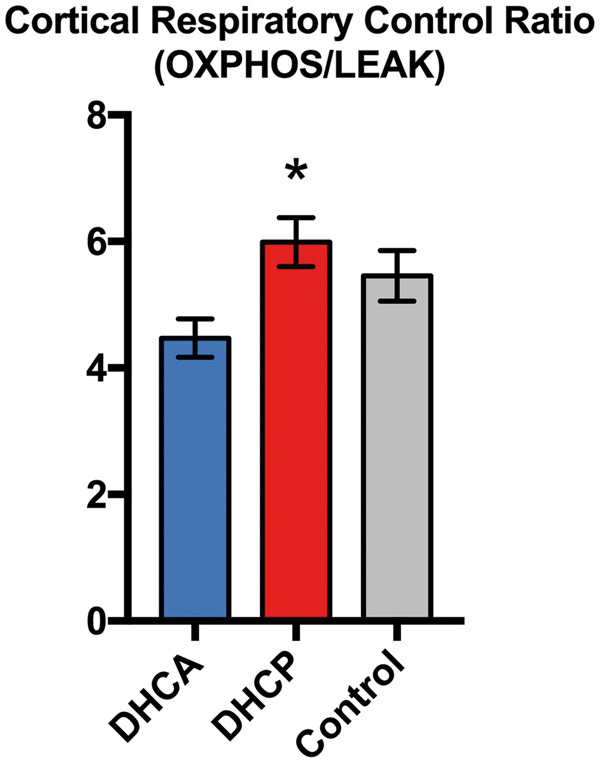
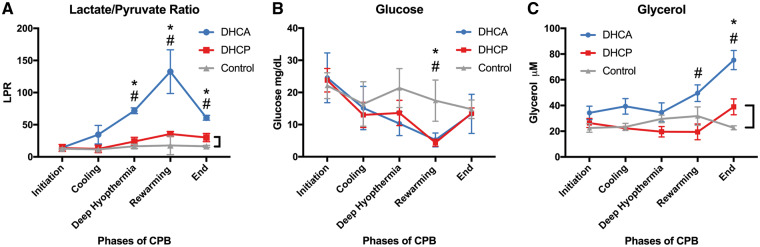
OBJECTIVES: Controversy remains regarding the use of deep hypothermic circulatory arrest (DHCA) in neonatal cardiac surgery. Alterations in cerebral mitochondrial bioenergetics are thought to contribute to ischaemia–reperfusion injury in DHCA. The purpose of this study was to compare cerebral mitochondrial bioenergetics for DHCA with deep hypothermic continuous perfusion using a neonatal swine model. METHODS: Twenty-four piglets (mean weight 3.8 kg) were placed on cardiopulmonary bypass (CPB): 10 underwent 40-min DHCA, following cooling to 18°C, 10 underwent 40 min DHCA and 10 remained at deep hypothermia for 40 min; animals were subsequently rewarmed to normothermia. 4 remained on normothermic CPB throughout. Fresh brain tissue was harvested while on CPB and assessed for mitochondrial respiration and reactive oxygen species generation. Cerebral microdialysis samples were collected throughout the analysis. RESULTS: DHCA animals had significantly decreased mitochondrial complex I respiration, maximal oxidative phosphorylation, respiratory control ratio and significantly increased mitochondrial reactive oxygen species (P < 0.05 for all). DHCA animals also had significantly increased cerebral microdialysis indicators of cerebral ischaemia (lactate/pyruvate ratio) and neuronal death (glycerol) during and after rewarming. CONCLUSIONS: DHCA is associated with disruption of mitochondrial bioenergetics compared with deep hypothermic continuous perfusion. Preserving mitochondrial health may mitigate brain injury in cardiac surgical patients. Further studies are needed to better understand the mechanisms of neurological injury in neonatal cardiac surgery and correlate mitochondrial dysfunction with neurological outcomes.
Overview
The claims and statistics of this paper haven’t been checked yet.
Free: it reads the open-access text and checks the first 5 claims that cite a source we can check. Create a free account to check every claim.
Integrity signals
Registry
Cites
Statistics
Figures


Verification
Claims the paper makes
The claims and statistics of this paper haven’t been checked yet.
Free: it reads the open-access text and checks the first 5 claims that cite a source we can check. Create a free account to check every claim.
Self-check
Percentages, sums and reported differences re-computed from the paper’s own numbers.
The self-check needs the paper’s full text.
Citations
Cites
Cyclosporine before PCI in Patients with Acute Myocardial Infarction
Cung, T.-T., Morel, O., Cayla, G., Rioufol, G., Garcia-Dorado, D., Angoulvant, D., Bonnefoy-Cudraz, E., Guérin, P., Elbaz, M., Delarche, N., et al. (2015) · New England Journal of Medicine · doi:10.1056/nejmoa1505489 · Cited by 713 · cited 1×
“Citrate synthase (CS) was measured as a marker of mitochondrial content and used in addition to tissue weight for normalization of brain tissue as previously described [15].”
MethodNeurodevelopmental Outcomes After Cardiac Surgery in Infancy
Gaynor, J. W., Stopp, C., Wypij, D., Andropoulos, D. B., Atallah, J., Atz, A. M., Beca, J., Donofrio, M. T., Duncan, K., Ghanayem, N. S., et al. (2015) · Pediatrics · doi:10.1542/peds.2014-3825 · Cited by 518
Self-citationAlgra, S. O., Jansen, N. J. G., van der Tweel, I., Schouten, A. N. J., Groenendaal, F., Toet, M., van Oeveren, W., van Haastert, I. C., Schoof, P. H., de Vries, L. S., et al. (2014) · Circulation · doi:10.1161/circulationaha.113.003312 · Cited by 163
Gaynor, J. W., Stopp, C., Wypij, D., Andropoulos, D. B., Atallah, J., Atz, A. M., Beca, J., Donofrio, M. T., Duncan, K., Ghanayem, N. S., et al. (2016) · The Annals of Thoracic Surgery · doi:10.1016/j.athoracsur.2016.05.081 · Cited by 152
Self-citationCell-permeable succinate prodrugs bypass mitochondrial complex I deficiency
Ehinger, J. K., Piel, S., Ford, R., Karlsson, M., Sjövall, F., Frostner, E. Å., Morota, S., Taylor, R. W., Turnbull, D. M., Cornell, C. L., et al. (2016) · Nature Communications · doi:10.1038/ncomms12317 · Cited by 144 · cited 1×
“human cells with inhibited CI function [17] and we plan further”
BackgroundSelf-citationKilbaugh, T. J., Bhandare, S., Lorom, D. H., Saraswati, M., Robertson, C., & Margulies, S. S. (2011) · Journal of Neurotrauma · doi:10.1089/neu.2010.1635 · Cited by 97 · cited 1×
“In swine models of cardiac arrest and traumatic brain injury, alterations in the mitochondrial function correlated with neurological injury [10].”
BackgroundSelf-citationDuebener, L. F., Hagino, I., Sakamoto, T., Mime, L. B., Stamm, C., Zurakowski, D., Schäfers, H., & Jonas, R. A. (2002) · Circulation · doi:10.1161/01.cir.0000032916.33237.a9 · Cited by 95 · cited 1×
“We chose pH stat during hypothermia and while cooling to optimize cerebral blood flow during these time periods according to both our institutional protocol and its demonstrated advantages [22, 23].”
MethodDose-dependent effect of isoflurane on regional cerebral blood flow in anesthetized macaque monkeys
Li, C.-X., Patel, S., Auerbach, E. J., & Zhang, X. (2013) · Neuroscience Letters · doi:10.1016/j.neulet.2013.02.007 · Cited by 86 · cited 1×
“5–1% to simulate human anaesthetic protocols and minimize confounding toxicity and cerebral blood flow changes associated with higher doses of isoflurane [11, 12].”
BackgroundHan, F., Da, T., Galdo, N. A. R., & Becker, L. B. (2008) · Critical Care Medicine · doi:10.1097/ccm.0b013e31818a8a51 · Cited by 77 · cited 1×
“Cerebral mitochondrial dysfunction has been shown to be a critical component driving secondary brain injury after ischaemia–reperfusion (IR) [8, 9].”
BackgroundTargeting mitochondria for resuscitation from cardiac arrest
Ayoub, I. M., Radhakrishnan, J., & Gazmuri, R. J. (2008) · Critical Care Medicine · doi:10.1097/ccm.0b013e31818a89f4 · Cited by 76
Cited by
Kant, S., Banerjee, D., Sabe, S. A., Sellke, F. W., & Feng, J. (2023) · Frontiers in Medicine · doi:10.3389/fmed.2023.1110532 · Cited by 67
Ko, T. S., Mavroudis, C. D., Baker, W. B., Morano, V. C., Mensah-Brown, K. G., Boorady, T. W., Schmidt, A. L., Lynch, J. M., Busch, D. R., Gentile, J. I., et al. (2018) · Journal of Cerebral Blood Flow & Metabolism · doi:10.1177/0271678x18809828 · Cited by 45
“1.(40) Continuous non-invasive measurements comprised NPT ( C), for guidance of hypothermic therapy, and frequency-domain diffuse optical spectroscopy (FD-DOS) and DCS.”
MethodSelf-citationContrast-enhanced ultrasound of the pediatric brain
Hwang, M., Barnewolt, C. E., Jüngert, J., Prada, F. U., Sridharan, A. N., & Didier, R. A. (2021) · Pediatric Radiology · doi:10.1007/s00247-021-04974-4 · Cited by 36
Davidson, J. A., Khailova, L. S., Treece, A. L., Robison, J., Soranno, D. E., Jaggers, J. J., Ing, R. J., Lawson, S., & Lujan, S. M. O. (2019) · Scientific Reports · doi:10.1038/s41598-019-50481-w · Cited by 28
Kajimoto, M., Nuri, M., Sleasman, J. R., Charette, K. A., Nelson, B. R., & Portman, M. A. (2020) · Journal of Thoracic and Cardiovascular Surgery · doi:10.1016/j.jtcvs.2019.12.075 · Cited by 26
Metadata
- Authors
- Mavroudis, C. D., Karlsson, M., Ko, T., Hefti, M., Gentile, J. I., Morgan, R. W., Plyler, R., Mensah-Brown, K. G., Boorady, T. W., Melchior, R. W., Rosenthal, T. M., Shade, B. C., Schiavo, K. L., Nicolson, S. C., Spray, T. L., Sutton, R. M., Berg, R. A., Licht, D. J., Gaynor, J. W., & Kilbaugh, T. J.
- Affiliations
- Children's Hospital of Philadelphia (US)
- University of Iowa (US)
- Corresponding author
- Mavroudis, Constantine D
- ORCID
- Venue
- European Journal of Cardio-Thoracic Surgery
- Publisher
- Oxford University Press (OUP)
- Published
- 2018-01-15
- Volume
- 54
- Issue
- 1
- Pages
- 162-168
- ISSN
- 1010-7940 (ISSN-L)
- 1873-734X
- PMC
- PMC7448940
- OpenAlex
- W2782798890
- Cited by
- 37
- References
- 23
- Citations by year
- 2026: 4 · 2025: 1 · 2024: 4 · 2023: 4 · 2022: 3 · 2021: 5 · 2020: 10 · 2019: 3 · 2018: 3
- FWCI
- 4.48
- Type
- journal article
- Language
- en
- Open access
- hybrid
- doi.org
- Licence
- Locations
- European Journal of Cardio-Thoracic Surgery (publishedVersion, cc-by-nc)
- PubMed Central (publishedVersion, cc-by-nc)
- PubMed (publishedVersion)
- Funders
- NIH
- Topics
- Health Sciences › Medicine › Surgery › Cardiac and Coronary Surgery Techniques
- Health Sciences › Medicine › Critical Care and Intensive Care Medicine › Thermal Regulation in Medicine
- Life Sciences › Biochemistry, Genetics and Molecular Biology › Molecular Biology › Mitochondrial Function and Pathology
- Keywords
- deep hypothermic circulatory arrest, mitochondrial dysfunction, neonatal cardiac surgery, ischemia-reperfusion injury, oxidative phosphorylation, reactive oxygen species, cerebral microdialysis, lactate/pyruvate ratio, glycerol, neuronal cell death, brain injury, cardiopulmonary bypass
- MeSH terms
- Animals, Animals, Newborn, Cardiopulmonary Bypass, Cerebral Cortex, Energy Metabolism, Female, Hemodynamics, Mitochondria, Reactive Oxygen Species, Microdialysis, Cell Respiration, Sus scrofa, Circulatory Arrest, Deep Hypothermia Induced
About these checks
Registry, retraction, Cites and statistics results are computed, not judged, with one exception: a printed reference that no index lists is read once by a model before it counts as a citation error. Claims are extracted by a model and kept only when their quote appears verbatim in the text; each cited source is then checked, with a model’s help, for whether it says what the claim relies on. Those verdicts can be wrong — read the claim’s quote and the cited source before relying on one.
Statistics and arithmetic are recomputed, not judged.
Confidence bands are shown only for fields calibrated on our annotated test set. None is calibrated yet, so no band is shown.
What counts as a claim ›How we measure confidence ›How we check this ›
Are you an author, or do you see a problem with this page? Request a review
How to cite
Cite CoChat for the checks on this page, and the paper for its own findings.
- This page
- CoChat. (2026). Citation check: Cerebral mitochondrial dysfunction associated with deep hypothermic circulatory arrest in neonatal swine. https://app.cochat.ai/papers/10.1093/ejcts/ezx467
- The paper
- Mavroudis, C. D., Karlsson, M., Ko, T., Hefti, M., Gentile, J. I., Morgan, R. W., Plyler, R., Mensah-Brown, K. G., Boorady, T. W., Melchior, R. W., Rosenthal, T. M., Shade, B. C., Schiavo, K. L., Nicolson, S. C., Spray, T. L., Sutton, R. M., Berg, R. A., Licht, D. J., Gaynor, J. W., & Kilbaugh, T. J. (2018). Cerebral mitochondrial dysfunction associated with deep hypothermic circulatory arrest in neonatal swine. European Journal of Cardio-Thoracic Surgery. https://doi.org/10.1093/ejcts/ezx467
Data sources
Bibliographic data: Semantic Scholar, OpenAlex, Crossref.
Contains information from the Semantic Scholar Academic Graph Datasets, made available under the ODC Attribution License (ODC-BY 1.0).
Semantic Scholar’s data is described in: Kinney, R., et al. (2023). The Semantic Scholar Open Data Platform. arXiv:2301.10140.
