

No effect of PCSK9 inhibitor alirocumab on the incidence of diabetes in a pooled analysis from 10 ODYSSEY Phase 3 studies
Open accessThe DOI matches its Crossref record; 34 of the 34 references it cites were found in a registry or an index.
Abstract
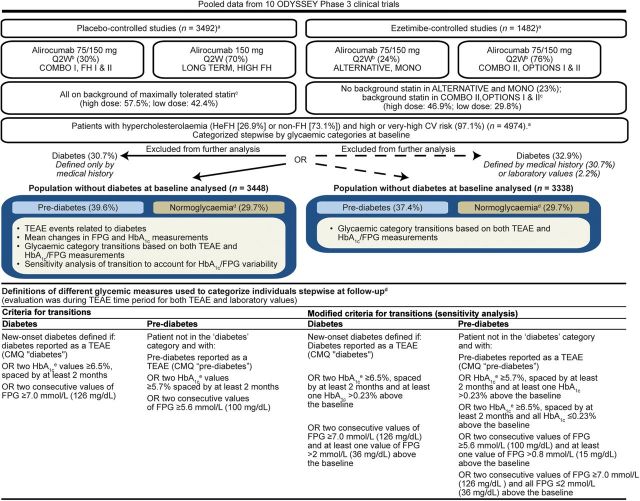
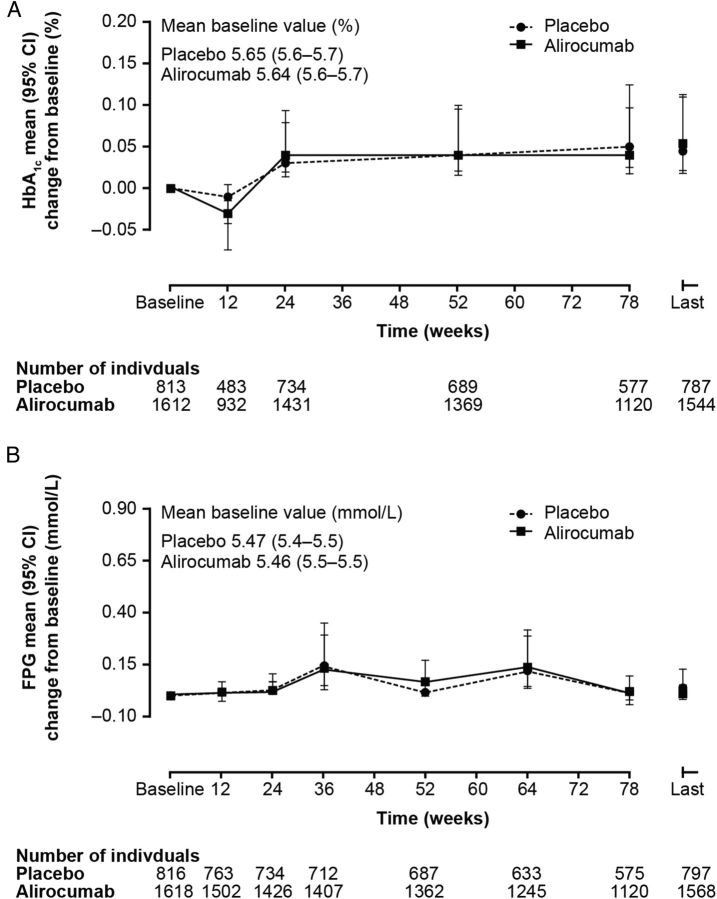
Statins have modest adverse effects on glycaemic control. Alirocumab, a proprotein convertase subtilisin/kexin type 9 inhibitor, lowers low-density lipoprotein cholesterol. This study assessed the effects of alirocumab on new-onset diabetes and pre-diabetes incidence in individuals without diabetes at baseline. Pooled analysis of 10 ODYSSEY Phase 3 trials (n = 4974) of 24–104 weeks duration. Six trials (n = 4211) were ≥52 weeks in length. Most patients received background maximally tolerated statin. Alirocumab effect on the rate of diabetes-related treatment-emergent adverse events (TEAEs), and/or fasting plasma glucose (FPG) and glycated haemoglobin A1C (HbA1C) was measured at baseline and every 12–24 weeks. Transition to diabetes analysis combined TEAE and FPG/HbA1C laboratory data. At baseline, 30.7% of individuals had diabetes and were excluded from the current analysis. The remaining 3448 individuals without diabetes had pre-diabetes (39.6%) or were normoglycaemic (29.7%). The hazard ratio (HR; 95% confidence interval) for diabetes-related TEAEs in alirocumab was 0.64 (0.36–1.14) vs. placebo and 0.55 (0.22–1.41) vs. ezetimibe. The HR associated for transition from pre-diabetes to new-onset diabetes for alirocumab was 0.90 (0.63–1.29) vs. placebo and 1.10 (0.57–2.12) vs. ezetimibe. Mean change in FPG/HbA1C over time showed no difference between treatment groups in patients without diabetes. There was no evidence of an effect of alirocumab on transition to new-onset diabetes in 3448 individuals without diabetes at baseline with a follow-up period of 6–18 months, compared to either placebo or ezetimibe. Longer follow-up with larger number of individuals is needed to conclusively rule out an effect.
Overview
The claims and statistics of this paper haven’t been checked yet.
Free: it reads the open-access text and checks the first 5 claims that cite a source we can check. Create a free account to check every claim.
Integrity signals
Registry
Cites
Statistics
Figures
Verification
Claims the paper makes
The claims and statistics of this paper haven’t been checked yet.
Free: it reads the open-access text and checks the first 5 claims that cite a source we can check. Create a free account to check every claim.
Claims other papers make about this one
Each is checked against this paper’s own text: does it say what the citing paper says it does?
The cited source says what the claim attributes to it.
In the citing paper
“Mendelian randomisation analyses 8,20,21 have shown that genetically determined loss of function of PCSK9 is associated with an increased risk of incident diabetes, but clinical trials of PCSK9 inhibitors have shown no such effect.9”
Self-check
Percentages, sums and reported differences re-computed from the paper’s own numbers.
The self-check needs the paper’s full text.
Citations
Cites
European Guidelines on cardiovascular disease prevention in clinical practice (version 2012)
Authors/Task Force Members:, Perk, J., De Backer, G., Gohlke, H., Graham, I., Reiner, Ž., Verschuren, M., Albus, C., Benlian, P., Boysen, G., et al. (2012) · European Heart Journal · doi:10.1093/eurheartj/ehs092 · Cited by 8,490
Rosuvastatin to Prevent Vascular Events in Men and Women with Elevated C-Reactive Protein
Ridker, P. M., Danielson, E., Fonseca, F. A. H., Genest, J., Gotto, A. M., Kastelein, J. J. P., Koenig, W., Libby, P., Lorenzatti, A. J., MacFadyen, J. G., et al. (2008) · New England Journal of Medicine · doi:10.1056/nejmoa0807646 · Cited by 6,674 · cited 1×
“15 000 individuals at 24 months exposure.(3,4) In the Collaborative Atorvastatin in”
BackgroundAuthors/Task Force Members, Graham, I., Atar, D., Borch-Johnsen, K., Boysen, G., Burell, G., Cifkova, R., Dallongeville, J., De Backer, G., Ebrahim, S., et al. (2007) · European Heart Journal · doi:10.1093/eurheartj/ehm316 · Cited by 3,753
Rosuvastatin to Prevent Vascular Events in Men and Women With Elevated C-Reactive Protein
Ridker, P. M., Danielson, E., Fonseca, F. A. H., Genest, J., Gotto, A. M., Kastelein, J. J. P., Koenig, W., Libby, P., Lorenzatti, A. J., MacFadyen, J. G., et al. (2009) · Obstetrical & Gynecological Survey · doi:10.1097/01.ogx.0000344393.60303.0a · Cited by 3,641
ESC/EAS Guidelines for the management of dyslipidaemias
Reiner, Ž., Catapano, A. L., De Backer, G., Graham, I., Taskinen, M.-R., Wiklund, O., Agewall, S., Alegria, E., Chapman, M. J., Durrington, P., et al. (2011) · European Heart Journal · doi:10.1093/eurheartj/ehr158 · Cited by 3,549
Standards of medical care in diabetes 2010
American Diabetes Association (2010) · Diabetes Care · doi:10.2337/dc10-s011 · Cited by 3,470
Statins and risk of incident diabetes: A collaborative meta-analysis of randomised statin trials
Sattar, N., Preiss, D., Murray, H. M., Welsh, P., Buckley, B. M., de Craen, A. J., Seshasai, S. R. K., McMurray, J. J., Freeman, D. J., Jukema, J. W., et al. (2010) · The Lancet · doi:10.1016/s0140-6736(09)61965-6 · Cited by 2,436 · cited 2×
“a meta-analyses with 91 140 participants followed for an average of 4 years.(5) In a subsequent analysis of five statin trials (n 1⁄4 32 752) with a weighted mean (standard deviation [SD]) follow-up of 4.”
BackgroundMethodEfficacy and Safety of Alirocumab in Reducing Lipids and Cardiovascular Events
Robinson, J. G., Farnier, M., Krempf, M., Bergeron, J., Luc, G., Averna, M., Stroes, E. S., Langslet, G., Raal, F. J., El Shahawy, M., et al. (2015) · New England Journal of Medicine · doi:10.1056/nejmoa1501031 · Cited by 2,296
Self-citationPreiss, D. (2011) · JAMA · doi:10.1001/jama.2011.860 · Cited by 1,390
Ridker, P. M., Pradhan, A., MacFadyen, J. G., Libby, P., & Glynn, R. J. (2012) · The Lancet · doi:10.1016/s0140-6736(12)61190-8 · Cited by 816 · cited 2×
“99).(4) Since the initial JUPITER report, several meta-analyses reported a small increase in the risk of statin-associated diabetes.”
BackgroundA 52-Week Placebo-Controlled Trial of Evolocumab in Hyperlipidemia
Blom, D. J., Hala, T., Bolognese, M., Lillestol, M. J., Toth, P. D., Burgess, L., Ceska, R., Roth, E., Koren, M. J., Ballantyne, C. M., et al. (2014) · New England Journal of Medicine · doi:10.1056/nejmoa1316222 · Cited by 720
Swerdlow, D. I., Preiss, D., Kuchenbaecker, K. B., Holmes, M. V., Engmann, J. E. L., Shah, T., Sofat, R., Stender, S., Johnson, P. C. D., Scott, R. A., et al. (2015) · The Lancet · doi:10.1016/s0140-6736(14)61183-1 · Cited by 680 · cited 3×
“single nucleotide polymorphisms of HMGCR gene with type 2 diabetes, consistent with the glycaemic effects of statins resulting from the downstream effects of HMGCR inhibition itself rather than an offtarget effect.(7) A 6-year observational cohort study in 8749 participants reported decreases in insulin sensitivity an…”
BackgroundInfluentialSelf-citationKastelein, J. J. P., Ginsberg, H. N., Langslet, G., Hovingh, G. K., Ceska, R., Dufour, R., Blom, D., Civeira, F., Krempf, M., Lorenzato, C., et al. (2015) · European Heart Journal · doi:10.1093/eurheartj/ehv370 · Cited by 533
Self-citationMoriarty, P. M., Thompson, P. D., Cannon, C. P., Guyton, J. R., Bergeron, J., Zieve, F. J., Bruckert, E., Jacobson, T. A., Kopecky, S. L., Baccara-Dinet, M. T., et al. (2015) · Journal of Clinical Lipidology · doi:10.1016/j.jacl.2015.08.006 · Cited by 470
Self-citationStandards of Medical Care in Diabetes—2016: Summary of Revisions
(2016) · Diabetes Care · doi:10.2337/dc16-s003 · Cited by 448
Statin Therapy and Risk of Developing Type 2 Diabetes: A Meta-Analysis
Rajpathak, S. N., Kumbhani, D. J., Crandall, J., Barzilai, N., Alderman, M., & Ridker, P. M. (2009) · Diabetes Care · doi:10.2337/dc09-0738 · Cited by 439
Cannon, C. P., Cariou, B., Blom, D., McKenney, J. M., Lorenzato, C., Pordy, R., Chaudhari, U., & Colhoun, H. M. (2015) · European Heart Journal · doi:10.1093/eurheartj/ehv028 · Cited by 402
Self-citationAssociation Between Familial Hypercholesterolemia and Prevalence of Type 2 Diabetes Mellitus
Besseling, J., Kastelein, J. J. P., Defesche, J. C., Hutten, B. A., & Hovingh, G. K. (2015) · JAMA · doi:10.1001/jama.2015.1206 · Cited by 387 · cited 2×
“levels in the Framingham Heart Study.(25,26) Given the uncertainty regarding the underlying mechanism, an important question is whether the increased risk of new-onset diabetes is an inevitable consequence of LDL-C lowering with any drug class.”
BackgroundKereiakes, D. J., Robinson, J. G., Cannon, C. P., Lorenzato, C., Pordy, R., Chaudhari, U., & Colhoun, H. M. (2015) · American Heart Journal · doi:10.1016/j.ahj.2015.03.004 · Cited by 349
Self-citationCederberg, H., Stančáková, A., Yaluri, N., Modi, S., Kuusisto, J., & Laakso, M. (2015) · Diabetologia · doi:10.1007/s00125-015-3528-5 · Cited by 316 · cited 1×
“A 6-year observational cohort study in 8749 participants reported decreases in insulin sensitivity and insulin secretion associated in statin users.(9) Others have postulated a lipotoxic effect”
BackgroundUrban, D., Pöss, J., Böhm, M., & Laufs, U. (2013) · Journal of the American College of Cardiology · doi:10.1016/j.jacc.2013.07.056 · Cited by 286 · cited 1×
“–10 Alirocumab is a fully human proprotein convertase subtilisin/kexin type 9 (PCSK9) monoclonal antibody that lowers LDL-C levels by increasing the number of low-density lipoprotein receptors (LDLRs).(11) Alirocumab reduces LDL-C by up to 61% as monotherapy or in addition to statins, with or without other lipid-lower…”
BackgroundRoth, E. M., Taskinen, M.-R., Ginsberg, H. N., Kastelein, J. J. P., Colhoun, H. M., Robinson, J. G., Merlet, L., Pordy, R., & Baccara-Dinet, M. T. (2014) · International Journal of Cardiology · doi:10.1016/j.ijcard.2014.06.049 · Cited by 249
Self-citationKoh, K. K., Quon, M. J., Han, S. H., Lee, Y., Kim, S. J., & Shin, E. K. (2010) · Journal of the American College of Cardiology · doi:10.1016/j.jacc.2009.10.053 · Cited by 229
Statin treatment and new-onset diabetes: A review of proposed mechanisms
Brault, M., Ray, J., Gomez, Y.-H., Mantzoros, C. S., & Daskalopoulou, S. S. (2014) · Metabolism · doi:10.1016/j.metabol.2014.02.014 · Cited by 216 · cited 1×
“The exact molecular mechanism by which statins impact glycaemic control is not understood.(10) The most recent meta-analysis of”
BackgroundPCSK9‐deficient mice exhibit impaired glucose tolerance and pancreatic islet abnormalities
Mbikay, M., Sirois, F., Mayne, J., Wang, G.-S., Chen, A., Dewpura, T., Prat, A., Seidah, N. G., Chretien, M., & Scott, F. W. (2010) · FEBS Letters · doi:10.1016/j.febslet.2009.12.018 · Cited by 197 · cited 1×
“Studies conducted in PCSK9-null mice investigating the role of the protein on glycaemic control have also thus far yielded contradictory results.(33,34) In summary, pooled analysis from the Phase 3 ODYSSEY trial programme for the PCSK9 inhibitor alirocumab shows no evidence of”
ResultSattar, N. A., Preiss, D., Robinson, J. G., Djedjos, C. S., Elliott, M., Somaratne, R. M., Wasserman, S. M., & Raal, F. J. (2016) · The Lancet Diabetes & Endocrinology · doi:10.1016/s2213-8587(16)00003-6 · Cited by 148
Self-citationMid-P Confidence Intervals: A Brief Review
Berry, G., & Armitage, P. (1995) · The Statistician · doi:10.2307/2348891 · Cited by 144 · cited 1×
“The mid-P method was used to determine these CIs due to the discrete distribution of the endpoint and the low number of events.(23) The HR was calculated using a Cox proportional hazards model stratified on the study in order to compare treatment groups.”
MethodPCSK9 is expressed in pancreatic δ-cells and does not alter insulin secretion
Langhi, C., May, C. L., Gmyr, V., Vandewalle, B., Kerr-Conte, J. A., Krempf, M., Pattou, F. N., Costet, P., & Cariou, B. (2009) · Biochemical and Biophysical Research Communications · doi:10.1016/j.bbrc.2009.10.138 · Cited by 124 · cited 1×
“Studies conducted in PCSK9-null mice investigating the role of the protein on glycaemic control have also thus far yielded contradictory results.(33,34) In summary, pooled analysis from the Phase 3 ODYSSEY trial programme for the PCSK9 inhibitor alirocumab shows no evidence of”
ResultSelf-citationRoth, E. M., & McKenney, J. M. (2015) · Future Cardiology · doi:10.2217/fca.14.82 · Cited by 70
The loss-of-function PCSK9 p.R46L genetic variant does not alter glucose homeostasis
for the DESIR study group, Bonnefond, A., Yengo, L., May, C. L., Fumeron, F., Marre, M., Balkau, B., Charpentier, G., Franc, S., Froguel, P., et al. (2015) · Diabetologia · doi:10.1007/s00125-015-3659-8 · Cited by 61 · cited 1×
“393 mmol/L lower LDL-C but was not associated with any altered markers of glucose homeostasis or type 2 diabetes risk.(31) Another study reported a difference of 10% vs.”
BackgroundSelf-citationFamilial hypercholesterolemia: PCSK9 InsLEU genetic variant and prediabetes/diabetes risk
Saavedra, Y. G. L., Dufour, R., & Baass, A. W. (2015) · Journal of clinical lipidology · doi:10.1016/j.jacl.2015.08.005 · Cited by 59 · cited 1×
“04).(32) Studies conducted in PCSK9-null mice investigating the role of the protein on glycaemic control have also thus far yielded contradictory results.”
ResultAndersson, C., Lyass, A., Larson, M. G., Robins, S. J., & Vasan, R. S. (2015) · Diabetologia · doi:10.1007/s00125-015-3762-x · Cited by 57 · cited 2×
“levels in the Framingham Heart Study.(25,26) Given the uncertainty regarding the underlying mechanism, an important question is whether the increased risk of new-onset diabetes is an inevitable consequence of LDL-C lowering with any drug class.”
BackgroundLivingstone, S. J., Looker, H. C., Akbar, T., Betteridge, D. J., Durrington, P. N., Hitman, G. A., Neil, H. A. W., Fuller, J. H., & Colhoun, H. M. (2016) · Diabetologia · doi:10.1007/s00125-015-3802-6 · Cited by 46 · cited 1×
“3]) an effect that was seen within the first year of exposure in 2739 participants.(24) An important aspect of our analysis is that the majority of people were already on background statin therapy.”
Self-citationHenry, R. R., Holman, R. R., Giugliano, R. P., Raal, F. J., Sullivan, D., Honarpour, N., Nelson, P., Elliott, M., Liu, T., Wasserman, S. M., et al. (2014) · Canadian Journal of Diabetes · doi:10.1016/j.jcjd.2014.07.047 · Cited by 2 · cited 1×
“reported no effect on glycaemia in 1104 participants over 52 weeks in the OSLER trial.(29) A recent random-effects meta-analysis of randomized clinical trials comparing the efficacy of evolocumab, placebo, and ezetimibe(30)”
MethodSelf-citation
Cited by
Sabatine, M. S., Leiter, L. A., Wiviott, S. D., Giugliano, R. P., Deedwania, P., De Ferrari, G. M., Murphy, S. A., Kuder, J. F., Gouni-Berthold, I., Lewis, B. S., et al. (2017) · The Lancet Diabetes & Endocrinology · doi:10.1016/s2213-8587(17)30313-3 · Cited by 603
Self-citationPCSK9 genetic variants and risk of type 2 diabetes: a mendelian randomisation study
Schmidt, A. F., Swerdlow, D. I., Holmes, M. V., Patel, R. S., Fairhurst-Hunter, Z., Lyall, D. M., Hartwig, F. P., Horta, B. L., Hyppönen, E., Power, C., et al. (2017) · The Lancet Diabetes & Endocrinology · doi:10.1016/s2213-8587(16)30396-5 · Cited by 380
Mach, F., Ray, K. K., Wiklund, O., Corsini, A., Catapano, A. L., Bruckert, E., De Backer, G., Hegele, R. A., Hovingh, G. K., Jacobson, T. A., et al. (2018) · European Heart Journal · doi:10.1093/eurheartj/ehy182 · Cited by 370
Self-citationRay, K. K., Colhoun, H. M., Szarek, M., Baccara-Dinet, M., Bhatt, D. L., Bittner, V. A., Budaj, A. J., Diaz, R., Goodman, S. G., Hanotin, C., et al. (2019) · The Lancet Diabetes & Endocrinology · doi:10.1016/s2213-8587(19)30158-5 · Cited by 315
Self-citationPCSK9: From Basic Science Discoveries to Clinical Trials
Shapiro, M. D., Tavori, H., & Fazio, S. (2018) · Circulation Research · doi:10.1161/circresaha.118.311227 · Cited by 285
Metadata
- Authors
- Colhoun, H. M., Ginsberg, H. N., Robinson, J. G., Leiter, L. A., Müller-Wieland, D., Henry, R. R., Cariou, B., Baccara-Dinet, M. T., Pordy, R., Merlet, L., & Eckel, R. H.
- Affiliations
- University of Edinburgh (GB)
- Columbia University (US)
- University of Iowa (US)
- St. Michael's Hospital (CA)
- University of California San Diego (US)
- Centre Hospitalier Universitaire de Nantes (FR)
- Regeneron (United States) (US)
- Sanofi (France) (FR)
- University of Colorado Anschutz (US)
- Corresponding author
- Colhoun, Helen M.
- ORCID
- Venue
- European Heart Journal
- Publisher
- Oxford University Press (OUP)
- Published
- 2016-07-26
- Volume
- 37
- Issue
- 39
- Pages
- 2981-2989
- ISSN
- 0195-668X (ISSN-L)
- 1522-9645
- PMC
- PMC5081037
- OpenAlex
- W2486690983
- Cited by
- 172
- References
- 34
- Citations by year
- 2026: 8 · 2025: 4 · 2024: 18 · 2023: 15 · 2022: 9 · 2021: 8 · 2020: 14 · 2019: 19 · 2018: 30 · 2017: 32 · 2016: 15
- FWCI
- 35.45
- Type
- journal article
- Language
- en
- Open access
- hybrid
- doi.org
- Licence
- cc-by-nc
- Locations
- European Heart Journal (publishedVersion, cc-by-nc)
- Europe PMC (PubMed Central) (publishedVersion, cc-by-nc)
- PubMed Central (publishedVersion, cc-by-nc)
- PubMed (publishedVersion)
- HighWire Press Open Archive (submittedVersion)
- RWTH Publications (RWTH Aachen) (submittedVersion, other-oa)
- Edinburgh Research Explorer (University of Edinburgh) (submittedVersion, cc-by-nc)
- Funders
- Sanofi and Regeneron Pharmaceuticals, Inc
- Topics
- Health Sciences › Medicine › Cardiology and Cardiovascular Medicine › Lipoproteins and Cardiovascular Health
- Health Sciences › Medicine › Endocrinology, Diabetes and Metabolism › Diabetes, Cardiovascular Risks, and Lipoproteins
- Health Sciences › Medicine › Cardiology and Cardiovascular Medicine › Lipid metabolism and disorders
- Keywords
- alirocumab, PCSK9 inhibitors, new-onset diabetes, prediabetes, diabetes incidence, ezetimibe, LDL cholesterol lowering, fasting blood glucose, glycated haemoglobin A1c, treatment-emergent adverse events, ODYSSEY trial
- MeSH terms
- Proprotein Convertase 9, Antibodies, Monoclonal, Diabetes Mellitus, Enzyme Inhibitors, Humans, Hypercholesterolemia, Cholesterol, LDL, Incidence, Antibodies, Monoclonal, Humanized
About these checks
Registry, retraction, Cites and statistics results are computed, not judged, with one exception: a printed reference that no index lists is read once by a model before it counts as a citation error. Claims are extracted by a model and kept only when their quote appears verbatim in the text; each cited source is then checked, with a model’s help, for whether it says what the claim relies on. Those verdicts can be wrong — read the claim’s quote and the cited source before relying on one.
Statistics and arithmetic are recomputed, not judged.
Confidence bands are shown only for fields calibrated on our annotated test set. None is calibrated yet, so no band is shown.
What counts as a claim ›How we measure confidence ›How we check this ›
Are you an author, or do you see a problem with this page? Request a review
Data sources
Bibliographic data: Semantic Scholar, OpenAlex, Crossref.
Contains information from the Semantic Scholar Academic Graph Datasets, made available under the ODC Attribution License (ODC-BY 1.0).
Semantic Scholar’s data is described in: Kinney, R., et al. (2023). The Semantic Scholar Open Data Platform. arXiv:2301.10140.
