

The DOI matches its Crossref record; 18 of the 19 references it cites were found in a registry or an index.
The European TeleCheck-AF project on remote app-based management of atrial fibrillation during the COVID-19 pandemic: centre and patient experiences
Open accessAbstract
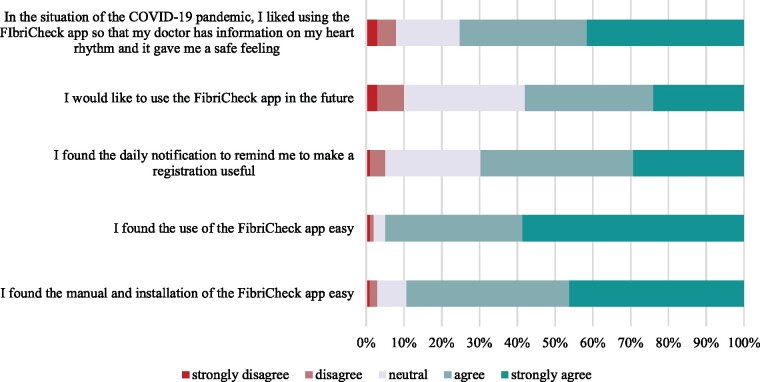
AIMS: TeleCheck-AF is a multicentre international project initiated to maintain care delivery for patients with atrial fibrillation (AF) during COVID-19 through teleconsultations supported by an on-demand photoplethysmography-based heart rate and rhythm monitoring app (FibriCheck®). We describe the characteristics, inclusion rates, and experiences from participating centres according the TeleCheck-AF infrastructure as well as characteristics and experiences from recruited patients. METHODS AND RESULTS: Three surveys exploring centre characteristics (n = 25), centre experiences (n = 23), and patient experiences (n = 826) were completed. Self-reported patient characteristics were obtained from the app. Most centres were academic (64%) and specialized public cardiology/district hospitals (36%). Majority of the centres had AF outpatient clinics (64%) and only 36% had AF ablation clinics. The time required to start patient inclusion and total number of included patients in the project was comparable for centres experienced (56%) or inexperienced in mHealth use. Within 28 weeks, 1930 AF patients were recruited, mainly for remote AF control (31% of patients) and AF ablation follow-up (42%). Average inclusion rate was highest during the lockdown restrictions and reached a steady state at a lower level after easing the restrictions (188 vs. 52 weekly recruited patients). Majority (>80%) of the centres reported no problems during the implementation of the TeleCheck-AF approach. Recruited patients [median age 64 (55-71), 62% male] agreed that the FibriCheck® app was easy to use (94%). CONCLUSION: Despite different health care settings and mobile health experiences, the TeleCheck-AF approach could be set up within an extremely short time and easily used in different European centres during COVID-19.
Overview
The claims and statistics of this paper haven’t been checked yet.
Run the check — free, no account needed. It reads the open-access text and checks the sources it cites.
Integrity signals
Registry
Cites
Statistics
Figures
Verification
Claims the paper makes
The claims and statistics of this paper haven’t been checked yet.
Run the check — free, no account needed. It reads the open-access text and checks the sources it cites.
Claims other papers make about this one
Each is checked against this paper’s own text: does it say what the citing paper says it does?
In the citing paper
“Digital tools that require constant monitoring, often leading to false positive results, are prone to limited sustainability.60”
From Unlocking Tomorrow’s Health Care: Expanding the Clinical Scope of Wearables by Applying Artificial Intelligence (2024) · cites this paper as [60]
Self-check
Percentages, sums and reported differences re-computed from the paper’s own numbers.
The self-check needs the paper’s full text.
Citations
Cites
Hindricks, G., Potpara, T., Dagres, N., Arbelo, E., Bax, J. J., Blomström‐Lundqvist, C., Boriani, G., Castella, M., Dan, G.-A., Dilaveris, P., et al. (2020) · European Heart Journal · doi:10.1093/eurheartj/ehaa612 · Cited by 10,550
Self-citationDriggin, E., Madhavan, M. V., Bikdeli, B., Chuich, T., Laracy, J. C., Biondi‐Zoccai, G., Brown, T. S., Der-Nigoghossian, C. A., Zidar, D. A., Haythe, J. H., et al. (2020) · Journal of the American College of Cardiology · doi:10.1016/j.jacc.2020.03.031 · Cited by 2,086
Evaluating barriers to adopting telemedicine worldwide: A systematic review
Scott Kruse, C., Karem, P., Shifflett, K., Vegi, L., Ravi, K., & Brooks, M. (2018) · Journal of Telemedicine and Telecare · doi:10.1177/1357633x16674087 · Cited by 1,735
Mobile Health Technology to Improve Care for Patients With Atrial Fibrillation
Guo, Y., Lane, D. A., Wang, L., Zhang, H., Wang, H., Zhang, W., Wen, J., Xing, Y., Wu, F., Xia, Y., et al. (2020) · Journal of the American College of Cardiology · doi:10.1016/j.jacc.2020.01.052 · Cited by 380
Nieuwlaat, R., Prins, M. H., Heuzey, J. Y. L., Vardas, P. E., Aliot, E., Santini, M., Cobbe, S. M., Widdershoven, J. W. M. G., Baur, L. H. B., Lévy, S., et al. (2008) · European Heart Journal · doi:10.1093/eurheartj/ehn139 · Cited by 283
Self-citationChan, P., Wong, C., Poh, Y. C., Pun, L., Leung, W. W., Wong, Y., Wong, M. M., Poh, M., Chu, D. W., & Siu, C. (2016) · Journal of the American Heart Association · doi:10.1161/jaha.116.003428 · Cited by 240
Gawalko, M. M., Kapłon‐Cieślicka, A., Hohl, M., Dobrev, D., & Linz, D. (2020) · IJC Heart & Vasculature · doi:10.1016/j.ijcha.2020.100631 · Cited by 162
Self-citationPluymaekers, N. A. H. A., Hermans, A. N. L., van der Velden, R. M. J., Gawalko, M. M., den Uijl, D. W., Buskes, S., Vernooy, K., Crijns, H. J. G. M., Hendriks, J., & Linz, D. (2020) · EP Europace · doi:10.1093/europace/euaa201 · Cited by 112
Self-citationHolt, A., Gislason, G., Schou, M., Zareini, B., Biering‐Sørensen, T., Phelps, M. D., Kragholm, K. H., Andersson, C., Fosbøl, E. L., Hansen, M. L., et al. (2020) · European Heart Journal · doi:10.1093/eurheartj/ehaa494 · Cited by 111
Accuracy of Smartphone Camera Applications for Detecting Atrial Fibrillation
O’Sullivan, J. W., Grigg, S. E., Crawford, W., Turakhia, M. P., Perez, M. V., Ingelsson, E., Wheeler, M. T., Ioannidis, J. P. A., & Ashley, E. A. (2020) · JAMA Network Open · doi:10.1001/jamanetworkopen.2020.2064 · Cited by 100
Linz, D., Pluymaekers, N. A. H. A., & Hendriks, J. (2020) · European Heart Journal · doi:10.1093/eurheartj/ehaa404 · Cited by 88
Self-citationVarma, N., Marrouche, N. F., Aguinaga, L., Albert, C. M., Arbelo, E., Choi, J., Chung, M. K., Conte, G., Dagher, L., Epstein, L. M., et al. (2020) · EP Europace · doi:10.1093/europace/euaa187 · Cited by 61
Hendriks, J., Tieleman, R. G., Vrijhoef, H. J., Wijtvliet, P., Gallagher, C., Prins, M. H., Sanders, P., & Crijns, H. J. G. M. (2019) · EP Europace · doi:10.1093/europace/euz209 · Cited by 58
Self-citationHermans, A. N. L., van der Velden, R. M. J., Gawalko, M. M., Verhaert, D. V. M., Desteghe, L., Duncker, D., Manninger, M., Heidbüchel, H., Pisters, R., Hemels, M. E. W., et al. (2020) · Clinical Cardiology · doi:10.1002/clc.23469 · Cited by 57
Self-citationRole of wearable rhythm recordings in clinical decision making—The wEHRAbles project
Manninger, M., Kosiuk, J., Zweiker, D., Njeim, M., Antolic, B., Kircanski, B., Larsen, J. M., Svennberg, E., Vanduynhoven, P., & Duncker, D. (2020) · Clinical Cardiology · doi:10.1002/clc.23404 · Cited by 50
Self-citationPluymaekers, N. A. H. A., Hermans, A. N. L., van der Velden, R. M. J., den Uijl, D. W., Vorstermans, B. J. G. H., Buskes, S., Hendriks, J., Vernooy, K., Crijns, H. J. G. M., & Linz, D. (2020) · IJC Heart & Vasculature · doi:10.1016/j.ijcha.2020.100533 · Cited by 39
Self-citationNieuwlaat, R., Vrijhoef, H. J., de Wit, R., Crijns, H. J. G. M., Tieleman, R. G., & Hendriks, J. (2010) · Netherlands Heart Journal · doi:10.1007/bf03091818 · Cited by 36
Self-citationvan der Velden, R. M. J., Hermans, A. N. L., Pluymaekers, N. A. H. A., Gawalko, M. M., Vorstermans, B. J. G. H., Martens, H., Buskes, S., Crijns, H. J. G. M., Linz, D., & Hendriks, J. (2020) · International Journal of Care Coordination · doi:10.1177/2053434520954619 · Cited by 13
Self-citation
Cited by
Sorted by citations
Gelder, I. C. V., Rienstra, M., Bunting, K. V., Casado-Arroyo, R., Caso, V., Crijns, H. J. G. M., Potter, T. J. R. D., Dwight, J., Guasti, L., Hanke, T., et al. (2024) · European Heart Journal · doi:10.1093/eurheartj/ehae176 · Cited by 3,594
Self-citationTzeis, S. E., Gerstenfeld, E. P., Kalman, J. M., Saad, E., Shamloo, A. S., Andrade, J. G., Barbhaiya, C. R., Baykaner, T., Bovéda, S., Calkins, H. G., et al. (2024) · EP Europace · doi:10.1093/europace/euae043 · Cited by 724
Self-citationAtrial fibrillation: epidemiology, screening and digital health
Linz, D., Gawalko, M. M., Betz, K., Hendriks, J., Lip, G. Y. H., Vinter, N., Guo, Y., & Johnsen, S. P. (2024) · The Lancet Regional Health - Europe · doi:10.1016/j.lanepe.2023.100786 · Cited by 476
Self-citationTzeis, S. E., Gerstenfeld, E. P., Kalman, J. M., Saad, E., Shamloo, A. S., Andrade, J. G., Barbhaiya, C. R., Baykaner, T., Bovéda, S., Calkins, H. G., et al. (2024) · Heart Rhythm · doi:10.1016/j.hrthm.2024.03.017 · Cited by 323
Self-citationHow to use digital devices to detect and manage arrhythmias: an EHRA practical guide
Svennberg, E., Tjong, F., Goette, A., Akoum, N., Di Biase, L., Bordachar, P., Boriani, G., Burri, H., Conte, G., Deharo, J. C., et al. (2022) · Europace · doi:10.1093/europace/euac038 · Cited by 261
Self-citation
Metadata
- Authors
- Gawałko, M., Duncker, D., Manninger, M., van der Velden, R. M. J., Hermans, A. N. L., Verhaert, D. V. M., Pison, L., Pisters, R., Hemels, M., Sultan, A., Steven, D., Gupta, D., Heidbuchel, H., Sohaib, A., Wijtvliet, P., Tieleman, R., Gruwez, H., Chun, J., Schmidt, B., Keaney, J. J., Müller, P., Lodziński, P., Svennberg, E., Hoekstra, O., Jansen, W. P. J., Desteghe, L., de Potter, T., Tomlinson, D. R., Neubeck, L., Crijns, H. J. G. M., Pluymaekers, N. A. H. A., Hendriks, J. M., Linz, D., & the TeleCheck-AF investigators
- Affiliations
- Department of Cardiology, Maastricht University Medical Centre, Cardiovascular Research Institute Maastricht, 6202 AZ Maastricht, The Netherlands
- Medizinische Hochschule Hannover (DE)
- Medical University of Graz (AT)
- Maastricht University Medical Centre (NL)
- Radboud University Medical Center (NL)
- Ziekenhuis Oost-Limburg (BE)
- Rijnstate Hospital (NL)
- University of Cologne (DE)
- Liverpool Heart and Chest Hospital (GB)
- Antwerp University and University Hospital, Antwerp, Belgium
- Barts Heart Centre, West Smithfield, London, UK
- Martini Ziekenhuis (NL)
- KU Leuven (BE)
- Cardiovascular Center Bethanien (DE)
- Mater Misericordiae University Hospital (IE)
- University Hospital Münster (DE)
- Medical University of Warsaw (PL)
- Karolinska University Hospital (SE)
- Tergooi (NL)
- Jessa Hospital (BE)
- Cardiovascular Center, Onze Lieve Vrouwziekenhuis, Aalst, Belgium
- Derriford Hospital (GB)
- Edinburgh Napier University (GB)
- Royal Adelaide Hospital (AU)
- University of Copenhagen (DK)
- Corresponding author
- Linz, Dominik
- ORCID
- Gawałko, Monika
- Duncker, David
- Manninger, Martin
- Hermans, Astrid N.L.
- Verhaert, Dominique V.M.
- Pison, Laurent
- Pisters, Ron
- Hemels, Martin
- Sultan, Arian
- Steven, Daniel
- Gupta, Dhiraj
- Sohaib, Afzal
- Wijtvliet, Petra
- Tieleman, Robert
- Gruwez, Henri
- Chun, Julian
- Schmidt, Boris
- Müller, Patrick
- Lodziński, Piotr
- Svennberg, Emma
- Jansen, Ward P.J.
- Desteghe, Lien
- Neubeck, Lis
- Crijns, Harry J.G.M.
- Pluymaekers, Nikki A.H.A.
- Hendriks, Jeroen M.
- Linz, Dominik
- Venue
- EP Europace
- Publisher
- Oxford University Press (OUP)
- Published
- 2021-04-02
- Volume
- 23
- Issue
- 7
- Pages
- 1003-1015
- ISSN
- 1099-5129 (ISSN-L)
- 1532-2092
- PMC
- PMC8083545
- OpenAlex
- W3149244439
- Cited by
- 106
- References
- 19
- Citations by year
- 2026: 6 · 2025: 18 · 2024: 27 · 2023: 13 · 2022: 28 · 2021: 14
- FWCI
- 17.77
- Type
- journal article
- Language
- en
- Open access
- hybrid
- doi.org
- Licence
- Locations
- EP Europace (publishedVersion, cc-by-nc)
- PubMed Central (publishedVersion, cc-by-nc)
- PubMed (publishedVersion)
- Kölner Universitäts PublikationsServer (Universität zu Köln) (publishedVersion)
- Research Publications (Maastricht University) (publishedVersion, cc-by-nc)
- Research at the University of Copenhagen (University of Copenhagen) (publishedVersion, cc-by-nc)
- Edinburgh Napier Research Repository (Edinburgh Napier University) (publishedVersion, cc-by-nc)
- Lirias (KU Leuven) (submittedVersion, cc-by-nc)
- Research Output (Edinburgh Napier University) (submittedVersion, cc-by-nc)
- Document Server@UHasselt (UHasselt) (submittedVersion, cc-by-nc)
- Radboud Repository (Radboud University) (submittedVersion)
- Radboud Repository (Radboud University) (submittedVersion, other-oa)
- Research Publications (Maastricht University) (submittedVersion, other-oa)
- Funders
- Maastricht Universitair Medisch Centrum
- Biosense Webster
- Topics
- Health Sciences › Medicine › Public Health, Environmental and Occupational Health › Telemedicine and Telehealth Implementation
- Health Sciences › Medicine › Cardiology and Cardiovascular Medicine › Atrial Fibrillation Management and Outcomes
- Health Sciences › Health Professions › General Health Professions › Mobile Health and mHealth Applications
- Keywords
- atrial fibrillation, remote patient monitoring, COVID-19 pandemic, photoplethysmography, mobile health apps, remote patient care, teleconsultation, patient recruitment, patient experience, lockdown measures
- MeSH terms
- COVID-19, SARS-CoV-2, Atrial Fibrillation, Communicable Disease Control, Female, Humans, Male, Middle Aged, Pandemics, Mobile Applications, Patient Outcome Assessment
About these checks
Registry, retraction, Cites and statistics results are computed, not judged, with one exception: a printed reference that no index lists is read once by a model before it counts as a citation error. Claims are extracted by a model and kept only when their quote appears verbatim in the text; each cited source is then checked, with a model’s help, for whether it says what the claim relies on. Those verdicts can be wrong — read the claim’s quote and the cited source before relying on one.
Statistics and arithmetic are recomputed, not judged.
Confidence bands are shown only for fields calibrated on our annotated test set. None is calibrated yet, so no band is shown.
What counts as a claim ›How we measure confidence ›How we check this ›
Are you an author, or do you see a problem with this page? Request a review
