

The DOI matches its Crossref record; 17 of the 17 references it cites were found in a registry or an index.
Remote monitoring of implantable cardioverter defibrillator patients: a safe, time-saving, and cost-effective means for follow-up
Open accessAbstract
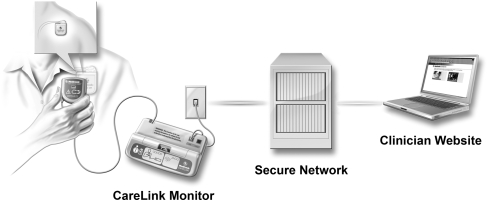
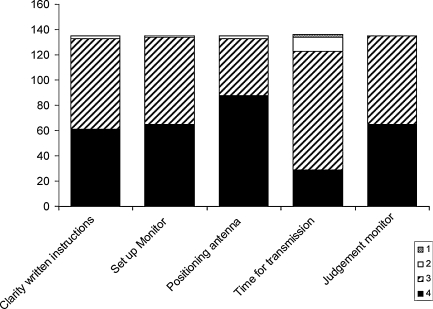
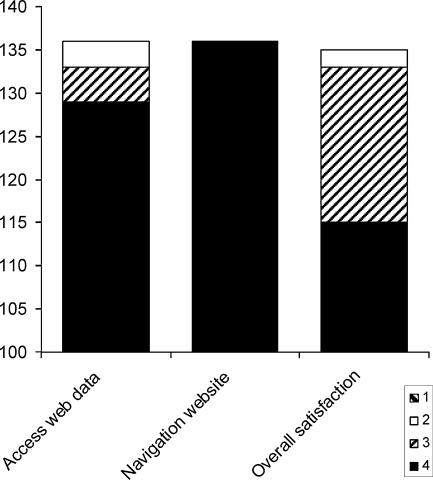
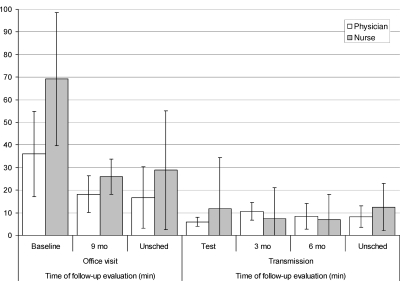
AIMS: The purpose of this prospective study was to investigate whether internet-based remote monitoring offers a safe, practical, and cost-effective alternative to the in-office follow-up visits of patients with an implantable cardioverter defibrillator (ICD). METHODS AND RESULTS: Forty-one patients (62 +/- 10 years, range 41-76, 83% male) with previously implanted ICD were followed for 9 months. One-hundred and nineteen scheduled and 18 unscheduled data transmissions were performed. There were no device-related adverse events. Over 90% of the patients found the system easy to use. Physicians reported the system as being 'very easy' or 'easy' to use and found the data comparable to traditional device interrogation in 99% of the cases. They were able to address all unscheduled data transmissions remotely. Compared with the in-office visits, remote monitoring required less time from patients (6.9 +/- 5.0 vs. 182 +/- 148 min, P < 0.001) and physicians (8.4 +/- 4.5 vs. 25.8 +/- 17.0 min, P < 0.001) to complete the follow-up. Substitution of two routine in-office visits during the study by remote monitoring reduced the overall cost of routine ICD follow-up by 524 euro per patient (41%). CONCLUSION: Remote monitoring offers a safe, feasible, time-saving, and cost-effective solution to ICD follow-up.
Overview
The claims and statistics of this paper haven’t been checked yet.
Run the check — free, no account needed. It reads the open-access text and checks the sources it cites.
Integrity signals
Registry
Cites
Statistics
Figures
Verification
Claims the paper makes
The claims and statistics of this paper haven’t been checked yet.
Run the check — free, no account needed. It reads the open-access text and checks the sources it cites.
Claims other papers make about this one
Each is checked against this paper’s own text: does it say what the citing paper says it does?
The source backs part of the claim, not all of it — or backs it for a different population, condition or comparison.
In the citing paper
“In general, surveys reveal that patients prefer home to in-office monitoring, and physicians find that the systems are user friendly.52,53”
From Managing with pacemakers and implantable cardioverter defibrillators (2013) · cites this paper as [52]
Experimental — accuracy not yet measuredThe cited source says what the claim attributes to it.
In the citing paper
“Data on the cost benefits of remote monitoring are not definitive to date.52,56”
From Managing with pacemakers and implantable cardioverter defibrillators (2013) · cites this paper as [52]
Self-check
Percentages, sums and reported differences re-computed from the paper’s own numbers.
The self-check needs the paper’s full text.
Citations
Cites
Guidelines for cardiac pacing and cardiac resynchronization therapy
Vardas, P. E., Auricchio, A., Blanc, J., Daubert, J., Drexler, H., Ector, H., Gasparini, M., Linde, C. M., Morgado, F. B., Oto, A., et al. (2007) · European Heart Journal · doi:10.1093/eurheartj/ehm305 · Cited by 895
[Guidelines for cardiac pacing and cardiac resynchronization therapy].
Vardas, P. E., Auricchio, A., Blanc, J., Daubert, J., Drexler, H., Ector, H., Gasparini, M., Linde, C. M., Morgado, F. B., Oto, A., et al. (2008) · PubMed · Cited by 550
Lazarus, A. (2007) · Pacing and Clinical Electrophysiology · doi:10.1111/j.1540-8159.2007.00595.x · Cited by 227
Remote Monitoring of Implantable Cardioverter Defibrillators: A Prospective Analysis
SCHOENFELD, M. H., COMPTON, S. J., MEAD, R. H., WEISS, D. N., SHERFESEE, L., ENGLUND, J., & MONGEON, L. R. (2004) · Pacing and Clinical Electrophysiology · doi:10.1111/j.1540-8159.2004.00524.x · Cited by 194
Fauchier, L., Sadoul, N., Kouakam, C., Briand, F., Chauvin, M., Babuty, D., & Clémenty, J. (2005) · Pacing and Clinical Electrophysiology · doi:10.1111/j.1540-8159.2005.00071.x · Cited by 124
Remote Interrogation and Monitoring of Implantable Cardioverter Defibrillators
Joseph, G. K., Wilkoff, B. L., Dresing, T., BURKHARDT, J. D., & Khaykin, Y. (2004) · Journal of Interventional Cardiac Electrophysiology · doi:10.1023/b:jice.0000042356.52369.89 · Cited by 98
What evidence do we have to replace in-hospital implantable cardioverter defibrillator follow-up?
Brugada, P. (2006) · Clinical Research in Cardiology · doi:10.1007/s00392-006-1302-x · Cited by 94
Home monitoring in ICD therapy: future perspectives
Theuns, D. (2003) · EP Europace · doi:10.1053/eupc.2002.0302 · Cited by 62
Twiddler's Syndrome Detected by Home Monitoring Device
SCHOLTEN, M. F., Thornton, A. S., Theuns, D. A. M. J., Res, J., & Jordaens, L. J. L. M. (2004) · Pacing and Clinical Electrophysiology · doi:10.1111/j.1540-8159.2004.00599.x · Cited by 49
RES, J. C. J., Theuns, D. A. M. J., & Jordaens, L. J. L. M. (2006) · Clinical Research in Cardiology · doi:10.1007/s00392-006-1304-8 · Cited by 48
Research works printed but not linked: 2
- 2007, Pacing and clinical electrophysiology : PACE, 30, s2
- 2006, 33, 241
Cited by
Sorted by citations
Slotwiner, D. J., Varma, N., Akar, J. G., Annas, G. J., Beardsall, M., Fogel, R. I., Galizio, N. O., Glotzer, T. V., Leahy, R. A., Love, C. J., et al. (2015) · Heart Rhythm · doi:10.1016/j.hrthm.2015.05.008 · Cited by 533
Boriani, G., Costa, A. D., Quesada, A., Ricci, R. P., Favale, S., Boscolo, G., Clémenty, N., Amori, V., Stefano, L. M. D. S., & Burri, H. (2016) · European Journal of Heart Failure · doi:10.1002/ejhf.626 · Cited by 213
Ambulatory Arrhythmia Monitoring: Choosing the Right Device
Zimetbaum, P., & Goldman, A. (2010) · Circulation · doi:10.1161/circulationaha.109.925610 · Cited by 209
Shameer, K., Badgeley, M. A., Miotto, R., Glicksberg, B. S., Morgan, J. W., & Dudley, J. T. (2017) · Briefings in Bioinformatics · doi:10.1093/bib/bbv118 · Cited by 198
A review of telerehabilitation for cardiac patients
Frederix, I., Vanhees, L., Dendale, P., & Goetschalckx, K. (2014) · Journal of Telemedicine and Telecare · doi:10.1177/1357633x14562732 · Cited by 194
Metadata
- Authors
- Raatikainen, M. J. P., Uusimaa, P., van Ginneken, M. M. E., Janssen, J. P. G., & Linnaluoto, M.
- Affiliations
- University of Oulu (FI)
- Medtronic (Netherlands) (NL)
- Corresponding author
- Raatikainen, M.J. P.
- ORCID
- Raatikainen, M.J. P.
- Venue
- Europace
- Publisher
- Oxford University Press (OUP)
- Published
- 2008-10-01
- Volume
- 10
- Issue
- 10
- Pages
- 1145-1151
- ISSN
- 1099-5129 (ISSN-L)
- 1532-2092
- PMC
- PMC2552405
- OpenAlex
- W2129785807
- Cited by
- 189
- References
- 17
- Citations by year
- 2026: 2 · 2025: 6 · 2024: 3 · 2023: 3 · 2022: 5 · 2021: 5 · 2020: 7 · 2019: 5 · 2018: 6 · 2017: 8 · 2016: 12 · 2015: 16 · 2014: 13 · 2013: 30 · 2012: 17
- FWCI
- 12.37
- Type
- journal article
- Language
- en
- Open access
- hybrid
- doi.org
- Licence
- other-oa
- Locations
- EP Europace (publishedVersion, other-oa)
- PubMed Central (publishedVersion)
- PubMed (publishedVersion)
- Topics
- Health Sciences › Medicine › Cardiology and Cardiovascular Medicine › Cardiac pacing and defibrillation studies
- Health Sciences › Medicine › Public Health, Environmental and Occupational Health › Telemedicine and Telehealth Implementation
- Health Sciences › Medicine › Cardiology and Cardiovascular Medicine › ECG Monitoring and Analysis
- Keywords
- implantable cardioverter-defibrillator, remote monitoring, device interrogation, cost-effectiveness, patient satisfaction
- MeSH terms
- Adult, Aged, Cost-Benefit Analysis, Female, Humans, Male, Middle Aged, Netherlands, Workload, Death, Sudden, Cardiac, Health Care Costs, Defibrillators, Implantable, Remote Consultation, Internet
About these checks
Registry, retraction, Cites and statistics results are computed, not judged, with one exception: a printed reference that no index lists is read once by a model before it counts as a citation error. Claims are extracted by a model and kept only when their quote appears verbatim in the text; each cited source is then checked, with a model’s help, for whether it says what the claim relies on. Those verdicts can be wrong — read the claim’s quote and the cited source before relying on one.
Statistics and arithmetic are recomputed, not judged.
Confidence bands are shown only for fields calibrated on our annotated test set. None is calibrated yet, so no band is shown.
What counts as a claim ›How we measure confidence ›How we check this ›
Are you an author, or do you see a problem with this page? Request a review
