

The DOI matches its Crossref record; 24 of the 24 references it cites were found in a registry or an index.
Management of atrial fibrillation in seven European countries after the publication of the 2010 ESC Guidelines on atrial fibrillation: primary results of the PREvention oF thromboemolic events—European Registry in Atrial Fibrillation (PREFER in AF)
Open accessAbstract
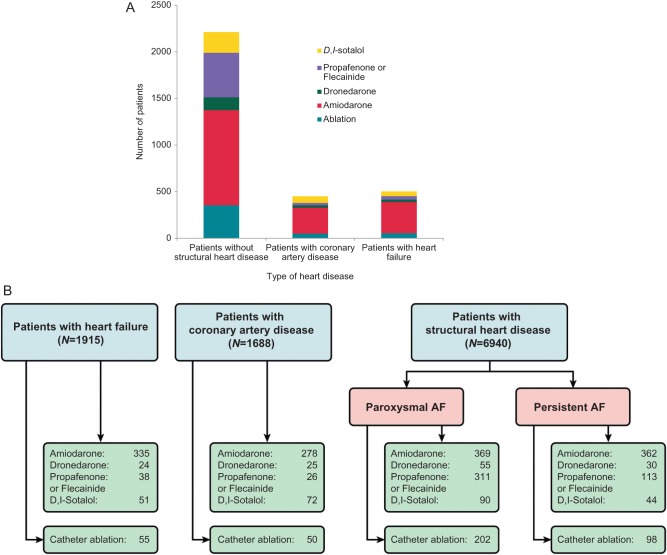
AIMS: We sought to describe the management of patients with atrial fibrillation (AF) in Europe after the release of the 2010 AF Guidelines of the European Society of Cardiology. METHODS AND RESULTS: The PREFER in AF registry enrolled consecutive patients with AF from January 2012 to January 2013 in 461 centres in seven European countries. Seven thousand two hundred and forty-three evaluable patients were enrolled, aged 71.5 ± 11 years, 60.1% male, CHA2DS2VASc score 3.4 ± 1.8 (mean ± standard deviation). Thirty per cent patients had paroxysmal, 24.0% had persistent, 7.2% had long-standing persistent, and 38.8% had permanent AF. Oral anticoagulation was used in the majority of patients: 4799 patients (66.3%) received a vitamin K antagonist (VKA) as mono-therapy, 720 patients a combination of VKA and antiplatelet agents (9.9%), 442 patients (6.1%) a new oral anticoagulant drugs (NOAC). Antiplatelet agents alone were given to 808 patients (11.2%), no antithrombotic therapy to 474 patients (6.5%). Of 7034 evaluable patients, 5530 (78.6%) patients were adequately rate controlled (mean heart rate 60-100 bpm). Half of the patients (50.7%) received rhythm control therapy by electrical cardioversion (18.1%), pharmacological cardioversion (19.5%), antiarrhythmic drugs (amiodarone 24.1%, flecainide or propafenone 13.5%, sotalol 5.5%, dronedarone 4.0%), and catheter ablation (5.0%). CONCLUSION: The management of AF patients in 2012 has adapted to recent evidence and guideline recommendations. Oral anticoagulant therapy with VKA (majority) or NOACs is given to over 80% of eligible patients, including those at risk for bleeding. Rate is often adequately controlled, and rhythm control therapy is widely used.
Overview
The claims and statistics of this paper haven’t been checked yet.
Run the check — free, no account needed. It reads the open-access text and checks the sources it cites.
Integrity signals
Registry
Cites
Statistics
Figures
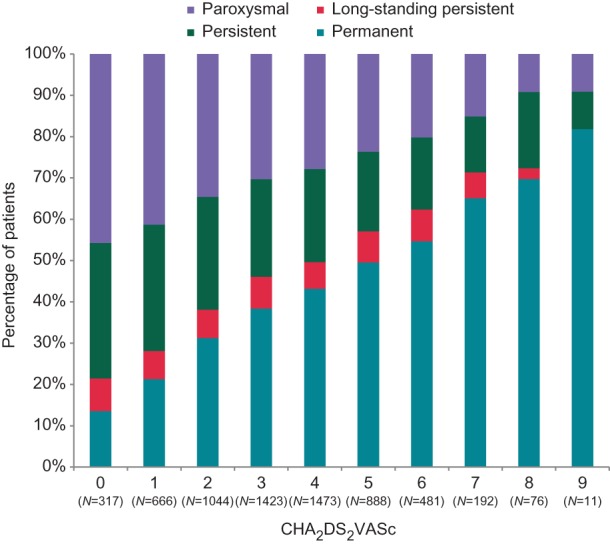
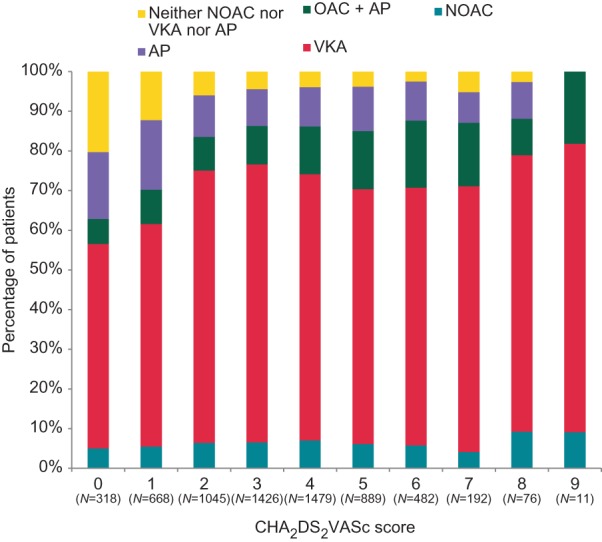
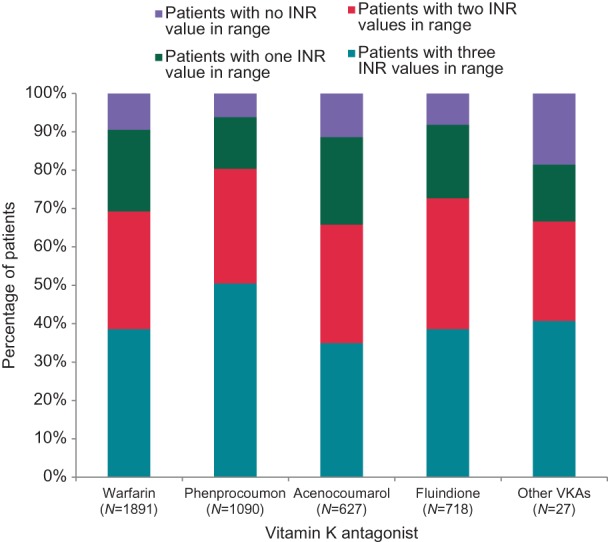
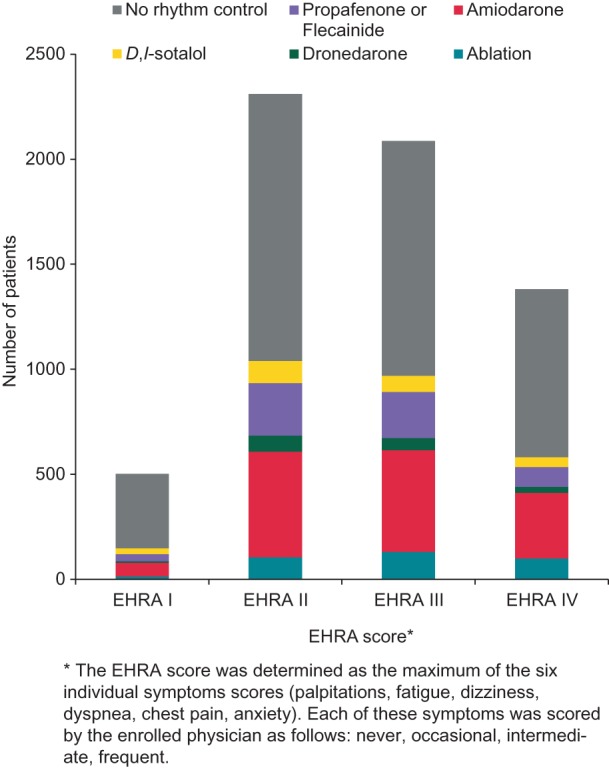
Verification
Claims the paper makes
The claims and statistics of this paper haven’t been checked yet.
Run the check — free, no account needed. It reads the open-access text and checks the sources it cites.
Claims other papers make about this one
Each is checked against this paper’s own text: does it say what the citing paper says it does?
In the citing paper
“The EHRA scale has been used and validated.”
From 2016 ESC Guidelines for the management of atrial fibrillation developed in collaboration with EACTS (2016) · cites this paper as [194]
In the citing paper
“While some AF patients had no or minimal symptoms (25-40%), many (15-30%) reported severe or disabling symptoms.”
From 2016 ESC Guidelines for the management of atrial fibrillation developed in collaboration with EACTS (2016) · cites this paper as [194]
In the citing paper
“While some AF patients had no or minimal symptoms (25-40%), many (15-30%) reported severe or disabling symptoms.”
From 2016 ESC Guidelines for the management of atrial fibrillation developed in collaboration with EACTS (2016) · cites this paper as [194]
In the citing paper
“AF-related symptoms are most commonly fatigue/tiredness and exertional shortness of breath, or less frequently palpitations and chest pain.”
From 2016 ESC Guidelines for the management of atrial fibrillation developed in collaboration with EACTS (2016) · cites this paper as [194]
Self-check
Percentages, sums and reported differences re-computed from the paper’s own numbers.
The self-check needs the paper’s full text.
Citations
Cites
Guidelines for the management of atrial fibrillation
Authors/Task Force Members, Camm, A. J., Kirchhof, P. F., Lip, G. Y. H., Schotten, U., Savelieva, I., Ernst, S., Gelder, I. C. V., Al‐Attar, N., Hindricks, G., et al. (2010) · European Heart Journal · doi:10.1093/eurheartj/ehq278 · Cited by 5,924
Lifetime Risk for Development of Atrial Fibrillation: The Framingham Heart Study
Lloyd-Jones, D. M., Wang, T. J., Leip, E. P., Larson, M. G., Levy, D., Vasan, R. S., D’Agostino, R. B., Massaro, J. M., Beiser, A., Wolf, P. A., et al. (2004) · Circulation · doi:10.1161/01.cir.0000140263.20897.42 · Cited by 2,041
Prevalence, incidence and lifetime risk of atrial fibrillation: the Rotterdam study
Heeringa, J., van der Kuip, D. A. M., Hofman, A., Kors, J. A., van Herpen, G., Stricker, B. H. C., Stijnen, T., Lip, G. Y. H., & Witteman, J. C. M. (2006) · European Heart Journal · doi:10.1093/eurheartj/ehi825 · Cited by 1,939
Guidelines for the management of atrial fibrillation
Authors/Task Force Members, Camm, A. J., Kirchhof, P. F., Lip, G. Y. H., Schotten, U., Savelieva, I., Ernst, S., Gelder, I. C. V., Al‐Attar, N., Hindricks, G., et al. (2010) · EP Europace · doi:10.1093/europace/euq350 · Cited by 1,764
Olesen, J. B., Lip, G. Y. H., Hansen, M. L., Hansen, P. R., Tolstrup, J. S., Lindhardsen, J., Selmer, C., Ahlehoff, O., Olsen, A.-M. S., Gislason, G. H., et al. (2011) · BMJ · doi:10.1136/bmj.d124 · Cited by 1,428
Lenient versus strict rate control in patients with atrial fibrillation
Van Gelder, I. C., Groenveld, H. F., Crijns, H. J. G. M., Tuininga, Y. S., Tijssen, J. G. P., Alings, A. M., Hillege, H. L., Bergsma-Kadijk, J. A., Cornel, J. H., Kamp, O., et al. (2010) · New England Journal of Medicine · doi:10.1056/nejmoa1001337 · Cited by 1,033
Atrial fibrillation management: a prospective survey in ESC Member Countries
Nieuwlaat, R., Capucci, A., Camm, A. J., Olsson, S. B., Andresen, D., Davies, D. W., Cobbe, S. M., BREITHARDT, G. E., Heuzey, J. L., Prins, M. H., et al. (2005) · European Heart Journal · doi:10.1093/eurheartj/ehi505 · Cited by 825
Progression From Paroxysmal to Persistent Atrial Fibrillation
de Vos, C. B., Pisters, R., Nieuwlaat, R., Prins, M. H., Tieleman, R. G., Coelen, R. J. S., Heijkant, A. C. V. D., Allessie, M. A., & Crijns, H. J. G. M. (2010) · Journal of the American College of Cardiology · doi:10.1016/j.jacc.2009.11.040 · Cited by 720
Kakkar, A. K., Mueller, I., Bassand, J., Fitzmaurice, D. A., Goldhaber, S. Z., Goto, S., Haas, S. K., Hacke, W., Lip, G. Y. H., Mantovani, L. G., et al. (2013) · PLoS ONE · doi:10.1371/journal.pone.0063479 · Cited by 449
Nabauer, M., Gerth, A., Limbourg, T., Schneider, S., Oeff, M., Kirchhof, P., Goette, A., Lewalter, T., Ravens, U., Meinertz, T., et al. (2008) · Europace · doi:10.1093/europace/eun369 · Cited by 427
Research works printed but not linked: 1
- Lip, 2013, EUR Observational research programme: atrial fibrillation general registry pilot phase, Eur H J, 34, 794
Cited by
Sorted by citations
Hindricks, G., Potpara, T., Dagres, N., Arbelo, E., Bax, J. J., Blomström‐Lundqvist, C., Boriani, G., Castella, M., Dan, G.-A., Dilaveris, P., et al. (2020) · European Heart Journal · doi:10.1093/eurheartj/ehaa612 · Cited by 10,550
2016 ESC Guidelines for the management of atrial fibrillation developed in collaboration with EACTS
Kirchhof, P. F., Benussi, S., Kotecha, D., Ahlsson, A., Atar, D., Casadei, B., Castellà, M., Diener, H., Heidbüchel, H., Hendriks, J., et al. (2016) · EP Europace · doi:10.1093/europace/euw295 · Cited by 6,438
2016 ESC Guidelines for the management of atrial fibrillation developed in collaboration with EACTS
Kirchhof, P., Benussi, S., Kotecha, D., Ahlsson, A., Atar, D., Casadei, B., Castella, M., Diener, H.-C., Heidbuchel, H., Hendriks, J., et al. (2016) · European Heart Journal · doi:10.1093/eurheartj/ehw210 · Cited by 6,418
2016 ESC Guidelines for the management of atrial fibrillation developed in collaboration with EACTS
Kirchhof, P., Benussi, S., Kotecha, D., Ahlsson, A., Atar, D., Casadei, B., Castella, M., Diener, H.-C., Heidbuchel, H., Hendriks, J., et al. (2016) · European Journal of Cardio-Thoracic Surgery · doi:10.1093/ejcts/ezw313 · Cited by 1,403
Antithrombotic Therapy for Atrial Fibrillation
Lip, G. Y. H., Banerjee, A., Boriani, G., Chiang, C. E., Fargo, R. A., Freedman, B., Lane, D. A., Ruff, C. T., Turakhia, M. P., Werring, D. J., et al. (2018) · CHEST Journal · doi:10.1016/j.chest.2018.07.040 · Cited by 963
Metadata
- Authors
- Kirchhof, P., Ammentorp, B., Darius, H., De Caterina, R., Le Heuzey, J.-Y., Schilling, R. J., Schmitt, J., & Zamorano, J. L.
- Affiliations
- University of Münster (DE)
- Daiichi Sankyo (Germany) (DE)
- Vivantes Klinikum (DE)
- St Thomas' Hospital (GB)
- Corresponding author
- Kirchhof, Paulus
- Venue
- EP Europace
- Publisher
- Oxford University Press (OUP)
- Published
- 2013-10-01
- Volume
- 16
- Issue
- 1
- Pages
- 6-14
- ISSN
- 1099-5129 (ISSN-L)
- 1532-2092
- PMC
- PMC3864758
- OpenAlex
- W1973416160
- Cited by
- 404
- References
- 24
- Citations by year
- 2026: 3 · 2025: 8 · 2024: 16 · 2023: 15 · 2022: 20 · 2021: 31 · 2020: 46 · 2019: 27 · 2018: 36 · 2017: 59 · 2016: 44 · 2015: 56 · 2014: 36 · 2013: 6
- FWCI
- 32.15
- Type
- journal article
- Language
- en
- Open access
- hybrid
- doi.org
- Licence
- cc-by-nc
- Locations
- EP Europace (publishedVersion, cc-by-nc)
- Europe PMC (PubMed Central) (publishedVersion, cc-by-nc)
- PubMed Central (publishedVersion, cc-by-nc)
- PubMed (publishedVersion)
- CINECA IRIS Institutial research information system (University of Pisa) (submittedVersion)
- Funders
- Daiichi Sankyo Europe
- Topics
- Health Sciences › Medicine › Cardiology and Cardiovascular Medicine › Atrial Fibrillation Management and Outcomes
- Health Sciences › Medicine › Internal Medicine › Venous Thromboembolism Diagnosis and Management
- Health Sciences › Medicine › Clinical Neurology › Acute Ischemic Stroke Management
- Keywords
- atrial fibrillation, clinical management, oral anticoagulation, vitamin K antagonists, direct oral anticoagulants, antiplatelet therapy, rate control, rhythm control, cardioversion, antiarrhythmic drugs, catheter ablation, guideline adherence, bleeding risk, CHA2DS2-VASc score
- MeSH terms
- Aged, Anticoagulants, Atrial Fibrillation, Cardiology, Europe, Female, Humans, Male, Practice Patterns, Physicians', Platelet Aggregation Inhibitors, Registries, Thromboembolism, Vitamin K, Comorbidity, Causality, Prevalence, Practice Guidelines as Topic, Guideline Adherence
About these checks
Registry, retraction, Cites and statistics results are computed, not judged, with one exception: a printed reference that no index lists is read once by a model before it counts as a citation error. Claims are extracted by a model and kept only when their quote appears verbatim in the text; each cited source is then checked, with a model’s help, for whether it says what the claim relies on. Those verdicts can be wrong — read the claim’s quote and the cited source before relying on one.
Statistics and arithmetic are recomputed, not judged.
Confidence bands are shown only for fields calibrated on our annotated test set. None is calibrated yet, so no band is shown.
What counts as a claim ›How we measure confidence ›How we check this ›
Are you an author, or do you see a problem with this page? Request a review
