

The nitazene epidemic in Estonia: a first report
Open accessThe DOI matches its Crossref record; 23 of the 23 references it cites were found in a registry or an index.
Abstract
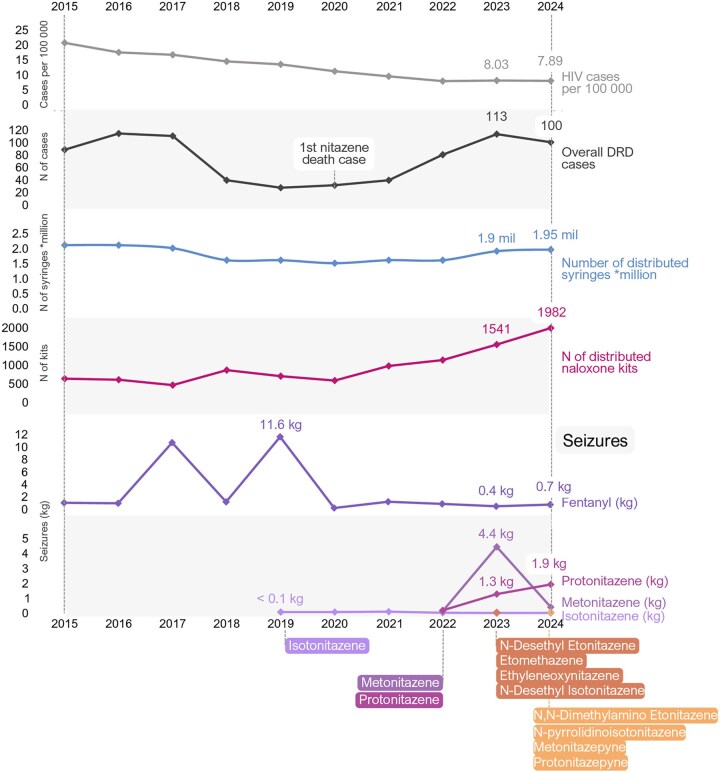
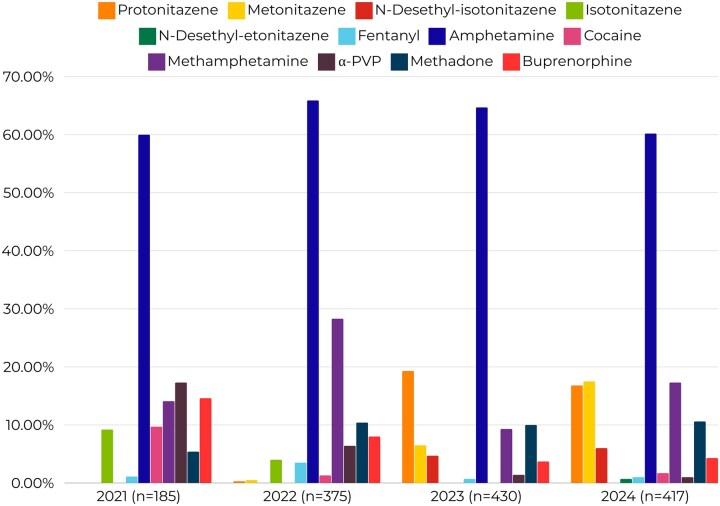
Since 2022, Estonia, a north-east European nation of 1.3 million people, has faced challenges with nitazenes, a class of novel synthetic opioids, which present a new threat to public health. The purpose of this article is to provide the timeline of the nitazene epidemic in Estonia, examining the prevalence and health consequences of nitazene use in the country. This case study uses a multifaceted approach. Data sources include administrative statistics, surveillance and research data, national service provision information, and government documentation from 2015 to 2024, with a focus on health consequences from 2019 to 2024. Quantitative data is complemented by qualitative interviews with nitazene users. The number of drug-related deaths in Estonia has more than doubled since 2022 (39 vs. 80 cases), exceeding over 100 cases in 2023. The increasing prevalence of nitazenes from 2022 is confirmed by syringe residue studies and seizure data. Nitazenes are often sold on the drug market, usually with no or limited information to the user about the substance being sold. Users frequently describe the effect of nitazenes as stronger, faster, sharper and more short-lived compared to fentanyl. Harm reduction services have seen increased utilization since 2022, with first responders facing growing challenges linked to the emergence of the nitazene phenomenon. This study provides the first comprehensive description of the nitazene epidemic. Results indicate a need for more evidence-based information on the use of nitazenes and their consequences to effectively address emerging challenges.
Overview
The claims and statistics of this paper haven’t been checked yet.
Free: it reads the open-access text and checks the first 5 claims that cite a source we can check. Create a free account to check every claim.
Integrity signals
Registry
Cites
Statistics
Figures
Verification
Claims the paper makes
The claims and statistics of this paper haven’t been checked yet.
Free: it reads the open-access text and checks the first 5 claims that cite a source we can check. Create a free account to check every claim.
Claims other papers make about this one
Each is checked against this paper’s own text: does it say what the citing paper says it does?
The source backs part of the claim, not all of it — or backs it for a different population, condition or comparison.
In the citing paper
“particularly the Baltic states (Estonia, Latvia and Lithuania), which collectively accounted for approximately 75% of novel synthetic opioid adulterant seizures reported to the EUDA, including nitazenes and carfentanil [29, 30, 31, 32].”
From Temporal and geographical patterns of nitazene detections in drug samples and biospecimens in the United States, 2019–2024 (2026) · cites this paper as [32]
Experimental — accuracy not yet measuredThe cited source says what the claim attributes to it.
In the citing paper
“Estonia documented 136 nitazene‐involved overdose deaths between 2019 and 2024 [32].”
From Temporal and geographical patterns of nitazene detections in drug samples and biospecimens in the United States, 2019–2024 (2026) · cites this paper as [32]
The cited source says what the claim attributes to it.
In the citing paper
“Although studies from the US, Australia and Europe (including the United Kingdom, Norway and Estonia) have documented a high prevalence of polysubstance involvement with nitazenes [6, 32, 45, 46, 47], there remains a very limited understanding of where along the drug supply chain nitazenes are introduced.”
From Temporal and geographical patterns of nitazene detections in drug samples and biospecimens in the United States, 2019–2024 (2026) · cites this paper as [32]
Self-check
Percentages, sums and reported differences re-computed from the paper’s own numbers.
The self-check needs the paper’s full text.
Citations
Cites
Gale, N. K., Heath, G., Cameron, E., Rashid, S., & Redwood, S. (2013) · BMC Medical Research Methodology · doi:10.1186/1471-2288-13-117 · Cited by 10,865 · cited 1×
“The data collected were analysed using framework analysis [18], a qualitative method that allows for a systematic and transparent approach to analysing textual data.”
Qualitative Case Study Methodology: Study Design and Implementation for Novice Researchers
Baxter, P., & Jack, S. (2015) · The Qualitative Report · doi:10.46743/2160-3715/2008.1573 · Cited by 7,594
The changing opioid crisis: development, challenges and opportunities
Volkow, N. D., & Blanco, C. (2021) · Molecular Psychiatry · doi:10.1038/s41380-020-0661-4 · Cited by 522
Johansson, R. (2007) · Open House International · doi:10.1108/ohi-03-2007-b0006 · Cited by 209
Synthetic opioids: a review and clinical update
Shafi, A., Berry, A. J., Sumnall, H. R., Wood, D. M., & Tracy, D. K. (2022) · Therapeutic Advances in Psychopharmacology · doi:10.1177/20451253221139616 · Cited by 93
Nitazenes—Heralding a Second Wave for the UK Drug-Related Death Crisis?
Holland, A., Copeland, C. S., Shorter, G. W., Connolly, D. J., Wiseman, A., Mooney, J., Fenton, K., & Harris, M. (2024) · The Lancet Public Health · doi:10.1016/s2468-2667(24)00001-x · Cited by 86
Naloxone Use in Novel Potent Opioid and Fentanyl Overdoses in Emergency Department Patients
Amaducci, A., Aldy, K., Campleman, S. L., Li, S., Meyn, A., Abston, S., Culbreth, R. E., Krotulski, A., Logan, B., Wax, P., et al. (2023) · JAMA Network Open · doi:10.1001/jamanetworkopen.2023.31264 · Cited by 84 · cited 1×
“Although naloxone is generally effective in reversing nitazene-involved over-doses, observations suggest that multiple doses are often required, and some users express uncertainty regarding its immediate efficacy [4, 39].”
Old Drugs and New Challenges: A Narrative Review of Nitazenes
Pergolizzi Jr, J., Raffa, R., LeQuang, J. A. K., Breve, F., & Varrassi, G. (2023) · Cureus · doi:10.7759/cureus.40736 · Cited by 81 · cited 1×
“Evidence suggests these services can help mitigate substance use risks, including overdose, by enabling users to test their supply [34], and appear responsive to changes in drug markets, including the emergence of novel psychoactive substances and highly potent compounds [35–37].”
Drug checking: a potential solution to the opioid overdose epidemic?
Bardwell, G., & Kerr, T. (2018) · Substance Abuse Treatment, Prevention, and Policy · doi:10.1186/s13011-018-0156-3 · Cited by 54 · cited 1×
“Evidence suggests these services can help mitigate substance use risks, including overdose, by enabling users to test their supply [34], and appear responsive to changes in drug markets, including the emergence of novel psychoactive substances and highly potent compounds [35–37].”
Uusküla, A., Talu, A., Vorobjov, S., Salekešin, M., Rannap, J., Lemsalu, L., & Jarlais, D. C. D. (2020) · International Journal of Drug Policy · doi:10.1016/j.drugpo.2020.102757 · Cited by 54 · cited 3×
“The fentanyl epidemic of 2002–17 in Estonia, including its evolution and harm reduction responses, is comprehensively documented [12, 13].”
Self-citation
Research works printed but not linked: 5
- Abel-Ollo K, Riikoja A, Barndõk T et al Tallinna Ja Narva Linna Kahjude Vähendamise Keskustes Kogutavate Süstalde Uuring Narkootikumide Jääkide Suhtes, 2021 [Drug Residue Survey of Syringes Collected at Tallinn and Narva City Harm Reduction Centers, 2021]. Tallinn: Tervise Arengu Instituut, 2022. In Estonian.
- Abel-Ollo K, Riikoja A, Barndõk T et al Study of Syringes Collected in Estonian Harm Reduction Services for Drug Residues. Study Summary. Tallinn: National Institute for Health Development, 2023. https://www.tai.ee/sites/default/files/2024-02/TAI_%20kogutavate_systalde_uuring2023_ENG.pdf.
- Abel-Ollo K, Riikoja A, Barndõk T et al Study of Syringes Collected in Estonian Harm Reduction Services for Drug Residues. Study Summary. Tallinn: National Institute for Health Development, 2024. https://www.tai.ee/sites/default/files/2025-02/tai_systalde_uuring2024_210x297_eng_5.pdf
- Vorobjov S, Kaste AL. HIVi Levimuse Ja Riskikäitumise Uuring Narva Narkootikume Süstivate Inimeste Seas 2023 [HIV Prevalence and Risk Behaviour Study among People Who Inject Drugs in Narva 2023]. Tallinn: Tervise Arengu Instituut, 2024. In Estonian.
- Vorobjov S, Raag HM, Salekešin M. HIVi Levimuse Ja Teiste Vere Teel Levivate Infektsioonide Ning Nendega Seotud Riskikäitumise Levimus Narkootikume Süstivate Inimeste Seas Tallinnas 2022 [Prevalence of HIV and Other Blood-Borne Infections and Related Risk Behaviours among People Who Inject Drugs in Tallinn 2022]. Tallinn: Tervise Arengu Instituut, 2023. In Estonian.
Cited by
Zhu, D. T., Fitzgerald, N. D., Palamar, J. J., & Krotulski, A. J. (2026) · Addiction · doi:10.1111/add.70378 · Cited by 8
“Estonia documented 136 nitazene-involved overdose deaths between 2019 and 2024 [32].”
Nitazene-related deaths in Norway 2021–2024
Vevelstad, M., Krabseth, H.-M., Haneborg, A.-M., Gundersen, P. O. M., Frost, J., & Øiestad, Å. M. L. (2026) · Forensic Science International · doi:10.1016/j.forsciint.2025.112794 · Cited by 3
In Vitro Cytotoxic and Genotoxic Evaluation of Nitazenes, a Potent Class of New Synthetic Opioids
Rombolà, F., Bartoletti, S., Bilel, S., Hrelia, P., Marti, M., & Lenzi, M. (2025) · Journal of Xenobiotics · doi:10.3390/jox15060203 · Cited by 2
“Since 2019, nitazenes have emerged on recreational drug markets in the form of powders, counterfeit tablets, and liquids, and have been identified in illicit heroin, fentanyl, as well as in adulterated benzodiazepines and analgesics, thereby further exacerbating the opioid crisis [6].”
Röhrig, J., Sutter, L., Witsch, N., Rademacher, L., & Cabanis, M. (2026) · medRxiv · doi:10.64898/2026.05.28.26354329
Un cluster strasbourgeois de décès avec présence de fentanyl : une série de 13 cas (2020–2025)
Arbouche, N., Gheddar, L., Ameline, A., Baudry, M., Raul, J., & Kintz, P. (2026) · Bulletin de l Académie Nationale de Médecine · doi:10.1016/j.banm.2026.05.031
Hong, A., Okundaye, A., & Shapiro, F. E. (2026) · Current Pain and Headache Reports · doi:10.1007/s11916-026-01564-7
Abel‐Ollo, K., Riikoja, A., Barndõk, T., Vorobjov, S., Oja, M., Jarlais, D. D., Reile, R., & Uusküla, A. (2026) · International Journal of Drug Policy · doi:10.1016/j.drugpo.2026.105520
Self-citationThe opioid crisis in different contexts around the world: a scoping review
LIMA, V. L. S., Garcia, J. B. S., Gonçalves, T. M. R., Nwasor, E. O., Nair, A. S., Reyes, S. S., Bruno, A. S., Afshan, G., & Chetty, S. (2026) · Journal of Public Health · doi:10.1007/s10389-026-02858-1
Metadata
- Authors
- Abel-Ollo, K., Tõnisson, M., Rausberg, P., Riikoja, A., Barndõk, T., Oja, M., Denissov, G., Des Jarlais, D., & Uusküla, A.
- Affiliations
- Drugs and Addictions Department, National Institute for Health Development , Tallinn,
- University of Tartu (EE)
- Department of Chemistry, Estonian Forensic Science Institute , Tallinn,
- Department of Toxicology, Estonian Forensic Science Institute , Tallinn,
- National Institute for Health Development (EE)
- School of Global Public Health, New York University , New York, NY,
- Venue
- European Journal of Public Health
- Publisher
- Oxford University Press (OUP)
- Published
- 2025-09-23
- Volume
- 35
- Issue
- 6
- Pages
- 1233-1240
- ISSN
- 1101-1262 (ISSN-L)
- 1464-360X
- PMC
- PMC12707477
- OpenAlex
- W4414451053
- Cited by
- 7
- References
- 23
- Citations by year
- 2026: 5 · 2025: 2
- FWCI
- 3.57
- Type
- journal article
- Language
- en
- Open access
- gold
- doi.org
- Licence
- Locations
- European Journal of Public Health (publishedVersion, cc-by)
- Europe PMC (PubMed Central) (publishedVersion, cc-by)
- PubMed (publishedVersion)
- PubMed Central (publishedVersion, cc-by)
- Funders
- NIHD
- EUDA (GA.24.RTX.007.1.1, PRG2218)
- Estonian Research Council
- Topics
- Life Sciences › Pharmacology, Toxicology and Pharmaceutics › Toxicology › Forensic Toxicology and Drug Analysis
- Health Sciences › Medicine › Public Health, Environmental and Occupational Health › Opioid Use Disorder Treatment
- Health Sciences › Medicine › Epidemiology › HIV, Drug Use, Sexual Risk
- Keywords
- nitazenes, synthetic opioids, drug epidemic, Estonia, drug-related deaths, harm reduction services, drug market, first responders, user experience
- MeSH terms
- Adult, Analgesics, Opioid, Estonia, Female, Humans, Male, Opioid-Related Disorders, Thiazoles, Prevalence, Epidemics
About these checks
Registry, retraction, Cites and statistics results are computed, not judged, with one exception: a printed reference that no index lists is read once by a model before it counts as a citation error. Claims are extracted by a model and kept only when their quote appears verbatim in the text; each cited source is then checked, with a model’s help, for whether it says what the claim relies on. Those verdicts can be wrong — read the claim’s quote and the cited source before relying on one.
Statistics and arithmetic are recomputed, not judged.
Confidence bands are shown only for fields calibrated on our annotated test set. None is calibrated yet, so no band is shown.
What counts as a claim ›How we measure confidence ›How we check this ›
Are you an author, or do you see a problem with this page? Request a review
Data sources
Bibliographic data: Semantic Scholar, OpenAlex, Crossref.
Contains information from the Semantic Scholar Academic Graph Datasets, made available under the ODC Attribution License (ODC-BY 1.0).
Semantic Scholar’s data is described in: Kinney, R., et al. (2023). The Semantic Scholar Open Data Platform. arXiv:2301.10140.
