

The DOI matches its Crossref record; 110 of the 110 references it cites were found in a registry or an index.
Genomic diversity, lifestyles and evolutionary origins of DPANN archaea
Open accessAbstract
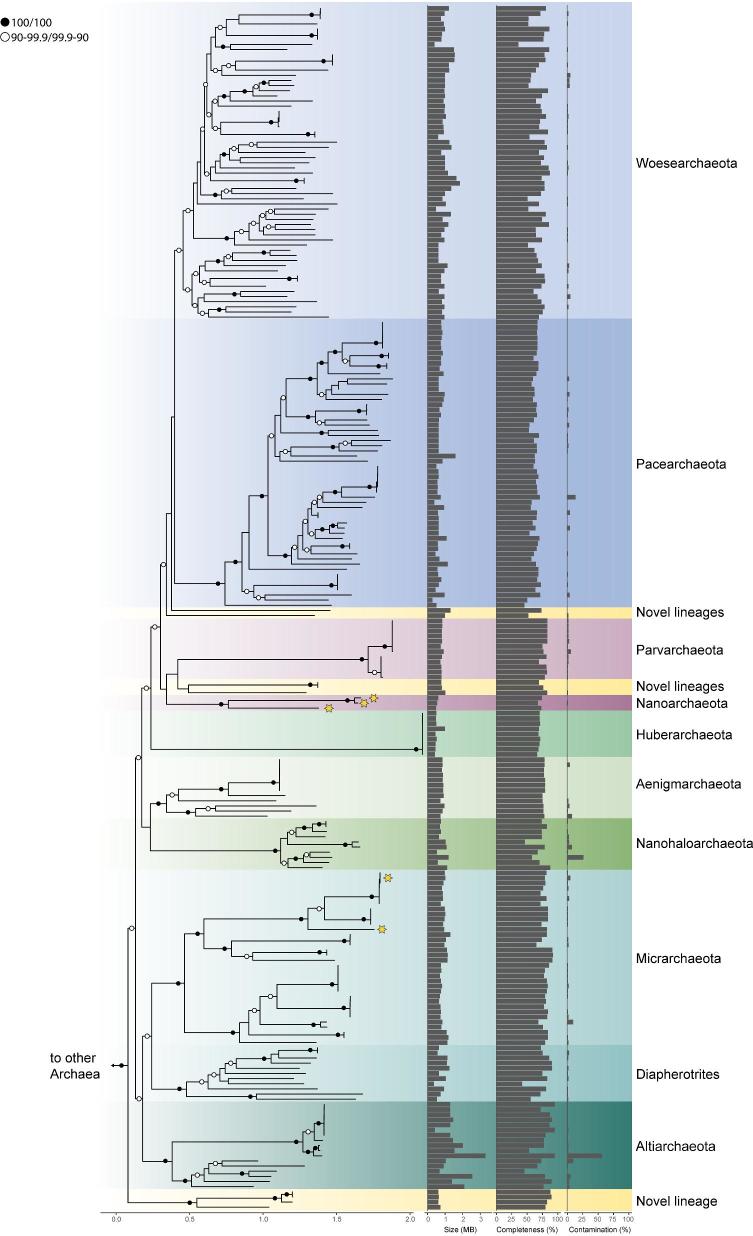
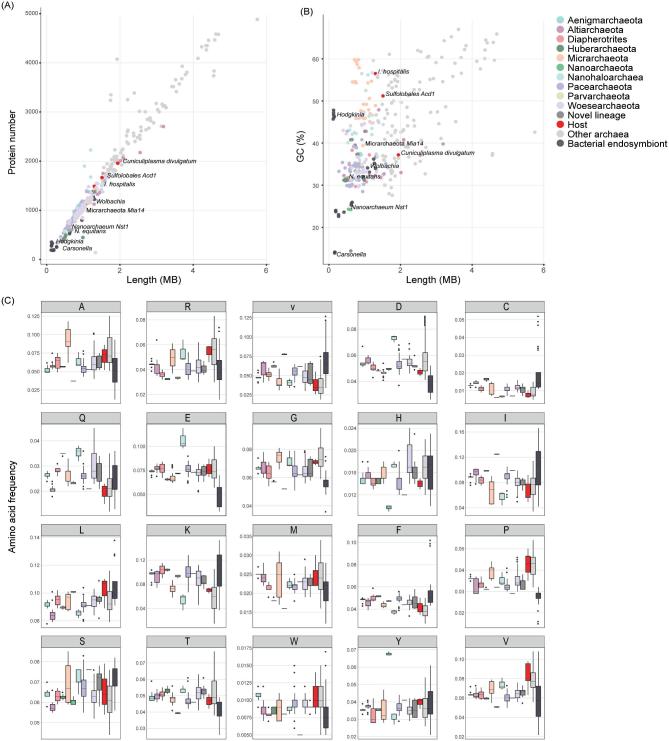
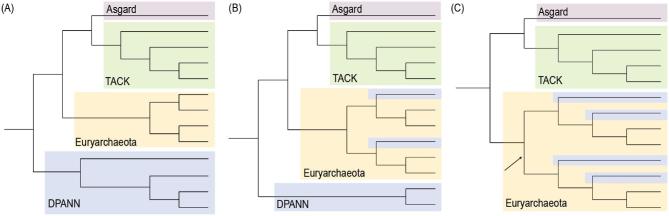
Archaea-a primary domain of life besides Bacteria-have for a long time been regarded as peculiar organisms that play marginal roles in biogeochemical cycles. However, this picture changed with the discovery of a large diversity of archaea in non-extreme environments enabled by the use of cultivation-independent methods. These approaches have allowed the reconstruction of genomes of uncultivated microorganisms and revealed that archaea are diverse and broadly distributed in the biosphere and seemingly include a large diversity of putative symbiotic organisms, most of which belong to the tentative archaeal superphylum referred to as DPANN. This archaeal group encompasses at least 10 different lineages and includes organisms with extremely small cell and genome sizes and limited metabolic capabilities. Therefore, many members of DPANN may be obligately dependent on symbiotic interactions with other organisms and may even include novel parasites. In this contribution, we review the current knowledge of the gene repertoires and lifestyles of members of this group and discuss their placement in the tree of life, which is the basis for our understanding of the deep microbial roots and the role of symbiosis in the evolution of life on Earth.
Overview
The claims and statistics of this paper haven’t been checked yet.
Run the check — free, no account needed. It reads the open-access text and checks the sources it cites.
Integrity signals
Registry
Cites
Statistics
Figures
Verification
Claims the paper makes
The claims and statistics of this paper haven’t been checked yet.
Run the check — free, no account needed. It reads the open-access text and checks the sources it cites.
Claims other papers make about this one
Each is checked against this paper’s own text: does it say what the citing paper says it does?
The source backs part of the claim, not all of it — or backs it for a different population, condition or comparison.
In the citing paper
“These artifacts are expected to particularly affect microbial lineages comprised predominantly of symbiotic members such as the CPR bacteria and DPANN archaea, as genomes of known symbionts are often compositionally biased and characterized by faster evolutionary rates (Dombrowski et al. 2019).”
From The Emergence of Life (2019) · cites this paper as Dombrowski et al. 2019
Experimental — accuracy not yet measuredThe source backs part of the claim, not all of it — or backs it for a different population, condition or comparison.
In the citing paper
“These absences are present across related lineages, suggesting a genuine loss, rather than metagenome-assembled genome incompleteness.”
From ATP synthase evolution on a cross-braced dated tree of life (2023) · cites this paper as [59]
Experimental — accuracy not yet measuredThe source backs part of the claim, not all of it — or backs it for a different population, condition or comparison.
In the citing paper
“This finding suggests that ATP synthases are not as essential as previously assumed32,33,45,65 with loss in DPANN and CPR lineages likely being the result of genome streamlining processes consistent with their predicted host-dependent lifestyles58,59.”
From ATP synthase evolution on a cross-braced dated tree of life (2023) · cites this paper as [59]
Experimental — accuracy not yet measured
Self-check
Percentages, sums and reported differences re-computed from the paper’s own numbers.
The self-check needs the paper’s full text.
Citations
Cites
Guindon, S., Dufayard, J.-F., Lefort, V., Anisimova, M., Hordijk, W., & Gascuel, O. (2010) · Systematic Biology · doi:10.1093/sysbio/syq010 · Cited by 18,376
Towards a natural system of organisms: proposal for the domains Archaea, Bacteria, and Eucarya.
Woese, C. R., Kandler, O., & Wheelis, M. L. (1990) · Proceedings of the National Academy of Sciences · doi:10.1073/pnas.87.12.4576 · Cited by 6,128
Ultrafast Approximation for Phylogenetic Bootstrap
Minh, B. Q., Nguyen, M. A. T., & von Haeseler, A. (2013) · Molecular Biology and Evolution · doi:10.1093/molbev/mst024 · Cited by 4,844
Phylogenetic structure of the prokaryotic domain: The primary kingdoms
Woese, C. R., & Fox, G. E. (1977) · Proceedings of the National Academy of Sciences · doi:10.1073/pnas.74.11.5088 · Cited by 4,131
A standardized bacterial taxonomy based on genome phylogeny substantially revises the tree of life
Parks, D. H., Chuvochina, M., Waite, D. W., Rinke, C., Skarshewski, A., Chaumeil, P.-A., & Hugenholtz, P. (2018) · Nature Biotechnology · doi:10.1038/nbt.4229 · Cited by 3,603
Archaea in coastal marine environments.
DeLong, E. F. (1992) · Proceedings of the National Academy of Sciences · doi:10.1073/pnas.89.12.5685 · Cited by 2,758
Insights into the phylogeny and coding potential of microbial dark matter
Rinke, C., Schwientek, P., Sczyrba, A., Ivanova, N. N., Anderson, I. J., Cheng, J.-F., Darling, A., Malfatti, S., Swan, B. K., Gies, E. A., et al. (2013) · Nature · doi:10.1038/nature12352 · Cited by 2,394
A new view of the tree of life
Hug, L. A., Baker, B. J., Anantharaman, K., Brown, C. T., Probst, A. J., Castelle, C. J., Butterfield, C. N., Hernsdorf, A. W., Amano, Y., Ise, K., et al. (2016) · Nature Microbiology · doi:10.1038/nmicrobiol.2016.48 · Cited by 2,039
Genomics and Evolution of Heritable Bacterial Symbionts
Moran, N. A., McCutcheon, J. P., & Nakabachi, A. (2008) · Annual Review of Genetics · doi:10.1146/annurev.genet.41.110306.130119 · Cited by 1,771
A Bayesian Mixture Model for Across-Site Heterogeneities in the Amino-Acid Replacement Process
Lartillot, N., & Philippe, H. (2004) · Molecular Biology and Evolution · doi:10.1093/molbev/msh112 · Cited by 1,516
Cited by
Sorted by citations
Items 201–232 of 232
Hu, H., Karwautz, C., Duszka, K., Karner, T., Wagner, I. C., Grander, C., Grander, W., Steinwidder, L., Boito, L., de Velde, V. V., et al. (2026) · ISME Communications · doi:10.1093/ismeco/ycag141
Unraveling the archaeal virosphere: diversity, functional and virus-host interactionsPreprint
Zhao, Y., Liu, P., Feng, M., Wen, R., Zhang, Z., Zhang, X., Huang, X., & Chi, H. (2025) · bioRxiv (Cold Spring Harbor Laboratory) · doi:10.1101/2025.11.27.691053
Xie, Y.-G., Luo, Z.-H., Fang, B.-Z., Jiao, J., Xie, Q.-J., Cao, X.-R., Qu, Y.-N., Qi, Y.-L., Rao, Y.-Z., Li, Y.-X., et al. (2022) · Figshare · doi:10.6084/m9.figshare.21340505
Xie, Y.-G., Luo, Z.-H., Fang, B.-Z., Jiao, J., Xie, Q.-J., Cao, X.-R., Qu, Y.-N., Qi, Y.-L., Rao, Y.-Z., Li, Y.-X., et al. (2022) · Figshare · doi:10.6084/m9.figshare.21340508
Šmrhová, T., Jani, K., Pajer, P., Kapinusová, G., Vylita, T., Šuman, J., Strejcek, M., & Uhlík, O. (2022) · Figshare · doi:10.6084/m9.figshare.21078724
Méheust, R., Castelle, C. J., Jaffe, A. L., & Banfield, J. F. (2022) · Figshare · doi:10.6084/m9.figshare.20236089
Méheust, R., Castelle, C. J., Jaffe, A. L., & Banfield, J. F. (2022) · Figshare · doi:10.6084/m9.figshare.20236086
Microbial Evolution and Systematics: Archaea and Bacteria
Ay, H. (2026) · Progress in molecular and subcellular biology · doi:10.1007/978-3-032-11438-9_1
Metabarcoding and metagenomic approaches to decipher microbial communities in suboxic environments
Reboul, G. (2020) · theses.fr (ABES) · doi:10.70675/f0308064z2fe8z44fczb92dzb797ed7fe3ed
Un nouveau monde microbien chez l’homme : les candidate phyla radiation (CPR)
Naud, S. (2021) · theses.fr (ABES) · doi:10.70675/2c6ab74fz802bz4a59z8eb9z97ba8ac4edd6
Comparative genomic analysis in taxonomy : classification and reclassification of bacterial species
Zgheib, R. (2021) · theses.fr (ABES) · doi:10.70675/43888f17z8ddfz4c18za819zc86b2288b819
Deep archaeal phylogeny and evolutionary dynamics of DPANNs
Baker, B. A. (2024) · theses.fr (ABES) · doi:10.70675/d2a702bfzb170z4a5fz9317z2d27179942d0
Gomez-Raya-Vilanova, M. V. (2024) · theses.fr (ABES) · doi:10.70675/426feb97z7f5ez4a21z911ezefbbc5456dc5
Bouderka, F. (2024) · theses.fr (ABES) · doi:10.70675/3d2ed8abz09a5z42a4z9c14z58de20b92eb9
Nielsen, T. N., & Lui, L. M. (2026) · bioRxiv (Cold Spring Harbor Laboratory) · doi:10.64898/2026.05.13.725050
Osburn, M. R., Casar, C. P., Stevenson, B. S., Selensky, M. J., Kruger, B. R., Momper, L., Flynn, T. M., & Amend, J. P. (2026) · Journal of Geophysical Research Biogeosciences · doi:10.1029/2025jg009515
Forterre, P., Schmitt, E., & Cunha, V. D. (2026) · bioRxiv (Cold Spring Harbor Laboratory) · doi:10.64898/2026.06.17.729505
Kadnikov, V. V., Mardanov, A. V., Beletsky, A. V., & Ravin, N. V. (2026) · Frontiers in Microbiology · doi:10.3389/fmicb.2026.1892847
Huang, W.-C., Dombrowski, N., Mahendrarajah, T., Wahl, N. A., Stamatakis, A., Szöllősi, G. J., Williams, T. A., & Spang, A. (2026) · Nature Communications · doi:10.1038/s41467-026-76386-7 · Cited by 7
Self-citationRomano, R., Morita, T., Peres, F., Lizárraga, R., Padoan, L., Nascimento, M., Rocha, L., Bendia, A., Karmann, I., & Pellizari, V. (2026) · Frontiers in Microbiology · doi:10.3389/fmicb.2026.1883366
Izotova, A. O., Komova, A. V., Zhinzhakova, L. Z., Khazieva, K. R., Созырович, К. Г., Chaika, K., & Toshchakov, S. V. (2026) · International Journal of Molecular Sciences · doi:10.3390/ijms27198549
McIntosh, J. C., Drake, H., Kim, J., Martini, A., Osburn, M. R., Shah, M., Stevenson, B. S., & Ferguson, G. (2026) · AGU Advances · doi:10.1029/2026av002557
Wan, Z., Liao, M., Wang, L., Bi, H., & Gong, C. (2026) · World Journal of Microbiology and Biotechnology · doi:10.1007/s11274-026-05289-y
Reduced vegetation growth but limited microbial restructuring in soils exposed to road deicing salts
Mahajan, S., Tedersoo, L., Almutairi, B. O., Alkahtani, S. H., Souza, J. P. S., & Niinemets, Ü. (2026) · European Journal of Soil Biology · doi:10.1016/j.ejsobi.2026.103876
Beaver, R. C., & Neufeld, J. D. (2026) · Current Biology · doi:10.1016/j.cub.2026.03.074
Metadata
- Authors
- Dombrowski, N., Lee, J.-H., Williams, T. A., Offre, P., & Spang, A.
- Affiliations
- Utrecht University (NL)
- Uppsala University (SE)
- University of Bristol (GB)
- Corresponding author
- Spang, Anja
- Venue
- FEMS Microbiology Letters
- Publisher
- Oxford University Press (OUP)
- Published
- 2019-01-01
- Volume
- 366
- Issue
- 2
- ISSN
- 0378-1097 (ISSN-L)
- 1574-6968
- PMC
- PMC6349945
- OpenAlex
- W2910961041
- Cited by
- 230
- References
- 110
- Citations by year
- 2026: 20 · 2025: 25 · 2024: 34 · 2023: 30 · 2022: 43 · 2021: 39 · 2020: 28 · 2019: 11
- FWCI
- 2.19
- Type
- journal article
- Language
- en
- Open access
- hybrid
- doi.org
- Licence
- Locations
- FEMS Microbiology Letters (publishedVersion, cc-by)
- NIOZ Publications (Royal Netherlands Institute for Sea Research) (publishedVersion, other-oa)
- Europe PMC (PubMed Central) (publishedVersion, cc-by)
- PubMed Central (publishedVersion, cc-by)
- PubMed (publishedVersion)
- Bristol Research (University of Bristol) (publishedVersion, cc-by)
- Flanders Marine Institute (Flanders Marine Institute) (submittedVersion, other-oa)
- KTH Publication Database DiVA (KTH Royal Institute of Technology) (submittedVersion, other-oa)
- Explore Bristol Research (submittedVersion, cc-by)
- Funders
- Swedish Research Council (2016-03559)
- Netherlands Organisation for Scientific Research
- Royal Society University Research
- Topics
- Physical Sciences › Environmental Science › Ecology › Microbial Community Ecology and Physiology
- Life Sciences › Biochemistry, Genetics and Molecular Biology › Molecular Biology › Genomics and Phylogenetic Studies
- Life Sciences › Agricultural and Biological Sciences › Ecology, Evolution, Behavior and Systematics › Protist diversity and phylogeny
- Keywords
- DPANN archaea, genomic diversity, symbiosis, obligate symbionts, gene repertoire, tree of life, unculturable microorganisms
- MeSH terms
- Archaea, Phylogeny, Genetic Variation, Evolution, Molecular, Genome, Archaeal
About these checks
Registry, retraction, Cites and statistics results are computed, not judged, with one exception: a printed reference that no index lists is read once by a model before it counts as a citation error. Claims are extracted by a model and kept only when their quote appears verbatim in the text; each cited source is then checked, with a model’s help, for whether it says what the claim relies on. Those verdicts can be wrong — read the claim’s quote and the cited source before relying on one.
Statistics and arithmetic are recomputed, not judged.
Confidence bands are shown only for fields calibrated on our annotated test set. None is calibrated yet, so no band is shown.
What counts as a claim ›How we measure confidence ›How we check this ›
Are you an author, or do you see a problem with this page? Request a review
