

SCPP Gene Repertoires in Teleosts and Evolutionary Changes in Bone, Teeth, and Scales
Open accessThe DOI matches its Crossref record; 58 of the 62 references it cites were found in a registry or an index, and 4 are not checked yet; none of the 55 sources its claims cite is checked for support yet.
Abstract
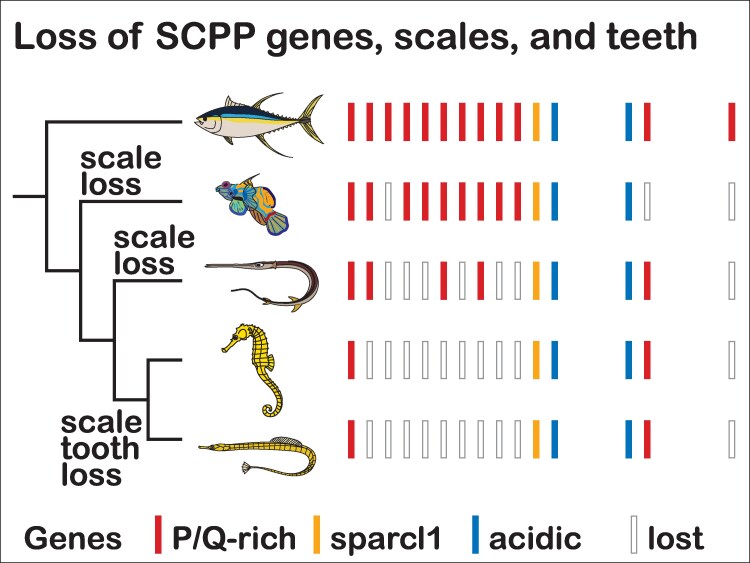
Secretory calcium-binding phosphoprotein (SCPP) genes are involved in bone, tooth, and scale formation in bony vertebrates, including teleosts. Various studies have investigated teleost SCPP genes to pinpoint genetic changes associated with phenotypic changes in mineralized skeletal elements. However, no comprehensive studies have been described to date. Here, SCPP genes were searched in 63 teleost genome sequences. The chromosomal distribution of individual SCPP genes suggests that all SCPP genes, except one, originally formed four clusters after the teleost genome duplication. Subsequently, various SCPP genes were apparently lost in different lineages, and scpp1 and spp1 were the only SCPP genes identified in all investigated teleosts. These 63 teleosts include 10 species with reduced scales, 11 scaleless species, and 2 toothless species. Among them, either scpp7 or gsp37 was missing or non-functional in 9 species with reduced scales, and both scpp7 and gsp37 in all 11 scaleless species. In seahorse and pipefish, which have bone but lost teeth and scales, scpp1, spp1, and only two other SCPP genes were found, while in closely related scaleless but toothed cornetfish, scpp5, scpp3, and odam were additionally identified. These findings suggest vital roles of scpp1 and spp1 in bone, scpp7 and gsp37 in scale, and scpp5, scpp3, and odam in tooth formation. However, many other SCPP genes are also involved in the formation of mineralized tissues and are likely important for some specific features of teeth or scales. It appears that the repertoire of SCPP genes in teleost species underlies diverse conditions of mineralized skeletal elements.
Overview
CoChat Summary
TL;DR
This comparative genomic survey of 63 teleosts found that scpp1 and spp1 are the only SCPP genes identified in all investigated species, while losses of scpp7/gsp37 and scpp5/scpp3/odam track scale and tooth loss, respectively. The study proposes a basic teleost SCPP repertoire for bone, teeth, and scales.
Key findings
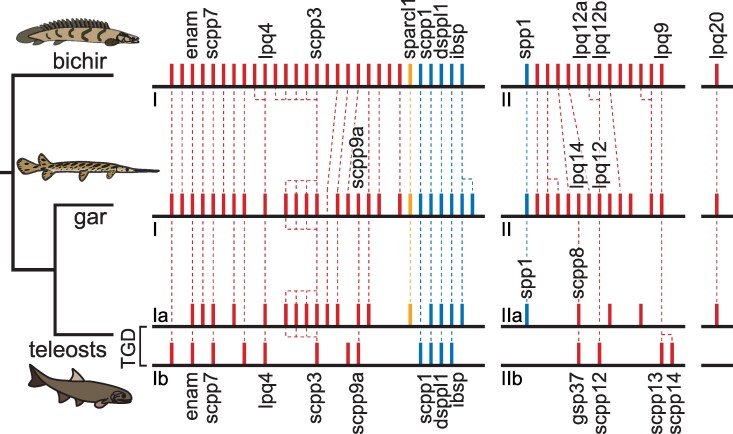
- Across 63 teleost genomes, all SCPP genes except scpplpq20 originally formed four clusters after the teleost genome duplication: Ia, Ib, IIa, and IIb; scpp1 and spp1 were the only SCPP genes identified in all investigated teleosts.
- Among the 63 teleosts, which include 10 species with reduced scales, 11 scaleless species, and 2 toothless species, either scpp7 or gsp37 was missing or non-functional in 9 species with reduced scales, and both scpp7 and gsp37 were missing/non-functional in all 11 scaleless species.
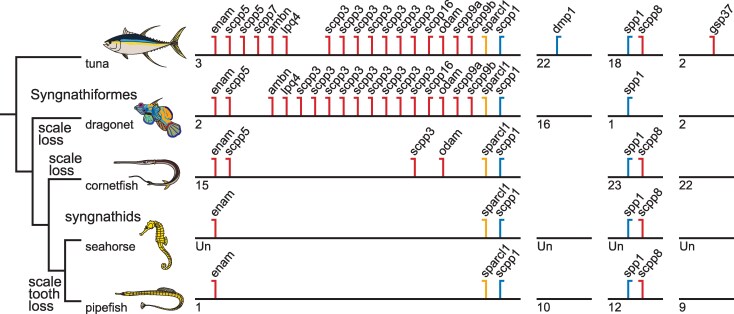
- In seahorse and pipefish, which have bone but lost teeth and scales, scpp1, spp1, and only two other SCPP genes were found; in closely related scaleless but toothed cornetfish, scpp5, scpp3, and odam were additionally identified.
- The proposed basic repertoire for teleost mineralized skeletal elements is scpp1, spp1, scpp5, scpp3, odam, scpp7, and gsp37; spp1 and odam are shared with sarcopterygians including coelacanth, while orthologs of the other five have remained unidentified in sarcopterygians to date.
Methods
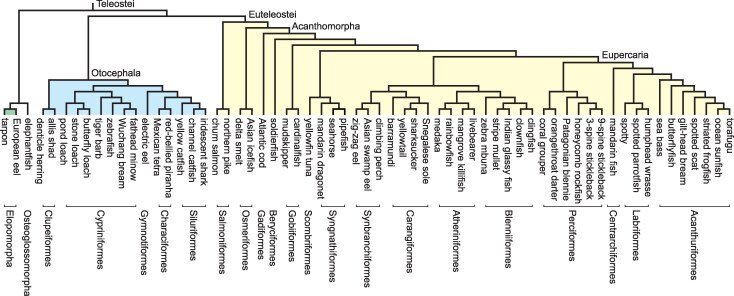
- The study searched SCPP genes in 63 teleost genome sequences selected because genome assemblies were relatively well annotated and massive RNA-seq data were available; the sample encompasses Elopomorpha (2 species), Osteoglossomorpha (1 species), Otocephala (15 species), and Euteleostei (45 species).
- SCPP gene clusters were identified by BLAST at NCBI, by examining annotated genes and RNA-seq exon coverage in SCPP gene clusters using the NCBI genome data viewer, and by gene prediction with Genscan; missing genes/exons were manually sought via potential “AG” splice acceptor sites and by translating downstream nucleotide sequence.
- Genes with premature termination codons, frameshifts, noncanonical splice sites, or unusual coding sequences were reassembled by BLASTN using Sequence Read Archive data, with raw SRA data assembled using CAP3.
Limitations
- Stated in the paper: cornetfish cluster Ib was not thoroughly investigated because of limited gene annotations; the presence or absence of scales is unclear in stone loach; it is not clear whether absence of scpp7 explains merely small scales of Atlantic cod; and loss of SCPP genes does not necessarily associate with overt changes in skeletal tissues, as illustrated by pike scpp7 genes.
- Evident from the text: the study is comparative and correlational, relying on existing genome assemblies, annotations, and RNA-seq data plus manual gene prediction and SRA reassembly, without experimental functional validation of the proposed roles.
- Evident from the text: the analysis covers 63 teleosts, not all teleosts, so lineage-specific patterns may remain undetected.
Model-written summary. Check it against the paper before relying on it.
Integrity signals
Registry
Cites
Statistics
Figures
Verification
Claims the paper makes
0 Valid · 0 Not valid · 43 Not checked · 61 Own results and interpretations
A result the paper reports from its own data — it cites no other source for it, so there is none to check. The quote shows it is in the paper.
In the paper
“scpp1 and spp1 were the only SCPP genes identified in all investigated teleosts”
- Also stated in: § Acidic SCPP Genes and Bone in Teleosts · plain
“Among SCPP genes, scpp1 and spp1 are the only genes identified in all teleosts studied to date.”
§ SCPP Gene Repertoires in Teleosts and Evolutionary Changes in Bone, Teeth, and Scales > Abstract
plain- Asserted: passes — The authors put it forward as true.
- Checkable: passes — It can be checked against evidence.
- Load-bearing: passes — The paper’s conclusions depend on it.
- Based: passes — The paper gives a reason why it holds.
- Also stated in: § Acidic SCPP Genes and Bone in Teleosts · plain
None of the sources cited for this claim have been checked yet.
In the paper
“no functional scpp7 was identified in scaleless teleosts, like catfishes (Siluriformes) and sticklebacks”
§ SCPP Gene Repertoires in Teleosts and Evolutionary Changes in Bone, Teeth, and Scales > Results > P/Q-Rich SCPP Genes in Teleosts: Phylogenetic Distribution and Expression in Teeth and Scales
What the sources say
plain- Asserted: passes — The authors put it forward as true.
- Checkable: passes — It can be checked against evidence.
- Load-bearing: passes — The paper’s conclusions depend on it.
- Based: passes — The paper gives a reason why it holds.
A result the paper reports from its own data — it cites no other source for it, so there is none to check. The quote shows it is in the paper.
In the paper
“gsp37 was not found in scaleless teleosts, like catfishes and sticklebacks”
§ SCPP Gene Repertoires in Teleosts and Evolutionary Changes in Bone, Teeth, and Scales > Results > P/Q-Rich SCPP Genes in Teleosts: Phylogenetic Distribution and Expression in Teeth and Scales
plain- Asserted: passes — The authors put it forward as true.
- Checkable: passes — It can be checked against evidence.
- Load-bearing: unclear — It is unclear whether the paper’s conclusions depend on it.
- Based: passes — The paper gives a reason why it holds.
A result the paper reports from its own data — it cites no other source for it, so there is none to check. The quote shows it is in the paper.
In the paper
“Among six acidic SCPP genes (dmp1, scpp1, dsppl1, ibsp, mepe, and spp1) found in bichir and gar, all their orthologs were identified in tarpon.”
§ SCPP Gene Repertoires in Teleosts and Evolutionary Changes in Bone, Teeth, and Scales > Results > Acidic SCPP Genes in Teleosts: Retention and Lineage-specific Loss
plain- Asserted: passes — The authors put it forward as true.
- Checkable: passes — It can be checked against evidence.
- Load-bearing: unclear — It is unclear whether the paper’s conclusions depend on it.
- Based: passes — The paper gives a reason why it holds.
A result the paper reports from its own data — it cites no other source for it, so there is none to check. The quote shows it is in the paper.
In the paper
“in closely related scaleless but toothed cornetfish, scpp5, scpp3, and odam were additionally identified”
§ SCPP Gene Repertoires in Teleosts and Evolutionary Changes in Bone, Teeth, and Scales > Abstract
plain- Asserted: passes — The authors put it forward as true.
- Checkable: passes — It can be checked against evidence.
- Load-bearing: passes — The paper’s conclusions depend on it.
- Based: passes — The paper gives a reason why it holds.
72 more claims
Create a free account to see all 104 claims and to verify the 51 references still open.
- It may state two separate claims as one. 20
- Probably not a substantial claim. 7
Self-check
Percentages, sums and reported differences re-computed from the paper’s own numbers.
Each contradiction between two passages listed here was confirmed by an independent check.
Rated minor: it would not touch a result — a value no result rests on, a p-value that stays on the same side of the significance level, or a conflict that is clerical, resolved elsewhere in the paper, or outside its own findings.
In the paper
§ SCPP Gene Repertoires in Teleosts and Evolutionary Changes in Bone, Teeth, and Scales > Results > P/Q-Rich SCPP Genes in Teleosts: Phylogenetic Distribution and Expression in Teeth and Scales
“Like scpp3 and scpp5, scpplpq4 was identified in all teleosts except syngnathids.”
§ SCPP Gene Repertoires in Teleosts and Evolutionary Changes in Bone, Teeth, and Scales > Discussion > SCPP Gene Repertoire and Teeth in Teleosts
“In mandarin dragonet, ambn, scpp9a, scpp9b, scpp16, and scpplpq4 were found among SCPP genes missing in both syngnathids and cornetfish (Fig. 3).”
Citations
Cites
Basic local alignment search tool
Altschul, S. F., Gish, W., Miller, W., Myers, E. W., & Lipman, D. J. (1990) · Journal of Molecular Biology · doi:10.1006/jmbi.1990.9999 · Cited by 98,669
CAP3: A DNA Sequence Assembly Program
Huang, X., & Madan, A. (1999) · Genome Research · doi:10.1101/gr.9.9.868 · Cited by 5,261
Prediction of complete gene structures in human genomic DNA
Burge, C., & Karlin, S. (1997) · Journal of Molecular Biology · doi:10.1006/jmbi.1997.0951 · Cited by 4,228
Nelson, J. S., Grande, T. C., & Wilson, M. V. H. (2016) · Wiley eBooks · doi:10.1002/9781119174844 · Cited by 2,096
The spotted gar genome illuminates vertebrate evolution and facilitates human-teleost comparisons
Braasch, I., Gehrke, A. R., Smith, J. J., Kawasaki, K., Manousaki, T., Pasquier, J., Amores, A., Desvignes, T., Batzel, P., Catchen, J., et al. (2016) · Nature Genetics · doi:10.1038/ng.3526 · Cited by 618
Self-citationInterrelationships of the ostariophysan fishes (Teleostei)
FINK, S. V., & FINK, W. L. (1981) · Zoological Journal of the Linnean Society · doi:10.1111/j.1096-3642.1981.tb01575.x · Cited by 454
Kawasaki, K., & Weiss, K. M. (2003) · Proceedings of the National Academy of Sciences · doi:10.1073/pnas.0638023100 · Cited by 314 · cited 1×
“In bony vertebrates (osteichthyans), many of these proteins belong to the secretory calcium-binding phosphoprotein (SCPP) fam - ily (Kawasaki and Weiss 2003).”
Self-citationSire, J.-Y., & Akimenko, M.-A. (2004) · The International Journal of Developmental Biology · doi:10.1387/ijdb.15272389 · Cited by 267
Liu, Z., Liu, S., Yao, J., Bao, L., Zhang, J., Li, Y., Jiang, C., Sun, L., Wang, R., Zhang, Y., et al. (2016) · Nature Communications · doi:10.1038/ncomms11757 · Cited by 254
The seahorse genome and the evolution of its specialized morphology
Lin, Q., Fan, S., Zhang, Y., Xu, M., Zhang, H., Yang, Y., Lee, A. P., Woltering, J. M., Ravi, V., Gunter, H. M., et al. (2016) · Nature · doi:10.1038/nature20595 · Cited by 237
Research works printed but not linked: 5
- Cockerell TDA. The scales of the cobitid and homalopterid fishes. Proc Biol Sci Wash. 1909: XXII: 205– 208. https://www.biodiversitylibrary.org/item/22857.
- Fischer W, Bianchi G. Echeneidae. In: Fisheries and aquatic management division, editor. FAO Species identification sheets for fishery purposes Western Indian Ocean: fishing area 51. FAO; 1984.
- Fritzsche RA, Thiesfeld KG. Fistulariidae, cornetfishes (flute mouths). In: Carpenter KE, Niem VH, editors. FAO species identification guide for fishery purposes: the living marine resources of the western central Pacific. FAO; 1999. p. 2278– 2279.
- Paulus T. Syngnathidae, pipefishes and seahorses. In: Carpenter KE, Niem VH, editors. FAO species identification guide for fishery purposes: the living marine resources of the western Central Pacific. FAO; 1999. p. 2264– 2276.
- Sadovy Y, Randall JE, Rasotto MB. Skin structure in six dragonet species (Gobiesociformes; Callionymidae): interspecific differences in glandular cell types and mucus secretion. J Fish Biol. 2005: 66: 1411– 1418. 10.1111/j.0022-1112.2005.00692.x. · doi:10.1111/j.0022-1112.2005.00692.x
Cited by
Still being checked.
Metadata
- Authors
- Kawasaki, K.
- Affiliations
- Pennsylvania State University (US)
- Corresponding author
- Kawasaki, Kazuhiko
- ORCID
- Kawasaki, Kazuhiko
- Venue
- Genome Biology and Evolution
- Publisher
- Oxford University Press (OUP)
- Published
- 2026-06-22
- Volume
- 18
- Issue
- 7
- Pages
- evag148
- ISSN
- 1759-6653 (ISSN-L)
- PMC
- PMC13367325
- OpenAlex
- W7165567029
- Cited by
- 0
- References
- 62
- FWCI
- 0.00
- Type
- journal article
- Language
- en
- Open access
- gold
- doi.org
- Licence
- Locations
- Genome Biology and Evolution (publishedVersion, cc-by)
- PubMed Central (publishedVersion, cc-by)
- PubMed (publishedVersion)
- Funders
- Office of Research and Development
- Northwestern University
- Auburn University
- Washington State University
- Michigan State University
- Pennsylvania State University
- Iowa State University
- Broad Institute
- National University of Singapore
- Chinese Academy of Sciences
- Northwestern Polytechnical University
- Okinawa Institute of Science and Technology Graduate University
- University of Tokyo
- Wuhan University
- Huazhong Agricultural University
- Shanghai Ocean University
- Temasek Life Sciences Laboratory
- University of Chinese Academy of Sciences
- Institut National de Recherche pour l'Agriculture, l'Alimentation et l'Environnement
- Directorate for Biological Sciences
- University of Illinois at Urbana-Champaign
- College of Engineering, Michigan State University
- Fisheries and Oceans Canada
- Chinese Academy of Fishery Sciences
- Institute of Hydrobiology
- Yellow Sea Fisheries Research Institute, Chinese Academy of Fishery Sciences
- Topics
- Life Sciences › Biochemistry, Genetics and Molecular Biology › Molecular Biology › Developmental Biology and Gene Regulation
- Life Sciences › Biochemistry, Genetics and Molecular Biology › Biochemistry › Bone and Dental Protein Studies
- Life Sciences › Agricultural and Biological Sciences › Aquatic Science › Fish Biology and Ecology Studies
- Keywords
- teleosts, teleost genome duplication, gene loss, osteopontin, ODAM, tooth development, scaling, bone formation, seahorse, pipefish
- MeSH terms
- Animal Scales, Animals, Bone and Bones, Calcium-Binding Proteins, Fishes, Phosphoproteins, Phylogeny, Tooth, Evolution, Molecular, Fish Proteins
About these checks
Registry, retraction, Cites and statistics results are computed, not judged, with one exception: a printed reference that no index lists is read once by a model before it counts as a citation error. Claims are extracted by a model and kept only when their quote appears verbatim in the text; each cited source is then checked, with a model’s help, for whether it says what the claim relies on. Those verdicts can be wrong — read the claim’s quote and the cited source before relying on one.
A language model drew the claims from the paper on 2026-11-25, under version 3 of the claim definition (model deepseek-v4.1-flash, prompt extract-v3).
A second model labelled each claim on 2026-11-25 (model jev-1.13-20260917, definition revision gold-guideline-v0.2).
Statistics and arithmetic are recomputed, not judged.
Confidence bands are shown only for fields calibrated on our annotated test set. None is calibrated yet, so no band is shown.
What counts as a claim ›How we measure confidence ›How we check this ›
Are you an author, or do you see a problem with this page? Request a review
How to cite
Cite CoChat for the checks on this page, and the paper for its own findings.
- This page
- CoChat. (2026). Citation check: SCPP Gene Repertoires in Teleosts and Evolutionary Changes in Bone, Teeth, and Scales. https://app.cochat.ai/papers/10.1093/gbe/evag148
- The paper
- Kawasaki, K. (2026). SCPP Gene Repertoires in Teleosts and Evolutionary Changes in Bone, Teeth, and Scales. Genome Biology and Evolution. https://doi.org/10.1093/gbe/evag148
Data sources
Bibliographic data: Semantic Scholar, OpenAlex, Crossref.
Contains information from the Semantic Scholar Academic Graph Datasets, made available under the ODC Attribution License (ODC-BY 1.0).
Semantic Scholar’s data is described in: Kinney, R., et al. (2023). The Semantic Scholar Open Data Platform. arXiv:2301.10140.
