

Why It Is Time to Look Beyond Algal Genes in Photosynthetic Slugs
Open accessThe DOI matches its Crossref record; 47 of the 47 references it cites were found in a registry or an index.
Abstract
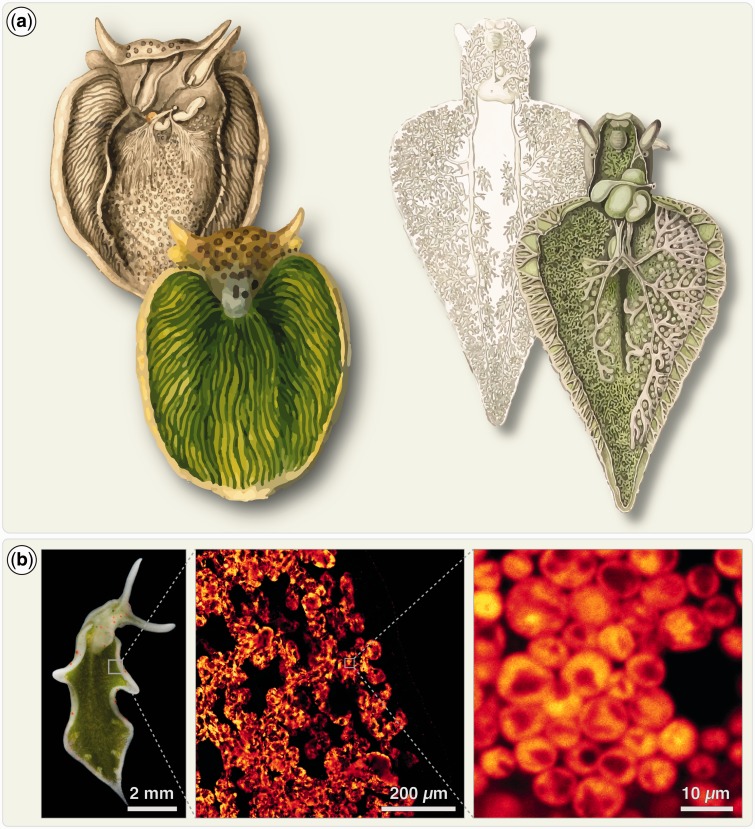
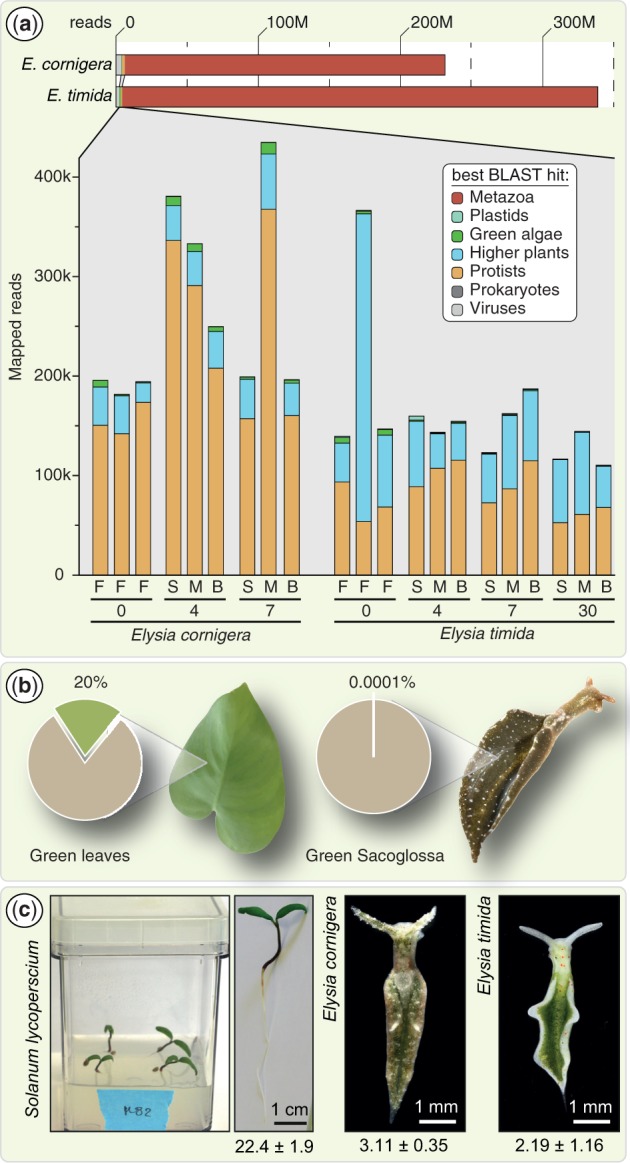
Eukaryotic organelles depend on nuclear genes to perpetuate their biochemical integrity. This is true for mitochondria in all eukaryotes and plastids in plants and algae. Then how do kleptoplasts, plastids that are sequestered by some sacoglossan sea slugs, survive in the animals' digestive gland cells in the absence of the algal nucleus encoding the vast majority of organellar proteins? For almost two decades, lateral gene transfer (LGT) from algae to slugs appeared to offer a solution, but RNA-seq analysis, later supported by genome sequencing of slug DNA, failed to find any evidence for such LGT events. Yet, isolated reports continue to be published and are readily discussed by the popular press and social media, making the data on LGT and its support for kleptoplast longevity appear controversial. However, when we take a sober look at the methods used, we realize that caution is warranted in how the results are interpreted. There is no evidence that the evolution of kleptoplasty in sea slugs involves LGT events. Based on what we know about photosystem maintenance in embryophyte plastids, we assume kleptoplasts depend on nuclear genes. However, studies have shown that some isolated algal plastids are, by nature, more robust than those of land plants. The evolution of kleptoplasty in green sea slugs involves many promising and unexplored phenomena, but there is no evidence that any of these require the expression of slug genes of algal origin.
Overview
The claims and statistics of this paper haven’t been checked yet.
Free: it reads the open-access text and checks the first 5 claims that cite a source we can check. Create a free account to check every claim.
Integrity signals
Registry
Cites
Statistics
Figures
Verification
Claims the paper makes
The claims and statistics of this paper haven’t been checked yet.
Free: it reads the open-access text and checks the first 5 claims that cite a source we can check. Create a free account to check every claim.
Claims other papers make about this one
Each is checked against this paper’s own text: does it say what the citing paper says it does?
The cited source says what the claim attributes to it.
In the citing paper
“Transcriptome and genome sequencing have failed to provide evidence of gene transfer from algae to the sacoglossan sea slug nuclear genome, despite suggestions that this had occurred (see Bhattacharya et al. 2013; Rauch et al. 2015 and references therein).”
From Genomic Insights into Plastid Evolution (2020) · cites this paper as Rauch et al. 2015
Self-check
Percentages, sums and reported differences re-computed from the paper’s own numbers.
The self-check needs the paper’s full text.
Citations
Cites
Endosymbiotic gene transfer: organelle genomes forge eukaryotic chromosomes
Timmis, J. N., Ayliffe, M. A., Huang, C. Y., & Martin, W. (2004) · Nature Reviews Genetics · doi:10.1038/nrg1271 · Cited by 1,568
Molecular Poltergeists: Mitochondrial DNA Copies (numts) in Sequenced Nuclear Genomes
Hazkani-Covo, E., Zeller, R. M., & Martin, W. (2010) · PLoS Genetics · doi:10.1371/journal.pgen.1000834 · Cited by 629
Fratini, M., Bukreeva, I., Campi, G., Brun, F., Tromba, G., Modregger, P., Bucci, D., Battaglia, G., Spanò, R., Mastrogiacomo, M., et al. (2015) · Scientific Reports · doi:10.1038/srep10771 · Cited by 377
Endosymbiotic origin and differential loss of eukaryotic genes
Ku, C., Nelson-Sathi, S., Roettger, M., Sousa, F. L., Lockhart, P. J., Bryant, D., Hazkani-Covo, E., McInerney, J. O., Landan, G., & Martin, W. F. (2015) · Nature · doi:10.1038/nature14963 · Cited by 347
Gene Expression in Autumn Leaves
Bhalerao, R., Keskitalo, J., Sterky, F., Erlandsson, R., Björkbacka, H., Birve, S. J., Karlsson, J., Gardeström, P., Gustafsson, P., Lundeberg, J., et al. (2003) · Plant Physiology · doi:10.1104/pp.012732 · Cited by 305
Pericentriolar material structure and dynamics
Woodruff, J. B., Wueseke, O., & Hyman, A. A. (2014) · Philosophical Transactions of the Royal Society B: Biological Sciences · doi:10.1098/rstb.2013.0459 · Cited by 297
メチル化DNA結合タンパク質MBD2はグルココルチコイド受容体のNGFI-A(egr-1)媒介転写活性化を促進する
Ian, C., Castleden, I. R., Shelley, E. B., Stephen, D., Sergiy, D., Josie, D., Tie-Yuan, Z., Moshe Szyf, A., & Michael, J. M. (2014) · Philosophical Transactions of the Royal Society B Biological Sciences · Cited by 255
Endosymbiotic associations within protists
Nowack, E. C. M., & Melkonian, M. (2010) · Philosophical Transactions of the Royal Society B: Biological Sciences · doi:10.1098/rstb.2009.0188 · Cited by 246
Retention of transcriptionally active cryptophyte nuclei by the ciliate Myrionecta rubra
Johnson, M. D., Oldach, D., Delwiche, C. F., & Stoecker, D. K. (2007) · Nature · doi:10.1038/nature05496 · Cited by 226 · cited 2×
“The authors thank the Library of the Naturalis Biodiversity Centre (Netherlands) for the rasterized scans of van Hasselt’s Plakobranchus.”
BackgroundIsolation of membranes and organelles from plant cells.
Hall, J. L., & Moore, A. L. (1983) · Academic Press eBooks · Cited by 223
Research works printed but not linked: 1
- Stolz B Walz D 1988 The absorption spectrum of single plebs and the specific surface thylakoids. Mol Cell Biol. 7: 83– 88.
Cited by
Genomic Insights into Plastid Evolution
Sibbald, S. J., & Archibald, J. M. (2020) · Genome Biology and Evolution · doi:10.1093/gbe/evaa096 · Cited by 161
Network-Thinking: Graphs to Analyze Microbial Complexity and Evolution
Corel, E., Lopez, P., Méheust, R., & Bapteste, E. P. (2016) · Trends in Microbiology · doi:10.1016/j.tim.2015.12.003 · Cited by 135
Hehenberger, E., Gast, R. J., & Keeling, P. J. (2019) · Proceedings of the National Academy of Sciences · doi:10.1073/pnas.1910121116 · Cited by 91
“D. Bhattacharya, K. N. Pelletreau, D. C. Price, K. E. Sarver, M. E. Rumpho, Genome analysis of Elysia chlorotica Egg DNA provides no evidence for horizontal gene transfer into the germ line of this Kleptoplastic Mollusc.”
BackgroundInfluentialMaeda, T., Takahashi, S., Yoshida, T., Shimamura, S., Takaki, Y., Nagai, Y., Toyoda, A., Suzuki, Y., Arimoto, A., Ishii, H., et al. (2021) · eLife · doi:10.7554/elife.60176 · Cited by 65
A new case of kleptoplasty in animals: Marine flatworms steal functional plastids from diatoms
Steenkiste, N. W. L. V., Stephenson, I., Herranz, M., Husník, F., Keeling, P. J., & Leander, B. S. (2019) · Science Advances · doi:10.1126/sciadv.aaw4337 · Cited by 59
Secondary Plastids of Stramenopiles
Dorrell, R. G., & Bowler, C. (2017) · Advances in botanical research · doi:10.1016/bs.abr.2017.06.003 · Cited by 43
Horizontal transfer of a retrotransposon between parasitic nematodes and the common shrew
Dunemann, S. M., & Wasmuth, J. D. (2019) · Mobile DNA · doi:10.1186/s13100-019-0166-3 · Cited by 29
Photoprotective Non-photochemical Quenching Does Not Prevent Kleptoplasts From Net Photoinactivation
Christa, G., Pütz, L., Sickinger, C., Clavijo, J. M., Laetz, E. M. J., Greve, C., & Serôdio, J. (2018) · Frontiers in Ecology and Evolution · doi:10.3389/fevo.2018.00121 · Cited by 24
Self-citationExamining the retention of functional kleptoplasts and digestive activity in sacoglossan sea slugs
Laetz, E. M. J., Rühr, P. T., Bartolomaeus, T., Preisfeld, A., & Wägele, H. (2016) · Organisms Diversity & Evolution · doi:10.1007/s13127-016-0308-0 · Cited by 23
Self-citationTakahashi, T. (2016) · Scientific Reports · doi:10.1038/srep31638 · Cited by 20
Cheng, W.-H., Huang, K., Huang, P.-J., Lee, C., Yeh, Y., Ku, F.-M., Lin, R., Cheng, M., Chiu, C., & Tang, P. (2017) · Parasites & Vectors · doi:10.1186/s13071-017-2381-4 · Cited by 16
Evolution: Welcome to Symbiont Prison
Kiers, E. T., & West, S. A. (2016) · Current Biology · doi:10.1016/j.cub.2015.12.009 · Cited by 16
Donohoo, S. A., Wade, R. M., & Sherwood, A. R. (2020) · Biological Bulletin · doi:10.1086/709371 · Cited by 15
Laetz, E. M. J., & Wägele, H. (2018) · Frontiers in Zoology · doi:10.1186/s12983-018-0264-y · Cited by 14
Self-citationRauch, C., Christa, G., de Vries, J., Woehle, C., & Gould, S. B. (2017) · Genome Biology and Evolution · doi:10.1093/gbe/evx129 · Cited by 14
Self-citationTakahashi, T. (2017) · Energies · doi:10.3390/en10091413 · Cited by 12
Weiner, A. K. M., Cullison, B., Date, S. V., Tyml, T., Volland, J., Woyke, T., Katz, L. A., & Sleith, R. S. (2021) · Protist · doi:10.1016/j.protis.2021.125853 · Cited by 11
Laetz, E. M. J., Kahyaoglu, C., Borgstein, N. M., Merkx, M., van der Meij, S. E. T., & Verberk, W. C. E. P. (2024) · Journal of Experimental Biology · doi:10.1242/jeb.246331 · Cited by 9
Self-citationChihara, S., Nakamura, T., & Hirose, E. (2020) · PubMed Central · doi:10.6620/zs.2020.59-65 · Cited by 9
Cells in Evolutionary Biology: Translating Genotypes into Phenotypes – Past, Present, Future
Schneider, R. A. (2018) · CRC Press eBooks · doi:10.1201/9781315155968 · Cited by 8
Kleptoplasts are continuously digested during feeding in the plastid-bearing sea slug Elysia viridis
Frankenbach, S., Luppa, Q., Serôdio, J., Greve, C., Bleidißel, S., Clavijo, J. M., Laetz, E. M. J., Preisfeld, A., & Christa, G. (2021) · Journal of Molluscan Studies · doi:10.1093/mollus/eyab022 · Cited by 7
Self-citationUlvophyceaen photophysiology and research opportunities
Handrich, M. R., de Vries, J., Gould, S. B., Serôdio, J., & Christa, G. (2017) · Perspectives in Phycology · doi:10.1127/pip/2017/0074 · Cited by 7
Self-citationPlastid Autonomy vs Nuclear Control Over Plastid Function
de Vries, J., & Archibald, J. M. (2017) · Advances in botanical research · doi:10.1016/bs.abr.2017.11.011 · Cited by 4
Self-citationTargeting Plastids in an Animal Cell
Clavijo, J. M., Gould, S. B., & Christa, G. (2024) · Springer eBooks · doi:10.1007/978-3-031-57446-7_8 · Cited by 3
Self-citationMaeda, T., Takahashi, S., Yoshida, T., Shimamura, S., Takaki, Y., Nagai, Y., Toyoda, A., Suzuki, Y., Arimoto, A., Ishii, H., et al. (2020) · bioRxiv (Cold Spring Harbor Laboratory) · doi:10.1101/2020.06.16.155838 · Cited by 1
Kleptoplasty: Solar-powered sea slugs house stolen plastids in kleptosomes
Baştürk, M. N., Christa, G., & de Vries, J. (2025) · Current Biology · doi:10.1016/j.cub.2025.07.072 · Cited by 1
Self-citationGénomique des virus "géants", des virophages, et échanges génétiques avec leur hôtes eucaryotes
Gallot-Lavallée, L. (2017) · theses.fr (ABES) · doi:10.70675/b42a7c5az169fz42fdz8119z66e7c3207c09
Büdel, B. (2024) · Springer eBooks · doi:10.1007/978-3-662-65712-6_6
Étude des processus introgressifs en évolution par des méthodes de réseaux
Méheust, R. (2016) · theses.fr (ABES) · doi:10.70675/1e50c9cdzd68dz470ezb00ez619849f86137
Ist die Schnecke, was sie isst?
Tetsch, L. (2016) · Biologie in unserer Zeit · doi:10.1002/biuz.201690048
Metadata
- Authors
- Rauch, C., Vries, J. D., Rommel, S., Rose, L. E., Woehle, C., Christa, G., Laetz, E. M., Wägele, H., Tielens, A. G. M., Nickelsen, J., Schumann, T., Jahns, P., & Gould, S. B.
- Affiliations
- Heinrich Heine University Düsseldorf (DE)
- Christian-Albrechts-Universität zu Kiel (DE)
- Zoological Research Museum Alexander Koenig (DE)
- Utrecht University (NL)
- Ludwig-Maximilians-Universität München (DE)
- Corresponding author
- Gould, Sven B.
- ORCID
- Venue
- Genome Biology and Evolution
- Publisher
- Oxford University Press (OUP)
- Published
- 2015-08-29
- Volume
- 7
- Issue
- 9
- Pages
- 2602-2607
- ISSN
- 1759-6653 (ISSN-L)
- PMC
- PMC4607529
- OpenAlex
- W2172312791
- Semantic Scholar
- de6611db9b33f50c86a46aa73fd8b14e8468a9ab
- Cited by
- 28
- References
- 47
- Citations by year
- 2025: 1 · 2024: 3 · 2023: 1 · 2021: 3 · 2020: 3 · 2019: 3 · 2018: 2 · 2017: 7 · 2016: 5
- FWCI
- 2.03
- Type
- journal article
- Language
- en
- Open access
- gold
- doi.org
- Licence
- cc-by-nc
- Locations
- Genome Biology and Evolution (publishedVersion, cc-by-nc)
- Europe PMC (PubMed Central) (publishedVersion, cc-by-nc)
- PubMed Central (publishedVersion, cc-by-nc)
- PubMed (publishedVersion)
- EUR Research Repository (Erasmus University Rotterdam) (publishedVersion, other-oa)
- Informationszentrum Lebenswissenschaften (ZB MED) (submittedVersion, cc-by-nc)
- EUR Research Repository (Erasmus University Rotterdam) (submittedVersion, other-oa)
- RePub (Erasmus University Rotterdam) (submittedVersion, other-oa)
- Utrecht University Repository (Utrecht University) (submittedVersion, other-oa)
- Open access LMU (Ludwid Maxmilian's Universitat Munchen) (submittedVersion)
- RePub (Erasmus University Rotterdam) (submittedVersion)
- Funders
- Deutscher Akademischer Austauschdienst
- Deutsche Forschungsgemeinschaft (GO1825/4-1)
- Topics
- Life Sciences › Agricultural and Biological Sciences › Ecology, Evolution, Behavior and Systematics › Protist diversity and phylogeny
- Life Sciences › Biochemistry, Genetics and Molecular Biology › Molecular Biology › Photosynthetic Processes and Mechanisms
- Life Sciences › Biochemistry, Genetics and Molecular Biology › Genetics › Chromosomal and Genetic Variations
- Keywords
- kleptoplasty, sacoglossan sea slugs, horizontal gene transfer, digestive gland cells
- MeSH terms
- Animals, Photosynthesis, Plastids, Evolution, Molecular, Gene Transfer, Horizontal, Gastropoda
About these checks
Registry, retraction, Cites and statistics results are computed, not judged, with one exception: a printed reference that no index lists is read once by a model before it counts as a citation error. Claims are extracted by a model and kept only when their quote appears verbatim in the text; each cited source is then checked, with a model’s help, for whether it says what the claim relies on. Those verdicts can be wrong — read the claim’s quote and the cited source before relying on one.
Statistics and arithmetic are recomputed, not judged.
Confidence bands are shown only for fields calibrated on our annotated test set. None is calibrated yet, so no band is shown.
What counts as a claim ›How we measure confidence ›How we check this ›
Are you an author, or do you see a problem with this page? Request a review
Data sources
Bibliographic data: Semantic Scholar, OpenAlex, Crossref.
Contains information from the Semantic Scholar Academic Graph Datasets, made available under the ODC Attribution License (ODC-BY 1.0).
Semantic Scholar’s data is described in: Kinney, R., et al. (2023). The Semantic Scholar Open Data Platform. arXiv:2301.10140.
