

Plastid Genomes and Proteins Illuminate the Evolution of Eustigmatophyte Algae and Their Bacterial Endosymbionts
Open accessThe DOI matches its Crossref record; 71 of the 71 references it cites were found in a registry or an index.
Abstract
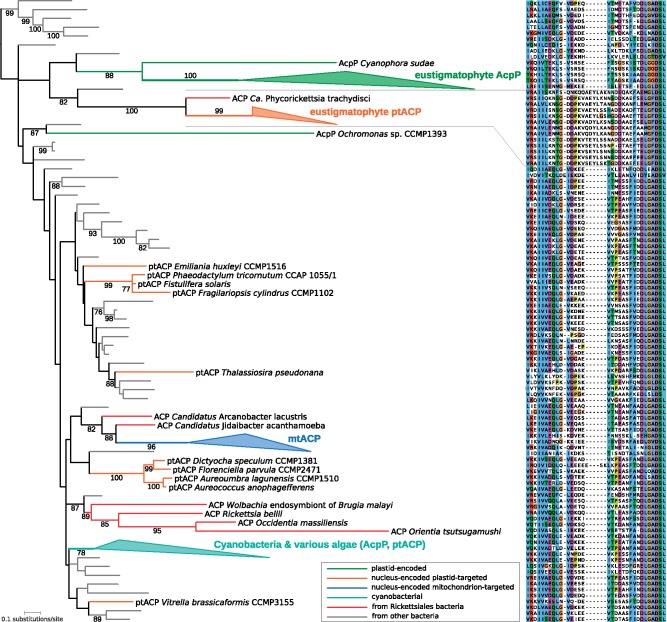
Eustigmatophytes, a class of stramenopile algae (ochrophytes), include not only the extensively studied biotechnologically important genus Nannochloropsis but also a rapidly expanding diversity of lineages with much less well characterized biology. Recent discoveries have led to exciting additions to our knowledge about eustigmatophytes. Some proved to harbor bacterial endosymbionts representing a novel genus, Candidatus Phycorickettsia, and an operon of unclear function (ebo) obtained by horizontal gene transfer from the endosymbiont lineage was found in the plastid genomes of still other eustigmatophytes. To shed more light on the latter event, as well as to generally improve our understanding of the eustigmatophyte evolutionary history, we sequenced plastid genomes of seven phylogenetically diverse representatives (including new isolates representing undescribed taxa). A phylogenomic analysis of plastid genome-encoded proteins resolved the phylogenetic relationships among the main eustigmatophyte lineages and provided a framework for the interpretation of plastid gene gains and losses in the group. The ebo operon gain was inferred to have probably occurred within the order Eustigmatales, after the divergence of the two basalmost lineages (a newly discovered hitherto undescribed strain and the Pseudellipsoidion group). When looking for nuclear genes potentially compensating for plastid gene losses, we noticed a gene for a plastid-targeted acyl carrier protein that was apparently acquired by horizontal gene transfer from Phycorickettsia. The presence of this gene in all eustigmatophytes studied, including representatives of both principal clades (Eustigmatales and Goniochloridales), is a genetic footprint indicating that the eustigmatophyte–Phycorickettsia partnership started no later than in the last eustigmatophyte common ancestor.
Overview
The claims and statistics of this paper haven’t been checked yet.
Free: it reads the open-access text and checks the first 5 claims that cite a source we can check. Create a free account to check every claim.
Integrity signals
Registry
Cites
Statistics
Figures
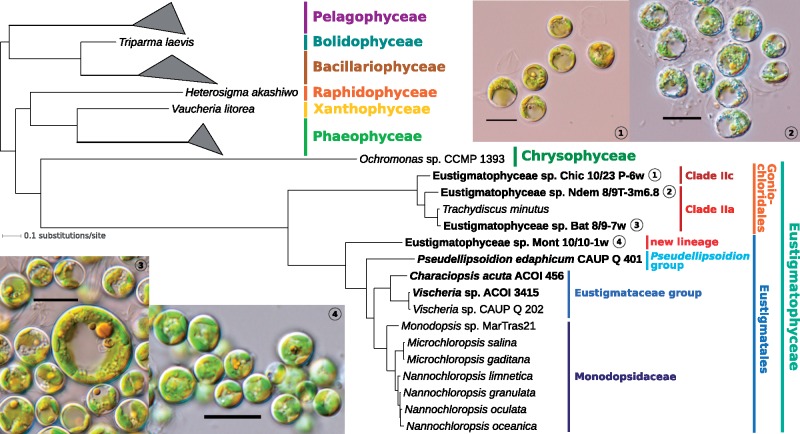
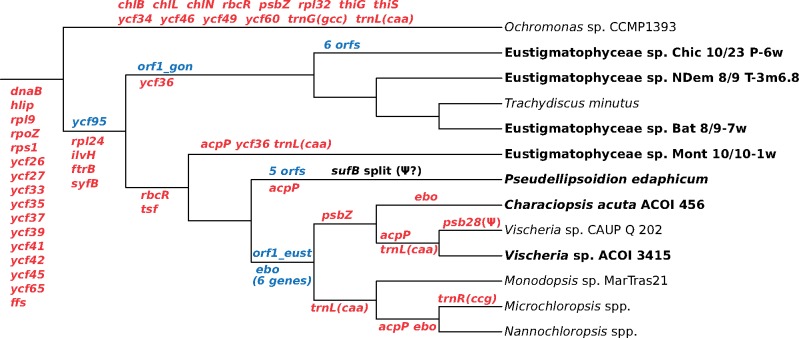
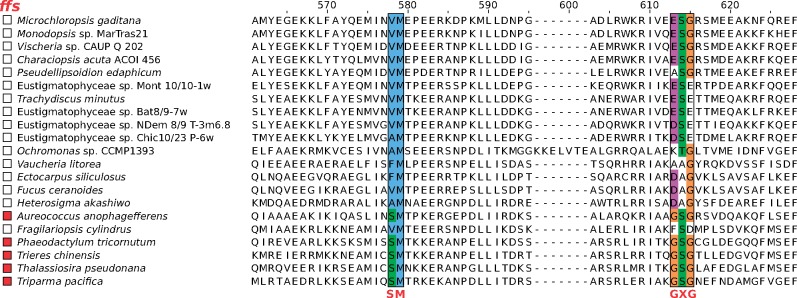
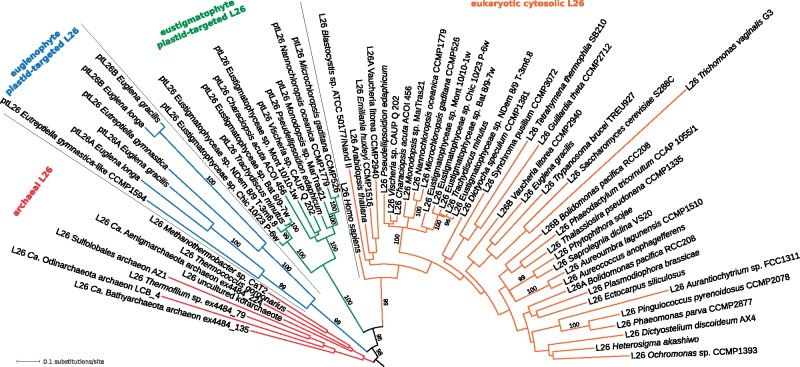
Verification
Claims the paper makes
The claims and statistics of this paper haven’t been checked yet.
Free: it reads the open-access text and checks the first 5 claims that cite a source we can check. Create a free account to check every claim.
Claims other papers make about this one
Each is checked against this paper’s own text: does it say what the citing paper says it does?
The cited source says what the claim attributes to it.
In the citing paper
“Putative LGTs from bacteria are also increasingly described in the nuclear and plastid genomes of phototrophs representing the full breadth of algal diversity (e.g., Khan et al. 2007; Dorrell et al. 2017; Ševcíková et al. 2019; Novák Vanclová et al. 2020).”
From Genomic Insights into Plastid Evolution (2020) · cites this paper as Ševcíková et al. 2019
Self-check
Percentages, sums and reported differences re-computed from the paper’s own numbers.
The self-check needs the paper’s full text.
Citations
Cites
Gapped BLAST and PSI-BLAST: a new generation of protein database search programs
Altschul, S. (1997) · Nucleic Acids Research · doi:10.1093/nar/25.17.3389 · Cited by 73,302
Trimmomatic: a flexible trimmer for Illumina sequence data
Bolger, A. M., Lohse, M., & Usadel, B. (2014) · Bioinformatics · doi:10.1093/bioinformatics/btu170 · Cited by 65,548
Fast gapped-read alignment with Bowtie 2
Langmead, B., & Salzberg, S. L. (2012) · Nature Methods · doi:10.1038/nmeth.1923 · Cited by 56,400 · cited 1×
“3.4.1 (Langmead and Salzberg 2012) onto intermediate and final assemblies.”
InfluentialMAFFT Multiple Sequence Alignment Software Version 7: Improvements in Performance and Usability
Katoh, K., & Standley, D. M. (2013) · Molecular Biology and Evolution · doi:10.1093/molbev/mst010 · Cited by 46,209
RAxML version 8: a tool for phylogenetic analysis and post-analysis of large phylogenies
Stamatakis, A. (2014) · Bioinformatics · doi:10.1093/bioinformatics/btu033 · Cited by 32,291 · cited 1×
“2.10 (Stamatakis 2014) and the GTR þ C þ I substitution model, and branch support was assessed by the rapid bootstrapping algorithm implemented in the program.”
MethodInfluentialIQ-TREE: A Fast and Effective Stochastic Algorithm for Estimating Maximum-Likelihood Phylogenies
Nguyen, L.-T., Schmidt, H. A., von Haeseler, A., & Minh, B. Q. (2015) · Molecular Biology and Evolution · doi:10.1093/molbev/msu300 · Cited by 26,046
SPAdes: A New Genome Assembly Algorithm and Its Applications to Single-Cell Sequencing
Bankevich, A., Nurk, S., Antipov, D., Gurevich, A. A., Dvorkin, M., Kulikov, A. S., Lesin, V. M., Nikolenko, S. I., Pham, S., Prjibelski, A. D., et al. (2012) · Journal of Computational Biology · doi:10.1089/cmb.2012.0021 · Cited by 25,987
FLASH: fast length adjustment of short reads to improve genome assemblies
Magoč, T., & Salzberg, S. L. (2011) · Bioinformatics · doi:10.1093/bioinformatics/btr507 · Cited by 15,366
trimAl: a tool for automated alignment trimming in large-scale phylogenetic analyses
Capella-Gutiérrez, S., Silla-Martínez, J. M., & Gabaldón, T. (2009) · Bioinformatics · doi:10.1093/bioinformatics/btp348 · Cited by 12,751
Krogh, A., Larsson, B., von Heijne, G., & Sonnhammer, E. L. L. (2001) · Journal of Molecular Biology · doi:10.1006/jmbi.2000.4315 · Cited by 12,654
Research works printed but not linked: 4
- Dorrell RG, et al. 2017. Chimeric origins of ochrophytes and haptophytes revealed through an ancient plastid proteome. Elife 6:e23717. PMC5462543 28498102
- Fawley MW, Fawley KP. 2004. A simple and rapid technique for the isolation of DNA from microalgae. J Phycol. 40(1):223–225
- Fawley MW, Fawley KP., Hegewald E. 2013. Desmodesmus baconii (Chlorophyta), a new species with double rows of arcuate spines. Phycologia 52(6):565–572.
- Graham LE, Graham JE, Wilcox LW. 2009 Algae. 2nd ed San Francisco (CA): Benjamin Cummings.
Cited by
Recent advances of algae-bacteria consortia in aquatic remediation
Li, S.-N., Zhang, C., Li, F., Ren, N.-Q., & Ho, S.-H. (2023) · Critical Reviews in Environmental Science and Technology · doi:10.1080/10643389.2022.2052704 · Cited by 188
Genomic Insights into Plastid Evolution
Sibbald, S. J., & Archibald, J. M. (2020) · Genome Biology and Evolution · doi:10.1093/gbe/evaa096 · Cited by 161
Host Range and Coding Potential of Eukaryotic Giant Viruses
Sun, T., Yang, C.-L., Kao, T., Wang, T., Lai, M. Y., & Ku, C. (2020) · Viruses · doi:10.3390/v12111337 · Cited by 67
Identification of eukaryotic microalgal strains
Fawley, M. W., & Fawley, K. P. (2020) · Journal of Applied Phycology · doi:10.1007/s10811-020-02190-5 · Cited by 65
“We are already embarking on projects to produce organellar genomes for new genera (e.g., Fawley et al. 2019; Ševcíková et al. 2019), and this effort could easily extend to the species level.”
BackgroundSelf-citationDictyochophyceae Plastid Genomes Reveal Unusual Variability in Their Organization
Han, K. Y., Maciszewski, K., Graf, L., Yang, J. H., Andersen, R. A., Karnkowska, A., & Yoon, H. S. (2019) · Journal of Phycology · doi:10.1111/jpy.12904 · Cited by 36
Amaral, R., Fawley, K. P., Němcová, Y., Ševčíková, T., Lukešová, A., Fawley, M. W., Santos, L. M. A., & Eliáš, M. (2020) · Journal of Phycology · doi:10.1111/jpy.12980 · Cited by 29
Self-citationSørensen, M., Zlatogursky, V. V., Brännström, I. O., Walraven, A., Foster, R. A., & Burki, F. (2023) · Current Biology · doi:10.1016/j.cub.2023.07.017 · Cited by 27
Rampen, S. W., Friedl, T., Rybalka, N., & Thiel, V. (2022) · Proceedings of the National Academy of Sciences · doi:10.1073/pnas.2116812119 · Cited by 21
Olisthodiscus represents a new class of Ochrophyta
Barcytė, D., Eikrem, W., Engesmo, A., Seoane, S., Wohlmann, J., Horák, A., Yurchenko, T., & Eliáš, M. (2021) · Journal of Phycology · doi:10.1111/jpy.13155 · Cited by 22
Self-citationImplicating the red body of Nannochloropsis in forming the recalcitrant cell wall polymer algaenan
Gee, C. W., Andersen‐Ranberg, J., Boynton, E., Rosen, R. Z., Jorgens, D. M., Grob, P., Holman, H. N., & Niyogi, K. (2024) · Nature Communications · doi:10.1038/s41467-024-49277-y · Cited by 19
Comparative Plastid Genomics of Non-Photosynthetic Chrysophytes: Genome Reduction and Compaction
Kim, J. I., Jeong, M., Archibald, J. M., & Shin, W. (2020) · Frontiers in Plant Science · doi:10.3389/fpls.2020.572703 · Cited by 19
“…with Eustigmatophyceae (Figure 4A and Supplementary Figure S1), consistent with recently published studies suggesting that eustigmatophyte plastids are closely related to those of chrysophytes (Ševčıḱová et al., 2015; Han et al., 2019; Kim et al., 2019; Ševčı ́ková et al., 2019).”
ResultFawley, M. W., Fawley, K. P., & Cahoon, A. B. (2021) · Journal of Phycology · doi:10.1111/jpy.13196 · Cited by 18
“…development of rbcL-based primers for diatoms (Bacillariophyta) that provide species-level identifications and up to fivefold greater species diversity than the algal 23S “Universal Plastid Amplicon” (Sherwood and Presting 2007, Hamsher et al. 2011, Kermarrec et al. 2013, 2014, Wolfe and Vis 2020).”
BackgroundSelf-citationVestiges of the Bacterial Signal Recognition Particle-Based Protein Targeting in Mitochondria
Pyrih, J., Pánek, T., Durante, I. M., Rašková, V., Cimrhanzlová, K., Kriegová, E., Tsaousis, A. D., Eliáš, M., & Lukeš, J. (2021) · Molecular Biology and Evolution · doi:10.1093/molbev/msab090 · Cited by 18
Self-citationMonodopsis and Vischeria Genomes Shed New Light on the Biology of Eustigmatophyte Algae
Yang, H., Wenzel, M. A., Hauser, D. A., Nelson, J. M., Xu, X., Eliáš, M., & Li, F. (2021) · Genome Biology and Evolution · doi:10.1093/gbe/evab233 · Cited by 16
Self-citationBarcytė, D., Zátopková, M., Němcová, Y., Richtář, M., Yurchenko, T., Jaške, K., Fawley, K. P., Škaloud, P., Ševčíková, T., Fawley, M. W., et al. (2022) · Molecular Phylogenetics and Evolution · doi:10.1016/j.ympev.2022.107607 · Cited by 16
“Alignments of plastid genome-encoded proteins originally built by ˇ ˇ ´ et al. (2019) and updated by Barcyt ˙ e et al. (2021) were further expanded by incorporating the newly sequenced organisms, resulting in 69 conserved protein-coding genes coming from 57 taxa, including a total of 21…”
BackgroundMethodInfluentialSelf-citationCharaciopsis Borzì belongs to the Eustigmatophyceae
Amaral, R., Ševčíková, T., Eliáš, M., & Santos, L. M. A. (2020) · European Journal of Phycology · doi:10.1080/09670262.2020.1808712 · Cited by 15
“Indeed, a genome survey has recently been conducted for C. acuta ACOI 456, yielding a complete plastid genome sequence (Ševčíková et al., 2019) and much more, including genome data from its Phycorickettsia endosymbiont (Eliáš et al., unpublished results).”
BackgroundResultSelf-citationPhylogenomic analyses of ochrophytes (stramenopiles) with an emphasis on neglected lineages
Cho, A., Lax, G., & Keeling, P. J. (2024) · Molecular Phylogenetics and Evolution · doi:10.1016/j.ympev.2024.108120 · Cited by 15
Barcytė, D., Jaške, K., Pánek, T., Yurchenko, T., Ševčíková, T., Eliášová, A., & Eliáš, M. (2024) · Open Biology · doi:10.1098/rsob.240022 · Cited by 10
“The resulting tree (figure 4) is generally congruent with recent phylogenetic analyses based on multiple plastid genome-encoded proteins [29–34].”
ResultSelf-citationDissecting the HGT network of carbon metabolic genes in soil-borne microbiota
Li, L., Liu, Y.-J., Xiao, Q., Xiao, Z., Meng, D., Yang, Z., Deng, W., Yin, H., & Liu, Z. (2023) · Frontiers in Microbiology · doi:10.3389/fmicb.2023.1173748 · Cited by 8
“As shown in previous studies, FabG has also been frequently observed in mobile genetic elements, like the plasmids of plant growth-promoting bacteria Azospirillum brasilense (Yu et al., 2019), and the plastid genomes of Eustigmatophyte Algae (Ševcíková et al., 2019).”
BackgroundReconstructing Dynamic Evolutionary Events in Diatom Nuclear and Organelle Genomes
Dorrell, R. G., Liu, F., & Bowler, C. (2022) · Springer eBooks · doi:10.1007/978-3-030-92499-7_6 · Cited by 7
Zhang, S., Liang, Y., Zhang, J., Draisma, S. G. A., & Duan, D. (2022) · BMC Genomics · doi:10.1186/s12864-022-08862-5 · Cited by 7
“Plastid gene loss has been observed in Dictyochophyceae [20], Eustigmatophyceae [21] and Synurophyceae [22], indicating that gene loss was widespread in Stramenopiles, and these genes were lost during evolution.”
BackgroundAlgae from Secondary Endosymbiosis
Friedl, T. (2024) · Springer eBooks · doi:10.1007/978-3-662-65712-6_5 · Cited by 3
Evolutionary dynamics in plastomes and mitogenomes of diatoms
Chang, A. C. G., Amaral, M. W. W., Greenwood, M., Ikudaisi, C., Li, J., Hamsher, S. E., Miller, S. R., & Kociolek, J. P. (2025) · PLoS ONE · doi:10.1371/journal.pone.0331749 · Cited by 2
“[59], some genes may appear absent in organisms, but they could actually be present in highly altered forms, making them difficult to identify using standard methods, highlighting the complexity of genetic evolution and the challenges in determining gene presence or absence based solely on sequence…”
Přibyl, P., & Procházková, L. (2022) · European Journal of Phycology · doi:10.1080/09670262.2022.2089913 · Cited by 2
“…(Yang et al., 2021), their organellar genomes (Ševčíková et al., 2015, 2016), co-evolutionary mechanisms such as endosymbiosis and horizontal gene transfer (Yurchenko et al., 2018; Ševčíková et al., 2019), and specific photosynthetic features (Litvín et al., 2019; Niedzwiedzki et al., 2019).”
BackgroundBall, S. G., Baurain, D., Leleu, M., Lafontaine, I., Cenci, U., Colleoni, C., Vallon, O., Greub, G., Weber, A. P. M., & Bhattacharya, D. (2025) · Comptes Rendus Biologies · doi:10.5802/crbiol.176 · Cited by 1
Richtář, M., Klapuchová, E., Yurchenko, T., Fawley, K. P., Fawley, M. W., Barcytė, D., Jaške, K., Wolf, B. M., Li, F., Ševčíková, T., et al. (2026) · Genome Biology and Evolution · doi:10.1093/gbe/evag169 · Cited by 1
Self-citationBarcytė, D., & Eliáš, M. (2023) · American Journal of Botany · doi:10.1002/ajb2.16238 · Cited by 1
Self-citationEasier Lost than Found? What We Know about Plastid Genome Reduction
Konupková, A., Tomečková, L., Záhonová, K., Oborník, M., & Füssy, Z. (2024) · Springer eBooks · doi:10.1007/978-3-031-57446-7_5 · Cited by 1
A pan-eukaryotic analysis of mitochondrial ribosomes uncovers major evolutionary transitionsPreprint
Pánek, T., Riha, J., Corre, P., Zadrobílková, E., Vummadi, H., Suri, A., Chauhan, P. S., Wong, J. E., Senk, K., Petrov, A. S., et al. (2026) · bioRxiv (Cold Spring Harbor Laboratory) · doi:10.64898/2026.10.06.756942 · Cited by 1
“Further, a paralog of cytosolic uL24 has been engaged in plastidial ribosomes independently in photosynthetic euglenids and Eustigmatophyta (86,87).”
Diversity, Phylogeny and Pigment Studies of Eustigmatophyceae, a Poorly Known Group of Microalgae
Amaral, R. F. D. A. (2020) · Portuguese National Funding Agency for Science, Research and Technology (RCAAP Project by FCT)
Self-citationZhang, S., Liang, Y., Zhang, J., Draisma, S. G. A., & 段德麟 (2022) · Figshare · doi:10.6084/m9.figshare.20786921
Zhang, S., Liang, Y., Zhang, J., Draisma, S. G. A., & 段德麟 (2022) · Figshare · doi:10.6084/m9.figshare.20786918
Zhang, S., Liang, Y., Zhang, J., Draisma, S. G. A., & 段德麟 (2022) · Figshare · doi:10.6084/m9.figshare.20786903
Zhang, S., Liang, Y., Zhang, J., Draisma, S. G. A., & 段德麟 (2022) · Figshare · doi:10.6084/m9.figshare.20786909
Zhang, S., Liang, Y., Zhang, J., Draisma, S. G. A., & 段德麟 (2022) · Figshare · doi:10.6084/m9.figshare.20786915
Zhang, S., Liang, Y., Zhang, J., Draisma, S. G. A., & 段德麟 (2022) · Figshare · doi:10.6084/m9.figshare.20786906
Rao, X., Liu, L., Yuan, X., Liang, W., & Gao, X. (2026) · Mitochondrial DNA Part A · doi:10.1080/24701394.2026.2677588
“…have demonstrated that the ebo operon is absent in other eustig-matophyte lineages but prevalent in bacterial genomes (Yurchenko et al. 2016; Ševcíková et al. 2019), implying that this gene cluster was likely acquired via horizontal gene transfer from a bacterial donor in the common…”
Gastineau, R., Freyria, N. J., Lemieux, C., Turmel, M., Otis, C., & Lovejoy, C. (2026) · Scientific Reports · doi:10.1038/s41598-026-58736-z
“For instance, the plastid ycf60 has previously been reported primarily in Phaeophyceae 19,20 , | https://doi.org/10.1038/s41598-026-58736-z www.nature.com/scientificreports Eustigmatophyceae 21–23 , and Olisthodiscophyceae 24 .”
Influential
Metadata
- Authors
- Ševčíková, T., Yurchenko, T., Fawley, K. P., Amaral, R., Strnad, H., Santos, L. M. A., Fawley, M. W., & Eliáš, M.
- Affiliations
- University of Ostrava (CZ)
- University of the Ozarks (US)
- University of Coimbra (PT)
- Czech Academy of Sciences (CZ)
- Coimbra Collection of Algae (ACOI), Department of Life Sciences, University of Coimbra, Coimbra, Portugal
- University of Arkansas at Monticello (US)
- Corresponding author
- Eliáš, Marek
- Venue
- Genome Biology and Evolution
- Publisher
- Oxford University Press (OUP)
- Published
- 2019-01-10
- Volume
- 11
- Issue
- 2
- Pages
- 362-379
- ISSN
- 1759-6653 (ISSN-L)
- PMC
- PMC6367104
- OpenAlex
- W2909085050
- Semantic Scholar
- b6e654348eb3b60cbcba141c8ca542dda37b80c9
- Cited by
- 38
- References
- 71
- Citations by year
- 2026: 4 · 2025: 2 · 2024: 5 · 2023: 4 · 2022: 12 · 2021: 4 · 2020: 6 · 2019: 1
- FWCI
- 1.90
- Type
- journal article
- Language
- en
- Open access
- gold
- doi.org
- Licence
- Locations
- Genome Biology and Evolution (publishedVersion, cc-by-nc)
- Europe PMC (PubMed Central) (publishedVersion, cc-by-nc)
- PubMed Central (publishedVersion, cc-by-nc)
- PubMed (publishedVersion)
- Portuguese National Funding Agency for Science, Research and Technology (RCAAP Project by FCT) (submittedVersion, cc-by-nc)
- Funders
- European Union’s Horizon 2020 research and innovation program (642575)
- Czech Science Foundation (18-13458S)
- National Feasibility Programme
- National Science Foundation (DEB1145414)
- Topics
- Life Sciences › Agricultural and Biological Sciences › Ecology, Evolution, Behavior and Systematics › Protist diversity and phylogeny
- Life Sciences › Biochemistry, Genetics and Molecular Biology › Molecular Biology › Photosynthetic Processes and Mechanisms
- Life Sciences › Biochemistry, Genetics and Molecular Biology › Genetics › Chromosomal and Genetic Variations
- Keywords
- eustigmatophytes, chloroplast genome, endosymbiotic bacteria, horizontal gene transfer, phylogenomics, acyl carrier protein, Nannochloropsis
- MeSH terms
- Amino Acid Sequence, Biological Evolution, Operon, Rickettsiaceae, Symbiosis, Genome, Plastid, Stramenopiles
About these checks
Registry, retraction, Cites and statistics results are computed, not judged, with one exception: a printed reference that no index lists is read once by a model before it counts as a citation error. Claims are extracted by a model and kept only when their quote appears verbatim in the text; each cited source is then checked, with a model’s help, for whether it says what the claim relies on. Those verdicts can be wrong — read the claim’s quote and the cited source before relying on one.
Statistics and arithmetic are recomputed, not judged.
Confidence bands are shown only for fields calibrated on our annotated test set. None is calibrated yet, so no band is shown.
What counts as a claim ›How we measure confidence ›How we check this ›
Are you an author, or do you see a problem with this page? Request a review
Data sources
Bibliographic data: Semantic Scholar, OpenAlex, Crossref.
Contains information from the Semantic Scholar Academic Graph Datasets, made available under the ODC Attribution License (ODC-BY 1.0).
Semantic Scholar’s data is described in: Kinney, R., et al. (2023). The Semantic Scholar Open Data Platform. arXiv:2301.10140.
