

Longitudinal Associations Between Loneliness and Cognitive Ability in the Lothian Birth Cohort 1936
Open accessThe DOI matches its Crossref record; 47 of the 47 references it cites were found in a registry or an index; 4 of the 39 sources its claims cite were checked for support.
Abstract
Objectives: Loneliness is associated with poorer cognitive function in old age; however, the direction of this association is unknown. We tested for reciprocal associations between loneliness and the cognitive ability domains of processing speed, visuospatial ability, verbal memory, and crystallized ability. Method: We used three triennial waves of longitudinal data from the Lothian Birth Cohort Study 1936, and tested for cross-lagged associations between loneliness and cognitive abilities using cross-lagged panel models. Results: Better processing speed, visuospatial ability, or crystallized ability at age 73, was associated with less positive changes in loneliness between ages 73 and 76; however, these associations were not replicated between ages 76 and 79. Loneliness at ages 73 and 76 did not predict subsequent changes in cognitive abilities. Discussion: Our findings indicate an association between cognitive ability and loneliness, such that individuals with lower cognitive abilities at age 73 may be at a slightly higher risk of becoming lonely. However, we did not find support for the hypothesis that loneliness causes a decline in cognitive health.
Overview
CoChat Summary
TL;DR
This study tested reciprocal longitudinal associations between loneliness and four cognitive ability domains in the Lothian Birth Cohort 1936 across ages 73, 76, and 79. Better processing speed, visuospatial ability, and crystallized ability at age 73 predicted less positive change in loneliness by age 76, but loneliness did not predict subsequent cognitive change.
Key findings
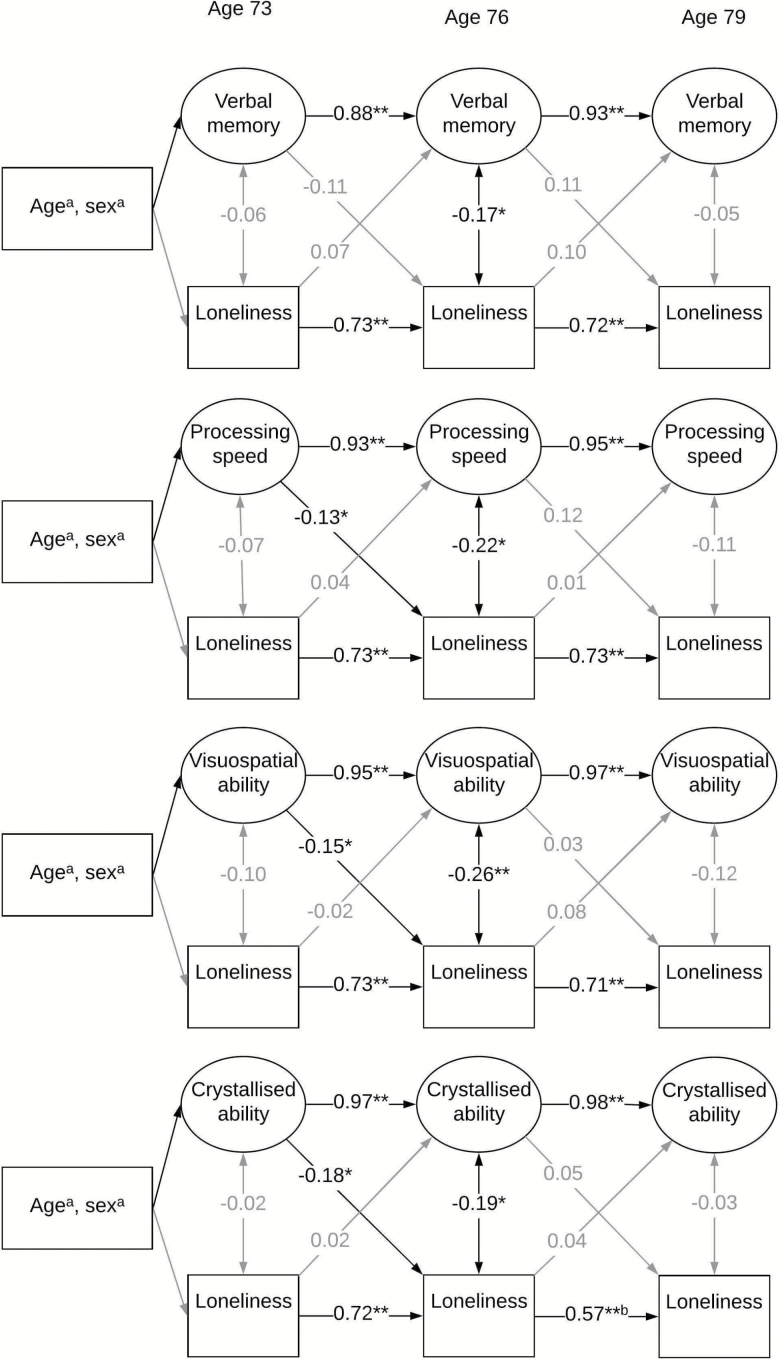
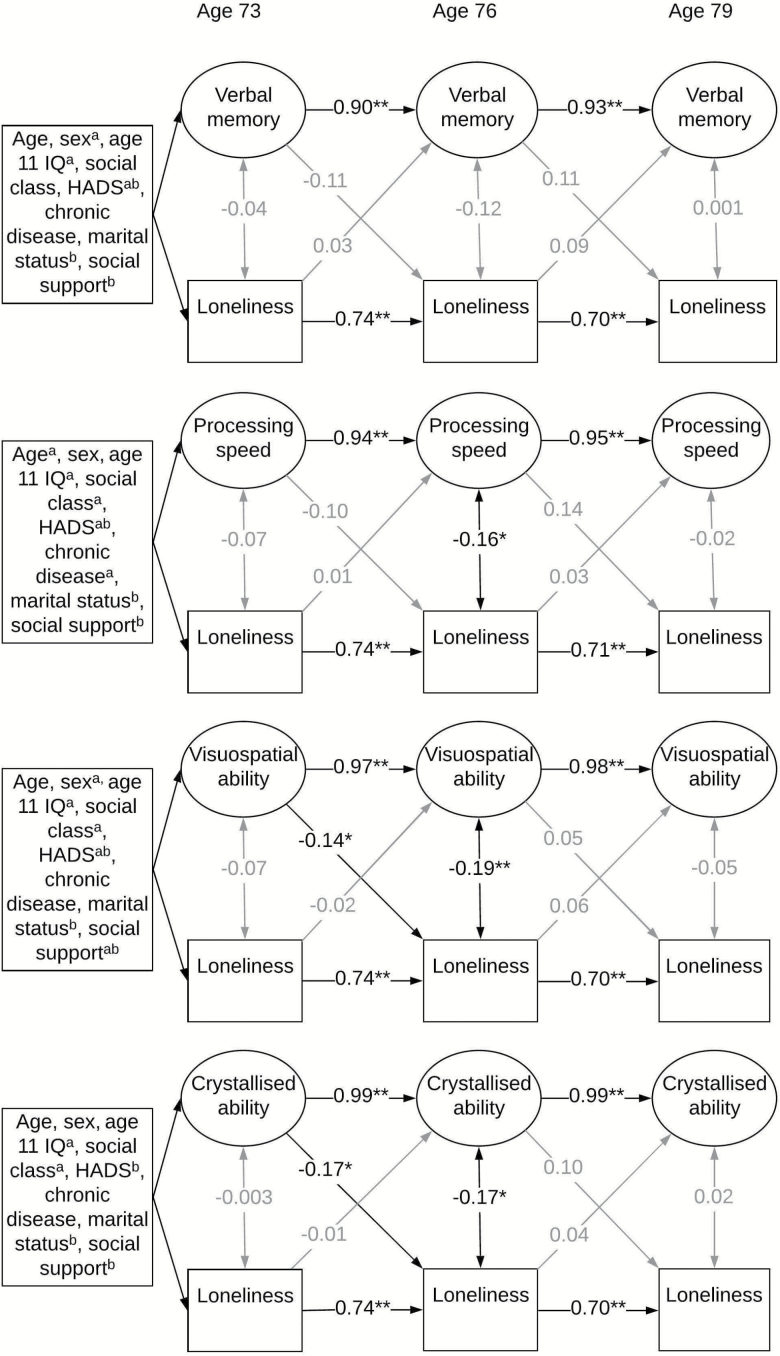
- Better processing speed at age 73 was associated with less positive change in loneliness by age 76 (β = −0.133, p = .029, FDR-corrected p = .046), but this was not significant in the fully adjusted model (β = −0.099, p = .128) and was not replicated from age 76 to 79 (β = 0.116, p = .138).
- Better visuospatial ability at age 73 was associated with less positive change in loneliness by age 76 (β = −0.146, p = .024, FDR-corrected p = .038); in the fully adjusted model this was β = −0.144, p = .048 but did not survive FDR correction (p = .077), and the 76-to-79 path was nonsignificant.
- Better crystallized ability at age 73 was associated with less positive change in loneliness by age 76 (β = −0.177, p = .001, FDR-corrected p = .002); this remained significant in the fully adjusted model (β = −0.169, p = .009, FDR-corrected p = .014), while the 76-to-79 path was nonsignificant.
- Loneliness at ages 73 and 76 did not predict subsequent changes in any cognitive ability domain; cross-sectional associations at age 76 were significant for processing speed (r = −.219, p = .001), visuospatial ability (r = −.256, p < .001), and crystallized ability (r = −.187, p = .001).
Methods
- Three triennial waves of Lothian Birth Cohort 1936 data were used; the analytical sample was 767 participants (mean age 73, SD = 0.71), with 620 contributing at age 76 and 490 at age 79. Participants with missing covariate data (n = 76) and MMSE < 24 (n = 23) were excluded.
- Loneliness was measured with a single ordinal item; cognitive ability was assessed with 13 tests grouped into processing speed, visuospatial ability, verbal memory, and crystallized ability. Covariates included age 11 IQ, occupational social class, HADS anxiety/depression symptoms, chronic disease, marital status, and social support.
- Cross-lagged panel models were estimated separately for each cognitive domain in Mplus using WLSMV, with age- and sex-adjusted and fully adjusted variants; p-values were corrected using Hochberg’s False Discovery Rate.
Limitations
- The paper states that loneliness was measured with a single item, likely less sensitive than comprehensive loneliness scales; that stability of loneliness and cognitive ability may have reduced detection of longitudinal associations; that attrition was associated with lower cognitive ability, lower age 11 IQ, lower occupational social class, and higher anxiety/depression symptoms, potentially biasing results toward the null; and that the cross-lagged panel model is not sensitive to within-person change, with no equivalent model for ordinal data yet available.
- Evident from the text: later waves had smaller samples and few lonely participants, and the authors note the study may have been underpowered to detect weak effects, especially at ages 76 to 79.
Model-written summary. Check it against the paper before relying on it.
Integrity signals
Registry
Cites
Statistics
Figures
Verification
Claims the paper makes
4 Valid · 0 Not valid · 22 Not checked · 82 Own results and interpretations
The sources with a verdict support this claim; the rest weren’t checked yet, have no full text we could read, or their verdicts aren’t rated yet.
In the paper
“longitudinal studies have reported an association between greater loneliness and steeper cognitive decline, which is partially independent of sociodemographic factors and some health conditions (Donovan et al., 2017; Gow & Mortensen, 2016; Shankar, Hamer, McMunn, & Steptoe, 2013; Wilson et al., 2007)”
§ Longitudinal Associations Between Loneliness and Cognitive Ability in the Lothian Birth Cohort 1936 > Abstract > Discussion
What the sources say
- Supportedcites Donovan et al., 2017 matched to “Loneliness, depression and cognitive function in older U.S. adults” (2017) source
The Discussion reports that greater baseline loneliness was associated with accelerated cognitive decline over 12 years after adjustment for sociodemographic factors, poor health, and baseline depression. The Conclusion qualifies this finding: the association did not remain significant when controlling for the effect of depression over time, consistent with the claim’s limited wording, “partially independent.” (LLM, conf=0.92)
- Not checked — no full text of the sourcecites Gow & Mortensen, 2016 matched to “Social resources and cognitive ageing across 30 years: The Glostrup 1914 Cohort” (2016) source
- Not checked yetcites Shankar, Hamer, McMunn, & Steptoe, 2013 source
Checked before — its earlier verdict is held back until a new check runs.
plainstates an association- Asserted: passes — The authors put it forward as true.
- Checkable: passes — It can be checked against evidence.
- Load-bearing: passes — The paper’s conclusions depend on it.
- Based: passes — The paper gives a reason why it holds.
- Supported
Every source the paper cites for this claim was checked and supports it.
In the paper
“A limitation of such test batteries is that they may not be sensitive to subclinical changes in cognitive function (Ritchie et al., 2016).”
§ Longitudinal Associations Between Loneliness and Cognitive Ability in the Lothian Birth Cohort 1936 > Abstract > Discussion
What the sources say
- Supportedcites Ritchie et al., 2016 matched to “Predictors of ageing-related decline across multiple cognitive functions” (2016) source
The Introduction identifies small cognitive batteries as a limitation and says that screening tests sometimes used in them are less sensitive to subclinical levels of, and changes in, cognitive function. This supports the citing sentence’s hedged claim. (LLM, conf=0.91)
hedged- Asserted: passes — The authors put it forward as true.
- Checkable: passes — It can be checked against evidence.
- Load-bearing: passes — The paper’s conclusions depend on it.
- Based: passes — The paper gives a reason why it holds.
- Supported
The sources with a verdict support this claim; the rest weren’t checked yet, have no full text we could read, or their verdicts aren’t rated yet.
In the paper
“It is likely that studies with more comprehensive measures of loneliness (e.g., the De Jong Gierveld Loneliness Scale [de Jong-Gierveld & Kamphuls, 1985)] or the UCLA loneliness scale [Russell, 1996]) are better able to detect associations between loneliness and subsequent cognitive decline.”
§ Longitudinal Associations Between Loneliness and Cognitive Ability in the Lothian Birth Cohort 1936 > Discussion
What the sources say
- Supportedcites de Jong-Gierveld & Kamphuls, 1985 matched to “The Development of a Rasch-Type Loneliness Scale” (1985) source
The citation identifies the De Jong Gierveld Loneliness Scale as an example of a more comprehensive loneliness measure. The scale-development passage describes its aim to assess both severe and less intense loneliness, using positively and negatively worded items. The citation is attached to the scale example, not to the sentence’s prediction about cognitive decline. (LLM, conf=0.91)
- Not checked — no full text of the sourcecites Russell, 1996 matched to “UCLA loneliness scale (version 3): reliability, validity, and factor structure” (1996) source
hedgedstates an association- Asserted: passes — The authors put it forward as true.
- Checkable: passes — It can be checked against evidence.
- Load-bearing: passes — The paper’s conclusions depend on it.
- Based: passes — The paper gives a reason why it holds.
- Supported
A result the paper reports from its own data — it cites no other source for it, so there is none to check. The quote shows it is in the paper.
In the paper
“In addition to the cross-lagged associations between cognitive abilities and subsequent experiences of loneliness, we found evidence of a cross-sectional association between these variables at age 76.”
§ Longitudinal Associations Between Loneliness and Cognitive Ability in the Lothian Birth Cohort 1936 > Discussion
plainstates an association- Asserted: passes — The authors put it forward as true.
- Checkable: passes — It can be checked against evidence.
- Load-bearing: unclear — It is unclear whether the paper’s conclusions depend on it.
- Based: passes — The paper gives a reason why it holds.
A result the paper reports from its own data — it cites no other source for it, so there is none to check. The quote shows it is in the paper.
In the paper
“We did observe a significant association between processing speed at age 73 and loneliness at age 76 (β = −0.133, p = .029, FDR corrected p = .046), such that participants with faster processing speed at age 73 were less likely to report higher levels of loneliness at age 76.”
§ Longitudinal Associations Between Loneliness and Cognitive Ability in the Lothian Birth Cohort 1936 > Results
plainstates an association- Asserted: passes — The authors put it forward as true.
- Checkable: passes — It can be checked against evidence.
- Load-bearing: passes — The paper’s conclusions depend on it.
- Based: passes — The paper gives a reason why it holds.
62 more claims
Create a free account to see all 108 claims and to verify the 5 references still open.
- It may state two separate claims as one. 20
- Probably not a substantial claim. 29
Self-check
Percentages, sums and reported differences re-computed from the paper’s own numbers.
Each contradiction between two passages listed here was confirmed by an independent check.
Rated minor: it would not touch a result — a value no result rests on, a p-value that stays on the same side of the significance level, or a conflict that is clerical, resolved elsewhere in the paper, or outside its own findings.
In the paper
§ Longitudinal Associations Between Loneliness and Cognitive Ability in the Lothian Birth Cohort 1936 > Abstract > Discussion
“A second study, of 14,199 Chinese older adults, tested for reciprocal associations between loneliness and cognitive ability over a 9-year period (Zhong, Chen, Tu, & Conwell, 2017).”
§ Longitudinal Associations Between Loneliness and Cognitive Ability in the Lothian Birth Cohort 1936 > Discussion
“However, the studies by Ellwardt et al. (2013) and Zhong et al. (2017) had larger samples sizes (n = 2,255 and n = 4,199, respectively) than our study (n = 767).”
Rated minor: it would not touch a result — a value no result rests on, a p-value that stays on the same side of the significance level, or a conflict that is clerical, resolved elsewhere in the paper, or outside its own findings.
In the paper
§ Longitudinal Associations Between Loneliness and Cognitive Ability in the Lothian Birth Cohort 1936 > Results
“| Matrix reasoning, M (SD) | 14.04 (10.12) | 479 | 12.20 (9.90) | 285 | <.001 | | Block design, M (SD) | 34.94 (1.34) | 480 | 32.44 (1.38) | 285 | .001 |”
§ Longitudinal Associations Between Loneliness and Cognitive Ability in the Lothian Birth Cohort 1936 > Results
“| Matrix reasoning, M (SD) | 13.36 (4.94) | 13.25 (4.83) | .002 | 13.04 (4.94) | .052 | | Block design, M (SD) | 34.01 (10.10) | 32.70 (9.67) | <.001 | 31.54 (9.28) | <.001 |”
Citations
Cites
Controlling the False Discovery Rate: A Practical and Powerful Approach to Multiple Testing
Benjamini, Y., & Hochberg, Y. (1995) · Journal of the Royal Statistical Society Series B: Statistical Methodology · doi:10.1111/j.2517-6161.1995.tb02031.x · Cited by 109,482
Folstein, M. F., Folstein, S. E., & McHugh, P. R. (1975) · Journal of Psychiatric Research · doi:10.1016/0022-3956(75)90026-6 · Cited by 88,282
The Hospital Anxiety and Depression Scale
Zigmond, A. S., & Snaith, R. P. (1983) · Acta Psychiatrica Scandinavica · doi:10.1111/j.1600-0447.1983.tb09716.x · Cited by 47,139
Hirono, N., Mori, E., Ikejiri, Y., Imamura, T., Shimomura, T., Hashimoto, M., Yamashita, H., & Ikeda, M. (1997) · Brain and nerve · Cited by 21,039
Kok, J. S., Berg, I. J., & Scherder, E. J. A. (2013) · Dementia and Geriatric Cognitive Disorders Extra · doi:10.1159/000353441 · Cited by 20,589
Older Adults' Reasons for Using Technology while Aging in Place
Peek, S. T. M., Luijkx, K. G., Rijnaard, M. D., Nieboer, M. E., van der Voort, C. S., Aarts, S., van Hoof, J., Vrijhoef, H. J. M., & Wouters, E. J. M. (2016) · Gerontology · doi:10.1159/000430949 · Cited by 19,690
Sensitivity and False Alarm Rate of a Fall Sensor in Long-Term Fall Detection in the Elderly
Kangas, M., Korpelainen, R., Vikman, I., Nyberg, L., & Jämsä, T. (2015) · Gerontology · doi:10.1159/000362720 · Cited by 18,909
Depression and quality of life in older persons: A review
Sivertsen, H., Bjørkløf, G. H., Engedal, K., Selbæk, G., & Helvik, A.-S. (2015) · Dementia and Geriatric Cognitive Disorders · doi:10.1159/000437299 · Cited by 14,152
UCLA loneliness scale (version 3): reliability, validity, and factor structure
Russell, D. W. (1996) · Journal of Personality Assessment · doi:10.1207/s15327752jpa6601_2 · Cited by 5,800
A critique of the cross-lagged panel model
Hamaker, E. L., Kuiper, R. M., & Grasman, R. P. P. P. (2015) · Psychological Methods · doi:10.1037/a0038889 · Cited by 4,005
Research works printed but not linked: 7
- General R (1991). Office of Population Censuses and Surveys. Classification of Occupations. London: HMSO.
- Muthén L. K., & Muthén B. O (2015). Mplus User’s Guide (7th ed). Los Angeles, CA: Muthén & Muthén.
- Nelson H. E., & Willison J (1991). National adult reading test (NART). Windsor: Nfer-Nelson.
- The Scottish Council for Research in Education. (1949). Introduction: The Trend of Scottish Intelligence. London: University of London Press.
- Wechsler D (1998a). Wechsler Adult Intelligence Scale III-UK Administration and Scoring Manual. London: Psychological Corporation.
- Wechsler D (1998b). Wechsler Memory Scale III-UK Administration and Scoring Manual. London: Psychological Corporation.
- Wechsler D (2001). Wechsler Test of Adult Reading: WTAR. San Antonio: Psychological Corporation.
Cited by
Are loneliness and social isolation associated with cognitive decline?
Lara, E., Caballero, F. F., Rico‐Uribe, L. A., Olaya, B., Haro, J. M., Ayuso‐Mateos, J. L., & Miret, M. (2019) · International Journal of Geriatric Psychiatry · doi:10.1002/gps.5174 · Cited by 423
“Consistently with this hypothesis, various longitudinal studies showed that global cognitive function and discrete cognitive domains predicted changes in perceived social isolation over time.(23,63,64) Findings of previous studies also indicated that social withdrawal or misperception of the social contacts are common…”
ResultYu, B., Steptoe, A., Chen, Y., & Jia, X. (2021) · Psychological Medicine · doi:10.1017/s0033291720001014 · Cited by 214
Maharani, A., Pendleton, N., & Leroi, I. (2019) · The American Journal of Geriatric Psychiatry · doi:10.1016/j.jagp.2019.07.010 · Cited by 190
Luchetti, M., Terracciano, A., Aschwanden, D., Lee, J. H., Stephan, Y., & Sutin, A. R. (2020) · International Journal of Geriatric Psychiatry · doi:10.1002/gps.5304 · Cited by 122
“Nonetheless, there still may be possible reciprocal relations between loneliness and cognition.(41) Further, changes in both loneliness and cognition may be reactive to changes in health status(42) and loss of partners.”
BackgroundYu, X., Westrick, A. C., & Kobayashi, L. C. (2022) · Alzheimer s & Dementia · doi:10.1002/alz.12734 · Cited by 48
Lee, J. H., Luchetti, M., Aschwanden, D., Sesker, A. A., Strickhouser, J. E., Terracciano, A., & Sutin, A. R. (2021) · Journal of Aging and Health · doi:10.1177/08982643211019500 · Cited by 42
Duffner, L. A., DeJong, N. R., Jansen, J. F. A., Backes, W. H., de Vugt, M. E., Deckers, K., & Köhler, S. (2023) · Ageing Research Reviews · doi:10.1016/j.arr.2023.101986 · Cited by 39
“Another study investigated changes in cognition in association with levels of loneliness using cross-legged panel models in the Lothian Birth Cohort 1936 (Okely and Deary, 2019).”
Sluiman, A. J., McLachlan, S., Forster, R., Strachan, M. W. J., Deary, I. J., & Price, J. F. (2021) · Diabetologia · doi:10.1007/s00125-021-05634-w · Cited by 39
“Over the 10 year follow-up period, there was an inevitable number of drop-outs from the ET2DS; however, the retention rate (55%) was in line with other studies [30] and relatively high when taking into account both participant age [31] and diabetes status [32].”
ResultSelf-citationOken, B., Kaplan, J., Klee, D., & Gallegos, A. M. (2024) · Frontiers in Human Neuroscience · doi:10.3389/fnhum.2024.1380002 · Cited by 40
“…is the fact that, although a consistently significant and positive relationship between loneliness and general cognitive ability that has already been described, there are some large studies have partially contradicted these findings, at least in terms of time course [e.g., Okely and Deary (2018)].”
ResultKim, A. J., Beam, C. R., Greenberg, N. E., & Burke, S. L. (2020) · American Journal of Geriatric Psychiatry · doi:10.1016/j.jagp.2020.07.017 · Cited by 34
Ng, T. K. S., Beck, T. L., Dennis, K. R., Desai, P., Krueger, K. R., Dhana, K., Wilson, R. S., Evans, D. A., & Rajan, K. B. (2025) · The Journal of Prevention of Alzheimer s Disease · doi:10.1016/j.tjpad.2024.100046 · Cited by 19
Loneliness in Older Indian Dyads
Shankar, A., & Kidd, T. (2022) · International Journal of Environmental Research and Public Health · doi:10.3390/ijerph19095302 · Cited by 12
Solé‐Padullés, C., Macià, D., Andersson, M., Stiernstedt, M., Pudas, S., Düzel, S., Zsoldos, E., Ebmeier, K. P., Binnewies, J., Drevon, C. A., et al. (2022) · Frontiers in Aging Neuroscience · doi:10.3389/fnagi.2022.795764 · Cited by 13
Harada, K., Masumoto, K., & Okada, S. (2023) · Archives of Gerontology and Geriatrics · doi:10.1016/j.archger.2023.105263 · Cited by 13
Drewelies, J., Windsor, T. D., Düzel, S., Demuth, I., Wagner, G. G., Lindenberger, U., Gerstorf, D., & Ghisletta, P. (2021) · The Journals of Gerontology Series B · doi:10.1093/geronb/gbab180 · Cited by 11
“For instance, Okely and Deary (2018) analyzed longitudinal data from the Lothian Birth Cohort Study and concluded that individuals with lower cognitive abilities, such as perceptual speed, at age 73 years were at higher risk of becoming lonely over time than those with better abilities (see also…”
BackgroundKang, J. E., Graham‐Engeland, J. E., Martire, L. M., Almeida, D. M., & Sliwinski, M. J. (2024) · The Journals of Gerontology Series B · doi:10.1093/geronb/gbae134 · Cited by 12
Social and Emotional Loneliness: Their Relationship to Multiple Domains of Cognition in Later Life
Hayslip, B., Maiden, R. J., & Greil, A. L. (2022) · The International Journal of Aging and Human Development · doi:10.1177/00914150221143961 · Cited by 7
Duffner, L. A., Deckers, K., Cadar, D., de Vugt, M. E., & Köhler, S. (2024) · Psychological Medicine · doi:10.1017/s0033291724001272 · Cited by 8
Loneliness and mental health at the early stages of the Covid‐19 pandemic in England
Allen, R. E., Prescott, J., McHugh, S., & Carson, J. F. (2021) · Health & Social Care in the Community · doi:10.1111/hsc.13676 · Cited by 5
Zheng, Q., Li, B., Wei-Wei, Y., Yu, Z., & Qi-Zhe, Z. (2023) · BMC Psychiatry · doi:10.1186/s12888-023-05443-y · Cited by 5
Leveraging the Power of Networks to Support Healthy Aging
Beadle, J. N. (2019) · The Journals of Gerontology Series B · doi:10.1093/geronb/gbz101 · Cited by 4
“It is well established that older adults generally show poorer short- and long-term memory performance (Park et al., 2002). However, less is known about the degree to which memory performance can be improved by leveraging other cognitive networks. In an article by Strunk, Morgan, Reaves, Verhaeghen, and Duarte (2018),…”
BackgroundWnuk, H. K., Orden, K. A. V., & Wang, K. H. (2025) · Neuroscience & Biobehavioral Reviews · doi:10.1016/j.neubiorev.2025.106451 · Cited by 7
Ikesu, R., Wu, Y. Y., Rojas‐Saunero, L. P., Nianogo, R. A., Torres, J. M., Kotwal, A., Ramirez, C. M., Tsugawa, Y., & Mayeda, E. R. (2026) · American Journal of Epidemiology · doi:10.1093/aje/kwag044 · Cited by 1
“47-49 Notably, to account for the potential reverse causation between loneliness and memory function, memory scores were treated not only as the outcome variable but also as a time-varying confounder 12 , 24 , 25 (see Supplementary material for details).”
Lessons we learned from the Lothian Birth Cohorts of 1921 and 1936
Deary, I. J., & Cox, S. R. (2024) · Genomic psychiatry : · doi:10.61373/gp024i.0076 · Cited by 2
Self-citationByrne, C., Coetzer, R., & Ramsey, R. (2024) · Archives of Clinical Neuropsychology · doi:10.1093/arclin/acae032 · Cited by 2
“Former studies primarily featured an older adult sample, surpassing the age of 70 years (O’Luanaigh et al., 2012; Gow et al., 2013; Okely & Deary, 2019), whereas our current study encompassed participants within a comparatively younger age range, spanning from 46 to 48 years.”
InfluentialLoneliness Modulates Inflammation to Affect the Neurocognitive Function of Older Adults
Jin, R. R., Chan, A. K. Y., & Lee, T. M. C. (2024) · Integrated science · doi:10.1007/978-3-031-73061-0_14 · Cited by 4
Hayslip, B., Maiden, R. J., & Greil, A. L. (2026) · The International Journal of Aging and Human Development · doi:10.1177/00914150261474087
de Araújo, M. V., Pereira, D. R., & Soares, A. P. (2026) · Frontiers in Aging Neuroscience · doi:10.3389/fnagi.2026.1831374
“Clinical or specific subsample studies generally included between 100 and 800 participants (e.g., Okely and Deary, 2019; Rehan and Phillips, 2025), while national cohort longitudinal studies frequently involved several thousand participants (1,500-10,000; e.g., Lara et al., 2019a; Shankar et al.,…”
InfluentialAVALIAÇÃO LONGITUDINAL DA FUNÇÃO COGNITIVA DE PACIENTES EM HEMODIÁLISE
Kupske, J. W., Dutra, T. S., Vieira, C. D. M., Duca, G. F. D., Moreira, P. R., Krug, M. M., & Krug, R. D. R. (2026) · Revista de Estudos Interdisciplinares · doi:10.56579/rei.v8i2.2862
Loneliness and trajectories of the cognition among Chinese middle and old-aged adultsPreprint
Hu, B., Zhou, Y., Zhang, P., Gu, C., Zhang, J., Jiang, L., Zhang, L., & Zhang, W. (2025) · Research Square · doi:10.21203/rs.3.rs-7044155/v1
Cumulative loneliness and memory function among U.S. older adults: the role of depressive symptoms
Yu, X., Hazzouri, A. Z. A., Cho, T., Zahodne, L. B., Gross, A. L., Needham, B. L., Langa, K. M., & Kobayashi, L. C. (2025) · The Journals of Gerontology Series A · doi:10.1093/gerona/glaf143 · Cited by 1
Byrne, C., Byrne, C., Coetzer, R., et al. (2023) · medRxiv · doi:10.1101/2023.10.09.23296730
Factors Associated with Direct and Indirect Aspects of Loneliness Among Europeans Aged 50 or Higher
Serafetinidou, E. (2023) · The Springer series on demographic methods and population analysis · doi:10.1007/978-3-031-28697-1_9
Yu, B., Steptoe, A., Chen, Y., & Jia, X. (2021) · Psychological Medicine · doi:10.1017/s0033291720001026 · Cited by 41
RetractedBeam, C. R., Kim, A. J., Greenberg, N. E., & Burke, S. L. (2020) · PsyArXiv (OSF Preprints) · doi:10.31234/osf.io/5x8gk
Shankar, A. (2019) · Oxford University Press eBooks · doi:10.1093/obo/9780199828340-0253
Metadata
- Authors
- Okely, J. A., & Deary, I. J.
- Affiliations
- University of Edinburgh (GB)
- Corresponding author
- Okely, Judith A
- Venue
- The Journals of Gerontology: Series B
- Publisher
- Oxford University Press (OUP)
- Published
- 2018-07-21
- Volume
- 74
- Issue
- 8
- Pages
- 1376-1386
- ISSN
- 1079-5014 (ISSN-L)
- 1758-5368
- PMC
- PMC6777773
- OpenAlex
- W2884890650
- Cited by
- 37
- References
- 47
- Citations by year
- 2026: 5 · 2025: 4 · 2024: 6 · 2023: 4 · 2022: 4 · 2021: 5 · 2020: 4 · 2019: 5
- FWCI
- 3.37
- Type
- journal article
- Language
- en
- Open access
- hybrid
- doi.org
- Licence
- Locations
- The Journals of Gerontology Series B (publishedVersion, cc-by)
- Europe PMC (PubMed Central) (publishedVersion, cc-by)
- PubMed Central (publishedVersion, cc-by)
- PubMed (publishedVersion)
- RePEc: Research Papers in Economics (submittedVersion)
- Edinburgh Research Explorer (University of Edinburgh) (submittedVersion, cc-by)
- Funders
- Age UK
- Biotechnology and Biological Sciences Research Council
- Medical Research Council (MR/K026992/1)
- Topics
- Social Sciences › Health › Health disparities and outcomes
- Social Sciences › Psychology › Developmental and Educational Psychology › Aging and Gerontology Research
- Health Sciences › Medicine › Psychiatry and Mental health › Dementia and Cognitive Impairment Research
- Keywords
- loneliness, cognitive ability, cognitive decline, processing speed, visuospatial ability, verbal memory, bidirectional relationship, older adults, Lothian Birth Cohort 1936
- MeSH terms
- Healthy Aging, Age Factors, Aged, Cognition, Female, Humans, Loneliness, Longitudinal Studies, Male, Neuropsychological Tests, Scotland
About these checks
Registry, retraction, Cites and statistics results are computed, not judged, with one exception: a printed reference that no index lists is read once by a model before it counts as a citation error. Claims are extracted by a model and kept only when their quote appears verbatim in the text; each cited source is then checked, with a model’s help, for whether it says what the claim relies on. Those verdicts can be wrong — read the claim’s quote and the cited source before relying on one.
The claim verdicts this report counts are experimental: their accuracy is not yet measured.
A language model drew the claims from the paper on 2026-10-10, under version 3 of the claim definition (model deepseek-v4.1-flash, prompt extract-v3).
A second model labelled each claim on 2026-10-10 (model jev-1.13-20260917, definition revision gold-guideline-v0.2).
Cited sources are checked with a language model’s help (gpt-6-sol).
Statistics and arithmetic are recomputed, not judged.
Confidence bands are shown only for fields calibrated on our annotated test set. None is calibrated yet, so no band is shown.
What counts as a claim ›How we measure confidence ›How we check this ›
Are you an author, or do you see a problem with this page? Request a review
Data sources
Bibliographic data: Semantic Scholar, OpenAlex, Crossref.
Contains information from the Semantic Scholar Academic Graph Datasets, made available under the ODC Attribution License (ODC-BY 1.0).
Semantic Scholar’s data is described in: Kinney, R., et al. (2023). The Semantic Scholar Open Data Platform. arXiv:2301.10140.
