

Mobile Technology for Cognitive Assessment of Older Adults: A Scoping Review
Open accessThe DOI matches its Crossref record; 58 of the 58 references it cites were found in a registry or an index.
Abstract
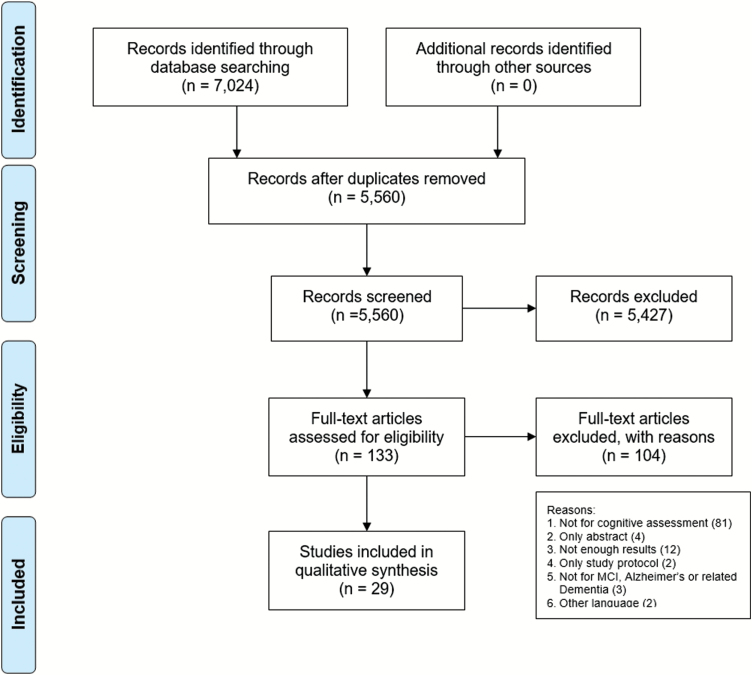
BACKGROUND AND OBJECTIVES: The number of people diagnosed with dementia is rising appreciably as the population ages. In an effort to improve outcomes, many have called for facilitating early detection of cognitive decline. Increased use of mobile technology by older adults provides the opportunity to deliver convenient, cost-effective assessments for earlier detection of cognitive impairment. This article presents a review of the literature on how mobile platforms-smartphones and tablets-are being used for cognitive assessment of older adults along with benefits and opportunities associated with using mobile platforms for cognitive assessment. RESEARCH DESIGN AND METHODS: We searched MEDLINE, Web of Science, PsycInfo, CINAHL, EMBASE, and Cochrane Central Register of Controlled Trials in October 2018. This search returned 7,024 articles. After removing 1,464 duplicates, we screened titles and abstracts then screened full-text for those articles meeting inclusion and exclusion criteria. RESULTS: Twenty-nine articles met our inclusion criteria and were categorized into 3 groups as follows: (a) mobile versions of existing article or computerized neuropsychological tests; (b) new cognitive tests developed specifically for mobile platforms; and (c) the use of new types of data for cognitive assessment. This scoping review confirms the considerable potential of mobile assessment. DISCUSSION AND IMPLICATIONS: Mobile technologies facilitate repeated and continuous assessment and support unobtrusive collection of auxiliary behavioral markers of cognitive impairment, thus allowing users to view trends and detect acute changes that have traditionally been difficult to identify. Opportunities include using new mobile sensors and wearable devices, improving reliability and validity of mobile assessments, determining appropriate clinical use of mobile assessment information, and incorporating person-centered assessment principles and digital phenotyping.
Overview
The claims and statistics of this paper haven’t been checked yet.
Free: it reads the open-access text and checks the first 5 claims that cite a source we can check. Create a free account to check every claim.
Integrity signals
Registry
Cites
Statistics
Figures
Verification
Claims the paper makes
The claims and statistics of this paper haven’t been checked yet.
Free: it reads the open-access text and checks the first 5 claims that cite a source we can check. Create a free account to check every claim.
Claims other papers make about this one
Each is checked against this paper’s own text: does it say what the citing paper says it does?
The cited source says what the claim attributes to it.
In the citing paper
“Moreover, the citation burst for several papers is still ongoing, such as Carlbring et al. (51), Cogn Behav Therapy (18.03), Jack et al. (52), Alzheimers Dement (25.23), Koo et al. (7), Innov Aging (15.1) and Livingston et al. (53), Lancet (17.23).”
From Research on digital tool in cognitive assessment: a bibliometric analysis (2023) · cites this paper as [7]
In the citing paper
“Digital cognitive assessment technology facilitates repeated and continuous assessments and the collection of clinical data, much more convenient and cost-effective than paper-and-pencil assessments (7).”
From Research on digital tool in cognitive assessment: a bibliometric analysis (2023) · cites this paper as [7]
In the citing paper
“The main cognitive assessment tools on the market are divided into three categories (7) (Figure 1).”
From Research on digital tool in cognitive assessment: a bibliometric analysis (2023) · cites this paper as [7]
In the citing paper
“The last is the use of new data streams for cognitive assessment specially designed for computers or other mobile platforms, always embedded with new types of technologies (7).”
From Research on digital tool in cognitive assessment: a bibliometric analysis (2023) · cites this paper as [7]
In the citing paper
“Second, for new tests or batteries, the majority of present studies still focus on their reliability and validity, with small and limited samples (7).”
From Research on digital tool in cognitive assessment: a bibliometric analysis (2023) · cites this paper as [7]
1 more claim about this paper
Create a free account to see every claim other papers make about this one.
Self-check
Percentages, sums and reported differences re-computed from the paper’s own numbers.
The self-check needs the paper’s full text.
Citations
Cites
Scoping studies: towards a methodological framework
Arksey, H., & O'Malley, L. (2005) · International Journal of Social Research Methodology · doi:10.1080/1364557032000119616 · Cited by 36,742
Guidance for conducting systematic scoping reviews
Peters, M. D. J., Godfrey, C. M., Khalil, H., McInerney, P., Parker, D., & Soares, C. B. (2015) · International Journal of Evidence-Based Healthcare · doi:10.1097/xeb.0000000000000050 · Cited by 7,472 · cited 1×
“Scoping reviews summarize and disseminate research findings to identify gaps in research and to make suggestions for future research (Peters et al., 2015).”
BackgroundVideo game training enhances cognitive control in older adults
Anguera, J. A., Boccanfuso, J., Rintoul, J. L., Al-Hashimi, O., Faraji, F., Janowich, J., Kong, E., Larraburo, Y., Rolle, C., Johnston, E., et al. (2013) · Nature · doi:10.1038/nature12486 · Cited by 1,666
Digital Phenotyping: Technology for a New Science of Behavior
Insel, T. R. (2017) · JAMA · doi:10.1001/jama.2017.11295 · Cited by 833 · cited 3×
“Digital phenotyping incorporates data from mobile sensors, keyboard interactions, voice, speech, and other streams obtained during everyday use of social media, wearable technologies, and mobile devices (Insel, 2017; Jain, Powers, Hawkins, & Brownstein, 2015).”
BackgroundThe Fundamentals of Person-Centered Care for Individuals With Dementia
Fazio, S., Pace, D., Flinner, J., & Kallmyer, B. (2018) · The Gerontologist · doi:10.1093/geront/gnx122 · Cited by 647
Jain, S. H., Powers, B. W., Hawkins, J. B., & Brownstein, J. S. (2015) · Nature Biotechnology · doi:10.1038/nbt.3223 · Cited by 425 · cited 1×
“Prior work on digital phenotypes (Insel, 2017; Jain et al., 2015; Wiederhold, 2016) does not mention incorporating the game performance elements we reviewed (Thompson et al.”
BackgroundMeasurement‐Burst Designs for Social Health Research
Sliwinski, M. J. (2008) · Social and Personality Psychology Compass · doi:10.1111/j.1751-9004.2007.00043.x · Cited by 333
Innovative diagnostic tools for early detection of Alzheimer's disease
Laske, C., Sohrabi, H. R., Frost, S. M., López-de-Ipiña, K., Garrard, P., Buscema, M., Dauwels, J., Soekadar, S. R., Mueller, S., Linnemann, C., et al. (2015) · Alzheimer's & Dementia · doi:10.1016/j.jalz.2014.06.004 · Cited by 316
Computerized Cognitive Testing for Older Adults: A Review
Zygouris, S., & Tsolaki, M. (2015) · American Journal of Alzheimer's Disease & Other Dementias® · doi:10.1177/1533317514522852 · Cited by 272
Makizako, H., Shimada, H., Park, H., Doi, T., Yoshida, D., Uemura, K., Tsutsumimoto, K., & Suzuki, T. (2013) · Geriatrics & Gerontology International · doi:10.1111/ggi.12014 · Cited by 242
Research works printed but not linked: 1
- Gerontological Society of America (2015). The Gerontological Society of America workgroup on cognitive impairment detection and earlier diagnosis: Report and recommendations. Washington, DC Retrieved from http://www.geron.org/images/gsa/ documents/gsaciworkgroup2015report.pdf
Cited by
Items 201–222 of 222
Examining the nervous system of an older patient
Woodford, H. J., & George, J. (2017) · Oxford University Press eBooks · doi:10.1093/med/9780198701590.003.0111_update_001
Novel digital biomarkers for frontotemporal dementia
Convery, R. S. (2023) · UCL Discovery (University College London)
New Approaches for Improving Equity in Mental Health Research, Treatment, and Policy
(2025) · Frontiers research topics · doi:10.3389/978-2-8325-6907-8
Assessment and Cognitive Training of Patients with Mild Cognitive Impairment Using Mobile Devices
Γιαννοπούλου, Π., & Doukakis, S. (2023) · Springer eBooks · doi:10.1007/978-3-319-75922-7_61
Esconde-Pirata: a serious game for measuring integrative episodic memory in younger and older
da Silva, J. S. C. (2022) · LA Referencia (Red Federada de Repositorios Institucionales de Publicaciones Científicas)
Exploring Transformational Leadership and Technology on UK Executives' Work-Life Balance
Chiwetu, F. (2026) · Sheffield Hallam University · doi:10.7190/shu-thesis-00826
Xiyue, T. (2025) · US-China Education Review A · doi:10.17265/2161-623x/2025.07.005
Livoti, V., Vitacca, M., & Bonato, M. (2026) · Journal of the International Neuropsychological Society · doi:10.1017/s1355617726102197
Terveysteknologian mahdollisuudet Alzheimerin taudin varhaisessa tunnistamisessa
Haverinen, E. (2025) · Theseus (Ammattikorkeakoulujen)
Röcke, C., Luo, M., Han, C., Sofios, A., & Weibel, R. (2026) · Frontiers in Psychology · doi:10.3389/fpsyg.2026.1883892
The Utility of Mobile Visuomotor Assessment for Neuropsychological Evaluation in Older Adults
Adibmoradi, G. (2023) · York University Digital Library (York University)
Improving Cognitive Assessment in the Context of Rural Dementia Diagnosis'
Ursenbach, J. (2024) · HARVEST (University of Saskatchewan)
Cognitive assessment in Multiple Sclerosis: towards the development of a cognitive screening pathway
Elwick, H. (2022) · Nottingham ePrints (University of Nottingham)
Assessment of Abbreviated Neurocognitive Tasks via a Custom-Built Mobile Platform
Alikaei, F., İzzetoğlu, M., Gomero, L. M., Rokowski, P., & Holtzer, R. (2026) · Scientific Reports · doi:10.1038/s41598-026-44459-8
Mancheno, A. S. E. (2024) · LUTPub (LUT University)
Berron, D., Ziegler, G., Vieweg, P., Billette, O., Güsten, J., Grande, X., Heneka, M. T., Schneider, A., Teipel, S., Jessen, F., et al. (2022) · doi:10.3389/fdgth.2022.892997.s001
Chen, L., Zhen, W., & Peng, D. (2023) · doi:10.3389/fpsyt.2023.1227261.s001
Yaşlı Bireylerde Bilişsel Fonksiyonların Değerlendirilmesi: Derleme Çalışması
Aydemir, M., Değerli, M. N. Ö., & Altuntaş, O. (2025) · DergiPark
Słowiński, P., White, A., Lison, S., Sullivan, S., Emmens, T., Self, P., Wileman, J., Karl, A., & Tsaneva-Atanasova, K. (2023) · doi:10.1371/journal.pdig.0000339.r003
Metadata
- Authors
- Koo, B. M., & Vizer, L. M.
- Affiliations
- University of North Carolina at Chapel Hill (US)
- Corresponding author
- Vizer, Lisa M
- Venue
- Innovation in Aging
- Publisher
- Oxford University Press (OUP)
- Published
- 2019-01-01
- Volume
- 3
- Issue
- 1
- Pages
- igy038-igy038
- ISSN
- 2399-5300 (ISSN-L)
- PMC
- PMC6312550
- OpenAlex
- W2907272110
- Cited by
- 194
- References
- 58
- Citations by year
- 2026: 14 · 2025: 31 · 2024: 35 · 2023: 26 · 2022: 31 · 2021: 27 · 2020: 24 · 2019: 5
- FWCI
- 3.66
- Type
- journal article
- Language
- en
- Open access
- gold
- doi.org
- Licence
- Locations
- Innovation in Aging (publishedVersion, cc-by-nc-nd)
- Europe PMC (PubMed Central) (publishedVersion, cc-by-nc-nd)
- PubMed Central (publishedVersion, cc-by-nc-nd)
- PubMed (publishedVersion)
- Funders
- National Center for Advancing Translational Sciences
- National Institutes of Health (UL1TR002489)
- Topics
- Health Sciences › Medicine › Psychiatry and Mental health › Dementia and Cognitive Impairment Research
- Health Sciences › Medicine › Geriatrics and Gerontology › Technology Use by Older Adults
- Social Sciences › Psychology › Clinical Psychology › Historical and Modern Theater Studies
- Keywords
- mobile technology, cognitive assessment, older adults, dementia, early detection of cognitive impairment, tablet-based assessment, mobile sensors, wearable devices, digital phenotyping, person-centered assessment
About these checks
Registry, retraction, Cites and statistics results are computed, not judged, with one exception: a printed reference that no index lists is read once by a model before it counts as a citation error. Claims are extracted by a model and kept only when their quote appears verbatim in the text; each cited source is then checked, with a model’s help, for whether it says what the claim relies on. Those verdicts can be wrong — read the claim’s quote and the cited source before relying on one.
Statistics and arithmetic are recomputed, not judged.
Confidence bands are shown only for fields calibrated on our annotated test set. None is calibrated yet, so no band is shown.
What counts as a claim ›How we measure confidence ›How we check this ›
Are you an author, or do you see a problem with this page? Request a review
Data sources
Bibliographic data: Semantic Scholar, OpenAlex, Crossref.
Contains information from the Semantic Scholar Academic Graph Datasets, made available under the ODC Attribution License (ODC-BY 1.0).
Semantic Scholar’s data is described in: Kinney, R., et al. (2023). The Semantic Scholar Open Data Platform. arXiv:2301.10140.
