

ART in Europe, 2018: results generated from European registries by ESHRE
Open accessThe DOI matches its Crossref record; 18 of the 18 references it cites were found in a registry or an index.
Abstract
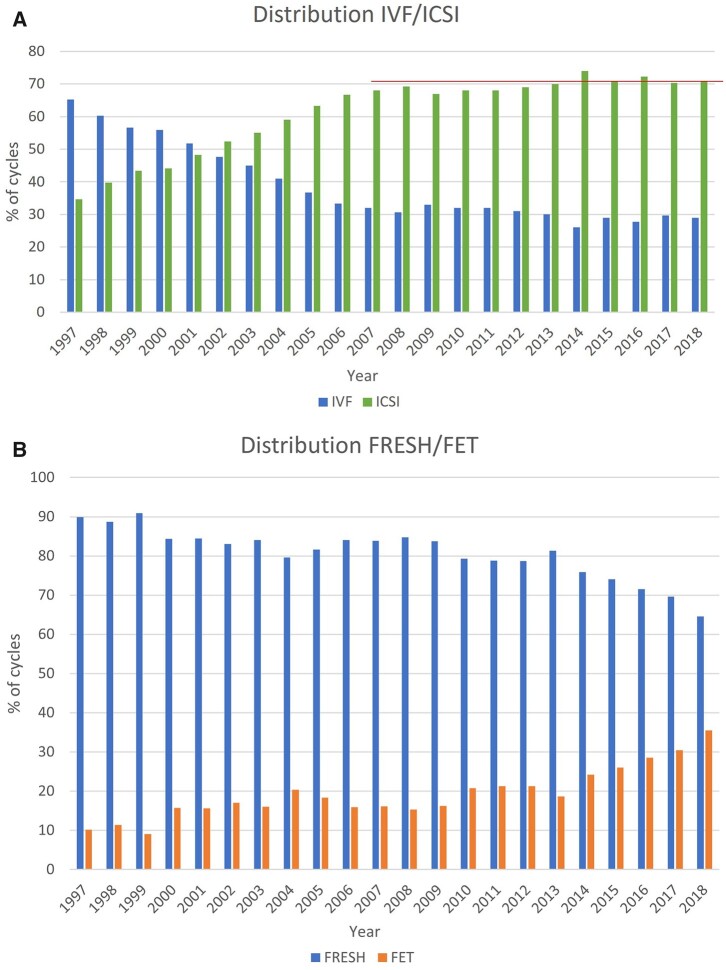
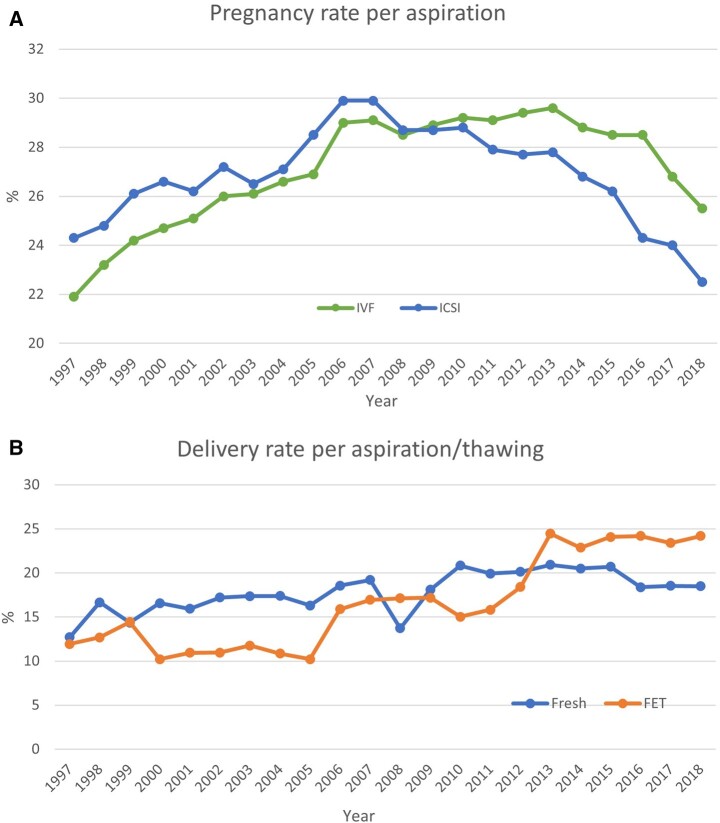
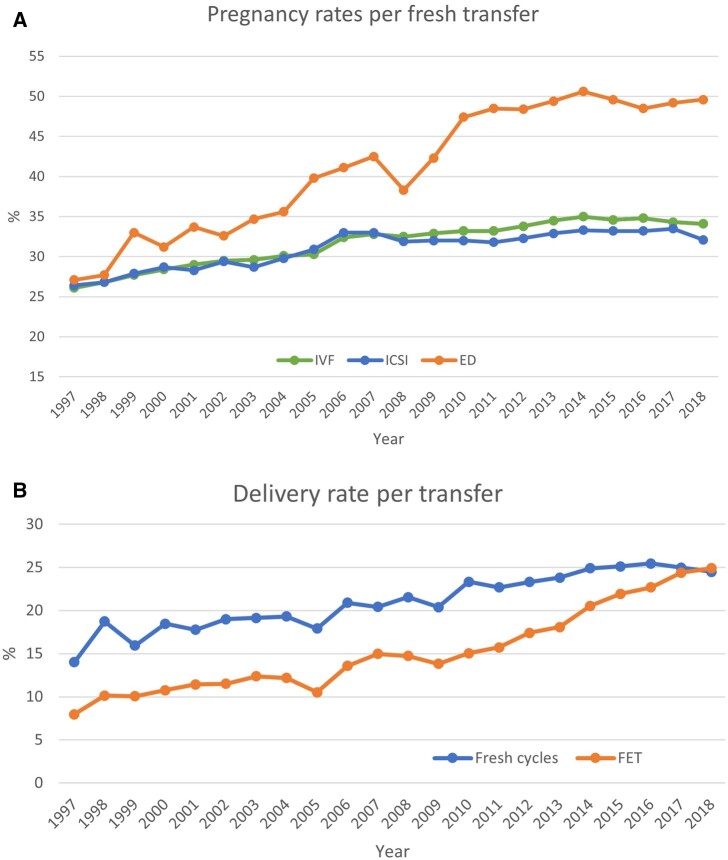
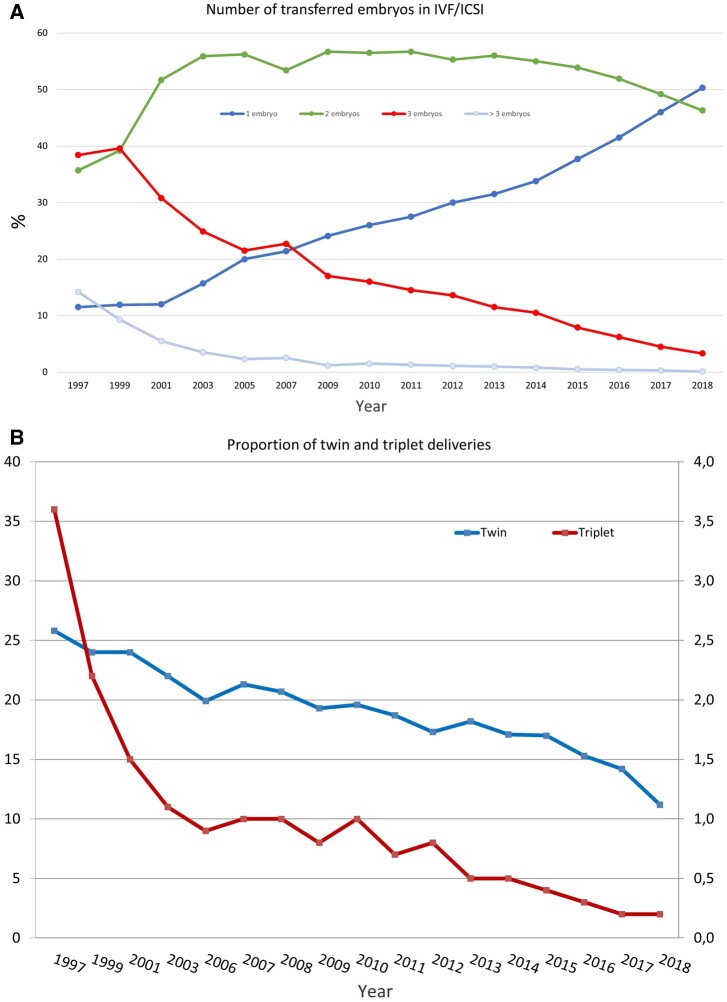
STUDY QUESTION: What are the data and trends on ART and IUI cycle numbers and their outcomes, and on fertility preservation (FP) interventions, reported in 2018 as compared to previous years? SUMMARY ANSWER: The 22nd ESHRE report shows a continued increase in reported numbers of ART treatment cycles and children born in Europe, a decrease in transfers with more than one embryo with a further reduction of twin delivery rates (DRs) as compared to 2017, higher DRs per transfer after fresh IVF or ICSI cycles (without considering freeze-all cycles) than after frozen embryo transfer (FET) with higher pregnancy rates (PRs) after FET and the number of reported IUI cycles decreased while their PR and DR remained stable. WHAT IS KNOWN ALREADY: ART aggregated data generated by national registries, clinics or professional societies have been gathered and analysed by the European IVF-monitoring Consortium (EIM) since 1997 and reported in 21 manuscripts published in Human Reproduction and Human Reproduction Open. STUDY DESIGN, SIZE, DURATION: Data on medically assisted reproduction (MAR) from European countries are collected by EIM for ESHRE on a yearly basis. The data on treatment cycles performed between 1 January and 31 December 2018 were provided by either national registries or registries based on initiatives of medical associations and scientific organizations or committed persons of 39 countries. PARTICIPANTS/MATERIALS, SETTING, METHODS: Overall, 1422 clinics offering ART services in 39 countries reported a total of more than 1 million (1 007 598) treatment cycles for the first time, including 162 837 with IVF, 400 375 with ICSI, 309 475 with FET, 48 294 with preimplantation genetic testing, 80 641 with egg donation (ED), 532 with IVM of oocytes and 5444 cycles with frozen oocyte replacement (FOR). A total of 1271 institutions reported data on IUI cycles using either husband/partner’s semen (IUI-H; n = 148 143) or donor semen (IUI-D; n = 50 609) in 31 countries and 25 countries, respectively. Sixteen countries reported 20 994 interventions in pre- and post-pubertal patients for FP including oocyte, ovarian tissue, semen and testicular tissue banking. MAIN RESULTS AND THE ROLE OF CHANCE: In 21 countries (21 in 2017) in which all ART clinics reported to the registry, 410 190 treatment cycles were registered for a total population of ∼ 300 million inhabitants, allowing a best estimate of a mean of 1433 cycles performed per million inhabitants (range: 641–3549). Among the 39 reporting countries, for IVF, the clinical PR per aspiration slightly decreased while the PR per transfer remained similar compared to 2017 (25.5% and 34.1% in 2018 versus 26.8% and 34.3% in 2017). In ICSI, the corresponding rates showed similar evolutions in 2018 compared to 2017 (22.5% and 32.1% in 2018 versus 24.0% and 33.5% in 2017). When freeze-all cycles were not considered for the calculations, the clinical PRs per aspiration were 28.8% (29.4% in 2017) and 27.3% (27.3% in 2017) for IVF and ICSI, respectively. After FET with embryos originating from own eggs, the PR per thawing was 33.4% (versus 30.2% in 2017), and with embryos originating from donated eggs 41.8% (41.1% in 2017). After ED, the PR per fresh embryo transfer was 49.6% (49.2% in 2017) and per FOR 44.9% (43.3% in 2017). In IVF and ICSI together, the trend towards the transfer of fewer embryos continues with the transfer of 1, 2, 3 and ≥4 embryos in 50.7%, 45.1%, 3.9% and 0.3% of all treatments, respectively (corresponding to 46.0%, 49.2%. 4.5% and 0.3% in 2017). This resulted in a reduced proportion of twin DRs of 12.4% (14.2% in 2017) and similar triplet DR of 0.2%. Treatments with FET in 2018 resulted in twin and triplet DRs of 9.4% and 0.1%, respectively (versus 11.2% and 0.2%, respectively in 2017). After IUI, the DRs remained similar at 8.8% after IUI-H (8.7% in 2017) and at 12.6% after IUI-D (12.4% in 2017). Twin and triplet DRs after IUI-H were 8.4% and 0.3%, respectively (in 2017: 8.1% and 0.3%), and 6.4% and 0.2% after IUI-D (in 2017: 6.9% and 0.2%). Among 20 994 FP interventions in 16 countries (18 888 in 13 countries in 2017), cryopreservation of ejaculated sperm (n = 10 503, versus 11 112 in 2017) and of oocytes (n = 9123 versus 6588 in 2017) were the most frequently reported. LIMITATIONS, REASONS FOR CAUTION: The results should be interpreted with caution as data collection systems and completeness of reporting vary among European countries. Some countries were unable to deliver data about the number of initiated cycles and/or deliveries. WIDER IMPLICATIONS OF THE FINDINGS: The 22nd ESHRE data collection on ART, IUI and FP interventions shows a continuous increase of reported treatment numbers and MAR-derived livebirths in Europe. Although it is the largest data collection on MAR in Europe, further efforts towards optimization of both the collection and reporting, with the aim of improving surveillance and vigilance in the field of reproductive medicine, are awaited. STUDY FUNDING/COMPETING INTEREST(S): The study has received no external funding and all costs are covered by ESHRE. There are no competing interests.
Overview
The claims and statistics of this paper haven’t been checked yet.
Free: it reads the open-access text and checks the first 5 claims that cite a source we can check. Create a free account to check every claim.
Integrity signals
Registry
Cites
Statistics
Figures
Verification
Claims the paper makes
The claims and statistics of this paper haven’t been checked yet.
Free: it reads the open-access text and checks the first 5 claims that cite a source we can check. Create a free account to check every claim.
Claims other papers make about this one
Each is checked against this paper’s own text: does it say what the citing paper says it does?
The source backs part of the claim, not all of it — or backs it for a different population, condition or comparison.
In the citing paper
“Also, the share of treatments provided to women age 40+ has increased considerably: about 22% of in vitro fertilization (IVF) /intracytoplasmic sperm injection treatments were provided to women aged 40+ in 2018, compared with 15% in 2005 (author ' s calculations for 21 European countries based on Andersen et al., 2009; Wyns et al., 2022).”
From Delayed Fertility as a Driver of Fertility Decline? (2023) · cites this paper as Wyns et al., 2022
Experimental — accuracy not yet measured
Self-check
Percentages, sums and reported differences re-computed from the paper’s own numbers.
The self-check needs the paper’s full text.
Citations
Cites
The international glossary on infertility and fertility care, 2017
Zegers-Hochschild, F., Adamson, G. D., Dyer, S., Racowsky, C., de Mouzon, J., Sokol, R., Rienzi, L., Sunde, A., Schmidt, L., Cooke, I. D., et al. (2017) · Human Reproduction · doi:10.1093/humrep/dex234 · Cited by 1,320 · cited 1×
“The terminology used was based on the glossary of The International Committee for Monitoring Assisted Reproductive Technology (Zegers-Hochschild et al., 2017).”
MethodCleavage stage versus blastocyst stage embryo transfer in assisted reproductive technology
Glujovsky, D., Farquhar, C., Quinteiro Retamar, A. M., Alvarez Sedo, C. R., & Blake, D. (2016) · Cochrane Database of Systematic Reviews · doi:10.1002/14651858.cd002118.pub5 · Cited by 706
Sullivan, E. A., Zegers-Hochschild, F., Mansour, R., Ishihara, O., de Mouzon, J., Nygren, K. G., & Adamson, G. D. (2013) · Human Reproduction · doi:10.1093/humrep/det036 · Cited by 414
Chambers, G. M., Dyer, S., Zegers-Hochschild, F., de Mouzon, J., Ishihara, O., Banker, M., Mansour, R., Kupka, M. S., & Adamson, G. D. (2021) · Human Reproduction · doi:10.1093/humrep/deab198 · Cited by 298
Self-citationART in Europe, 2016: results generated from European registries by ESHRE†
The European IVF-monitoring Consortium (EIM)‡ for the European Society of Human Reproduction and Embryology (ESHRE), Wyns, C., Gliozheni, O., Hambartsoumian, E., Strohmer, H., Petrovskaya, E., Tishkevich, O., Bogaerts, K., Wyns, C., Balic, D., et al. (2020) · Human Reproduction Open · doi:10.1093/hropen/hoaa032 · Cited by 274
Self-citationSurvey on ART and IUI: legislation, regulation, funding and registries in European countries
Calhaz-Jorge, C., De Geyter, C. H., Kupka, M. S., Wyns, C., Mocanu, E., Motrenko, T., Scaravelli, G., Smeenk, J., Vidakovic, S., & Goossens, V (2020) · Human Reproduction Open · doi:10.1093/hropen/hoz044 · Cited by 262
Self-citationRisks and complications in assisted reproduction techniques: Report of an ESHRE consensus meeting
Land, J. A. (2003) · Human Reproduction · doi:10.1093/humrep/deg081 · Cited by 234
ART in Europe, 2015: results generated from European registries by ESHRE†
De Geyter, C., Calhaz-Jorge, C., Kupka, M. S., Wyns, C., Mocanu, E., Motrenko, T., Scaravelli, G., Smeenk, J., Vidakovic, S., Goossens, V, et al. (2020) · Human Reproduction Open · doi:10.1093/hropen/hoz038 · Cited by 213
Self-citationDe Geyter, C., Wyns, C., Calhaz-Jorge, C., de Mouzon, J., Ferraretti, A. P., Kupka, M., Nyboe Andersen, A., Nygren, K. G., & Goossens, V (2020) · Human Reproduction · doi:10.1093/humrep/deaa250 · Cited by 195
Self-citationART in Europe, 2017: results generated from European registries by ESHRE
The European IVF-Monitoring Consortium (EIM) for the European Society of Human Reproduction and Embryology (ESHRE), Gliozheni, O., Hambartsoumian, E., Strohmer, H., Kreuz-Kinderwunschzentrum, O. &. S. P. G., Petrovskaya, E., Tishkevich, O., Bogaerts, K., I-Biostat, C. W., Balic, D., et al. (2021) · Human Reproduction Open · doi:10.1093/hropen/hoab026 · Cited by 192
Self-citationCorrigendum. ART in Europe, 2015: results generated from European registries by ESHRE
The European IVF-monitoring Consortium (EIM) for the European Society of Human Reproduction and Embryology (ESHRE), De Geyter, C., Calhaz-Jorge, C., Kupka, M. S., Wyns, C., Mocanu, E., Motrenko, T., Scaravelli, G., Smeenk, J., Vidakovic, S., et al. (2020) · Human Reproduction Open · doi:10.1093/hropen/hoaa038 · Cited by 136
Self-citationMaternal death related to IVF in the Netherlands 1984-2008
Braat, D. D. M., Schutte, J. M., Bernardus, R. E., Mooij, T. M., & van Leeuwen, F. E. (2010) · Human Reproduction · doi:10.1093/humrep/deq080 · Cited by 135 · cited 1×
“Reports on maternal deaths related to ART are even scarcer, with a reported best estimate of six maternal deaths directly related to IVF per 100 000 IVF treatments in a national cohort from The Netherlands, where OHSS and sepsis were the major causes (Braat et al., 2010).”
BackgroundTrends over 15 years in ART in Europe: an analysis of 6 million cycles†
Ferraretti, A. P., Nygren, K., Andersen, A. N., de Mouzon, J., Kupka, M., Calhaz-Jorge, C., Wyns, C., Gianaroli, L., Goossens, V., & The European IVF-Monitoring Consortium (EIM), F. T. E. S. O. H. R. A. E. (. (2017) · Human Reproduction Open · doi:10.1093/hropen/hox012 · Cited by 113
Self-citationBlastocyst culture and transfer in clinically assisted reproduction: a committee opinion
(2018) · Fertility and Sterility · doi:10.1016/j.fertnstert.2018.09.011 · Cited by 100 · cited 3×
“…et al., 2016; Practice Committee of the American Society for Reproductive Medicine and Practice Committee of the Society for Assisted Reproductive Technology, 2018), data showed pregnancy rates for blastocyst transfers to be higher than for cleavage stage embryos (40.0% versus 28.5% for fresh…”
BackgroundInfluentialESHRE PGT Consortium data collection XIX–XX: PGT analyses from 2016 to 2017
van Montfoort, A. P. A., Carvalho, F., Coonen, E., Kokkali, G., Moutou, C., Rubio, C., Goossens, V., & Rycke, M. D. (2021) · Human Reproduction Open · doi:10.1093/hropen/hoab024 · Cited by 65
Self-citationDe Neubourg, D., Bogaerts, K., Blockeel, C., Coetsier, T., Delvigne, A., Devreker, F., Dubois, M., Gillain, N., Gordts, S., & Wyns, C. (2016) · Human Reproduction · doi:10.1093/humrep/dev270 · Cited by 61
Self-citationAssisted Reproductive Technology Surveillance
(2019) · Cambridge University Press eBooks · doi:10.1017/9781108653763 · Cited by 43 · cited 1×
“Indeed, efforts of EIM and the collaboration of the EU affairs committee of ESHRE with the EU Directorate General for Health and Food Safety (DG SANTE), led to a broad reflection on the future of registries in the field of reproductive care; knowing that they are key to improving clinical care based on both outcome pa…”
BackgroundData collection systems in ART must follow the pace of change in clinical practice
Geyter, C. D., Wyns, C., Mocanu, E. V., de Mouzon, J., & Calhaz–Jorge, C. (2016) · Human Reproduction · doi:10.1093/humrep/dew199 · Cited by 29
Self-citation
Cited by
Eisenberg, M. L., Esteves, S. C., Lamb, D. J., Hotaling, J. M., Giwercman, A., Hwang, K., & Cheng, Y.-S. (2023) · Nature Reviews Disease Primers · doi:10.1038/s41572-023-00459-w · Cited by 536
ART in Europe, 2019: results generated from European registries by ESHRE
The European IVF Monitoring Consortium (EIM) for the European Society of Human Reproduction and Embryology (ESHRE), Gliozheni, O., Hambartsoumian, E., Strohmer, H., Petrovskaya, E., Tishkevich, O., De Neubourg, D., Bogaerts, K., Balic, D., Antonova, I., et al. (2023) · Human Reproduction · doi:10.1093/humrep/dead197 · Cited by 303
Self-citationESHRE good practice recommendations on recurrent implantation failure
ESHRE Working Group on Recurrent Implantation Failure, Cimadomo, D., de los Santos, M. J., Griesinger, G., Lainas, G., Le Clef, N., McLernon, D. J., Montjean, D., Toth, B., Vermeulen, N., et al. (2023) · Human Reproduction Open · doi:10.1093/hropen/hoad023 · Cited by 237
Good practice recommendations on add-ons in reproductive medicine
ESHRE Add-ons working group, Lundin, K., Bentzen, J. G., Bozdag, G., Ebner, T., Harper, J., Le Clef, N., Moffett, A., Norcross, S., Polyzos, N. P., et al. (2023) · Human Reproduction · doi:10.1093/humrep/dead184 · Cited by 172
Parisi, F., Fenizia, C., Introini, A., Zavatta, A., Scaccabarozzi, C., Biasin, M., & Savasi, V. M. (2023) · Human Reproduction Update · doi:10.1093/humupd/dmad016 · Cited by 159
“Such knowledge would be of relevance in light of the increasing rates of autologous and heterologous ART pregnancies, currently accounting for around 3% of livebirths in industrialized countries (Wyns et al. , 2022).”
Background
Metadata
- Authors
- European IVF Monitoring Consortium (EIM), F. T. E. S. O. H. R. A. E. (., Gliozheni, O., Hambartsoumian, E., Strohmer, H., Petrovskaya, E., Tishkevich, O., de Neubourg, D., Bogaerts, K., Balic, D., Sibincic, S., Antonova, I., Vrcic, H., Ljiljak, D., Rezabek, K., Markova, J., Kirk, J., Sõritsa, D., Gissler, M., Pelkonen, S., de Mouzon, J., Tandler, A., Vrachnis, N., Urbancsek, J., Kosztolanyi, G., Bjorgvinsson, H., Wingfield, M., Leyden, J., Scaravelli, G., de Luca, R., Lokshin, V., Karibayeva, S., Magomedova, V., Bausyte, R., Masliukaite, I., Schilling, C., Calleja-Agius, J., Moshin, V., Simic, T. M., Vukicevic, D., Smeenk, J. M. J., Petanovski, Z., Romundstad, L. B., Janicka, A., Calhaz-Jorge, C., Guimaraes, J. M. M., Laranjeira, A. R., Rugescu, I., Doroftei, B., Korsak, V., Vidakovic, S., Kovacic, B., Sáiz, I. C., Mondéjar, F. P., Bergh, C., Weder, M., Buttarelli, M., Isikoglu, M., Balaban, B., Baranowski, R., Gryshchenko, M., Wyns, C., De Geyter, C., Calhaz-Jorge, C., Kupka, M. S., Motrenko, T., Smeenk, J., Bergh, C., Tandler-Schneider, A., Rugescu, I. A., & Goossens, V
- Affiliations
- European Society of Human Reproduction and Embryology (BE)
- Cliniques Universitaires Saint-Luc (BE)
- Reproductive Medicine and Gynecological Endocrinology (RME), University Hospital, University of Basel , Basel, Switzerland
- Faculdade de Medicina da Universidade de Lisboa , Lisbon, Portugal
- Fertility Center—Gynaekologicum , Hamburg, Germany
- Human Reproduction Center Budva , Budva, Montenegro
- Elisabeth Twee Steden Ziekenhuis , Tilburg, The Netherlands
- Department of Obstetrics and Gynecology, Institute of Clinical Sciences, Göteborg University , Göteborg, Sweden
- Fertility Center Berlin , Berlin, Germany
- National Transplant Agency , Bucharest, Romania
- Corresponding author
- Strohmer, Heinz
- Wyns, C
- ORCID
- Venue
- Human Reproduction Open
- Publisher
- Oxford University Press (OUP)
- Published
- 2022-01-01
- Volume
- 2022
- Issue
- 3
- Pages
- hoac022-hoac022
- ISSN
- 2399-3529 (ISSN-L)
- PMC
- PMC9252765
- OpenAlex
- W4285208352
- Cited by
- 229
- References
- 18
- Citations by year
- 2026: 11 · 2025: 48 · 2024: 59 · 2023: 93 · 2022: 15
- FWCI
- 58.95
- Type
- journal article
- Language
- en
- Open access
- gold
- doi.org
- Locations
- Human Reproduction Open (publishedVersion, cc-by)
- PubMed Central (publishedVersion, cc-by)
- PubMed (publishedVersion)
- Digital Access to Libraries (submittedVersion, other-oa)
- Funders
- ESHRE
- Topics
- Health Sciences › Medicine › Pediatrics, Perinatology and Child Health › Assisted Reproductive Technology and Twin Pregnancy
- Health Sciences › Medicine › Reproductive Medicine › Reproductive Health and Technologies
- Health Sciences › Medicine › Reproductive Medicine › Reproductive Biology and Fertility
- Keywords
- assisted reproduction, in vitro fertilization, intracytoplasmic sperm injection, frozen embryo transfer, intrauterine insemination, fertility preservation, embryo transfer outcomes, pregnancy rate, preimplantation genetic testing, oocyte donation, ovarian tissue banking, ESHRE
About these checks
Registry, retraction, Cites and statistics results are computed, not judged, with one exception: a printed reference that no index lists is read once by a model before it counts as a citation error. Claims are extracted by a model and kept only when their quote appears verbatim in the text; each cited source is then checked, with a model’s help, for whether it says what the claim relies on. Those verdicts can be wrong — read the claim’s quote and the cited source before relying on one.
Statistics and arithmetic are recomputed, not judged.
Confidence bands are shown only for fields calibrated on our annotated test set. None is calibrated yet, so no band is shown.
What counts as a claim ›How we measure confidence ›How we check this ›
Are you an author, or do you see a problem with this page? Request a review
Data sources
Bibliographic data: Semantic Scholar, OpenAlex, Crossref.
Contains information from the Semantic Scholar Academic Graph Datasets, made available under the ODC Attribution License (ODC-BY 1.0).
Semantic Scholar’s data is described in: Kinney, R., et al. (2023). The Semantic Scholar Open Data Platform. arXiv:2301.10140.
