

ART in Europe, 2018: results generated from European registries by ESHRE
Open accessThe DOI matches its Crossref record; 18 of the 18 references it cites were found in a registry or an index.
Abstract
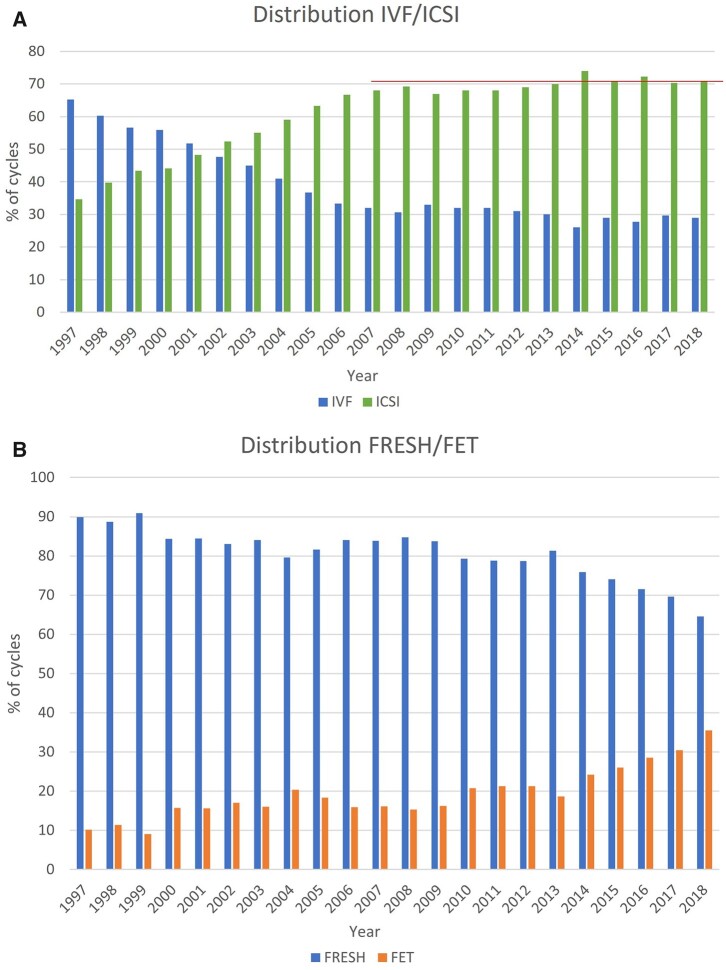
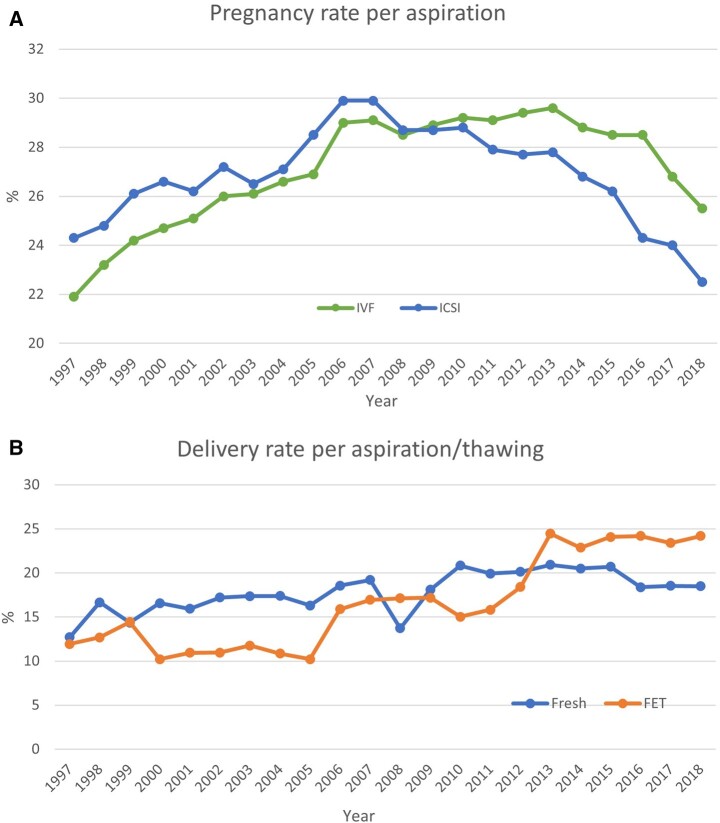
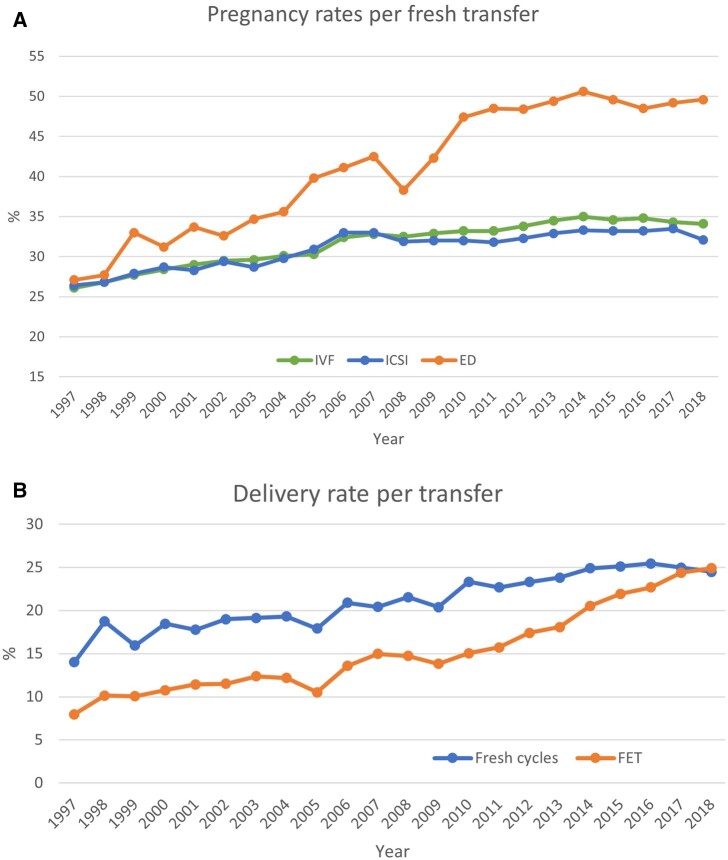
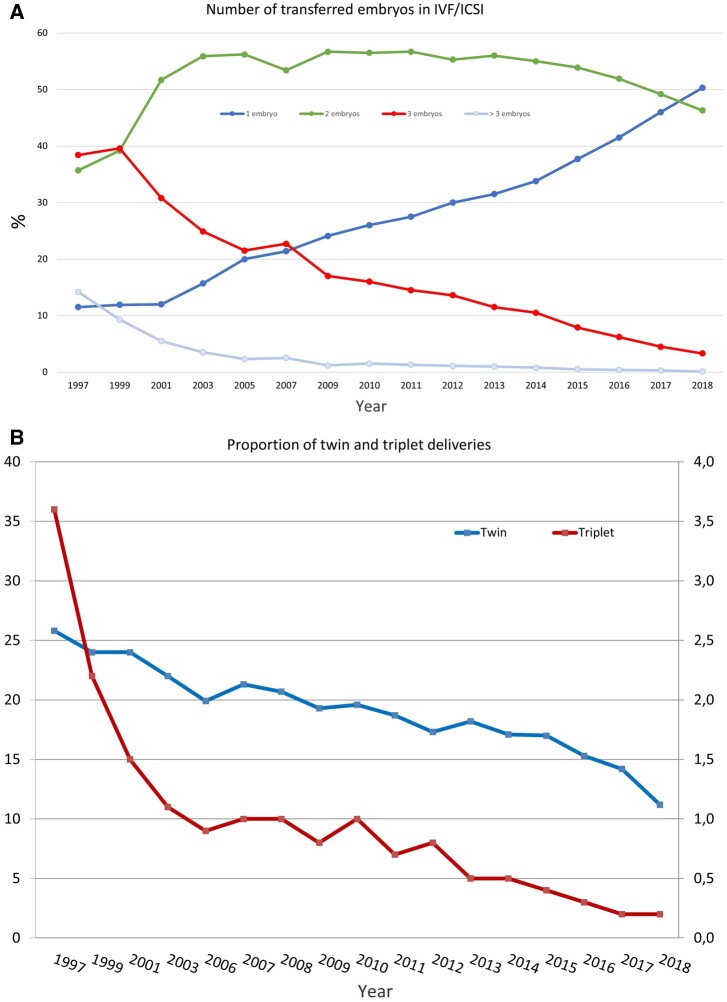
STUDY QUESTION: What are the data and trends on ART and IUI cycle numbers and their outcomes, and on fertility preservation (FP) interventions, reported in 2018 as compared to previous years? SUMMARY ANSWER: The 22nd ESHRE report shows a continued increase in reported numbers of ART treatment cycles and children born in Europe, a decrease in transfers with more than one embryo with a further reduction of twin delivery rates (DRs) as compared to 2017, higher DRs per transfer after fresh IVF or ICSI cycles (without considering freeze-all cycles) than after frozen embryo transfer (FET) with higher pregnancy rates (PRs) after FET and the number of reported IUI cycles decreased while their PR and DR remained stable. WHAT IS KNOWN ALREADY: ART aggregated data generated by national registries, clinics or professional societies have been gathered and analysed by the European IVF-monitoring Consortium (EIM) since 1997 and reported in 21 manuscripts published in Human Reproduction and Human Reproduction Open. STUDY DESIGN, SIZE, DURATION: Data on medically assisted reproduction (MAR) from European countries are collected by EIM for ESHRE on a yearly basis. The data on treatment cycles performed between 1 January and 31 December 2018 were provided by either national registries or registries based on initiatives of medical associations and scientific organizations or committed persons of 39 countries. PARTICIPANTS/MATERIALS, SETTING, METHODS: Overall, 1422 clinics offering ART services in 39 countries reported a total of more than 1 million (1 007 598) treatment cycles for the first time, including 162 837 with IVF, 400 375 with ICSI, 309 475 with FET, 48 294 with preimplantation genetic testing, 80 641 with egg donation (ED), 532 with IVM of oocytes and 5444 cycles with frozen oocyte replacement (FOR). A total of 1271 institutions reported data on IUI cycles using either husband/partner’s semen (IUI-H; n = 148 143) or donor semen (IUI-D; n = 50 609) in 31 countries and 25 countries, respectively. Sixteen countries reported 20 994 interventions in pre- and post-pubertal patients for FP including oocyte, ovarian tissue, semen and testicular tissue banking. MAIN RESULTS AND THE ROLE OF CHANCE: In 21 countries (21 in 2017) in which all ART clinics reported to the registry, 410 190 treatment cycles were registered for a total population of ∼ 300 million inhabitants, allowing a best estimate of a mean of 1433 cycles performed per million inhabitants (range: 641–3549). Among the 39 reporting countries, for IVF, the clinical PR per aspiration slightly decreased while the PR per transfer remained similar compared to 2017 (25.5% and 34.1% in 2018 versus 26.8% and 34.3% in 2017). In ICSI, the corresponding rates showed similar evolutions in 2018 compared to 2017 (22.5% and 32.1% in 2018 versus 24.0% and 33.5% in 2017). When freeze-all cycles were not considered for the calculations, the clinical PRs per aspiration were 28.8% (29.4% in 2017) and 27.3% (27.3% in 2017) for IVF and ICSI, respectively. After FET with embryos originating from own eggs, the PR per thawing was 33.4% (versus 30.2% in 2017), and with embryos originating from donated eggs 41.8% (41.1% in 2017). After ED, the PR per fresh embryo transfer was 49.6% (49.2% in 2017) and per FOR 44.9% (43.3% in 2017). In IVF and ICSI together, the trend towards the transfer of fewer embryos continues with the transfer of 1, 2, 3 and ≥4 embryos in 50.7%, 45.1%, 3.9% and 0.3% of all treatments, respectively (corresponding to 46.0%, 49.2%. 4.5% and 0.3% in 2017). This resulted in a reduced proportion of twin DRs of 12.4% (14.2% in 2017) and similar triplet DR of 0.2%. Treatments with FET in 2018 resulted in twin and triplet DRs of 9.4% and 0.1%, respectively (versus 11.2% and 0.2%, respectively in 2017). After IUI, the DRs remained similar at 8.8% after IUI-H (8.7% in 2017) and at 12.6% after IUI-D (12.4% in 2017). Twin and triplet DRs after IUI-H were 8.4% and 0.3%, respectively (in 2017: 8.1% and 0.3%), and 6.4% and 0.2% after IUI-D (in 2017: 6.9% and 0.2%). Among 20 994 FP interventions in 16 countries (18 888 in 13 countries in 2017), cryopreservation of ejaculated sperm (n = 10 503, versus 11 112 in 2017) and of oocytes (n = 9123 versus 6588 in 2017) were the most frequently reported. LIMITATIONS, REASONS FOR CAUTION: The results should be interpreted with caution as data collection systems and completeness of reporting vary among European countries. Some countries were unable to deliver data about the number of initiated cycles and/or deliveries. WIDER IMPLICATIONS OF THE FINDINGS: The 22nd ESHRE data collection on ART, IUI and FP interventions shows a continuous increase of reported treatment numbers and MAR-derived livebirths in Europe. Although it is the largest data collection on MAR in Europe, further efforts towards optimization of both the collection and reporting, with the aim of improving surveillance and vigilance in the field of reproductive medicine, are awaited. STUDY FUNDING/COMPETING INTEREST(S): The study has received no external funding and all costs are covered by ESHRE. There are no competing interests.
Overview
The claims and statistics of this paper haven’t been checked yet.
Free: it reads the open-access text and checks the first 5 claims that cite a source we can check. Create a free account to check every claim.
Integrity signals
Registry
Cites
Statistics
Figures
Verification
Claims the paper makes
The claims and statistics of this paper haven’t been checked yet.
Free: it reads the open-access text and checks the first 5 claims that cite a source we can check. Create a free account to check every claim.
Claims other papers make about this one
Each is checked against this paper’s own text: does it say what the citing paper says it does?
The source backs part of the claim, not all of it — or backs it for a different population, condition or comparison.
In the citing paper
“Also, the share of treatments provided to women age 40+ has increased considerably: about 22% of in vitro fertilization (IVF) /intracytoplasmic sperm injection treatments were provided to women aged 40+ in 2018, compared with 15% in 2005 (author ' s calculations for 21 European countries based on Andersen et al., 2009; Wyns et al., 2022).”
From Delayed Fertility as a Driver of Fertility Decline? (2023) · cites this paper as Wyns et al., 2022
Experimental — accuracy not yet measured
Self-check
Percentages, sums and reported differences re-computed from the paper’s own numbers.
The self-check needs the paper’s full text.
Citations
Cites
The international glossary on infertility and fertility care, 2017
Zegers-Hochschild, F., Adamson, G. D., Dyer, S., Racowsky, C., de Mouzon, J., Sokol, R., Rienzi, L., Sunde, A., Schmidt, L., Cooke, I. D., et al. (2017) · Human Reproduction · doi:10.1093/humrep/dex234 · Cited by 1,320 · cited 1×
“The terminology used was based on the glossary of The International Committee for Monitoring Assisted Reproductive Technology (Zegers-Hochschild et al., 2017).”
MethodCleavage stage versus blastocyst stage embryo transfer in assisted reproductive technology
Glujovsky, D., Farquhar, C., Quinteiro Retamar, A. M., Alvarez Sedo, C. R., & Blake, D. (2016) · Cochrane Database of Systematic Reviews · doi:10.1002/14651858.cd002118.pub5 · Cited by 706
Sullivan, E. A., Zegers-Hochschild, F., Mansour, R., Ishihara, O., de Mouzon, J., Nygren, K. G., & Adamson, G. D. (2013) · Human Reproduction · doi:10.1093/humrep/det036 · Cited by 414
Chambers, G. M., Dyer, S., Zegers-Hochschild, F., de Mouzon, J., Ishihara, O., Banker, M., Mansour, R., Kupka, M. S., & Adamson, G. D. (2021) · Human Reproduction · doi:10.1093/humrep/deab198 · Cited by 298
Self-citationART in Europe, 2016: results generated from European registries by ESHRE†
The European IVF-monitoring Consortium (EIM)‡ for the European Society of Human Reproduction and Embryology (ESHRE), Wyns, C., Gliozheni, O., Hambartsoumian, E., Strohmer, H., Petrovskaya, E., Tishkevich, O., Bogaerts, K., Wyns, C., Balic, D., et al. (2020) · Human Reproduction Open · doi:10.1093/hropen/hoaa032 · Cited by 274
Self-citationSurvey on ART and IUI: legislation, regulation, funding and registries in European countries
Calhaz-Jorge, C., De Geyter, C. H., Kupka, M. S., Wyns, C., Mocanu, E., Motrenko, T., Scaravelli, G., Smeenk, J., Vidakovic, S., & Goossens, V (2020) · Human Reproduction Open · doi:10.1093/hropen/hoz044 · Cited by 262
Self-citationRisks and complications in assisted reproduction techniques: Report of an ESHRE consensus meeting
Land, J. A. (2003) · Human Reproduction · doi:10.1093/humrep/deg081 · Cited by 234
ART in Europe, 2015: results generated from European registries by ESHRE†
De Geyter, C., Calhaz-Jorge, C., Kupka, M. S., Wyns, C., Mocanu, E., Motrenko, T., Scaravelli, G., Smeenk, J., Vidakovic, S., Goossens, V, et al. (2020) · Human Reproduction Open · doi:10.1093/hropen/hoz038 · Cited by 213
Self-citationDe Geyter, C., Wyns, C., Calhaz-Jorge, C., de Mouzon, J., Ferraretti, A. P., Kupka, M., Nyboe Andersen, A., Nygren, K. G., & Goossens, V (2020) · Human Reproduction · doi:10.1093/humrep/deaa250 · Cited by 195
Self-citationART in Europe, 2017: results generated from European registries by ESHRE
The European IVF-Monitoring Consortium (EIM) for the European Society of Human Reproduction and Embryology (ESHRE), Gliozheni, O., Hambartsoumian, E., Strohmer, H., Kreuz-Kinderwunschzentrum, O. &. S. P. G., Petrovskaya, E., Tishkevich, O., Bogaerts, K., I-Biostat, C. W., Balic, D., et al. (2021) · Human Reproduction Open · doi:10.1093/hropen/hoab026 · Cited by 192
Self-citation
Cited by
Eisenberg, M. L., Esteves, S. C., Lamb, D. J., Hotaling, J. M., Giwercman, A., Hwang, K., & Cheng, Y.-S. (2023) · Nature Reviews Disease Primers · doi:10.1038/s41572-023-00459-w · Cited by 536
ART in Europe, 2019: results generated from European registries by ESHRE
The European IVF Monitoring Consortium (EIM) for the European Society of Human Reproduction and Embryology (ESHRE), Gliozheni, O., Hambartsoumian, E., Strohmer, H., Petrovskaya, E., Tishkevich, O., De Neubourg, D., Bogaerts, K., Balic, D., Antonova, I., et al. (2023) · Human Reproduction · doi:10.1093/humrep/dead197 · Cited by 303
Self-citationESHRE good practice recommendations on recurrent implantation failure
ESHRE Working Group on Recurrent Implantation Failure, Cimadomo, D., de los Santos, M. J., Griesinger, G., Lainas, G., Le Clef, N., McLernon, D. J., Montjean, D., Toth, B., Vermeulen, N., et al. (2023) · Human Reproduction Open · doi:10.1093/hropen/hoad023 · Cited by 237
Good practice recommendations on add-ons in reproductive medicine
ESHRE Add-ons working group, Lundin, K., Bentzen, J. G., Bozdag, G., Ebner, T., Harper, J., Le Clef, N., Moffett, A., Norcross, S., Polyzos, N. P., et al. (2023) · Human Reproduction · doi:10.1093/humrep/dead184 · Cited by 172
Parisi, F., Fenizia, C., Introini, A., Zavatta, A., Scaccabarozzi, C., Biasin, M., & Savasi, V. M. (2023) · Human Reproduction Update · doi:10.1093/humupd/dmad016 · Cited by 159
“Such knowledge would be of relevance in light of the increasing rates of autologous and heterologous ART pregnancies, currently accounting for around 3% of livebirths in industrialized countries (Wyns et al. , 2022).”
BackgroundESHRE guideline: number of embryos to transfer during IVF/ICSI
ESHRE Guideline Group on the Number of Embryos to Transfer, Alteri, A., Arroyo, G., Baccino, G., Craciunas, L., Geyter, C. D., Ebner, T., Koleva, M., Kordic, K., Mcheik, S., et al. (2024) · Human Reproduction · doi:10.1093/humrep/deae010 · Cited by 126
Self-citationThe Working Group on the update of the ESHRE/ALPHA Istanbul Consensus, Coticchio, G., Ahlström, A., Arroyo, G., Balaban, B., Campbell, A., Santos, M. J. D. L., Ebner, T., Gardner, D. K., Kovačič, B., et al. (2025) · Human Reproduction · doi:10.1093/humrep/deaf021 · Cited by 122
Self-citationESHRE PGT Consortium data collection XXI: PGT analyses in 2018
Spinella, F., Bronet, F., Carvalho, F., Coonen, E., Rycke, M. D., Rubio, C., Goossens, V., & van Montfoort, A. P. A. (2023) · Human Reproduction Open · doi:10.1093/hropen/hoad010 · Cited by 71
Self-citationRibas‐Maynou, J., Novo, S., Torres, M., Salas‐Huetos, A., Rovira, S., Antich, M., & Yeste, M. (2022) · Biological Research · doi:10.1186/s40659-022-00409-y · Cited by 57
Zou, H., Kemper, J. M., Hammond, E. R. A., Xu, F., Liu, G., Xue, L., Bai, X., Liao, H., Xue, S., Zhao, S., et al. (2023) · Human Reproduction · doi:10.1093/humrep/dead212 · Cited by 53
“The proportion of SET cycles has increased over the last two decades, reaching over 90% in Australia, New Zealand, and some Nordic countries (Newman and Chambers, 2021; Wyns et al. , 2022).”
Maternal Risk of Cardiovascular Disease After Use of Assisted Reproductive Technologies
Magnus, M. C., Fraser, A., Håberg, S. E., Rönö, K., Romundstad, L. B., Bergh, C., Spangmose, A. L., Pinborg, A. B., Gissler, M., Wennerholm, U., et al. (2023) · JAMA Cardiology · doi:10.1001/jamacardio.2023.2324 · Cited by 48
Self-citationAssociation between the number of oocytes and cumulative live birth rate: A systematic review
Neves, A. R., Montoya-Botero, P., Guedj, N. S., & Polyzos, N. P. (2022) · Best Practice & Research Clinical Obstetrics & Gynaecology · doi:10.1016/j.bpobgyn.2022.102307 · Cited by 48
Cornelisse, S., Fleischer, K., van der Westerlaken, L., de Bruin, J. P., Vergouw, C. G., Koks, C. A. M., Derhaag, J. G., Visser, J., van Echten‐Arends, J., Slappendel, E., et al. (2024) · BMJ · doi:10.1136/bmj-2024-080133 · Cited by 40
ART in Europe, 2020: results generated from European registries by ESHRE
Gliozheni, O., Hambartsoumian, E., Strohmer, H., Petrovskaya, E., Neubourg, D. D., Bogaerts, K., Balić, D., Antonova, I., Cvetkova, E., Ljiljak, D., et al. (2025) · Human Reproduction · doi:10.1093/humrep/deaf179 · Cited by 41
Self-citationLong-term health risk of offspring born from assisted reproductive technologies
Zhang, S., Luo, Q., Meng, R., Yan, J., Wu, Y., & Huang, H. (2023) · Journal of Assisted Reproduction and Genetics · doi:10.1007/s10815-023-02988-5 · Cited by 39
Ma, X., Wang, J., Shi, Y., Tan, J., Guan, Y., Sun, Y. S., Zhang, B., Zhao, J., Liu, J., Cao, Y., et al. (2024) · Nature Communications · doi:10.1038/s41467-024-52008-y · Cited by 35
Transcriptomic integrity of human oocytes used in ARTs: technical and intrinsic factor effects
Ducreux, B., Patrat, C., Trasler, J. M., & Fauque, P. (2023) · Human Reproduction Update · doi:10.1093/humupd/dmad025 · Cited by 32
Dehghan, S., Rabiei, R., Choobineh, H., Maghooli, K., Nazari, M., & Vahidi-Asl, M. (2024) · PLoS ONE · doi:10.1371/journal.pone.0310829 · Cited by 31
Magnetotactic Sperm Cells for Assisted Reproduction
Striggow, F., Ribeiro, C., Aziz, A., Nauber, R., Hebenstreit, F., Schmidt, O. G., & Medina‐Sánchez, M. (2023) · Small · doi:10.1002/smll.202310288 · Cited by 29
Brautsch, L. A. S., Voss, I., Schmidt, L., & Vassard, D. (2022) · Human Reproduction · doi:10.1093/humrep/deac247 · Cited by 30
Havrljenko, J., Kopitović, V., Trninić-Pjević, A., Milatović, S., Pavlica, T., Andric, N. L., & Pogrmic‐Majkic, K. (2023) · Medicina · doi:10.3390/medicina59101799 · Cited by 29
Sciorio, R., Manna, C., Fauque, P., & Rinaudo, P. F. (2023) · Journal of Clinical Medicine · doi:10.3390/jcm12134444 · Cited by 28
Fjeldstad, J., Qi, W., Siddique, N., Mercuri, N. D., Nayot, D., & Taub-Krivoy, A. (2024) · Scientific Reports · doi:10.1038/s41598-024-60901-1 · Cited by 27
Dietary trends and the decline in male reproductive health
Whittaker, J. (2023) · HORMONES · doi:10.1007/s42000-023-00431-z · Cited by 27
Vidal, À., Dhakal, C., Werth, N., Weiss, J. M., Lehnick, D., & Schwartz, A. K. (2023) · Frontiers in Endocrinology · doi:10.3389/fendo.2023.1128564 · Cited by 28
Lédée, N., Petitbarat, M., Dray, G., Chevrier, L., Kazhalawi, A., Rahmati, M., Vicaut, É., Diallo, A., Cassuto, N. G., Ruoso, L., et al. (2025) · Frontiers in Immunology · doi:10.3389/fimmu.2025.1523871 · Cited by 27
Metabolic signature of follicular fluid in infertility-related diseases: a narrative review
Fiscus, J., Fraison, É., Renault, L., Salle, B., Panthu, B., & Labrune, E. (2023) · Reproductive BioMedicine Online · doi:10.1016/j.rbmo.2023.103762 · Cited by 27
Mapping ethical, legal, and social implications (ELSI) of preimplantation genetic testing (PGT)
Alón, I., Bussod, I., & Ravitsky, V. (2024) · Journal of Assisted Reproduction and Genetics · doi:10.1007/s10815-024-03076-y · Cited by 26
Advanced Sperm Selection Strategies as a Treatment for Infertile Couples: A Systematic Review
Ribas‐Maynou, J., Barranco, I., Sorolla-Segura, M., Llavanera, M., Delgado‐Bermúdez, A., & Yeste, M. (2022) · International Journal of Molecular Sciences · doi:10.3390/ijms232213859 · Cited by 24
Kocourková, J., Šťastná, A., & Burcin, B. (2023) · Scientific Reports · doi:10.1038/s41598-023-37071-7 · Cited by 25
Ahlström, A., Berntsen, J., Johansen, M., Bergh, C., Cimadomo, D., Hardarson, T., & Lundin, K. (2023) · Reproductive BioMedicine Online · doi:10.1016/j.rbmo.2023.103408 · Cited by 24
Self-citationEndometrial Fluid Biomarkers And Their Potential As Predictors Of Successful Embryo Implantation
Alves, A. R., Figueiredo-Dias, M., & Silvestre, M. (2023) · Biomedicine · doi:10.37796/2211-8039.1413 · Cited by 23
Bernstein, L. R., Mackenzie, A. C. L., Durkin, K., Kraemer, D. C., Chaffin, C. L., & Merchenthaler, I. J. (2023) · Molecular Human Reproduction · doi:10.1093/molehr/gaad030 · Cited by 23
Delayed Fertility as a Driver of Fertility Decline?
Beaujouan, E. (2023) · The Springer Series on Demographic Methods and Population Analysis · doi:10.1007/978-3-031-29666-6_4 · Cited by 21
Lammers, J., Reignier, A., Loubersac, S., Chaillot, M., & Fréour, T. (2025) · Reproductive Sciences · doi:10.1007/s43032-024-01762-x · Cited by 21
Chamayou, S., Giacone, F., Cannarella, R., & Guglielmino, A. (2023) · Journal of Clinical Medicine · doi:10.3390/jcm12020671 · Cited by 21
Lawrenz, B., Ata, B., Kalafat, E., Melado, L., Elkhatib, I., Gallego, R. D., & Fatemi, H. M. (2023) · Human Reproduction · doi:10.1093/humrep/dead104 · Cited by 21
Grande, G., Garolla, A., Graziani, A., Astorri, A. L., Cammarota, M. V., Merola, A., Polidori, M. P., Lulli, E., Busato, E., Pesce, F., et al. (2025) · Andrology · doi:10.1111/andr.70006 · Cited by 20
“PregnancyratesperaspirationinEuropeare reported to be 30.8%, 25.4%, and 13.6%, respectively, for women < 34 years, 35–39 years, and > 40 years.”
InfluentialZaat, T. R., de Bruin, J. P., Goddijn, M., van Baal, M., Benneheij, S. H., Brandes, M., Broekmans, F. J., Cantineau, A. E., Cohlen, B. J., van Disseldorp, J., et al. (2023) · The Lancet · doi:10.1016/s0140-6736(23)01312-0 · Cited by 20
Self-citationVenetis, C. A., Choi, S. K. Y., Jorm, L. R., Zhang, X., Ledger, W. J., Lui, K., Havard, A., CHAPMAN, M. G., Norman, R. J., & Chambers, G. M. (2023) · Annals of Internal Medicine · doi:10.7326/m23-0872 · Cited by 20
Sciorio, R., Tramontano, L., Gullo, G., & Fleming, S. D. (2025) · Medicina · doi:10.3390/medicina61071194 · Cited by 19
The Next Frontier in ART: Harnessing the Uterine Immune Profile for Improved Performance
Lédée, N., Petitbarat, M., Prat-Ellenberg, L., Dray, G., Vaucoret, V., Kazhalawi, A., Pozo, A. R., Habeichi, N. J., Ruoso, L., Cassuto, N. G., et al. (2023) · International Journal of Molecular Sciences · doi:10.3390/ijms241411322 · Cited by 19
Keller, E., & Chambers, G. M. (2022) · Frontiers in Medical Technology · doi:10.3389/fmedt.2022.1053719 · Cited by 19
Niu, Y., Suo, L., Zhao, D., Wang, Y., Miao, R., Zou, J., Han, X., Chen, Z., Li, Y., & Wei, D. (2023) · Journal of Assisted Reproduction and Genetics · doi:10.1007/s10815-023-02785-0 · Cited by 18
“The use of FET has steadily increased globally in the past decade [50, 51], and the risk of preeclampsia was reported to be higher after FETs than FreETs, especially FETs with artificial cycles for endometrial preparation.”
BackgroundFenwick, E. A. L., Eze, A. G., D’Hooghe, T. M., Pandey, S., Chaudhari, V., Ostawal, A., Luyten, J., & Harty, G. T. (2023) · Best Practice & Research Clinical Obstetrics & Gynaecology · doi:10.1016/j.bpobgyn.2023.102340 · Cited by 20
Major postpartum haemorrhage after frozen embryo transfer: A population‐based study
Al‐Khatib, A., Sagot, P., Cottenet, J., Aroun, M., Quantin, C., & Desplanches, T. (2023) · BJOG An International Journal of Obstetrics & Gynaecology · doi:10.1111/1471-0528.17625 · Cited by 18
“However, the number of women undergoing IVF after frozen embryo transfer is increasing worldwide, 1,2 implying that the outcome could affect more women each year.”
BackgroundLawrenz, B., Kalafat, E., Ata, B., Gallego, R. D., Melado, L., Elkhatib, I., & Fatemi, H. M. (2024) · Journal of Assisted Reproduction and Genetics · doi:10.1007/s10815-024-03049-1 · Cited by 18
Palomba, S., Caserta, D., Levi-Setti, P. E., & Busnelli, A. (2024) · Journal of Ovarian Research · doi:10.1186/s13048-024-01372-w · Cited by 18
Merging synthetic and real embryo data for advanced AI predictions
Presacan, O., Dorobanțiu, A., Thambawita, V. L., Riegler, M., Stensen, M. H., Iliceto, M., Aldea, A. C., & Sharma, A. (2025) · Scientific Reports · doi:10.1038/s41598-025-94680-0 · Cited by 18
The utility of nuclear magnetic resonance spectroscopy in assisted reproduction
Asampille, G., Cheredath, A., Joseph, D. M., Adiga, S. K., & Atreya, H. S. (2020) · Open Biology · doi:10.1098/rsob.200092 · Cited by 18
Boutet, M. L., Eixarch, E., Ahumada‐Droguett, P., Nakaki, A., Crovetto, F., Cívico, M. S., Borrás, A., Manau, D., Gratacós, E., Crispi, F., et al. (2022) · Ultrasound in Obstetrics and Gynecology · doi:10.1002/uog.24920 · Cited by 17
Meyer, B., Riedel, F., Amann, N., Graf, A., Stuehrenberg, A., Ritter, V., Wallwiener, M., Heublein, S., Recker, F., Weiss, M., et al. (2024) · BMC Medical Education · doi:10.1186/s12909-024-05138-2 · Cited by 16
Burgio, A., Castagnaro, C., Vignoli, D., & Vitali, A. (2025) · Human Reproduction · doi:10.1093/humrep/deaf137 · Cited by 16
“…is among the highest in Europe (equal to 34.4% in 2021 according to Ministry of Health, 2023 vs a European average of 21% as of 2018 according to Wyns et al. , 2022), while the waiting time between first medical consultation for infertility and first consultation in an infertility center…”
InfluentialGriesinger, G., & Larsson, P. (2023) · Human Reproduction Open · doi:10.1093/hropen/hoad018 · Cited by 16
Matorras, R., Chaudhari, V., Roeder, C., Schwarze, J.-E., Bühler, K. F., Hwang, K. J., Chang-Woo, C., Iniesta, S., D’Hooghe, T., & Mathur, R. (2023) · Best Practice & Research Clinical Obstetrics & Gynaecology · doi:10.1016/j.bpobgyn.2023.102349 · Cited by 15
Michalopoulou, M., Jebb, S. A., Hobson, A., Khaw, S. C., Stevens, R., Melo, P., Haffner, S. J. P., Clay, K. S., Mounsey, S., Granne, I., et al. (2025) · Annals of Internal Medicine · doi:10.7326/annals-24-01025 · Cited by 15
“As a result, many women with obesity and infertility seek assisted reproductive technology (ART) treatment, including in vitro fertilization (IVF) in order to help them conceive (5), despite observational evidence that IVF outcomes are poorer in women with obesity (1, 6, 7).”
Terho, A., Tiitinen, A. E., Salo, J., Martikainen, H. K., Gissler, M., & Pelkonen, S. (2024) · Human Reproduction · doi:10.1093/humrep/dead264 · Cited by 15
“The use of FET is on the rise, comprising 35.5% of all treatment cycles in 2018, and even freeze-all cycles are implemented widely (Wyns et al. , 2022).”
InfluentialSelf-citationCarosso, A. R., Brunod, N., Filippini, C., Revelli, A., Evangelisti, B., Cosma, S. D., Borella, F., Canosa, S., Benedetto, C., & Gennarelli, G. (2023) · Journal of Clinical Medicine · doi:10.3390/jcm12124032 · Cited by 14
La PMA en France : une reproduction des inégalités de genre ?
Rozée, V., & Rochebrochard, É. D. L. (2023) · Travail genre et sociétés · doi:10.3917/tgs.050.0043 · Cited by 14
Alternatives to in vitro fertilization
Wessel, J. A., Hunt, S., van Wely, M., Mol, F., & Wang, R. (2023) · Fertility and Sterility · doi:10.1016/j.fertnstert.2023.01.011 · Cited by 14
The future of frozen-thawed embryo transfer in hormone replacement therapy cycles
Løssl, K., Spangmose, A. L., Asserhøj, L. L., Dam, T. V., & Pinborg, A. B. (2023) · Current Opinion in Obstetrics & Gynecology · doi:10.1097/gco.0000000000000867 · Cited by 14
Chen, D., Xu, Q., Mao, X., Zhang, J., & Wu, L. (2023) · Ultrasound in Obstetrics and Gynecology · doi:10.1002/uog.26220 · Cited by 14
Making Multiple Babies: Anticipatory Regimes of Assisted Reproduction
Wu, C.-L. (2023) · Berghahn Books · doi:10.1515/9781800738850 · Cited by 14
Loreti, S., Roelens, C., Drakopoulos, P., Munck, N. D., Tournaye, H. J., Mackens, S., & Blockeel, C. (2023) · Reproductive BioMedicine Online · doi:10.1016/j.rbmo.2023.103601 · Cited by 15
Feng, Q., Li, W., Callander, E. J., Wang, R., & Mol, B. W. (2023) · Human Reproduction · doi:10.1093/humrep/dead265 · Cited by 13
Mapping ethical, legal, and social implications (ELSI) of fertility preservation
Alón, I., Bussod, I., Golan, O. C., & Ravitsky, V. (2024) · Journal of Assisted Reproduction and Genetics · doi:10.1007/s10815-024-03210-w · Cited by 13
Auvinen, P., Vehviläinen, J., Rämö, K., Laukkanen, I., Marjonen, H., Wallén, E., Söderström‐Anttila, V., Kahila, H. K., Hydén‐Granskog, C., Tuuri, T., et al. (2024) · Communications Medicine · doi:10.1038/s43856-024-00694-6 · Cited by 15
Epidemiology of falling fertility: the contribution of social, environmental, and genetic forces
Aitken, R. J., & Norman, R. J. (2025) · Fertility and Sterility · doi:10.1016/j.fertnstert.2025.04.048 · Cited by 13
ART in Latin America: the Latin American Registry, 2020
Zegers-Hochschild, F., Crosby, J. A., Musri, C., Petermann-Rocha, F. E., de Souza, M. D. C. B., Martinez, A. G., Azambuja, R., Roque, A., Estofan, G. M., & Croker, M. V. (2023) · Reproductive BioMedicine Online · doi:10.1016/j.rbmo.2023.03.006 · Cited by 13
Parvanov, D. A., Ganeva, R., Arsov, K., Decheva, I., Handzhiyska, M., Ruseva, M., Vidolova, N., Scarpellini, F., Metodiev, D., & Stamenov, G. (2023) · Journal of Assisted Reproduction and Genetics · doi:10.1007/s10815-023-02821-z · Cited by 13
Foyston, Z., Higgins, L. E., Smith, D. M., & Wittkowski, A. (2023) · BMC Pregnancy and Childbirth · doi:10.1186/s12884-023-05727-x · Cited by 13
Huang, W. M., Chen, A. C. H., Ng, E. H. Y., Yeung, W. S. B., & Lee, Y. L. (2023) · International Journal of Molecular Sciences · doi:10.3390/ijms24065751 · Cited by 12
Yao, Y., Du, Y., Guo, N., Liu, F., Deng, T., & Li, Y. (2024) · Frontiers in Endocrinology · doi:10.3389/fendo.2023.1286391 · Cited by 12
Capalbo, A., de Wert, G. M. W. R., Henneman, L., Kakourou, G., Mcheik, S., Peterlin, B., van El, C. G., Vassena, R., Vermeulen, N., Viville, S., et al. (2024) · Human Reproduction · doi:10.1093/humrep/deae131 · Cited by 12
Zhang, X., Chambers, G. M., Venetis, C. A., Choi, S. K. Y., Gerstl, B., Ng, C. H. M., & Abbott, J. A. (2024) · Fertility and Sterility · doi:10.1016/j.fertnstert.2024.12.007 · Cited by 12
RetractedChanfreau, J., Goisis, A., & Kravdal, Ø. (2025) · Population and Development Review · doi:10.1111/padr.70009 · Cited by 12
Birth size after embryo cryopreservation: larger by all measures?
Landsverk, E., Westvik‐Johari, K., Romundstad, L. B., & Opdahl, S. (2023) · Human Reproduction · doi:10.1093/humrep/dead094 · Cited by 12
“Children born after ART comprise an increasing proportion of birth cohorts in Europe (Wyns et al. , 2022).”
Self-citationYang, S., Xu, B., Zhuang, Y., Zhang, Q., Li, J., & Fu, X. (2024) · Medicine · doi:10.1097/md.0000000000039964 · Cited by 12
“[10] The noninvasive, simple, and accurate selection of high-quality embryos with optimal developmental potential before embryo transfer is a focal point of research in the fields of ART and genetics.”
BackgroundPrenatal testing for Imprinting Disorders: A clinical perspective
Dufke, A., Eggermann, T., Kagan, K. O., Hoopmann, M., & Elbracht, M. (2023) · Prenatal Diagnosis · doi:10.1002/pd.6400 · Cited by 12
ART in Latin America: the Latin American Registry, 2020
on behalf of the Latin American Network of Assisted Reproduction, Zegers-Hochschild, F., Crosby, J. A., Musri, C., Petermann-Rocha, F. E., de Souza, M. D. C. B., Martinez, A., Azambuja, R., Roque, A., Estofan, G. M., et al. (2023) · JBRA · doi:10.5935/1518-0557.20230025 · Cited by 12
Late reproductive age of a woman: risks of reproductive dysfunction (literature review)
Dolgushina, N. V., Adamyan, L. V., & Леонидовна, Ш. Е. (2023) · Russian Journal of Human Reproduction · doi:10.17116/repro20232904199 · Cited by 11
Chen, M., Kotsopoulos, N., Yen, A. M., Lin, K., & Connolly, M. P. (2024) · Human Reproduction · doi:10.1093/humrep/deae271 · Cited by 11
“Perhaps more importantly, the contribution from assisted reproduction to national births every year is on average 3.5% of all births in Europe, which is greater than the effects of most family-friendly policies currently being used by many countries (Wyns et al. , 2022).”
InfluentialGianaroli, L., Perruzza, D., Albanese, C., Azzena, S., Tabanelli, C., Ferraretti, A. P., & Magli, M. C. (2023) · Human Reproduction · doi:10.1093/humrep/dead088 · Cited by 11
Psychological Aspects of Infertility – Results from an Actor–Partner Interdependence Analysis
Thanscheidt, C. L., Pätsch, P., Rösner, S., Germeyer, A., Krause, M., Kentenich, H., Siercks, I., Häberlin, F., Ehrbar, V., Tschudin, S., et al. (2023) · Geburtshilfe und Frauenheilkunde · doi:10.1055/a-2041-2831 · Cited by 10
Birefringence properties of human immotile spermatozoa and ICSI outcome
Magli, M. C., Crippa, A., Perruzza, D., Azzena, S., Graziosi, S., Coppola, F., Tabanelli, C., Ferraretti, A. P., & Gianaroli, L. (2022) · Reproductive BioMedicine Online · doi:10.1016/j.rbmo.2022.11.015 · Cited by 10
Should ICSI be implemented on patients with poor-quality embryos in the previous IVF cycle?
Wang, J., Xiong, S., Gao, Y., Xia, F., Wei, B., Zou, J., Huang, G., & Han, W. (2023) · Heliyon · doi:10.1016/j.heliyon.2023.e17996 · Cited by 10
Experiences with transvaginal Ovum Pick-Up (OPU) in sows
Oltedal, A., Gaustad, A. H., Peltoniemi, O. A. T., Björkman, S., Skaare, A., & Oropeza-Moe, M. (2023) · Theriogenology · doi:10.1016/j.theriogenology.2023.09.021 · Cited by 10
Desy, A., & Marre, D. (2024) · Social Science & Medicine · doi:10.1016/j.socscimed.2024.116951 · Cited by 10
Wang, X., Xu, H.-M., Wang, Q.-L., Zhu, X.-Y., Zeng, Y.-M., Huang, L., Feng, X., & Chen, D. (2024) · Journal of Integrative and Complementary Medicine · doi:10.1089/jicm.2023.0478 · Cited by 10
Peng, X., Wu, B., Zhou, S., Xu, Y., Ogihara, A., Nishimura, S., Jin, Q., & Litscher, G. (2025) · Healthcare · doi:10.3390/healthcare13111326 · Cited by 10
Tourzani, D. A., Yin, Q., Jackson, E. A., Rando, O. J., Visconti, P. E., & Gervasi, M. G. (2022) · International Journal of Molecular Sciences · doi:10.3390/ijms24010640 · Cited by 10
The impact of cryopreserved sperm on intrauterine insemination outcomes: is frozen as good as fresh?
Cherouveim, P., Vagios, S., Hammer, K. C., Fitz, V. W., Jiang, V. S., Dimitriadis, I., Sacha, C. R., James, K. E., Bormann, C. L., & Souter, I. C. (2023) · Frontiers in Reproductive Health · doi:10.3389/frph.2023.1181751 · Cited by 10
Geyter, C. D., Calhaz–Jorge, C., Goossens, V., Magli, M. C., Smeenk, J. M. J., Vesela, K., Vermeulen, N., & Wyns, C. (2023) · Human Reproduction Open · doi:10.1093/hropen/hoad011 · Cited by 9
Self-citationSciorio, R., Campos, G., Tramontano, L., Bulletti, F. M., Baldini, G. M., & Vinciguerra, M. (2023) · Zygote · doi:10.1017/s0967199423000345 · Cited by 9
Yeung, E. H., Putnick, D. L., Ghassabian, A., Sundaram, R., Lin, T.-C., Mirzaei, S., Stern, J. E., & Bell, E. M. (2023) · Annals of Epidemiology · doi:10.1016/j.annepidem.2023.03.006 · Cited by 9
Subfertility versus ART: unraveling the origins of fetal cardiac programming
Boutet, M. L., Casals, G., Valenzuela‐Alcaráz, B., García‐Otero, L., Crovetto, F., Borrás, A., Cívico, M. S., Manau, D., Gratacós, E., & Crispi, F. (2023) · Human Reproduction · doi:10.1093/humrep/dead160 · Cited by 9
Pilegaard, S. P., Schmidt, L., Stormlund, S., Koert, E., Bogstad, J. W., Prætorius, L., Nielsen, H. S., Freiesleben, N. L. C., Sopa, N., Klajnbard, A., et al. (2023) · Human Reproduction · doi:10.1093/humrep/dead188 · Cited by 9
Self-citationZhang, G., Mao, Y., Zhang, Y., Huang, H., & Pan, J. (2023) · Human Fertility · doi:10.1080/14647273.2023.2261628 · Cited by 10
Artificial cycle frozen embryo transfer and obstetric adverse outcomes: association or causation?
Busnelli, A., Simone, N. D., & Levi-Setti, P. E. (2023) · Human Reproduction Update · doi:10.1093/humupd/dmad020 · Cited by 9
The Association of Assisted Reproductive Technology with Placental and Umbilical Abnormalities
Siargkas, A., Tsakiridis, I. G., Giouleka, S., Chaveeva, P., Gil, M. M., Plasencia, W., Matallana, C. D. P., Kolibianakis, E. M., & Dagklis, T. (2025) · Journal of Personalized Medicine · doi:10.3390/jpm15050176 · Cited by 8
Metadata
- Authors
- European IVF Monitoring Consortium (EIM), F. T. E. S. O. H. R. A. E. (., Gliozheni, O., Hambartsoumian, E., Strohmer, H., Petrovskaya, E., Tishkevich, O., de Neubourg, D., Bogaerts, K., Balic, D., Sibincic, S., Antonova, I., Vrcic, H., Ljiljak, D., Rezabek, K., Markova, J., Kirk, J., Sõritsa, D., Gissler, M., Pelkonen, S., de Mouzon, J., Tandler, A., Vrachnis, N., Urbancsek, J., Kosztolanyi, G., Bjorgvinsson, H., Wingfield, M., Leyden, J., Scaravelli, G., de Luca, R., Lokshin, V., Karibayeva, S., Magomedova, V., Bausyte, R., Masliukaite, I., Schilling, C., Calleja-Agius, J., Moshin, V., Simic, T. M., Vukicevic, D., Smeenk, J. M. J., Petanovski, Z., Romundstad, L. B., Janicka, A., Calhaz-Jorge, C., Guimaraes, J. M. M., Laranjeira, A. R., Rugescu, I., Doroftei, B., Korsak, V., Vidakovic, S., Kovacic, B., Sáiz, I. C., Mondéjar, F. P., Bergh, C., Weder, M., Buttarelli, M., Isikoglu, M., Balaban, B., Baranowski, R., Gryshchenko, M., Wyns, C., De Geyter, C., Calhaz-Jorge, C., Kupka, M. S., Motrenko, T., Smeenk, J., Bergh, C., Tandler-Schneider, A., Rugescu, I. A., & Goossens, V
- Affiliations
- European Society of Human Reproduction and Embryology (BE)
- Cliniques Universitaires Saint-Luc (BE)
- Reproductive Medicine and Gynecological Endocrinology (RME), University Hospital, University of Basel , Basel, Switzerland
- Faculdade de Medicina da Universidade de Lisboa , Lisbon, Portugal
- Fertility Center—Gynaekologicum , Hamburg, Germany
- Human Reproduction Center Budva , Budva, Montenegro
- Elisabeth Twee Steden Ziekenhuis , Tilburg, The Netherlands
- Department of Obstetrics and Gynecology, Institute of Clinical Sciences, Göteborg University , Göteborg, Sweden
- Fertility Center Berlin , Berlin, Germany
- National Transplant Agency , Bucharest, Romania
- Corresponding author
- Strohmer, Heinz
- Wyns, C
- ORCID
- Venue
- Human Reproduction Open
- Publisher
- Oxford University Press (OUP)
- Published
- 2022-01-01
- Volume
- 2022
- Issue
- 3
- Pages
- hoac022-hoac022
- ISSN
- 2399-3529 (ISSN-L)
- PMC
- PMC9252765
- OpenAlex
- W4285208352
- Cited by
- 229
- References
- 18
- Citations by year
- 2026: 11 · 2025: 48 · 2024: 59 · 2023: 93 · 2022: 15
- FWCI
- 58.95
- Type
- journal article
- Language
- en
- Open access
- gold
- doi.org
- Locations
- Human Reproduction Open (publishedVersion, cc-by)
- PubMed Central (publishedVersion, cc-by)
- PubMed (publishedVersion)
- Digital Access to Libraries (submittedVersion, other-oa)
- Funders
- ESHRE
- Topics
- Health Sciences › Medicine › Pediatrics, Perinatology and Child Health › Assisted Reproductive Technology and Twin Pregnancy
- Health Sciences › Medicine › Reproductive Medicine › Reproductive Health and Technologies
- Health Sciences › Medicine › Reproductive Medicine › Reproductive Biology and Fertility
- Keywords
- assisted reproduction, in vitro fertilization, intracytoplasmic sperm injection, frozen embryo transfer, intrauterine insemination, fertility preservation, embryo transfer outcomes, pregnancy rate, preimplantation genetic testing, oocyte donation, ovarian tissue banking, ESHRE
About these checks
Registry, retraction, Cites and statistics results are computed, not judged, with one exception: a printed reference that no index lists is read once by a model before it counts as a citation error. Claims are extracted by a model and kept only when their quote appears verbatim in the text; each cited source is then checked, with a model’s help, for whether it says what the claim relies on. Those verdicts can be wrong — read the claim’s quote and the cited source before relying on one.
Statistics and arithmetic are recomputed, not judged.
Confidence bands are shown only for fields calibrated on our annotated test set. None is calibrated yet, so no band is shown.
What counts as a claim ›How we measure confidence ›How we check this ›
Are you an author, or do you see a problem with this page? Request a review
Data sources
Bibliographic data: Semantic Scholar, OpenAlex, Crossref.
Contains information from the Semantic Scholar Academic Graph Datasets, made available under the ODC Attribution License (ODC-BY 1.0).
Semantic Scholar’s data is described in: Kinney, R., et al. (2023). The Semantic Scholar Open Data Platform. arXiv:2301.10140.
