

Availability, effectiveness and safety of ART in sub-Saharan Africa: a systematic review
Open accessThe DOI matches its Crossref record; 40 of the 40 references it cites were found in a registry or an index.
Abstract
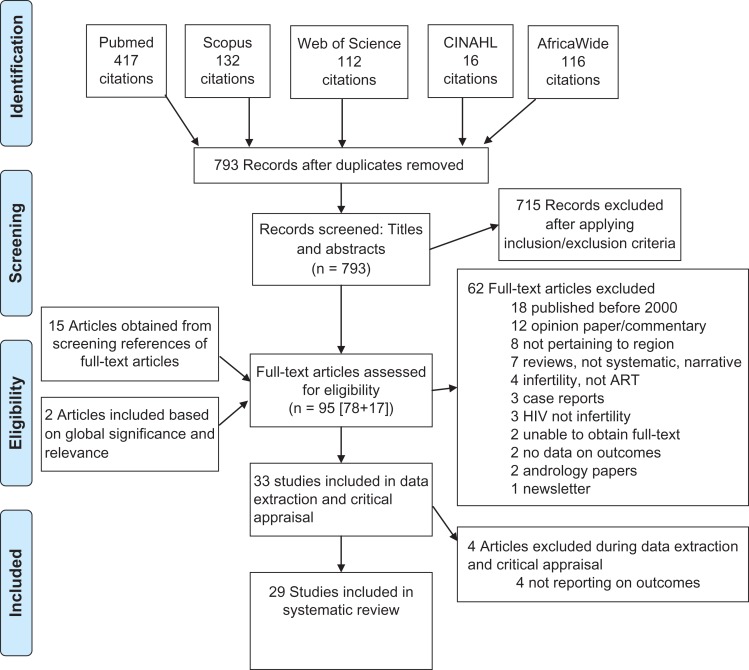
STUDY QUESTION: What is the evidence pertaining to availability, effectiveness and safety of ART in sub-Saharan Africa? SUMMARY ANSWER: According to overall limited and heterogeneous evidence, availability and utilization of ART are very low, clinical pregnancy rates largely compare to other regions but are accompanied by high multiple pregnancy rates, and in the near absence of data on deliveries and live births the true degree of effectiveness and safety remains to be established. WHAT IS KNOWN ALREADY: In most world regions, availability, utilization and outcomes of ART are monitored and reported by national and regional ART registries. In sub-Saharan Africa there is only one national and no regional registry to date, raising the question what other evidence exists documenting the status of ART in this region. STUDY DESIGN SIZE DURATION: A systematic review was conducted searching Pubmed, Scopus, Africawide, Web Of Science and CINAHL databases from January 2000 to June 2017. A total of 29 studies were included in the review. The extracted data were not suitable for meta-analysis. PARTICIPANTS/MATERIALS SETTING METHODS: The review was conducted according to Preferred Reporting Items for Systematic Reviews (PRISMA) guidelines. All peer-reviewed manuscripts irrespective of language or study design that presented original data pertaining to availability, effectiveness and safety of ART in sub-Saharan Africa were eligible for inclusion. Selection criteria were specified prior to the search. Two authors independently reviewed studies for possible inclusion and critically appraised selected manuscripts. Data were analysed descriptively, being unsuitable for statistical analysis. MAIN RESULTS AND THE ROLE OF CHANCE: The search yielded 810 references of which 29 were included based on the predefined selection and eligibility criteria. Extracted data came from 23 single centre observational studies, two global ART reports, two reviews, one national data registry and one community-based study. ART services were available in 10 countries and delivered by 80 centres in six of these. Data pertaining to number of procedures existed from three countries totalling 4619 fresh non-donor aspirations in 2010. The most prominent barrier to access was cost. Clinical pregnancy rates ranged between 21.2% and 43.9% per embryo transfer but information on deliveries and live births were lacking, seriously limiting evaluation of ART effectiveness. When documented, the rate of multiple pregnancy was high with information on outcomes similarly lacking. LIMITATIONS REASONS FOR CAUTION: The findings in this review are based on limited data from a limited number of countries, and are derived from heterogeneous studies, both in terms of study design and quality, many of which include small sample sizes. Although representing best available evidence, this requires careful interpretation regarding the degree of representativeness of the current status of ART in sub-Saharan Africa. WIDER IMPLICATIONS OF THE FINDINGS: The true extent and outcome of ART in sub-Saharan Africa could not be reliably documented as the relevant information was not available. Current efforts are underway to establish a regional ART data registry in order to report and monitor availability, effectiveness and safety of ART thus contributing to evidence-based practice and possible development strategies. STUDY FUNDING/COMPETING INTERESTS: No funding was received for this study. The authors had no competing interests. TRIAL REGISTRATION NUMBER: PROSPERO CRD42016032336.
Overview
The claims and statistics of this paper haven’t been checked yet.
Free: it reads the open-access text and checks the first 5 claims that cite a source we can check. Create a free account to check every claim.
Integrity signals
Registry
Cites
Statistics
Figures
Verification
Claims the paper makes
The claims and statistics of this paper haven’t been checked yet.
Free: it reads the open-access text and checks the first 5 claims that cite a source we can check. Create a free account to check every claim.
Claims other papers make about this one
Each is checked against this paper’s own text: does it say what the citing paper says it does?
The source backs part of the claim, not all of it — or backs it for a different population, condition or comparison.
In the citing paper
“Countries with high ART utilization generally have good access to non-ART fertility care, whereas poor access to ART is usually paralleled by poor access to non-ART fertility care (Botha et al., 2018).”
From Declining global fertility rates and the implications for family planning and family building: an IFFS consensus document based on a narrative review of the literature (2024) · cites this paper as Botha et al., 2018
Experimental — accuracy not yet measured
Self-check
Percentages, sums and reported differences re-computed from the paper’s own numbers.
The self-check needs the paper’s full text.
Citations
Cites
Inhorn, M. C., & Patrizio, P. (2015) · Human Reproduction Update · doi:10.1093/humupd/dmv016 · Cited by 1,926 · cited 2×
“In addition, access to and availability of ART has been shown to reduce the social stigma of infertility which is highly prevalent in Africa (Inhorn and Patrizio, 2015).”
BackgroundThe international glossary on infertility and fertility care, 2017
Zegers-Hochschild, F., Adamson, G. D., Dyer, S., Racowsky, C., de Mouzon, J., Sokol, R., Rienzi, L., Sunde, A., Schmidt, L., Cooke, I. D., et al. (2017) · Human Reproduction · doi:10.1093/humrep/dex234 · Cited by 1,320 · cited 3×
“The glossary for ART, recently revised and expanded, provides international consensus definitions as an important prerequisite for data collection, analysis and comparison (Zegers-Hochschild et al., 2009, 2017): it was referenced by two manuscripts in this review.”
MethodSelf-citationZegers-Hochschild, F., Adamson, G. D., de Mouzon, J., Ishihara, O., Mansour, R., Nygren, K., Sullivan, E., van der Poel, S., & WHO, O. B. O. I. A. (2009) · Human Reproduction · doi:10.1093/humrep/dep343 · Cited by 1,043 · cited 1×
“The glossary for ART, recently revised and expanded, provides international consensus definitions as an important prerequisite for data collection, analysis and comparison (Zegers-Hochschild et al., 2009, 2017): it was referenced by two manuscripts in this review.”
MethodDyer, S., Chambers, G. M., de Mouzon, J., Nygren, K. G., Zegers-Hochschild, F., Mansour, R., Ishihara, O., Banker, M., & Adamson, G. D. (2016) · Human Reproduction · doi:10.1093/humrep/dew082 · Cited by 491 · cited 10×
“Internationally, live birth – and preferably a single live birth at term – is considered the most important indicator of ART success, although increasingly the need to report cumulative live birth rates is recognized in view of the rising contribution from frozen ETs (Maheshwari et al., 2015).”
BackgroundInfluentialSelf-citationAccess as a policy-relevant concept in low- and middle-income countries
MCINTYRE, D., THIEDE, M., & BIRCH, S. (2009) · Health Economics, Policy and Law · doi:10.1017/s1744133109004836 · Cited by 321 · cited 1×
“Our findings are in keeping with reports on access to health care, which identify availability, affordability and acceptability as the key determinants of access (Thiede and McIntyre, 2008; McIntyre et al., 2009).”
ResultAn international survey of the health economics of IVF and ICSI
Collins, J. A. (2002) · Human Reproduction Update · doi:10.1093/humupd/8.3.265 · Cited by 311 · cited 1×
“One thousand five hundred cycles per million population per year are required to meet the need for ART, but in 2010 the regional mean for sub-Saharan Africa – albeit based on only three countries – was 87 cycles/million (Collins, 2002; Dyer et al., 2016).”
BackgroundCumulative live birth rate: time for a consensus?
Maheshwari, A., McLernon, D., & Bhattacharya, S. (2015) · Human Reproduction · doi:10.1093/humrep/dev263 · Cited by 298 · cited 4×
“This number was, however, derived from only two countries (Cameroon and South Africa) and fewer than 4000 ETs (Dyer et al., 2016).”
BackgroundInfluentialInformation, communication and equitable access to health care: a conceptual note
Thiede, M., & McIntyre, D. (2008) · Cadernos de Saúde Pública · doi:10.1590/s0102-311x2008000500025 · Cited by 125 · cited 1×
“Our findings are in keeping with reports on access to health care, which identify availability, affordability and acceptability as the key determinants of access (Thiede and McIntyre, 2008; McIntyre et al., 2009).”
ResultPräg, P., & Mills, M. C. (2017) · Human Reproduction · doi:10.1093/humrep/dex298 · Cited by 88 · cited 1×
“Moreover, even in Europe, where ART usage is high compared to sub-Saharan Africa, cultural norms and values have been shown to powerfully influence access to ART over and above country wealth (Präg and Mills, 2017).”
BackgroundDyer, S. J., Sherwood, K., McIntyre, D., & Ataguba, J. E. (2013) · Human Reproduction · doi:10.1093/humrep/det290 · Cited by 82 · cited 2×
“One study from South Africa explored out-of-pocket co-payment among 135 couples undergoing one ART cycle with conventional ovarian stimulation at a public-academic institution (Dyer et al., 2013).”
BackgroundSelf-citation
Research works printed but not linked: 1
- Giwa-Osagie OF ART in developing countries with particular reference to sub-Saharan Africa In: Vayena E, Rowe PJ, Griffin D (eds) Current Practices and Controversies in Assisted Reproduction: Report of a WHO Meeting. Geneva, Switzerland: WHO Library, 2002, 22– 27.
Cited by
Njagi, P., Groot, W., Arsenijevic, J., Dyer, S., Mburu, G., & Kiarie, J. (2023) · Human Reproduction Open · doi:10.1093/hropen/hoad007 · Cited by 277
“Even though ART has existed for over four decades, it remains either unavailable or inaccessible to most people in resource-poor settings (Sharma et al., 2009; Allahbadia, 2013; Botha et al., 2018; Ombelet and Onofre, 2019).”
BackgroundSelf-citationTwin Peaks: more twinning in humans than ever before
Monden, C., Pison, G., & Smits, J. (2021) · Human Reproduction · doi:10.1093/humrep/deab029 · Cited by 234
“All sub-Saharan African countries belong to the first group (Botha et al., 2018; Dyer et al., 2020).”
BackgroundFauser, B. C. J. M., Adamson, G. D., Boivin, J., Chambers, G. M., de Geyter, C., Dyer, S., Inhorn, M. C., Schmidt, L., Serour, G. I., Tarlatzis, B., et al. (2024) · Human Reproduction Update · doi:10.1093/humupd/dmad028 · Cited by 224
“Countries with high ART utilization generally have good access to non-ART fertility care, whereas poor access to ART is usually paralleled by poor access to non-ART fertility care (Botha et al. , 2018).”
BackgroundSelf-citationIVF and other ART in low- and middle-income countries: a systematic landscape analysis
Chiware, T. M., Vermeulen, N., Blondeel, K., Farquharson, R., Kiarie, J., Lundin, K., Matsaseng, T. C., Ombelet, W., & Toskin, I. (2021) · Human Reproduction Update · doi:10.1093/humupd/dmaa047 · Cited by 157
“religion (Catholic, Muslim, Anglican and traditional religions) (Fabamwo and Akinola, 2013; Iliyasu et al., 2013; Bello et al., 2014; Menuba et al., 2014; Fadare and Adeniyi, 2015; Omokanye et al., 2017; Botha et al., 2018; Dyer et al., 2019; Ombelet and Onofre, 2019).”
BackgroundBanker, M., Dyer, S., Chambers, G. M., Ishihara, O., Kupka, M. S., de Mouzon, J., Zegers-Hochschild, F., & Adamson, G. D. (2021) · Fertility and Sterility · doi:10.1016/j.fertnstert.2021.03.039 · Cited by 70
“Low utilization rates in the developing South were in stark contrast to the high infertility burden (6, 7).”
BackgroundSelf-citationAfferri, A., Allen, H., Booth, A., Dierickx, S., Pacey, A., & Balen, J. (2022) · Human Reproduction Update · doi:10.1093/humupd/dmab040 · Cited by 41
Madziyire, M. G., Magwali, T. L., Chikwasha, V., & Mhlanga, T. (2021) · Fertility Research and Practice · doi:10.1186/s40738-020-00093-0 · Cited by 54
“There was low access to ART in this study as is typical of low resource set ups(20).”
BackgroundNjagi, P., Groot, W. N. J., Arsenijevic, J., Dyer, S., Mburu, G., & Kiarie, J. N. (2020) · BMJ Open · doi:10.1136/bmjopen-2020-042951 · Cited by 42
Self-citationDyer, S., Archary, P., Potgieter, L., Smit, I., Ashiru, O. A., & Bell, E. G. (2020) · Reproductive BioMedicine Online · doi:10.1016/j.rbmo.2020.06.021 · Cited by 35
Self-citationFunding and public reporting strategies for reducing multiple pregnancy from fertility treatments
Chambers, G. M., Keller, E., Choi, S. K. Y., Khalaf, Y., Crawford, S. B., Botha, W., & Ledger, W. J. (2020) · Fertility and Sterility · doi:10.1016/j.fertnstert.2020.08.1405 · Cited by 29
Afferri, A., Allen, H., Dierickx, S., Bittaye, M., Marena, M., Pacey, A. A., & Balen, J. (2022) · BMC Health Services Research · doi:10.1186/s12913-022-08514-0 · Cited by 28
Dyer, S., Archary, P., de Mouzon, J., Fiadjoe, M., & Ashiru, O. (2019) · Reproductive BioMedicine Online · doi:10.1016/j.rbmo.2018.11.001 · Cited by 25
Self-citationAccess to assisted reproductive technologies in sub-Saharan Africa: fertility professionals’ views
Whittaker, A. M., Gerrits, T., Hammarberg, K., & Manderson, L. H. (2024) · Sexual and Reproductive Health Matters · doi:10.1080/26410397.2024.2355790 · Cited by 44
“33 Across SSA the majority of ART clinics are private, and patients pay out-of-pocket for their care.”
BackgroundCoordination and planning of clinical research on a national and global level
Devall, A., Out, H. J., Mol, B. W., Duffy, J. M., Collura, B. L., & Dyer, S. (2020) · Fertility and Sterility · doi:10.1016/j.fertnstert.2020.04.032 · Cited by 15
Self-citationConnolly, M. P., Panda, S., Mburu, G., Matsaseng, T., & Kiarie, J. (2021) · Reproductive Biomedicine & Society Online · doi:10.1016/j.rbms.2020.08.001 · Cited by 14
“Evidence from studies shows that where ART outcomes in South Africa are documented, multiple pregnancies are frequent (Botha et al., 2018).”
ResultOmbelet, W., Blerkom, J. V., Nargund, G., der Auwera, I. V., Janssen, M., Dhont, N., Bosmans, E., Boshoff, G., Vertessen, V.-J., & Campo, R. (2022) · Reproductive BioMedicine Online · doi:10.1016/j.rbmo.2022.04.008 · Cited by 14
The status of ART in the public health sector in Africa: a multi-country survey
Majangara, R., Archary, P., Bell, E. G., Khrouf, M., Loto, O. M., Wada, I., & Dyer, S. (2023) · Reproductive BioMedicine Online · doi:10.1016/j.rbmo.2023.04.004 · Cited by 14
Self-citationHammarberg, K., Trounson, A. O., McBain, J., Matthews, P. A., Robertson, T., Robertson, F., Magli, M. C., Mhlanga, T., Makurumure, T., & Marechera, F. (2018) · Human Reproduction Open · doi:10.1093/hropen/hoy017 · Cited by 16
“In most sub-Saharan countries access to ART is either non-existent or very limited and where it is available, it is only affordable for the wealthiest (Hammarberg and Kirkman, 2013; Asemota and Klatsky, 2015; Inhorn and Patrizio, 2015; Botha et al., 2018).”
BackgroundBell, S. O., Larson, E. A., Bittle, D., Moreau, C., Omoluabi, E., OlaOlorun, F. M., Akilimali, P. Z., Kibira, S. P. S., Makumbi, F. E., Guiella, G., et al. (2024) · Human Reproduction · doi:10.1093/humrep/deae084 · Cited by 10
Mutumba-Nakalembe, M. J., & Janes, C. R. (2025) · Reproduction and Fertility · doi:10.1530/raf-24-0063 · Cited by 8
Madziyire, M. G., Magwali, T. L., Chikwasha, V., & Mhlanga, T. (2020) · Research Square · doi:10.21203/rs.3.rs-47445/v1 · Cited by 7
Mesfin, M. D., Galgalo, D. A., Atmaca, L., Kovács, K. A., Várnagy, Á., & Prémusz, V. (2025) · Frontiers in Reproductive Health · doi:10.3389/frph.2025.1678033 · Cited by 6
Ombelet, W., Goemaes, R., Fomenko, E., & Campo, R. (2023) · Journal of Clinical Medicine · doi:10.3390/jcm12113683 · Cited by 5
Boshoff, G., Ombelet, W., & Huyser, C. (2025) · Reproduction and Fertility · doi:10.1530/raf-24-0072 · Cited by 8
Chikeme, P. C., Ihudiebube-Splendor, C. N., & Arinze, L. B. (2022) · PubMed Central · doi:10.11604/pamj.2022.42.181.35153 · Cited by 4
“Infertility problem is one of the commonest reasons women seek gynaecological consultation [8-11].”
BackgroundSafer conception care to eliminate transmission of HIV
Matthews, L. T., & Kiarie, J. N. (2019) · The Lancet HIV · doi:10.1016/s2352-3018(19)30178-x · Cited by 4
Gerrits, T., Whittaker, A. M., & Manderson, L. H. (2024) · Reproduction and Fertility · doi:10.1530/raf-24-0025 · Cited by 5
Nahar, P., Shafique, S., Satalkar-Götz, P., Sultana, F., & Mburu, G. (2024) · BMJ Open · doi:10.1136/bmjopen-2024-092365 · Cited by 4
Chikeme, P. C., & Arinze, L. B. (2021) · Research Square · doi:10.21203/rs.3.rs-1075780/v1 · Cited by 2
Bell, S. O., Kibira, S. P. S., Thomas, H. L., Nabukeera, S., Slivesteri, S., Tenda, I., Kennedy, C. E., & Moreau, C. (2025) · Social Science & Medicine · doi:10.1016/j.socscimed.2025.118664 · Cited by 2
Kasahun, S., Bizuneh, A., Ansa, M., Wondimagegnehu, A., & Asfaw, Z. G. (2025) · BMJ Open · doi:10.1136/bmjopen-2024-093455 · Cited by 2
A Scoping Review: Risk of Autism in Children Born from Assisted Reproductive Technology
Muller, K., Carballo, A., Vega, K., & Talyn, B. (2024) · Reproductive Medicine · doi:10.3390/reprodmed5040019 · Cited by 2
“Another study reviewing the efficacy of ART in sub-Saharan Africa cited the most prominent barrier to care was cost [140].”
Navigating Culture and Faith in Assisted Reproductive Technology: A Qualitative Exploration
Oti-Boadi, E., Asare, B., Attafuah, P. Y. A., Osei, E. A., Opoku-Frempong, D., Asiedu, P. O., Toure, H. A., & Kappiah, J. B. (2024) · The Family Journal · doi:10.1177/10664807241290246 · Cited by 2
Ajike, S. O., Asiegbu, U. C., Lawal, S. A., & Nantamu, S. (2023) · Research Square · doi:10.21203/rs.3.rs-3268867/v1
Causes of Infertility of Couples Residing in Libreville
Komba, O. M., Minkobame, U., Assoumou, P., Retno, R., Ntsame, E., Mewi, A., Ntamack, J. A. B., & Meye, J. (2024) · Advances in Reproductive Sciences · doi:10.4236/arsci.2024.121007
Whittaker, A. M., & Gerrits, T. (2025) · New York University Press eBooks · doi:10.18574/nyu/9781479832668.003.0016
Bell, S. O., Makumbi, F. E., Thomas, H. L., Kibira, S. P. S., Moreau, C., & Zimmerman, L. A. (2025) · Reproductive Health · doi:10.1186/s12978-025-02148-1 · Cited by 2
“Yet, evidence suggests less than one-third of facilities in Uganda offer any infertility-related services, likely far fewer of which offer advanced treatments [42–44].”
Afferri, A., Allen, H., Dierickx, S., Bittaye, M., Marena, M., Pacey, A. A., & Balen, J. (2022) · Figshare · doi:10.6084/m9.figshare.21062303
Pathak, B. G., Mburu, G., Habib, N., Kabra, R., Kiarie, J. N., Chowdhury, R., Dhabhai, N., & Mazumder, S. (2026) · Frontiers in Reproductive Health · doi:10.3389/frph.2026.1772807 · Cited by 1
Ajike, S. O., Asiegbu, U. C., Lawal, S. A., & Nantamu, S. (2026) · BMC Women s Health · doi:10.1186/s12905-026-04261-0
Tafese, F., Gezahign, M., Kura, Z., Alemayehu, E., Sima, Y. A., Bafikadu, C., Belako, G., Zerfu, T., Kenate, B., Dassie, Y., et al. (2026) · Health Science Reports · doi:10.1002/hsr2.73433
Metadata
- Authors
- Botha, B., Shamley, D., & Dyer, S.
- Affiliations
- University of Cape Town (ZA)
- Corresponding author
- Dyer, Silke
- Venue
- Human Reproduction Open
- Publisher
- Oxford University Press (OUP)
- Published
- 2018
- Volume
- 2018
- Issue
- 2
- Pages
- hoy003-hoy003
- ISSN
- 2399-3529 (ISSN-L)
- PMC
- PMC6276690
- OpenAlex
- W2792550381
- Cited by
- 41
- References
- 40
- Citations by year
- 2026: 3 · 2025: 7 · 2024: 7 · 2023: 5 · 2022: 4 · 2021: 5 · 2020: 7 · 2019: 1 · 2018: 2
- FWCI
- 0.57
- Type
- journal article
- Language
- en
- Open access
- gold
- doi.org
- Licence
- Locations
- Human Reproduction Open (publishedVersion, cc-by-nc)
- Europe PMC (PubMed Central) (publishedVersion, cc-by-nc)
- PubMed Central (publishedVersion, cc-by-nc)
- PubMed (publishedVersion)
- Topics
- Health Sciences › Medicine › Reproductive Medicine › Reproductive Health and Technologies
- Health Sciences › Medicine › Pediatrics, Perinatology and Child Health › Assisted Reproductive Technology and Twin Pregnancy
- Health Sciences › Medicine › Public Health, Environmental and Occupational Health › Reproductive Health and Contraception
- Keywords
- assisted reproduction, ART utilization, clinical pregnancy rate, multiple pregnancy, sub-Saharan Africa, infertility treatment, live birth outcomes, embryo transfer
About these checks
Registry, retraction, Cites and statistics results are computed, not judged, with one exception: a printed reference that no index lists is read once by a model before it counts as a citation error. Claims are extracted by a model and kept only when their quote appears verbatim in the text; each cited source is then checked, with a model’s help, for whether it says what the claim relies on. Those verdicts can be wrong — read the claim’s quote and the cited source before relying on one.
Statistics and arithmetic are recomputed, not judged.
Confidence bands are shown only for fields calibrated on our annotated test set. None is calibrated yet, so no band is shown.
What counts as a claim ›How we measure confidence ›How we check this ›
Are you an author, or do you see a problem with this page? Request a review
Data sources
Bibliographic data: Semantic Scholar, OpenAlex, Crossref.
Contains information from the Semantic Scholar Academic Graph Datasets, made available under the ODC Attribution License (ODC-BY 1.0).
Semantic Scholar’s data is described in: Kinney, R., et al. (2023). The Semantic Scholar Open Data Platform. arXiv:2301.10140.
