

Declining global fertility rates and the implications for family planning and family building: an IFFS consensus document based on a narrative review of the literature
Open accessThe DOI matches its Crossref record; 146 of the 157 references it cites were found in a registry or an index; 100 of the 243 sources its claims cite were checked for support.
Abstract
BACKGROUND: Family-planning policies have focused on contraceptive approaches to avoid unintended pregnancies, postpone, or terminate pregnancies and mitigate population growth. These policies have contributed to significantly slowing world population growth. Presently, half the countries worldwide exhibit a fertility rate below replacement level. Not including the effects of migration, many countries are predicted to have a population decline of >50% from 2017 to 2100, causing demographic changes with profound societal implications. Policies that optimize chances to have a child when desired increase fertility rates and are gaining interest as a family-building method. Increasingly, countries have implemented child-friendly policies (mainly financial incentives in addition to public funding of fertility treatment in a limited number of countries) to mitigate decreasing national populations. However, the extent of public spending on child benefits varies greatly from country to country. To our knowledge, this International Federation of Fertility Societies (IFFS) consensus document represents the first attempt to describe major disparities in access to fertility care in the context of the global trend of decreasing growth in the world population, based on a narrative review of the existing literature. OBJECTIVE AND RATIONALE: The concept of family building, the process by which individuals or couples create or expand their families, has been largely ignored in family-planning paradigms. Family building encompasses various methods and options for individuals or couples who wish to have children. It can involve biological means, such as natural conception, as well as ART, surrogacy, adoption, and foster care. Family-building acknowledges the diverse ways in which individuals or couples can create their desired family and reflects the understanding that there is no one-size-fits-all approach to building a family. Developing education programs for young adults to increase family-building awareness and prevent infertility is urgently needed. Recommendations are provided and important knowledge gaps identified to provide professionals, the public, and policymakers with a comprehensive understanding of the role of child-friendly policies. SEARCH METHODS: A narrative review of the existing literature was performed by invited global leaders who themselves significantly contributed to this research field. Each section of the review was prepared by two to three experts, each of whom searched the published literature (PubMed) for peer reviewed full papers and reviews. Sections were discussed monthly by all authors and quarterly by the review board. The final document was prepared following discussions among all team members during a hybrid invitational meeting where full consensus was reached. OUTCOMES: Major advances in fertility care have dramatically improved family-building opportunities since the 1990s. Although up to 10% of all children are born as a result of fertility care in some wealthy countries, there is great variation in access to care. The high cost to patients of infertility treatment renders it unaffordable for most. Preliminary studies point to the increasing contribution of fertility care to the global population and the associated economic benefits for society. WIDER IMPLICATIONS: Fertility care has rarely been discussed in the context of a rapid decrease in world population growth. Soon, most countries will have an average number of children per woman far below the replacement level. While this may have a beneficial impact on the environment, underpopulation is of great concern in many countries. Although governments have implemented child-friendly policies, distinct discrepancies in access to fertility care remain.
Overview
CoChat Summary
TL;DR
This IFFS consensus document, based on a narrative literature review, argues that global fertility rates are declining below replacement in most countries and that family building, including fertility care, should be integrated into family-planning policy. It highlights large inequities in access to fertility care and calls for more affordable, equitable treatment and better data.
Key findings
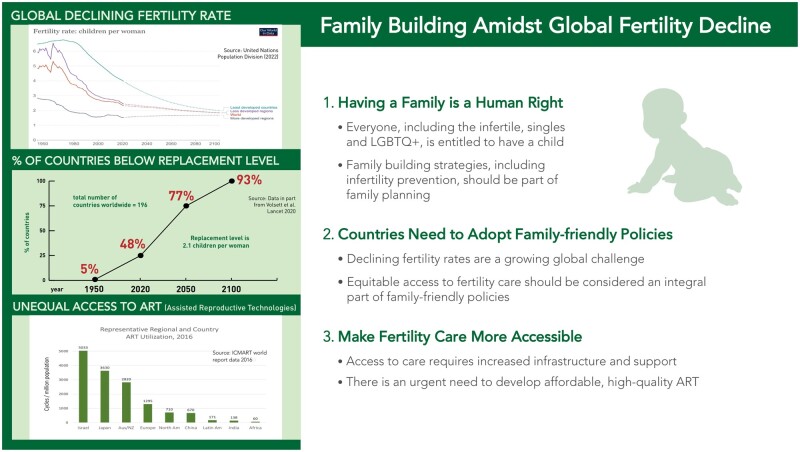
- Global total fertility rate (TFR) fell from 3.3 in 1990 to 2.3 in 2021; by 2050 and 2100, respectively, 77% of predominantly high-income countries and 93% of all countries are projected to have TFR below replacement level (2.1), with many countries predicted to have >50% population decline from 2017 to 2100 excluding migration.
- Infertility affects 48 million couples and 186 million individuals of reproductive age globally; WHO 2023 pooled primary 12-month infertility prevalence was 9.6% lifetime and 9.0% period, and secondary 12-month infertility was 6.5% lifetime and 4.9% period; a prior systematic review reported pooled period prevalence 12.6% and lifetime prevalence 17.5%.
- Fertility care contributes up to 10% of children in some wealthy countries; medically assisted reproduction contributed 3.2% to almost 10% of births in European countries versus <1% in Latin America and 2% in the USA; ART may raise TFR by approximately 0.05–0.10 where access is widely available.
- Access is highly unequal: global ART utilization is 535 cycles per million population, ranging from 16 to 5203; less than half of reporting countries provide any financial support for ART and only 20% offer full reimbursement. Cited economic analyses report UK lifetime tax revenue was eight times the return on investment from total fertility care cost, and the statistical value of a human life was estimated at US$5.7 million (median $858,599 in developing countries to $8,342,027 in developed countries).
Methods
- Narrative review by invited global leaders; each section was prepared by two to three experts who searched PubMed for peer-reviewed full papers and reviews, with listed keywords, and searches updated until September 2023.
- Consensus process: all authors discussed sections monthly from January 2021 to July 2022, the review board met quarterly from July 2021 to July 2022, and full consensus was reached at a hybrid invitational 2-day meeting in Amsterdam in May 2022.
- Synthesis was narrative and consensus-based; no quantitative meta-analysis or formal systematic review protocol is described.
Limitations
- The paper does not present a formal limitations section; it identifies key knowledge gaps including missing reliable fertility/infertility data in developing countries (especially male fertility), missing impact of infertility treatment on fertility patterns in most countries, lack of conclusive infertility prevalence data, and lack of national/global monitoring.
- It also states access and utilization data are limited or absent for all populations, especially LGBTQ+, singles, minorities, and males; the underlying population need for ART remains largely unknown; and almost no data exist on non-ART fertility treatments.
- Evident from the methods: as a narrative review and expert consensus, it lacks a systematic search protocol, formal risk-of-bias assessment, or meta-analysis, so conclusions reflect expert synthesis of available literature rather than systematic quantitative evidence.
Model-written summary. Check it against the paper before relying on it.
Integrity signals
Registry
Cites
Statistics
Figures
Verification
Claims the paper makes
69 Valid · 6 Not valid · 71 Not checked · 66 Own results and interpretations
The cited sources support only part of this claim — read each source’s verdict below.
In the paper
“By 2050 and 2100, respectively, 77% of predominantly high-income countries and 93% of all countries will have a TFR below the replacement level of 2.1 children per woman.”
§ Declining global fertility rates and the implications for family planning and family building: an IFFS consensus document based on a narrative review of the literature > Introduction
What the sources say
- Partly supportedcites Vollset et al., 2020 matched to “Fertility, mortality, migration, and population scenarios for 195 countries and territories from 2017 to 2100: a forecasting analysis for the Global Burden of Disease Study” (2020) sourceExperimental — accuracy not yet measured
The Discussion forecasts a TFR below the 2.1 replacement level for 183 of 195 countries and territories by 2100. That supports the claim’s substance, but 183/195 is approximately 94%, not the stated 93%. (LLM, conf=0.84)
- Could not verifycites Dao et al., 2021 matched to “Global migration in the twentieth and twenty-first centuries: the unstoppable force of demography” (2021) sourceExperimental — accuracy not yet measured
The ‘Projection scenarios’ passage in Section 4 discusses future fertility trends but does not give the share of countries projected to fall below replacement fertility. Searches for ‘93%’, ‘77%’, and ‘replacement level 2.1’ found no passage supporting the claimed 2100 figure; page numbers were unavailable in our copy. (LLM, conf=0.72)
plain- Asserted: passes — The authors put it forward as true.
- Checkable: passes — It can be checked against evidence.
- Load-bearing: passes — The paper’s conclusions depend on it.
- Based: passes — The paper gives a reason why it holds.
- Partly supported
The cited sources support only part of this claim — read each source’s verdict below.
In the paper
“By 2050 and 2100, respectively, 77% of predominantly high-income countries and 93% of all countries will have a TFR below the replacement level of 2.1 children per woman.”
§ Declining global fertility rates and the implications for family planning and family building: an IFFS consensus document based on a narrative review of the literature > Introduction
What the sources say
- Partly supportedcites Vollset et al., 2020 matched to “Fertility, mortality, migration, and population scenarios for 195 countries and territories from 2017 to 2100: a forecasting analysis for the Global Burden of Disease Study” (2020) sourceExperimental — accuracy not yet measured
The Abstract > Findings (page unavailable) forecasts 151 countries below replacement-level TFR by 2050—about 77% of the 195 countries and territories studied. It does not say that the 77% are predominantly high-income countries. The same passage forecasts 183 of 195, or about 94%, below replacement by 2100, rather than the citing sentence's 93%. (LLM, conf=0.93)
- Could not verifycites Dao et al., 2021 matched to “Global migration in the twentieth and twenty-first centuries: the unstoppable force of demography” (2021) sourceExperimental — accuracy not yet measured
The Forecasting section discusses fertility trends under two demographic scenarios, but gives no country-level TFR count or replacement-level threshold. Searches for “77%,” “2.1,” and fertility below replacement found no passage supporting the projection that 77% of predominantly high-income countries will be below 2.1 by 2050. Page numbers were not available in our copy. (LLM, conf=0.76)
plain- Asserted: passes — The authors put it forward as true.
- Checkable: passes — It can be checked against evidence.
- Load-bearing: unclear — It is unclear whether the paper’s conclusions depend on it.
- Based: passes — The paper gives a reason why it holds.
- Partly supported
The cited sources support only part of this claim — read each source’s verdict below.
In the paper
“Within this context, it is now recognized that the total fertility rate (TFR), defined as the number of children born per woman living to the end of childbearing years (15–49 years), has been decreasing dramatically for decades in many countries.”
§ Declining global fertility rates and the implications for family planning and family building: an IFFS consensus document based on a narrative review of the literature > Introduction
What the sources say
- Supportedcites Vollset et al., 2020 matched to “Fertility, mortality, migration, and population scenarios for 195 countries and territories from 2017 to 2100: a forecasting analysis for the Global Burden of Disease Study” (2020) source
The Introduction describes a demographic transition from high to low fertility, and Methods > Fertility discusses declines in TFR across countries. The paper notes that TFR can fluctuate or rise in some low-fertility countries, but that does not conflict with the claim that it has declined over decades in many countries. Page numbers were not available in our copy. (LLM, conf=0.87)
- Partly supportedcites Dao et al., 2021 matched to “Global migration in the twentieth and twenty-first centuries: the unstoppable force of demography” (2021) sourceExperimental — accuracy not yet measured
The Forecasting section (page unavailable) discusses falling fertility rates in its future demographic scenarios, particularly in high-fertility countries. It does not establish that TFR has decreased dramatically for decades in many countries, or provide the cited sentence’s definition of TFR. (LLM, conf=0.78)
plain- Asserted: passes — The authors put it forward as true.
- Checkable: passes — It can be checked against evidence.
- Load-bearing: passes — The paper’s conclusions depend on it.
- Based: passes — The paper gives a reason why it holds.
- Supported
The cited sources support only part of this claim — read each source’s verdict below.
In the paper
“Not including the effects of migration, many countries are predicted to have a population decline of more than 50% from 2017 to 2100 (Vollset et al., 2020; Dao et al., 2021).”
§ Declining global fertility rates and the implications for family planning and family building: an IFFS consensus document based on a narrative review of the literature > Introduction
What the sources say
- Partly supportedcites Vollset et al., 2020 matched to “Fertility, mortality, migration, and population scenarios for 195 countries and territories from 2017 to 2100: a forecasting analysis for the Global Burden of Disease Study” (2020) sourceExperimental — accuracy not yet measured
The Abstract > Findings reports that 23 countries in the reference scenario were forecast to lose more than 50% of their population from 2017 to 2100. But the Abstract > Methods says that scenario models population using fertility, mortality, and migration, so the claim's ‘not including the effects of migration’ qualifier is not supported. (LLM, conf=0.90)
- Could not verifycites Dao et al., 2021 matched to “Global migration in the twentieth and twenty-first centuries: the unstoppable force of demography” (2021) sourceExperimental — accuracy not yet measured
Section 4 (Forecasting; page unavailable) says the paper uses population projections through 2100 to forecast migration, but it does not report that many countries would lose more than 50% of their populations without migration. Searches for the 2017–2100 period, the 50% threshold, and no-migration population declines found no passage establishing the claim. (LLM, conf=0.76)
plain- Asserted: passes — The authors put it forward as true.
- Checkable: passes — It can be checked against evidence.
- Load-bearing: unclear — It is unclear whether the paper’s conclusions depend on it.
- Based: passes — The paper gives a reason why it holds.
- Partly supported
The cited sources support only part of this claim — read each source’s verdict below.
In the paper
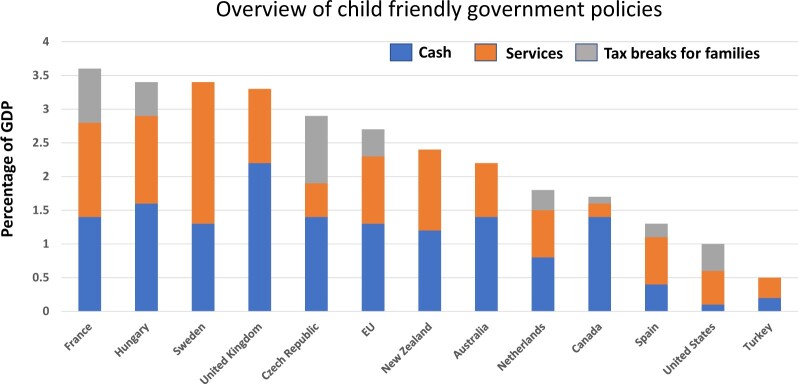
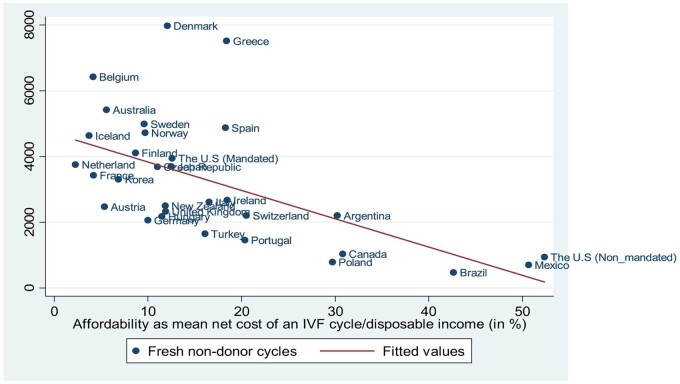
“However, the extent of public spending on child benefits varies greatly from country to country (Fig. 1), and many barriers remain for the inclusion of fertility care in reproductive health policies, especially in LMICs (Organization for Economic Cooperation and Development, OECD Social Expenditure Database; Ethics Committee of the American Society for Reproductive Medicine, 2021; Afferri et al.,”
§ Declining global fertility rates and the implications for family planning and family building: an IFFS consensus document based on a narrative review of the literature > Introduction
What the sources say
- Not matchedcites Ethics Committee of the American Society for Reproductive Medicine, 2021
An author–year citation the paper’s reference list doesn’t settle. We don’t search these by name.
- Supportedcites Afferri et al., 2022 matched to “Barriers and facilitators for the inclusion of fertility care in reproductive health policies in Africa: a qualitative evidence synthesis” (2022) source
The Abstract (p. 4) says inclusion of fertility care in reproductive health policies remains fragmented or non-existent in low- and middle-income countries, particularly across Africa. It identifies limited political commitment, under-recognition of infertility, and high treatment costs as key barriers. (LLM, conf=0.92)
- Not matchedcites Organization for Economic Cooperation and Development, OECD Social Expenditure Database
This doesn’t read as a citation we can look up.
plain- Asserted: passes — The authors put it forward as true.
- Checkable: passes — It can be checked against evidence.
- Load-bearing: unclear — It is unclear whether the paper’s conclusions depend on it.
- Based: passes — The paper gives a reason why it holds.
- Not matched
101 more claims · 32 with their cited sources checked
Create a free account to see all 212 claims and to verify the 8 references still open.
- It may state two separate claims as one. 60
- Probably not a substantial claim. 58
Self-check
Percentages, sums and reported differences re-computed from the paper’s own numbers.
Each contradiction between two passages listed here was confirmed by an independent check.
Rated minor: it would not touch a result — a value no result rests on, a p-value that stays on the same side of the significance level, or a conflict that is clerical, resolved elsewhere in the paper, or outside its own findings.
In the paper
§ Declining global fertility rates and the implications for family planning and family building: an IFFS consensus document based on a narrative review of the literature > Changes in global population: patterns of fertility
“| World | 4.08 | 3.31 | 2.62 | 2.32 | | More developed regionsb | 2.01 | 1.78 | 1.61 | 1.52 | | Less developed regionsc | 4.64 | 3.43 | 2.52 | 2.12 |”
§ Declining global fertility rates and the implications for family planning and family building: an IFFS consensus document based on a narrative review of the literature > Changes in global population: patterns of fertility
“More developed regions comprise Europe, Northern America, Australia/New Zealand, and Japan. Less developed regions comprise all regions of Africa, Asia (excluding Japan), Latin America and the Caribbean plus Melanesia, Micronesia, and Polynesia.”
Citations
Cites
EDC-2: the endocrine society's second scientific statement on endocrine-disrupting chemicals
Gore, A. C., Chappell, V. A., Fenton, S. E., Flaws, J. A., Nadal, A., Prins, G. S., Toppari, J., & Zoeller, R. T. (2015) · Endocrine Reviews · doi:10.1210/er.2015-1010 · Cited by 2,407 · cited 1×
“…and toxicants, such as pesticides, can be directly deleterious to gametes (oocytes and spermatozoa), resulting in decreased numbers and quality, and subsequent infertility (Gore et al. , 2015; Segal and Giudice, 2019; World Health Organization, 2021; Skakkebæk et al. , 2022; Giudice et al. , 2023).”
BackgroundInhorn, M. C., & Patrizio, P. (2015) · Human Reproduction Update · doi:10.1093/humupd/dmv016 · Cited by 1,926 · cited 3×
“A rich qualitative narrative describes the often-profound consequences of infertility as a social reality as well as a medical disease (Greil et al. , 2010; Inhorn and Patrizio, 2015).”
BackgroundSelf-citationChlamydia, gonorrhoea, trichomoniasis and syphilis: global prevalence and incidence estimates, 2016
Rowley, J., Vander Hoorn, S., Korenromp, E., Low, N., Unemo, M., Abu-Raddad, L. J., Chico, R. M., Smolak, A., Newman, L., Gottlieb, S., et al. (2019) · Bulletin of the World Health Organization · doi:10.2471/blt.18.228486 · Cited by 1,665
Starrs, A. M., Ezeh, A. C., Barker, G., Basu, A., Bertrand, J. T., Blum, R., Coll-Seck, A. M., Grover, A., Laski, L., Roa, M., et al. (2018) · The Lancet · doi:10.1016/s0140-6736(18)30293-9 · Cited by 1,598 · cited 2×
“Fertility decline initially results in more working-age adults relative to children, potentially leading to accelerated economic growth and a temporary ‘demographic dividend’ (Starrs et al. , 2018).”
BackgroundSelf-citationVollset, S. E., Goren, E., Yuan, C.-W., Cao, J., Smith, A. E., Hsiao, T., Bisignano, C., Azhar, G. S., Castro, E., Chalek, J., et al. (2020) · The Lancet · doi:10.1016/s0140-6736(20)30677-2 · Cited by 1,506 · cited 4×
“Not including the effects of migration, many countries are predicted to have a population decline of more than 50% from 2017 to 2100 (Vollset et al. , 2020; Dao et al. , 2021).”
BackgroundInfluentialTemporal trends in sperm count: a systematic review and meta-regression analysis
Levine, H., Jørgensen, N., Martino-Andrade, A., Mendiola, J., Weksler-Derri, D., Mindlis, I., Pinotti, R., & Swan, S. H. (2017) · Human Reproduction Update · doi:10.1093/humupd/dmx022 · Cited by 1,374 · cited 1×
“1093 / hu m upd / d m ad028 / 751342 7 b y gue s t on 31 J anua r y 2024 and 1.6% in total sperm count, although the impact on TRF is yet unknown (Levine et al. , 2017; Jørgensen et al. , 2021; Levine et al. , 2023).”
BackgroundInfluentialThe international glossary on infertility and fertility care, 2017
Zegers-Hochschild, F., Adamson, G. D., Dyer, S., Racowsky, C., de Mouzon, J., Sokol, R., Rienzi, L., Sunde, A., Schmidt, L., Cooke, I. D., et al. (2017) · Human Reproduction · doi:10.1093/humrep/dex234 · Cited by 1,320
Self-citationDiagnosis and Management of Infertility: A Review
Carson, S. A., & Kallen, A. N. (2021) · JAMA · doi:10.1001/jama.2021.4788 · Cited by 1,294 · cited 1×
“Health behaviors, such as smoking, obesity, use of cannabis and anabolic steroids, are risk factors for both women and men (Bala et al. , 2021; Carson and Kallen, 2021; Eisenberg et al. , 2023).”
BackgroundOvarian aging: mechanisms and clinical consequences
Broekmans, F. J., Soules, M. R., & Fauser, B. C. (2009) · Endocrine Reviews · doi:10.1210/er.2009-0006 · Cited by 1,248 · cited 1×
“For example, advanced female age is linked to the social determinants of education and gender equality, since both may delay acting on fertility desires and opportunities for procreation (Broekmans et al. , 2009; Fall et al. , 2015; Van Roode et al. , 2017; Cedars, 2022; Choi et al. , 2023).”
BackgroundSelf-citationZegers-Hochschild, F., Adamson, G. D., de Mouzon, J., Ishihara, O., Mansour, R., Nygren, K., Sullivan, E., van der Poel, S., & WHO, O. B. O. I. A. (2009) · Human Reproduction · doi:10.1093/humrep/dep343 · Cited by 1,043
Self-citation
Research works printed but not linked: 5
- Bergsvik J, Fauske A, Hart RK. Effects of Policy on Fertility: A Systematic Review of (Quasi) Experiments Discussion Papers No. 922. Oslo: Statistics Norway, 2020. https://www.econstor.eu/bitstream/10419/249112/1/DP922_web.pdf (10 July 2023, date last accessed).
- International Conference on Population and Development. ICPD’94 Summary of the Programme of Action. https://partners-popdev.org/icpd/ICPD_POA_summary.pdf (17 July 2022, date last accessed).
- International Federation of Fertility Societies’ Surveillance (IFFS) 2022: Global Trends in Reproductive Policy and Practice, 9th Edition Editor-in-Chief: Steven J. Ory Managing Editor: Kathleen Miller Assistant Editor: Marcos Horton. https://www.iffsreproduction.org/wp-content/uploads/2022/04/2022-Surveillance-Report-April-2-2022-Upload.pdf (17 August 2022, date last accessed).
- Serour GI, Hamed AF, Al-Agzai H, Sultan M, Hegab M. Experience with microsurgery. J Egypt Soc Obstet Gynaecol 1988; 14: 9– 16.
- Tarsi K, Tuff T. Introduction to population demographics. Nat Educ Knowl 2012; 3: 3.
Cited by
Liang, Y., Huang, J., Zhao, Q., Mo, H., Su, Z., Feng, S., Li, S., & Ruan, X. (2025) · Human Reproduction · doi:10.1093/humrep/deae292 · Cited by 180
Kupka, M. S., Chambers, G. M., Dyer, S., Zegers-Hochschild, F., de Mouzon, J., Ishihara, O., Banker, M., Jwa, S. C., Bai, F., Elgindy, E. A., et al. (2024) · Fertility and Sterility · doi:10.1016/j.fertnstert.2024.07.009 · Cited by 90
Self-citationCurrent global status of male reproductive health
Jonge, C. J. D., Barratt, C. L. R., Aitken, R. J., Anderson, R. A., Baker, P., Chan, D. Y. L., Connolly, M. P., Eisenberg, M. L., Garrido, N., Jørgensen, N., et al. (2024) · Human Reproduction Open · doi:10.1093/hropen/hoae017 · Cited by 95
Self-citationHow many infants have been born with the help of assisted reproductive technology?
Adamson, G. D., Creighton, P., de Mouzon, J., Zegers-Hochschild, F., Dyer, S., & Chambers, G. M. (2025) · Fertility and Sterility · doi:10.1016/j.fertnstert.2025.02.009 · Cited by 93
Self-citationThe Environmental Impacts of Overpopulation
Tal, A. (2025) · Encyclopedia · doi:10.3390/encyclopedia5020045 · Cited by 69
“These efforts have transformed national demographic profiles in disparate places, offering a modicum of stability that now enables meaningful economic and environmental progress [390].”
Baker, V. L., Dyer, S., Chambers, G. M., Keller, E., Banker, M., de Mouzon, J., Elgindy, E. A., Bai, F., Ishihara, O., Jwa, S. C., et al. (2025) · Human Reproduction · doi:10.1093/humrep/deaf049 · Cited by 42
Self-citationDyer, S., Chambers, G. M., Jwa, S. C., Baker, V. L., Banker, M., de Mouzon, J., Elgindy, E. A., Bai, F., Ishihara, O., Kupka, M. S., et al. (2025) · Fertility and Sterility · doi:10.1016/j.fertnstert.2025.06.003 · Cited by 40
Self-citationSeifer, D. B., Feinberg, E. C., & Hsu, A. L. (2024) · JAMA · doi:10.1001/jama.2024.18207 · Cited by 27
Ovarian aging: pathophysiology and recent developments in maintaining ovarian reserve
Hirano, M., Onodera, T., Takasaki, K., Takahashi, Y., Ichinose, T., Nishida, H., Hiraike, H., & Nagasaka, K. (2025) · Frontiers in Endocrinology · doi:10.3389/fendo.2025.1619516 · Cited by 35
Jeong, S., Lee, G., Park, S., Son, M., Lee, S., & Ryu, B. (2025) · Advanced Science · doi:10.1002/advs.202407585 · Cited by 28
Achieving more equitable access to assisted reproduction
Dyer, S., Adamson, G. D., Inhorn, M. C., & Zegers-Hochschild, F. (2024) · BMJ · doi:10.1136/bmj-2023-077111 · Cited by 19
Self-citationChlamydia trachomatis: From Urogenital Infections to the Pathway of Infertility
Rodrigues, R. C., Sousa, C., Barros, A., & Vale, N. (2025) · Genes · doi:10.3390/genes16020205 · Cited by 23
“As a consequence, infertility may also hinder the ability to maintain employment, potentially resulting in prolonged economic or financial challenges [145].”
Doroftei, B., Săvucă, A., Cretu, A.-M., Maftei, R., Anton, N., Ilea, C. G., Doroftei, M., & Puha, B. (2025) · Ecotoxicology and Environmental Safety · doi:10.1016/j.ecoenv.2025.118939 · Cited by 17
Beyond the body: Social, structural, and environmental infertility
Díaz, M. Y., & Watkins, L. (2024) · Social Science & Medicine · doi:10.1016/j.socscimed.2024.117557 · Cited by 28
Detrimental effects of cadmium on male infertility: A review
Zečević, N., Kocic, J., Perović, M., & Stojsavljević, A. (2024) · Ecotoxicology and Environmental Safety · doi:10.1016/j.ecoenv.2024.117623 · Cited by 16
Ombelet, W., Blerkom, J. V., Boshoff, G., Huyser, C., Lopes, F., Nargund, G., Sallam, H. N., Vanmechelen, K., & Campo, R. (2025) · Human Reproduction Open · doi:10.1093/hropen/hoaf001 · Cited by 19
Self-citationPrémusz, V., Kovács, K. A., Skriba, E., Tándor, Z., Szmatona, G., & Dózsa-Juhász, O. (2024) · Epidemiologia · doi:10.3390/epidemiologia5040044 · Cited by 12
“The process is more prevalent in high-and middle-income countries, showing total fertility rates (TFR) below the population replacement level [3–5].”
BackgroundYao, M. W. M., Nguyen, E. T., Retzloff, M. G., Gago, L. A., Nichols, J. E., Payne, J. F., Ripps, B. A., Opsahl, M. S., Groll, J. M., Beesley, R. D., et al. (2025) · Nature Communications · doi:10.1038/s41467-025-58744-z · Cited by 20
Bayoumi, R. R., Hurt, L. S., Zhang, N., Law, Y. J., Venetis, C. A., Fatem, H. M., Serour, G. I., van der Poel, S. Z., & Boivin, J. (2023) · Reproductive BioMedicine Online · doi:10.1016/j.rbmo.2023.04.008 · Cited by 14
Self-citationBogdán, P. M., Varga, K., Tóth, L., Gróf, K., & Pakai, A. (2025) · Healthcare · doi:10.3390/healthcare13131603 · Cited by 20
“The willingness to have children is influenced by various factors, including age, family financial situation, economic environment, social background, and parental support [56].”
Xie, H., Chen, Y., Xu, S., Miao, N., Zheng, W., Jiang, C., & Sun, T. (2025) · Frontiers in Aging · doi:10.3389/fragi.2025.1603916 · Cited by 15
Towards a nuanced view and response to global fertility trends
Mburu, G., Kiarie, J. N., & Allotey, P. A. (2024) · The Lancet · doi:10.1016/s0140-6736(24)00490-2 · Cited by 10
Bodily Autonomy, Reproductive Rights and Company‐Sponsored Fertility Benefits: A Call to Action
MacKenzie, C. A., O’Brien, E., & Garavan, T. N. (2024) · Gender Work and Organization · doi:10.1111/gwao.13225 · Cited by 8
Fine particulate matter and ovarian health: A review of emerging risks
Tao, Q., Zhao, Z., Yang, R., Li, Q., & Qiao, J. (2024) · Heliyon · doi:10.1016/j.heliyon.2024.e40503 · Cited by 10
From gut to gamete: how the microbiome influences fertility and preconception health
Munyoki, S. K., Vukmer, N. A., Rios, J. M., Kallen, A. N., & Jašarević, E. (2025) · Microbiome · doi:10.1186/s40168-025-02230-7 · Cited by 11
Zheng, T., Song, C., & Cao, L. (2025) · Energies · doi:10.3390/en18112780 · Cited by 7
Cimadomo, D., Garolla, A., & Vitagliano, A. (2024) · Journal of Clinical Medicine · doi:10.3390/jcm13195860 · Cited by 7
Globalization, economic and social development, and fertility decline in Bangladesh
Maitra, B. (2024) · Oxford Development Studies · doi:10.1080/13600818.2024.2416186 · Cited by 8
Environmental determinants of male infertility: emerging threats and technological interventions
Jagadesh, P., & Tb, S. (2026) · Frontiers in Medicine · doi:10.3389/fmed.2026.1770866 · Cited by 11
Infertility and Unrealized Ideal Family Size
Lazzari, E., & Beaujouan, É. (2026) · Population and Development Review · doi:10.1111/padr.70043 · Cited by 12
“This includes raising awareness of age-related decline in reproductive capacity and minimizing financial and structural barriers to infertility treatment (Fauser et al. 2024).”
Freitas, H. R., & Malva, J. O. (2025) · Frontiers in Public Health · doi:10.3389/fpubh.2025.1678040 · Cited by 8
Hadadian, F., Abbasi, M., Parsajam, T., Haseli, A., & Rostami, N. (2025) · BMC Women s Health · doi:10.1186/s12905-025-03986-8 · Cited by 9
“The global total fertility rate (TFR) has fallen from 5.0 births per woman in 1950 to 2.2 in 2024, with projections indicating a continued decline [2].”
InfluentialTan, J., Huang, L.-L., Lu, Z., Xiang, H.-Y., Yang, H. H., Zhou, H.-X., Meng, T., Xiong, C., Wang, Y., & Zhang, J. (2025) · Environmental Research · doi:10.1016/j.envres.2025.122947 · Cited by 9
Zhang, X., Wu, L., Li, H., Zhang, S., & Hua, W. (2025) · Frontiers in Nutrition · doi:10.3389/fnut.2025.1583805 · Cited by 9
Guo, X., Ma, M., Chen, Y., Fang, Z., Liu, J., Yan, S., Feng, Y., Cheng, X., Wu, J., & Ye, B. (2025) · BMC Public Health · doi:10.1186/s12889-025-21412-4 · Cited by 8
Reversible Contraception in Males: An Obtainable Target?
Koilpillai, J., Nunan, E. L., Butler, L., et al. (2024) · Biology · doi:10.3390/biology13050291 · Cited by 6
“Currently, fertility rates are well below the replacement level, which suggests that contraceptives are less a population control issue and more a matter of individual choice [93].”
BackgroundThe road to restore male fertility using in vitro -derived germ cells
Macedo, T., & Alves-Lopes, J. P. (2025) · Human Reproduction Update · doi:10.1093/humupd/dmaf029 · Cited by 6
Sharifian, G., Aseminia, P., Heidary, D., & Esformes, J. I. (2025) · European Review of Aging and Physical Activity · doi:10.1186/s11556-025-00384-9 · Cited by 16
“As birth rates continue to decline worldwide, the population’s age distribution is shifting toward a greater proportion of older individuals [3].”
Adamson, G. D., Armstrong, H., Cheong, Y. C., Damato, E., Fatemi, H. M., Ferriani, R. A., Griesinger, G., Ledger, W. J., Pistollato, M., Pellicer, A., et al. (2025) · Frontiers in Reproductive Health · doi:10.3389/frph.2025.1605480 · Cited by 19
Self-citationEffects of Aging on Z-DNA-Induced Genetic Instability In Vivo
Li, T. T., D’Amico, A. M., Christensen, L. A., & Vásquez, K. M. (2025) · Genes · doi:10.3390/genes16080942 · Cited by 5
“Currently, there is a global increase in the population of aging individuals due to longer life expectancies and decreases in fertility [1,2].”
Navigating parenthood in a climate change era: determinants of childbearing intentions in Iran
Alipour, Z., Ghaedrahmati, M., & Taghvi, S. (2025) · Scientific Reports · doi:10.1038/s41598-025-11708-1 · Cited by 8
Maternal Age Trends and Patterns in Greece (1956–2023): A Nationwide Analysis
Vlachadis, N., Sioutis, D., Christodoulaki, C., Machairiotis, N., Theofanakis, C., Tsakiridis, I. G., Dagklis, T., Louis, K., & Panagopoulos, P. (2025) · Cureus · doi:10.7759/cureus.87827 · Cited by 7
Gong, J., Wu, Y., Qiu, C., Yin, G., & Yuan, P. (2025) · BMC Public Health · doi:10.1186/s12889-025-23369-w · Cited by 6
Analysis of factors influencing clinical pregnancy rates in frozen-thawed embryo transfer cycles
Wang, J., Yang, Z., Chen, Y., Gao, F., Zhao, W., Cao, S., Li, Y., & He, L. (2025) · Frontiers in Endocrinology · doi:10.3389/fendo.2025.1551530 · Cited by 9
Extreme heat and human fertility: Amplified challenges in the era of climate change
Molla, A. (2025) · Journal of Thermal Biology · doi:10.1016/j.jtherbio.2025.104158 · Cited by 9
Evaluation of China’s fertility policy based on PMC modeling
Chen, J., Gao, Y., & Xi, W. (2025) · Frontiers in Public Health · doi:10.3389/fpubh.2025.1533307 · Cited by 6
Infertility treatment and offspring blood pressure—a systematic review and meta-analysis
Yeung, E. H., Ryan, I., Clayton, P., Polinski, K. J., Livinski, A. A., & Putnick, D. L. (2024) · Human Reproduction Update · doi:10.1093/humupd/dmae029 · Cited by 5
Synthetic human gonadal tissues for toxicology
Nishimura, T., & Takebe, T. (2024) · Reproductive Toxicology · doi:10.1016/j.reprotox.2024.108598 · Cited by 6
Mutlu, B. R., Civale, S. C., Diettrich, J., Gupta, N., Barber, T., Sayare, M., Penzias, A. S., Alper, M. M., Toth, T. L., Kapur, R., et al. (2026) · Nature Medicine · doi:10.1038/s41591-026-04207-x · Cited by 8
“Currently, only a fraction of infertility patients have access to IVF care 43 , and demand will continue to increase because of rising infertility 44 , delayed childbearing and the expanding use of egg banking for fertility preservation 45 .”
Zhang, P., Wei, Z., Zhou, M., Evans, J. A., & Hui, P. (2026) · ACM Transactions on Social Computing · doi:10.1145/3790251 · Cited by 6
Yang, L., Liu, R., Li, K., Chen, S., Tan, L., Xu, X., Au, W. W., & Huo, X. (2025) · Reproductive Toxicology · doi:10.1016/j.reprotox.2025.109107 · Cited by 7
Genazzani, A. R., Fidecicchi, T., Arduini, D., Benagiano, G., Birkhaeuser, M. H., Schenker, J. G., Strauss, J. F., Awad, D. V., Arnal, J., Bahamondes, L. G., et al. (2025) · Gynecological Endocrinology · doi:10.1080/09513590.2025.2543423 · Cited by 9
“The family planning roadmap should focus primarily on awareness raising, education, effective communication, and the provision of ethical and professional services, emphasizing its importance for sustainable development [42].”
Self-citationPhysical Activity During the Perinatal Period: A Fact Sheet for Clinicians
Zielke, C., Badon, S. E., Bhalala, M. M., & Thompson, H. R. (2025) · American Journal of Lifestyle Medicine · doi:10.1177/15598276251364774 · Cited by 9
Human fertility at a crossroad
Fauser, B. C. J. M., Gianaroli, L., & Mocanu, E. V. (2025) · Reproductive BioMedicine Online · doi:10.1016/j.rbmo.2024.104787 · Cited by 6
Self-citationMeo, S. A., Shaikh, N., & Meo, A. S. (2024) · Saudi Medical Journal · doi:10.15537/smj.2024.45.9.20240437 · Cited by 7
Simms-Cendan, J. S., Jayasinghe, Y., Aguilar, A., Nunzio, C. D., Rome, E. S., Orti, M., Vatopoulou, A., Drejza, M. A., Tyson, N. A., Sumida, M., et al. (2024) · Journal of Pediatric and Adolescent Gynecology · doi:10.1016/j.jpag.2024.06.001 · Cited by 5
Myeloid‐Derived CD38 Mediates Age‐Related Endometrial Aging Through NAD + Depletion
Hua, L., Liu, L., Gao, D., Ma, L., Jin, X., Lu, L., Tian, S., Jiang, X., Jin, C., Feng, B., et al. (2025) · Aging Cell · doi:10.1111/acel.70356 · Cited by 3
“The global prevalence of delayed childbearing is increasing, with the average age at first childbirth in developed countries rising by approximately 1 year per decade since 1970 (Fauser et al. 2024).”
Martín-Manchado, L., Sánchez‐SanSegundo, M., Moya-Yeste, A. M., Sánchez, J. A. H., Tuells, J., & Zaragoza-Martí, A. (2025) · European Journal of Public Health · doi:10.1093/eurpub/ckaf100 · Cited by 7
Lindahl‐Jacobsen, R., Beck, A. L., Priskorn, L., Holmboe, S. A., Andersson, A., Juul, A., & Skakkebæk, N. E. (2025) · Scientific Reports · doi:10.1038/s41598-025-08332-4 · Cited by 4
Inequality of opportunity and fertility intentions
Ma, B., Wu, J., & Yu, Y. (2025) · China Economic Quarterly International · doi:10.1016/j.ceqi.2025.05.003 · Cited by 6
Human reproduction in crisis: causes unknown
Skakkebæk, N. E., Priskorn, L., Lindahl‐Jacobsen, R., Andersson, A., Kristensen, D. M., Beck, A. L., Aksglæde, L., Fischer, M. B., França, L. R., & Juul, A. (2025) · The Lancet · doi:10.1016/s0140-6736(25)00736-6 · Cited by 4
Educate. Empower. Reproduce. A call for action against the demographic winter
Blockeel, C., Campbell, A., Coticchio, G., et al. (2025) · Reproductive BioMedicine Online · doi:10.1016/j.rbmo.2025.105047 · Cited by 3
NeJhaddadgar, N., Mardi, A., & Zare, M. (2025) · Frontiers in Reproductive Health · doi:10.3389/frph.2025.1520027 · Cited by 4
Zhang, L., & Qiao, D. (2025) · Healthcare · doi:10.3390/healthcare13050555 · Cited by 8
“While prior research has underscored the importance of including fertility care in public health agendas [1,10,11,13], this study contributes to the growing body of literature on fertility care policy by exploring implementation pathways in a middle-income country context.”
Soubry, A. (2025) · Frontiers in Reproductive Health · doi:10.3389/frph.2025.1506312 · Cited by 7
Fertility Rates in Cambodia: A Bumpy Road
Sean, S., Ou, P., Pirtea, P., & de Ziegler, D. (2024) · Fertility & Reproduction · doi:10.1142/s2661318224300034 · Cited by 3
Exposure to Environmental Chemicals and Infertility Among US Reproductive-Aged Women
Martinez, V., Yen, I. H., Alvarez, C., Williams, A., & Ha, S. (2024) · International Journal of Environmental Research and Public Health · doi:10.3390/ijerph21121541 · Cited by 4
“Low fertility rates can also be attributed to factors such as delayed childbearing and smaller ideal family sizes [13,14].”
Inflation and reproduction: the impact of inflation targeting on fertility in emerging economies
Wu, T. (2024) · China Population and Development Studies · doi:10.1007/s42379-024-00167-2 · Cited by 3
Vignera, S. L., & Condorelli, R. A. (2026) · Antioxidants · doi:10.3390/antiox15060778 · Cited by 2
“Global total fertility rates (TFRs) have fallen dramatically, from 4.84 births per woman in 1950 to 2.23 in 2021, with projections indicating a further decline to 1.83 by 2050 and 1.59 by 2100 [14,15].”
InfluentialSong, Z., Ding, M., Zang, Q., Wang, L., Ma, D., Ren, G., Wang, Y., & Feng, Y. (2025) · BMC Cancer · doi:10.1186/s12885-025-15048-1 · Cited by 4
Lakjuni, S., Schmidt, L., Ziebe, S., Sylvest, R., Vassard, D., & Malling, G. M. H. (2025) · Reproductive BioMedicine Online · doi:10.1016/j.rbmo.2025.105342 · Cited by 4
Self-citationMarcellusi, A., Scortichini, M., Guarnotta, G., Connolly, M. P., & Busnelli, A. (2025) · Health Economics Review · doi:10.1186/s13561-025-00672-1 · Cited by 2
Bellassai, N., Biricik, A., Surdo, M., Bianchi, V., D’Agata, R., Breveglieri, G., Gambari, R., Spinella, F., & Spoto, G. (2025) · Analytical Chemistry · doi:10.1021/acs.analchem.5c03164 · Cited by 3
XiangHua, Y., Durrani, S. K., & Li, R. (2025) · Higher Education Policy · doi:10.1057/s41307-025-00407-1 · Cited by 2
Mohammadi, H., Khoddam, S., Golbabaei, F., & Dehghan, S. F. (2025) · Reproductive Toxicology · doi:10.1016/j.reprotox.2025.108959 · Cited by 4
Connolly, M. P., Kotsopoulos, N., Li, J., & Chambers, G. M. (2025) · Journal of health economics and outcomes research · doi:10.36469/001c.133796 · Cited by 4
Self-citationObern, C., Tydén, T., Poromaa, I. S., & Gyllenberg, F. (2025) · The European Journal of Contraception & Reproductive Health Care · doi:10.1080/13625187.2025.2470422 · Cited by 7
Nguyen, E. T., Retzloff, M. G., Gago, L. A., et al. (2024) · medRxiv · doi:10.1101/2024.06.20.24308970 · Cited by 2
SOS reproductive healthcare: a call for action
Carneiro, M. M. (2024) · Women & Health · doi:10.1080/03630242.2024.2308308 · Cited by 2
Meng, J., Wang, J., Li, Z., Li, F., Yun, X., Jin, Y., & Zhang, L. (2026) · Molecular Pharmaceutics · doi:10.1021/acs.molpharmaceut.6c00656 · Cited by 1
Oliva-Retamal, C., Ramírez-Lazo, D., Valdés-Campos, F., Vásquez-Cortez, K., & Caro, P. (2026) · Revista Panamericana de Salud Pública · doi:10.26633/rpsp.2026.27 · Cited by 2
Razzaghi, A., Salari, S., Raesi, R., Hushmandi, K., & Daneshi, S. (2026) · The Open Public Health Journal · doi:10.2174/0118749445435035260128101012 · Cited by 2
Lay, K., Zhang, D., Wang, H., Li, M., Zhang, Y., Xu, Q., Jia, B., Nguyen, T., ChunHuan, R., Zhou, X., et al. (2026) · Animal Reproduction Science · doi:10.1016/j.anireprosci.2026.108163 · Cited by 1
A bibliometric and thematic analysis of successful educational leadership research, 1980–2025
Liu, Y., & Chen, J. (2026) · Educational Management Administration & Leadership · doi:10.1177/17411432261423473 · Cited by 1
Zhang, C., He, F., Zhao, W., ZHANG, R., & Gao, M. (2026) · BMC Public Health · doi:10.1186/s12889-025-26103-8 · Cited by 1
“Once considered a phenomenon confined to advanced industrial societies, low fertility is now a near-universal reality, with implications that extend beyond population size to reshape economic productivity, welfare sustainability, and intergenerational dynamics [3].”
Zeraati, A. R., Fathnezhad‐Kazemi, A., & Velayati, A. (2026) · Journal of Public Health Research · doi:10.1177/22799036251410258 · Cited by 2
“These findings align with the global trend of declining childbearing intentions in many developing countries and even some developed nations, 36–38 indicating a profound transformation in family formation patterns, gender roles, and reproductive decision-making in contemporary societies.”
Mitsuhashi, H., Kodama, T., & Itami, T. (2025) · Journal of Robotics and Mechatronics · doi:10.20965/jrm.2025.p1602 · Cited by 1
Partner Ethnicity and Assisted Reproductive Technology Outcomes: A Retrospective Cohort Study
Wei, S. Q., Dahan, M. H., Lu, Y., et al. (2025) · Journal of Clinical Medicine · doi:10.3390/jcm14248962 · Cited by 1
“As global fertility rates continue to decline, the use of assisted reproductive technology (ART) has increased substantially, underscoring the need to understand the multifactorial determinants of ART treatment success [1,2].”
The Impact of Chronic Toxoplasmosis on the Gonadotropic Gonadal Axis in Male Rats
El-Beshbishi, S. N., Awad, S. I., Almeniar, E. F., Youssef, M., El-Tantawy, N. L., & Taman, A. I. (2025) · Acta Parasitologica · doi:10.1007/s11686-025-01185-x · Cited by 2
“In addition, given the growing concern around the world about a decline in male fertility rates [16 ], studying the effects of toxoplasmosis, a chronic infection, on hormonal balance and male fertility is crucial.”
Mori, Y., Chen, L., Nishii, S., Sakamoto, M., Ohara, M., Sekizawa, A., & Yamagishi, S. (2025) · Journal of Clinical Medicine · doi:10.3390/jcm14248892 · Cited by 1
“The declining birth rate has become a serious social issue in many developed countries, particularly those with a birth rate below 2.0 [1].”
InfluentialDevelopment of canine testicular organoid for assessing the effects of environmental exposure
Yin, L., Hsiao, Z. H., Hu, C., & Yu, X. (2025) · Reproductive Toxicology · doi:10.1016/j.reprotox.2025.109117 · Cited by 1
Empowering fertility journeys: organizational policies, autonomy and well-being
Khassawneh, O. (2025) · Employee Relations · doi:10.1108/er-07-2025-0589 · Cited by 3
Microplastics and Health: What Nurse Practitioners Need to Know
Pratesi, C. B., Lavin, R. P., Rohde, T., & Yu, X. (2025) · The Journal for Nurse Practitioners · doi:10.1016/j.nurpra.2025.105599 · Cited by 1
Qi, Y., Wang, G., Kuang, J., Xu, W., Zhang, Y., Mu, X., & Xiao, J. (2025) · Frontiers in Public Health · doi:10.3389/fpubh.2025.1697298 · Cited by 3
He, Y., Shi, S., Su, X., Chen, G., & Zhao, X. (2025) · BMC Pregnancy and Childbirth · doi:10.1186/s12884-025-08372-8 · Cited by 4
“These results highlight the substantial challenges in achieving successful pregnancies in RIF patients, especially compared to the general IVF population, whose CPR often ranges from 40% to 50% [21–24].”
Martinez, R. M. G. (2025) · Studies in Nonlinear Dynamics and Econometrics · doi:10.1515/snde-2025-0048 · Cited by 1
“…toward gender equality can also be seen as a contributing factor of the changes in fertility, as it grants women greater autonomy over their reproductive choices, often leading to delayed childbearing, which can impact fertility rates due to age-related biological factors (Vayena et al. 2023).”
Grandschools: a new intergenerational third place for community regeneration
Miller, E., Pham, K., Lindquist, M., Pepping, G., Kuys, S. S., Harrington, R., Trotter, M., Blake, A., Limb, M., Sanders, P. S., et al. (2025) · Contemporary Social Science · doi:10.1080/21582041.2025.2590111 · Cited by 2
“Both age groups are vulnerable to shrinking networks and weaker family support (Fauser et al., 2024; Hantrais et al., 2020).”
Maitra, B. (2025) · Quality & Quantity · doi:10.1007/s11135-025-02299-0 · Cited by 1
“Contemporary researches document the significant role of family planning, improved education, social development, religiosity, urbanization, and external factors like globalization as the causative factors for fertility rate trajectory (Fauser et al. 2024 for details).”
Toft, F. B., Yahyavi, S. K., Jorsal, M. J., Boisen, I. M., Cui, Z., Jørgensen, N., Juul, A., Holt, R., & Jensen, M. B. (2025) · European Journal of Endocrinology · doi:10.1093/ejendo/lvaf146 · Cited by 1
‘False positive’: understanding pseudocyesis through old and new perspectives
Jayarajah, C. G. (2025) · The British Journal of Psychiatry · doi:10.1192/bjp.2025.57 · Cited by 1
Metadata
- Authors
- Fauser, B. C. J. M., Adamson, G. D., Boivin, J., Chambers, G. M., de Geyter, C., Dyer, S., Inhorn, M. C., Schmidt, L., Serour, G. I., Tarlatzis, B., Zegers-Hochschild, F., Contributors and members of the IFFS Demographics and Access to Care Review Board, Ashiru, O., Brown, S., Bye, K., Calhaz-Jorge, C., Collura, B., De Sutter, P., Gianaroli, L., Giudice, L., Ishihara, O., Mocanu, E. V., Ombelet, W., Pai, R., Pennings, G., Raymer, J., & Taylor, H.
- Affiliations
- Utrecht University (NL)
- ARC Fertility , Cupertino, CA, USA
- Cardiff University (GB)
- UNSW Sydney (AU)
- University Hospital, University of Basel , Basel, Switzerland
- University of Cape Town (ZA)
- Yale University (US)
- University of Copenhagen (DK)
- Al-Azhar University (EG)
- Aristotle University of Thessaloniki (GR)
- Universidad Diego Portales (CL)
- Corresponding author
- Fauser, Bart C J M
- ORCID
- Fauser, Bart C J M
- Adamson, G David
- Boivin, Jacky
- Chambers, Georgina M
- de Geyter, Christian
- Dyer, Silke
- Inhorn, Marcia C
- Schmidt, Lone
- Serour, Gamal I
- Tarlatzis, Basil
- Zegers-Hochschild, Fernando
- Ashiru, Oladapo
- Collura, Barbara
- Gianaroli, Luca
- Giudice, Linda
- Ishihara, Osamu
- Mocanu, Edgar V
- Ombelet, Willem
- Pennings, Guido
- Raymer, James
- Taylor, Hugh
- Venue
- Human Reproduction Update
- Publisher
- Oxford University Press (OUP)
- Published
- 2024-01-10
- Volume
- 30
- Issue
- 2
- Pages
- 153-173
- ISSN
- 1355-4786 (ISSN-L)
- 1460-2369
- PMC
- PMC10905510
- OpenAlex
- W4390701907
- Cited by
- 224
- References
- 157
- Citations by year
- 2026: 82 · 2025: 103 · 2024: 38
- FWCI
- 8.98
- Type
- journal article
- Language
- en
- Open access
- hybrid
- doi.org
- Licence
- Locations
- Human Reproduction Update (publishedVersion, cc-by-nc)
- PubMed Central (publishedVersion, cc-by-nc)
- PubMed (publishedVersion)
- ORCA Online Research @Cardiff (Cardiff University) (acceptedVersion)
- Research at the University of Copenhagen (University of Copenhagen) (acceptedVersion, cc-by-nc)
- Ghent University Academic Bibliography (Ghent University) (submittedVersion, cc-by-nc)
- Utrecht University Repository (Utrecht University) (submittedVersion, other-oa)
- ORCA Online Research @Cardiff (Cardiff University) (submittedVersion, cc-by-nc)
- Funders
- International Federation of Fertility Societies
- Topics
- Health Sciences › Medicine › Reproductive Medicine › Reproductive Health and Technologies
- Health Sciences › Medicine › Public Health, Environmental and Occupational Health › Reproductive Health and Contraception
- Social Sciences › Gender Studies › Demographic Trends and Gender Preferences
- Keywords
- family building, family planning, assisted reproduction, surrogacy, adoption, family allowances, population decline, infertility prevention, fertility education, unintended pregnancy, infertility treatment outcomes
- MeSH terms
- Birth Rate, Family Planning Services, Female, Fertility, Humans, Pregnancy
About these checks
Registry, retraction, Cites and statistics results are computed, not judged, with one exception: a printed reference that no index lists is read once by a model before it counts as a citation error. Claims are extracted by a model and kept only when their quote appears verbatim in the text; each cited source is then checked, with a model’s help, for whether it says what the claim relies on. Those verdicts can be wrong — read the claim’s quote and the cited source before relying on one.
The claim verdicts this report counts are experimental: their accuracy is not yet measured.
A language model drew the claims from the paper on 2026-10-10, under version 3 of the claim definition (model deepseek-v4.1-flash, prompt extract-v3).
A second model labelled each claim on 2026-10-10 (model jev-1.13-20260917, definition revision gold-guideline-v0.2).
Cited sources are checked with a language model’s help (gpt-6-sol).
Statistics and arithmetic are recomputed, not judged.
Confidence bands are shown only for fields calibrated on our annotated test set. None is calibrated yet, so no band is shown.
What counts as a claim ›How we measure confidence ›How we check this ›
Are you an author, or do you see a problem with this page? Request a review
Data sources
Bibliographic data: Semantic Scholar, OpenAlex, Crossref.
Contains information from the Semantic Scholar Academic Graph Datasets, made available under the ODC Attribution License (ODC-BY 1.0).
Semantic Scholar’s data is described in: Kinney, R., et al. (2023). The Semantic Scholar Open Data Platform. arXiv:2301.10140.
