

The DOI matches its Crossref record; 27 of the 28 references it cites were found in a registry or an index.
Robust inference in summary data Mendelian randomization via the zero modal pleiotropy assumption
Open accessPublished version of a preprint
Abstract
Background: Mendelian randomization (MR) is being increasingly used to strengthen causal inference in observational studies. Availability of summary data of genetic associations for a variety of phenotypes from large genome-wide association studies (GWAS) allows straightforward application of MR using summary data methods, typically in a two-sample design. In addition to the conventional inverse variance weighting (IVW) method, recently developed summary data MR methods, such as the MR-Egger and weighted median approaches, allow a relaxation of the instrumental variable assumptions. Methods: Here, a new method - the mode-based estimate (MBE) - is proposed to obtain a single causal effect estimate from multiple genetic instruments. The MBE is consistent when the largest number of similar (identical in infinite samples) individual-instrument causal effect estimates comes from valid instruments, even if the majority of instruments are invalid. We evaluate the performance of the method in simulations designed to mimic the two-sample summary data setting, and demonstrate its use by investigating the causal effect of plasma lipid fractions and urate levels on coronary heart disease risk. Results: The MBE presented less bias and lower type-I error rates than other methods under the null in many situations. Its power to detect a causal effect was smaller compared with the IVW and weighted median methods, but was larger than that of MR-Egger regression, with sample size requirements typically smaller than those available from GWAS consortia. Conclusions: The MBE relaxes the instrumental variable assumptions, and should be used in combination with other approaches in sensitivity analyses.
Overview
The claims and statistics of this paper haven’t been checked yet.
Run the check — free, no account needed. It reads the open-access text and checks the sources it cites.
Integrity signals
Registry
Cites
Statistics
Figures
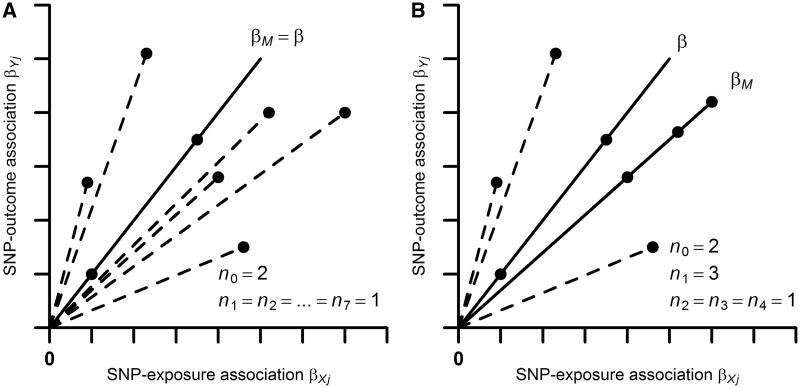
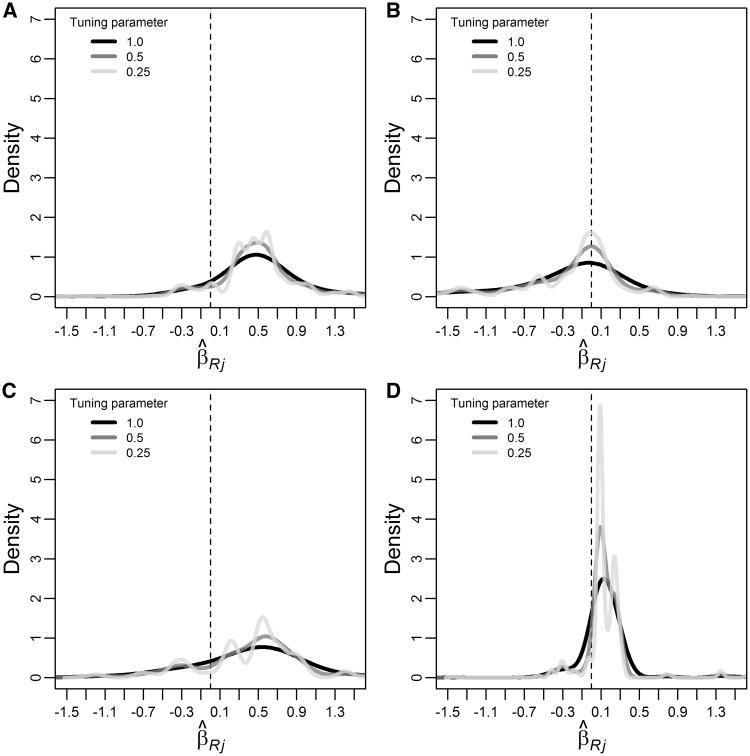
Verification
Claims the paper makes
The claims and statistics of this paper haven’t been checked yet.
Run the check — free, no account needed. It reads the open-access text and checks the sources it cites.
Claims other papers make about this one
Each is checked against this paper’s own text: does it say what the citing paper says it does?
In the citing paper
“Additional approaches to test the exclusion restriction include weighted median56 and mode.57”
From Strengthening the Reporting of Observational Studies in Epidemiology using Mendelian Randomisation (STROBE-MR): explanation and elaboration. (2021) · cites this paper as [57]
In the citing paper
“The MR-PRESSO method is a variation on the IVW method that first sequentially removes genetic variants from the analysis whose variant-specific causal estimate differs substantially from those of other variants 21 .”
From Guidelines for performing Mendelian randomization investigations (2020) · cites this paper as [21]
Self-check
Percentages, sums and reported differences re-computed from the paper’s own numbers.
The self-check needs the paper’s full text.
Citations
Cites
Density Estimation for Statistics and Data Analysis
Silverman, B. W. (2018) · Routledge eBooks · doi:10.1201/9781315140919 · Cited by 15,938
Bowden, J., Davey Smith, G., & Burgess, S. (2015) · International Journal of Epidemiology · doi:10.1093/ije/dyv080 · Cited by 9,816
Self-citationBowden, J., Davey Smith, G., Haycock, P. C., & Burgess, S. (2016) · Genetic Epidemiology · doi:10.1002/gepi.21965 · Cited by 8,922
Self-citationDensity Estimation for Statistics and Data Analysis
(1986) · Springer eBooks · doi:10.1007/978-1-4899-3324-9 · Cited by 8,514
Mendelian Randomization Analysis With Multiple Genetic Variants Using Summarized Data
Burgess, S., Butterworth, A., & Thompson, S. G. (2013) · Genetic Epidemiology · doi:10.1002/gepi.21758 · Cited by 6,050
Davey Smith, G., & Ebrahim, S. (2003) · International Journal of Epidemiology · doi:10.1093/ije/dyg070 · Cited by 5,882
Mendelian randomization: genetic anchors for causal inference in epidemiological studies
Davey Smith, G., & Hemani, G. (2014) · Human Molecular Genetics · doi:10.1093/hmg/ddu328 · Cited by 4,677
Willer (2013) · doi:10.1038/ng.2797 · Cited by 2,983
Burgess, S., Bowden, J., Fall, T., Ingelsson, E., & Thompson, S. G. (2017) · Epidemiology · doi:10.1097/ede.0000000000000559 · Cited by 2,017
Self-citationA framework for the investigation of pleiotropy in two‐sample summary data Mendelian randomization
Bowden, J., Del Greco M, F., Minelli, C., Davey Smith, G., Sheehan, N., & Thompson, J. (2017) · Statistics in Medicine · doi:10.1002/sim.7221 · Cited by 1,887
Self-citation
Cited by
Sorted by citations
Items 1,001–1,004 of 1,004
Zhao, Z., Xing, N., & Hou, L. (2024) · Epilepsia Open · doi:10.1002/epi4.13101 · Cited by 8
Wang, Z., Zhu, H., Chen, L., Gan, C., Min, W., Xiao, J., Zou, Z., & He, Y. (2024) · Journal of Attention Disorders · doi:10.1177/10870547241264660 · Cited by 4
Xiang, N., Hu, Y., Peng, W., Luo, M., Chen, H., & Zhang, Q. (2024) · Frontiers in Endocrinology · doi:10.3389/fendo.2024.1400491 · Cited by 1
MR-MAS: an end-to-end multi-agent system for autonomous Mendelian randomization analysis
Wei, W., Fan, Y., Li, L., Le, T. D., Li, X., Cheng, D., & Feng, Z. (2026) · Bioinformatics · doi:10.1093/bioinformatics/btag722
Metadata
- Authors
- Hartwig, F. P., Davey Smith, G., & Bowden, J.
- Affiliations
- Universidade Federal de Pelotas (BR)
- MRC Integrative Epidemiology Unit and
- University of Bristol (GB)
- Corresponding author
- Hartwig, Fernando Pires
- Venue
- International Journal of Epidemiology
- Publisher
- Oxford University Press (OUP)
- Published
- 2017-07-12
- Volume
- 46
- Issue
- 6
- Pages
- 1985-1998
- ISSN
- 0300-5771 (ISSN-L)
- 1464-3685
- PMC
- PMC5837715
- OpenAlex
- W2613603864
- Cited by
- 3,485
- References
- 28
- Citations by year
- 2026: 387 · 2025: 798 · 2024: 1094 · 2023: 475 · 2022: 231 · 2021: 226 · 2020: 119 · 2019: 88 · 2018: 53 · 2017: 12
- FWCI
- 49.57
- Type
- journal article
- Language
- en
- Open access
- hybrid
- doi.org
- Licence
- cc-by
- Locations
- International Journal of Epidemiology (publishedVersion, cc-by)
- PubMed Central (publishedVersion, cc-by)
- PubMed (publishedVersion)
- Bristol Research (University of Bristol) (submittedVersion, cc-by)
- Explore Bristol Research (submittedVersion, cc-by)
- Funders
- University of Bristol (MC_UU_12013/9)
- Medical Research Council (MC_UU_12013, MR/N501906/1, MC_UU_12013/9)
- Topics
- Life Sciences › Biochemistry, Genetics and Molecular Biology › Genetics › Genetic Associations and Epidemiology
- Physical Sciences › Mathematics › Statistics and Probability › Advanced Causal Inference Techniques
- Social Sciences › Decision Sciences › Statistics, Probability and Uncertainty › Meta-analysis and systematic reviews
- Keywords
- Mendelian randomization, summary data, invalid instruments, causal effect estimation, MR-Egger, weighted median, inverse variance weighting, plasma lipids, uric acid, coronary artery disease, sensitivity analysis
- MeSH terms
- Humans, Models, Statistical, Causality, Sample Size, Genome-Wide Association Study, Mendelian Randomization Analysis, Genetic Pleiotropy
About these checks
Registry, retraction, Cites and statistics results are computed, not judged, with one exception: a printed reference that no index lists is read once by a model before it counts as a citation error. Claims are extracted by a model and kept only when their quote appears verbatim in the text; each cited source is then checked, with a model’s help, for whether it says what the claim relies on. Those verdicts can be wrong — read the claim’s quote and the cited source before relying on one.
Statistics and arithmetic are recomputed, not judged.
Confidence bands are shown only for fields calibrated on our annotated test set. None is calibrated yet, so no band is shown.
What counts as a claim ›How we measure confidence ›How we check this ›
Are you an author, or do you see a problem with this page? Request a review
