

The DOI matches its Crossref record; 21 of the 21 references it cites were found in a registry or an index.
Motives and Side-Effects of Microdosing With Psychedelics Among Users
Open accessAbstract
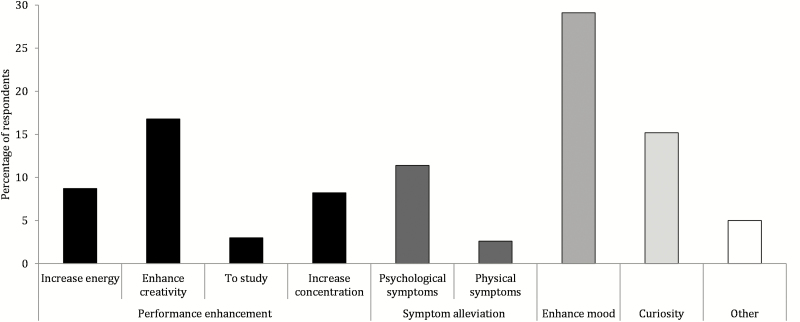
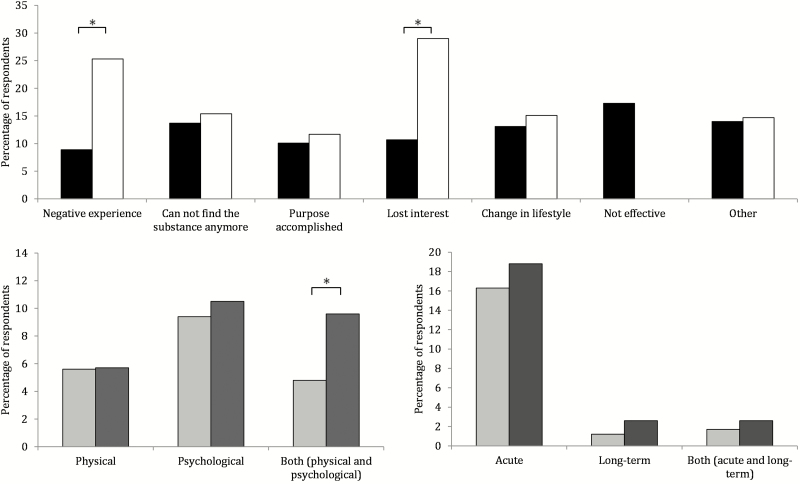
Background: Microdosing with psychedelics has gained considerable media attention where it is portrayed as a performance enhancer, especially popular on the work floor. While reports are in general positive, scientific evidence about potential negative effects is lacking aside from the prevalence and motives for use. The present study addressed this gap by surveying psychedelic users about their experience with microdosing including their dosing schedule, motivation, and potential experienced negative effects. Methods: An online questionnaire was launched on several websites and fora between March and July 2018. Respondents who had consented, were 18 years of age or older, and had experience with microdosing were included in the analyses. Results: In total, 1116 of the respondents were either currently microdosing (79.5%) or microdosed in the past (20.5%). Lysergic acid diethylamide (10 mcg) and psilocybin (0.5 g) were the most commonly used psychedelics with a microdosing frequency between 2 and 4 times per week. The majority of users, however, were oblivious about the consumed dose. Performance enhancement was the main motive to microdose (37%). The most reported negative effects were of psychological nature and occurred acutely while under the influence. Conclusion: In line with media reports and anecdotes, the majority of our respondents microdosed to enhance performance. Negative effects occurred mostly acutely after substance consumption. However, the main reason to have stopped microdosing was that it was not effective. Future experimental placebo-controlled studies are needed to test whether performance enhancement can be quantified and to assess potential negative effects after longer term microdosing.
Overview
The claims and statistics of this paper haven’t been checked yet.
Run the check — free, no account needed. It reads the open-access text and checks the sources it cites.
Integrity signals
Registry
Cites
Statistics
Figures
Verification
Claims the paper makes
The claims and statistics of this paper haven’t been checked yet.
Run the check — free, no account needed. It reads the open-access text and checks the sources it cites.
Self-check
Percentages, sums and reported differences re-computed from the paper’s own numbers.
The self-check needs the paper’s full text.
Citations
Cites
Cognitive Enhancement: Methods, Ethics, Regulatory Challenges
Bostrom, N., & Sandberg, A. (2009) · Science and Engineering Ethics · doi:10.1007/s11948-009-9142-5 · Cited by 782
The neurobiology of psychedelic drugs: implications for the treatment of mood disorders
Vollenweider, F. X., & Kometer, M. (2010) · Nature Reviews Neuroscience · doi:10.1038/nrn2884 · Cited by 723
Psychedelics and the essential importance of context
Carhart-Harris, R. L., Roseman, L., Haijen, E., Erritzoe, D., Watts, R., Branchi, I., & Kaelen, M. (2018) · Journal of Psychopharmacology · doi:10.1177/0269881118754710 · Cited by 657
Carbonaro, T. M., Bradstreet, M. P., Barrett, F. S., MacLean, K. A., Jesse, R., Johnson, M. W., & Griffiths, R. R. (2016) · Journal of Psychopharmacology · doi:10.1177/0269881116662634 · Cited by 596
Modern clinical research on LSD
Liechti, M. E. (2017) · Neuropsychopharmacology · doi:10.1038/npp.2017.86 · Cited by 236
A systematic study of microdosing psychedelics
Polito, V., & Stevenson, R. J. (2019) · PLoS ONE · doi:10.1371/journal.pone.0211023 · Cited by 235 · cited 6×
“A recent follow-up study found a mismatch between expected effects and the perceived psychological changes when microdosing for 6 weeks (Polito and Stevenson, 2019).”
BackgroundResultInfluentialExploring the effect of microdosing psychedelics on creativity in an open-label natural setting
Prochazkova, L., Lippelt, D. P., Colzato, L. S., Kuchar, M., Sjoerds, Z., & Hommel, B. (2018) · Psychopharmacology · doi:10.1007/s00213-018-5049-7 · Cited by 177
Yanakieva, S., Polychroni, N., Family, N., Williams, L. T. J., Luke, D. P., & Terhune, D. B. (2018) · Psychopharmacology · doi:10.1007/s00213-018-5119-x · Cited by 174
Powerful substances in tiny amounts: An interview study of psychedelic microdosing
Johnstad, P. G. (2018) · Nordic Studies on Alcohol and Drugs · doi:10.1177/1455072517753339 · Cited by 155 · cited 8×
“The most reported microdoses of LSD (10 mcg) and psilocybin (0.5 g) are comparable with the doses reported in previous studies (Johnstad, 2018; Winstock et al., 2018; Polito and Stevenson, 2019) and in line with the reported one-tenth of a regular dose (Chandler, 2018; thethirdwave, 2018).”
BackgroundResultInfluentialThe Psychedelic Explorer's Guide: Safe, Therapeutic, and Sacred Journeys
Fadiman, J. (2011) · Cited by 138
Pharmacological cognitive enhancement—how neuroscientific research could advance ethical debate
Maslen, H., Faber, N. S., & Savulescu, J. (2014) · Frontiers in Systems Neuroscience · doi:10.3389/fnsys.2014.00107 · Cited by 106
Horsley, R. R., Páleníček, T., Kolin, J., & Valeš, K. (2018) · Behavioural Pharmacology · doi:10.1097/fbp.0000000000000394 · Cited by 52
Psychopathology and Psychophysiology of Minimal LSD-25 Dosage
GREINER, T. H. (1958) · A M A Archives of Neurology & Psychiatry · doi:10.1001/archneurpsyc.1958.02340020088016 · Cited by 47
How cognitive enhancement can change our duties
de Sio, F. S., Faber, N. S., & Vincent, N. A. (2014) · Frontiers in Systems Neuroscience · doi:10.3389/fnsys.2014.00131 · Cited by 44
Occurrence and use of hallucinogenic mushrooms containing psilocybin alkaloids
Andersson, C., Gry, J., & Kristinsson, J. (2009) · TemaNord · doi:10.6027/tn2008-606 · Cited by 41
Focusing the Neuroscience and Societal Implications of Cognitive Enhancers
Savulich, G., Piercy, T., Brühl, A. B., Fox, C., John Suckling, A., Rowe, J. B., O'Brien, J. T., & Sahakian, B. J. (2016) · Clinical Pharmacology & Therapeutics · doi:10.1002/cpt.457 · Cited by 41
The Psychedelic Explorer’s Guide: Safe, Therapeutic, and Sacred Journeys
Rhead, J. (2014) · Journal of Psychoactive Drugs · doi:10.1080/02791072.2014.948329 · Cited by 30
Garasic, M. D., & Lavazza, A. (2015) · Frontiers in Systems Neuroscience · doi:10.3389/fnsys.2015.00013 · Cited by 16
Responsible Cognitive Enhancement: Neuroethical Considerations
Colzato, L. S. (2018) · Journal of Cognitive Enhancement · doi:10.1007/s41465-018-0090-3 · Cited by 15
Use of LSD in the Haight-Ashbury. Observations at a neighborhood clinic.
Smith, D. E. (1969) · PubMed · Cited by 11
Wong, S. (2017) · The New Scientist · doi:10.1016/s0262-4079(17)31161-2 · Cited by 4
Research works printed but not linked: 5
- Academy of Medical Sciences, the British Academy, the Royal Academy of Engineering, the Royal Society, 2012, Human enhancement and the future of work
- Passie, 2019, The science of microdosing psychedelics
- Waldman, 2018, A really good day: how microdosing made a mega difference in my mood, my marriage, and my life
- Winstock, 2017, Global Drug Survey (GDS) 2017. Global overview and highlights
- Winstock, 2018, Global Drug Survey (GDS) 2018
Cited by
Sorted by citations
Holze, F., Vizeli, P., Ley, L., Müller, F., Dolder, P., Stocker, M., Duthaler, U., Varghese, N., Eckert, A., Borgwardt, S., et al. (2021) · Neuropsychopharmacology · doi:10.1038/s41386-020-00883-6 · Cited by 245
Self-citationPsychedelics in Psychiatry: Neuroplastic, Immunomodulatory, and Neurotransmitter Mechanisms
Inserra, A., De Gregorio, D., & Gobbi, G. (2021) · Pharmacological Reviews · doi:10.1124/pharmrev.120.000056 · Cited by 232
Kuypers, K. P. C., Ng, L., Erritzøe, D., Knudsen, G. M., Nichols, C. D., Nichols, D. E., Pani, L., Soula, A., & Nutt, D. (2019) · Journal of Psychopharmacology · doi:10.1177/0269881119857204 · Cited by 227
Self-citationKettner, H., Rosas, F. E., Timmermann, C., Kärtner, L., Carhart-Harris, R. L., & Roseman, L. (2021) · Frontiers in Pharmacology · doi:10.3389/fphar.2021.623985 · Cited by 221
Therapeutic Use of LSD in Psychiatry: A Systematic Review of Randomized-Controlled Clinical Trials
Fuentes, J. J., Fonseca, F., Elices, M., Farré, M., & Torrens, M. (2020) · Frontiers in Psychiatry · doi:10.3389/fpsyt.2019.00943 · Cited by 177
Metadata
- Authors
- Hutten, N. R. P. W., Mason, N. L., Dolder, P. C., & Kuypers, K. P. C.
- Affiliations
- Maastricht University (NL)
- Corresponding author
- Hutten, Nadia R P W
- Venue
- International Journal of Neuropsychopharmacology
- Publisher
- Oxford University Press (OUP)
- Published
- 2019-05-31
- Volume
- 22
- Issue
- 7
- Pages
- 426-434
- ISSN
- 1461-1457 (ISSN-L)
- 1469-5111
- PMC
- PMC6600464
- OpenAlex
- W2946918750
- Cited by
- 126
- References
- 21
- Citations by year
- 2026: 11 · 2025: 20 · 2024: 19 · 2023: 19 · 2022: 18 · 2021: 16 · 2020: 19 · 2019: 4
- FWCI
- 16.64
- Type
- journal article
- Language
- en
- Open access
- gold
- doi.org
- Licence
- Locations
- The International Journal of Neuropsychopharmacology (publishedVersion, cc-by-nc)
- Europe PMC (PubMed Central) (publishedVersion, cc-by-nc)
- PubMed Central (publishedVersion, cc-by-nc)
- PubMed (publishedVersion)
- Research Publications (Maastricht University) (submittedVersion, cc-by-nc)
- Research Publications (Maastricht University) (submittedVersion, other-oa)
- Topics
- Social Sciences › Psychology › Clinical Psychology › Psychedelics and Drug Studies
- Social Sciences › Arts and Humanities › Philosophy › Neuroethics, Human Enhancement, Biomedical Innovations
- Life Sciences › Pharmacology, Toxicology and Pharmaceutics › Toxicology › Forensic Toxicology and Drug Analysis
- Keywords
- microdosing, psychedelics, lysergic acid diethylamide, psilocybin, performance improvement, adverse outcomes, dosing frequency, user experience
- MeSH terms
- Adult, Female, Hallucinogens, Humans, Lysergic Acid Diethylamide, Male, Motivation, Psilocybin, Surveys and Questionnaires, Substance-Related Disorders, Performance-Enhancing Substances
About these checks
Registry, retraction, Cites and statistics results are computed, not judged, with one exception: a printed reference that no index lists is read once by a model before it counts as a citation error. Claims are extracted by a model and kept only when their quote appears verbatim in the text; each cited source is then checked, with a model’s help, for whether it says what the claim relies on. Those verdicts can be wrong — read the claim’s quote and the cited source before relying on one.
Statistics and arithmetic are recomputed, not judged.
Confidence bands are shown only for fields calibrated on our annotated test set. None is calibrated yet, so no band is shown.
What counts as a claim ›How we measure confidence ›How we check this ›
Are you an author, or do you see a problem with this page? Request a review
