

Group Meeting Frequency and Borrowers’ Repayment Performance in Microfinance: Evidence from a Quasi-natural Experiment in South Africa
Open accessThe DOI matches its Crossref record; 45 of the 46 references it cites were found in a registry or an index.
Abstract
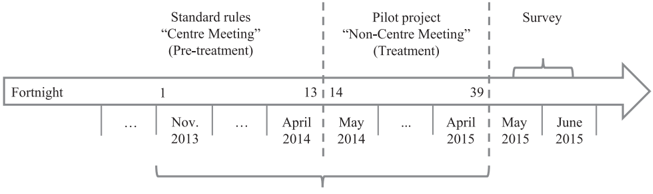
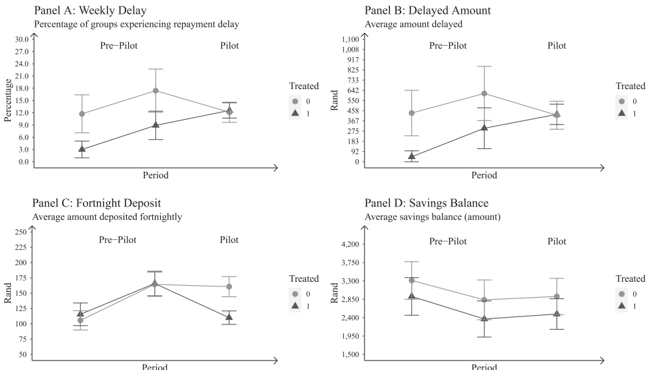
A quasi-natural experiment has been carried out at The Small Enterprise Foundation, a South African microfinance institution offering group lending with joint liability. In a pilot project, the frequency of meetings was reduced from fortnightly to monthly and the members of the groups were no more required to attend all the meetings but they could send a representative. After selecting a suitable control group using propensity score matching techniques, we ran difference-in-difference regressions to evaluate the impact of the policy changes. Estimates suggest that the pilot project increased loan repayment delays and decreased groups’ deposits, but it had a negligible impact on groups’ savings balances. Text mining techniques, applied to survey data, pointed towards the lack of trust within the groups whose members did not meet frequently outside the repayment meetings as one of the causes of the negative outcomes of the pilot experiment. We conclude that group meetings are an effective tool to stimulate the accumulation of social capital among microcredit borrowers.
Overview
The claims and statistics of this paper haven’t been checked yet.
Free: it reads the open-access text and checks the first 5 claims that cite a source we can check. Create a free account to check every claim.
Integrity signals
Registry
Cites
Statistics
Figures
Verification
Claims the paper makes
The claims and statistics of this paper haven’t been checked yet.
Free: it reads the open-access text and checks the first 5 claims that cite a source we can check. Create a free account to check every claim.
Claims other papers make about this one
Each is checked against this paper’s own text: does it say what the citing paper says it does?
The source backs part of the claim, not all of it — or backs it for a different population, condition or comparison.
In the citing paper
“Dalla Pellegrina et al. (2021) showed that the frequency of group meetings strengthened repayment through social accountability effects”
From Drivers of willingness to repay Parish Revolving funds (PRF) under Uganda’s Parish Development Model: a Bayesian Latent Class Logistic Regression (LCLR) approach (2026) · cites this paper as Dalla Pellegrina et al. (2021)
Experimental — accuracy not yet measuredThe cited source says what the claim attributes to it.
In the citing paper
“In microfinance, social capital operates through peer monitoring, group accountability and reputational incentives that encourage loan repayment (Dalla Pellegrina et al., 2021;Wydick, 1999).”
From Drivers of willingness to repay Parish Revolving funds (PRF) under Uganda’s Parish Development Model: a Bayesian Latent Class Logistic Regression (LCLR) approach (2026) · cites this paper as Dalla Pellegrina et al., 2021
Self-check
Percentages, sums and reported differences re-computed from the paper’s own numbers.
The self-check needs the paper’s full text.
Citations
Cites
The central role of the propensity score in observational studies for causal effects
ROSENBAUM, P. R., & RUBIN, D. B. (1983) · Biometrika · doi:10.1093/biomet/70.1.41 · Cited by 31,241 · cited 1×
“As a solution to the non-random selection of the treated group, we decided to identify the control group through PSM methods (Rosenbaum and Rubin, 1983), given that the information related to both the excluded centres and the allocation mode of the treatment were known.”
MethodHandbook of Theory and Research for the Sociology of Education.
O'Shea, D. W., & Richardson, J. G. (1987) · Contemporary Sociology · doi:10.2307/2069964 · Cited by 15,142
Credit Rationing in Markets with Imperfect Information
Stiglitz, J. E., & Weiss, A. (1981) · Columbia University · doi:10.7916/d8v12ft1 · Cited by 12,769 · cited 2×
“Since their origins, using the joint liability methodology, MFIs have exploited the clients’ social capital to select safe borrowers and less risky projects, to monitor their execution and enforce debt repayment (Stiglitz and Weiss, 1981; Stiglitz, 1990; Varian, 1990; Besley and Coate, 1995; Ghatak, 1999; Ghatak and G…”
BackgroundMethodMostly Harmless Econometrics: An Empiricist's Companion
Angrist, J. D., & Pischke, J.-S. (2009) · doi:10.1515/9781400829828 · Cited by 9,467
The Miracle of Microfinance? Evidence from a Randomized Evaluation
Banerjee, A., Duflo, E., Glennerster, R., & Kinnan, C. (2015) · American Economic Journal: Applied Economics · doi:10.1257/app.20130533 · Cited by 2,076
Peer Monitoring and Credit Markets
Stiglitz, J. E. (1990) · The World Bank Economic Review · doi:10.1093/wber/4.3.351 · Cited by 1,309 · cited 4×
“Since their origins, using the joint liability methodology, MFIs have exploited the clients’ social capital to select safe borrowers and less risky projects, to monitor their execution and enforce debt repayment (Stiglitz and Weiss, 1981; Stiglitz, 1990; Varian, 1990; Besley and Coate, 1995; Ghatak, 1999; Ghatak and G…”
BackgroundMethodInfluentialGroup lending, repayment incentives and social collateral
Besley, T., & Coate, S. (1995) · Journal of Development Economics · doi:10.1016/0304-3878(94)00045-e · Cited by 1,227 · cited 2×
“Since their origins, using the joint liability methodology, MFIs have exploited the clients’ social capital to select safe borrowers and less risky projects, to monitor their execution and enforce debt repayment (Stiglitz and Weiss, 1981; Stiglitz, 1990; Varian, 1990; Besley and Coate, 1995; Ghatak, 1999; Ghatak and G…”
BackgroundMethodBanker to the poor: micro-lending and the battle against world poverty
(2000) · Choice Reviews Online · doi:10.5860/choice.37-4016 · Cited by 1,133 · cited 2×
“, the rules designed to disseminate good social and economic behaviour, hygiene practices and generally a sense of self-esteem and a commitment to self-promotion among clients (Yunus and Jolis, 2003).”
Fast and wild: Bootstrap inference in Stata using boottest
Roodman, D., Nielsen, M. Ø., MacKinnon, J. G., & Webb, M. D. (2019) · The Stata Journal: Promoting communications on statistics and Stata · doi:10.1177/1536867x19830877 · Cited by 1,007
The economics of lending with joint liability: theory and practice
Ghatak, M., & Guinnane, T. W. (1999) · Journal of Development Economics · doi:10.1016/s0304-3878(99)00041-3 · Cited by 879 · cited 4×
“Since their origins, using the joint liability methodology, MFIs have exploited the clients’ social capital to select safe borrowers and less risky projects, to monitor their execution and enforce debt repayment (Stiglitz and Weiss, 1981; Stiglitz, 1990; Varian, 1990; Besley and Coate, 1995; Ghatak, 1999; Ghatak and G…”
BackgroundMethodInfluential
Research works printed but not linked: 5
- Adler M., Waldschmidt S. (2013) '"Microfinance 3.0"-Perspectives for sustainable financial service delivery', in D. Köhn (ed), Microfinance 3.0: Reconciling Sustainability with Social Outreach and Responsible Delivery. Berlin: Springer, pp. 123-37 https://doi.org/10.1007/978- 3-642-41704-7_6. · doi:10.1007/978-3-642-41704-7_6
- Matin, I. (1996) 'Group credit arrangements with joint liability: Some thoughts and puzzles'. Grassroots, 5(20), 44-48.
- Portes, A. (2000) 'The two meanings of social capital'. Sociological Forum, 15(1), 1-12. https:// doi.org/10.1023/A:1007537902813. · doi:10.1023/a:1007537902813
- Putnam R. D., Leonardi R., Nanetti R. Y. (1993) Making Democracy Word: Civic Traditions in Modern Italy. Princeton, NJ: Princeton University Press.
- Women’s World Banking, 2003, What do microfinance customer value?, What Works, 1, 1
Cited by
Loan repayment among group borrowers in Tanzania: the role of relationship quality
Tegambwage, A. G., & Kasoga, P. S. (2022) · Future Business Journal · doi:10.1186/s43093-022-00151-7 · Cited by 32
“Individual group members’ history of positive interaction is a primary source of relationship pleasure [46, 49], and group members’ best assurance of future performance is a continuous history of individualized, error-free engagement [17].”
BackgroundResultInfluentialJindo, K., Andersson, J., Quist-Wessel, F. P. M., Onyango, J., & Langeveld, J. W. A. (2023) · Food Security · doi:10.1007/s12571-023-01394-0 · Cited by 28
“…contributing to successful management by microfinance institutions (MFIs) is crucial to understanding the behaviours exhibited by microcredit clients (Dalla Pellegrina et al., 2021a; Naegels et al., 2022), particularly the relationship between investment behaviours and repayment performance.”
BackgroundInfluentialCruz, N. A. O. D., Villanueva, A., Tolin, L. A. C., Disse, S., Lensink, R., & White, H. (2025) · Campbell Systematic Reviews · doi:10.1002/cl2.70061 · Cited by 29
Li, Q., Yu, Y., Li, Y., & Sun, G. (2023) · Research in International Business and Finance · doi:10.1016/j.ribaf.2023.101971 · Cited by 13
Pellegrina, L. D., Michele, A. D., Maio, G. D., & Landoni, P. (2019) · World Development · doi:10.1016/j.worlddev.2021.105660 · Cited by 12
Self-citation
Metadata
- Authors
- Dalla Pellegrina, L., De Michele, A., Di Maio, G., Landoni, P., & Parravicini, S.
- Affiliations
- Department of Economics, Management and Statistics (DEMS), Università degli Studi di Milano-Bicocca Milano, Italy
- The Small Enterprise Foundation, Tzaneen, South Africa
- Department of Economics, Università degli Studi dell’Insubria, Varese, Italy
- Politecnico di Torino (IT)
- University of Milano-Bicocca (IT)
- ORCID
- Landoni, Paolo
- Venue
- Journal of African Economies
- Publisher
- Oxford University Press (OUP)
- Published
- 2021-03-16
- Volume
- 30
- Issue
- 5
- Pages
- 447-477
- ISSN
- 0963-8024 (ISSN-L)
- 1464-3723
- OpenAlex
- W2775750413
- Cited by
- 19
- References
- 46
- Citations by year
- 2026: 2 · 2025: 7 · 2024: 1 · 2023: 6 · 2022: 2
- FWCI
- 1.72
- Type
- journal article
- Language
- en
- Open access
- hybrid
- doi.org
- Licence
- Locations
- Journal of African Economies (publishedVersion, cc-by-nc)
- RePEc: Research Papers in Economics (submittedVersion)
- Archivio istituzionale della Ricerca - Bocconi (submittedVersion, cc-by)
- BOA (University of Milano-Bicocca) (submittedVersion, cc-by-nc)
- BOA (University of Milano-Bicocca) (submittedVersion, other-oa)
- IrInSubria (University of Insubria) (submittedVersion, cc-by-nc)
- Funders
- Fondazione Roberto Franceschi
- Topics
- Social Sciences › Economics, Econometrics and Finance › Economics and Econometrics › Microfinance and Financial Inclusion
- Social Sciences › Economics, Econometrics and Finance › Finance › Banking stability, regulation, efficiency
- Social Sciences › Business, Management and Accounting › Management Information Systems › FinTech, Crowdfunding, Digital Finance
- Keywords
- microfinance, group lending, loan repayment performance, joint liability, social capital, microcredit borrowers, savings deposits, policy interventions, South Africa
About these checks
Registry, retraction, Cites and statistics results are computed, not judged, with one exception: a printed reference that no index lists is read once by a model before it counts as a citation error. Claims are extracted by a model and kept only when their quote appears verbatim in the text; each cited source is then checked, with a model’s help, for whether it says what the claim relies on. Those verdicts can be wrong — read the claim’s quote and the cited source before relying on one.
Statistics and arithmetic are recomputed, not judged.
Confidence bands are shown only for fields calibrated on our annotated test set. None is calibrated yet, so no band is shown.
What counts as a claim ›How we measure confidence ›How we check this ›
Are you an author, or do you see a problem with this page? Request a review
How to cite
Cite CoChat for the checks on this page, and the paper for its own findings.
- This page
- CoChat. (2026). Citation check: Group Meeting Frequency and Borrowers’ Repayment Performance in Microfinance: Evidence from a Quasi-natural Experiment in South Africa. https://app.cochat.ai/papers/10.1093/jae/ejab004
- The paper
- Dalla Pellegrina, L., De Michele, A., Di Maio, G., Landoni, P., & Parravicini, S. (2021). Group Meeting Frequency and Borrowers’ Repayment Performance in Microfinance: Evidence from a Quasi-natural Experiment in South Africa. Journal of African Economies. https://doi.org/10.1093/jae/ejab004
Data sources
Bibliographic data: Semantic Scholar, OpenAlex, Crossref.
Contains information from the Semantic Scholar Academic Graph Datasets, made available under the ODC Attribution License (ODC-BY 1.0).
Semantic Scholar’s data is described in: Kinney, R., et al. (2023). The Semantic Scholar Open Data Platform. arXiv:2301.10140.
