

Assessing Phlebotomy Device Preference and Specimen Quality in an Oncology Outpatient Clinic
Open accessThe DOI matches its Crossref record; 8 of the 8 references it cites were found in a registry or an index.
Abstract
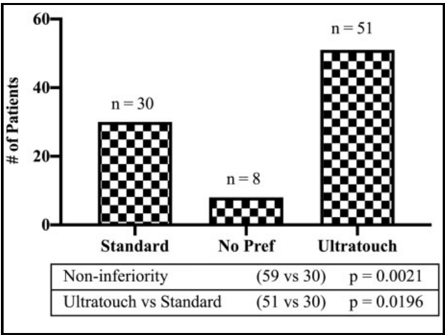
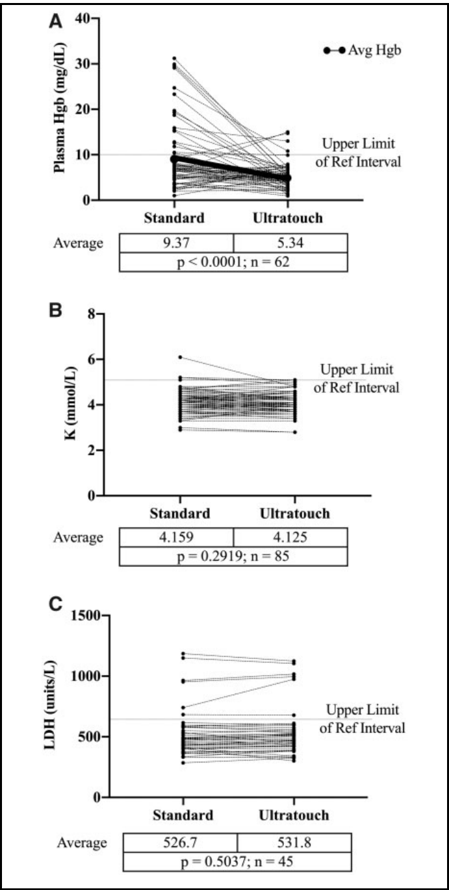
Background: Oncology patients have frequent venipunctures, which causes scarring, making subsequent draws difficult and painful. Novel blood collection systems may decrease discomfort in patients experiencing repeat blood draws. Methods: Oncology outpatients (n = 101; criteria excluded 12) were recruited to determine their preference for either of two blood collection systems, the 23-gauge standard BD Vacutainer Push Button Blood Collection Set (Standard Push Button system) or the 25-gauge BD Vacutainer UltraTouch Push Button Blood Collection Set (UltraTouch Push Button system). Subjects received two blinded, randomized blood draws, one with each device and just one device for each arm. Subjects subsequently rated their blinded preference for blood collection system. Specimen quality was assessed for each device with measurements for plasma hemoglobin (Shimadzu UV-1800 spectrophotometer, Shimadzu), lactate dehydrogenase, and potassium (Vitros 4600/5600 analyzer, Ortho Diagnostics). Results: Preference for the 25-gauge UltraTouch Push Button system over the 23-gauge Standard Push Button system was significant (UltraTouch, n = 51; Standard n = 30; no preference, n = 8; P = 0.0196). Regarding sample quality, the 25-gauge UltraTouch Push Button system had significantly lower plasma hemoglobin (average 5.34 mg/dL) vs the 23-gauge Standard Push Button system (9.37 mg/dL; P < 0.0001); serum lactate dehydrogenase and potassium differences were not statistically significant. Conclusion: Subjects in an oncology clinic preferred phlebotomy with the 25-gauge UltraTouch Push Button system, and samples using this device had less hemolysis as assessed by plasma hemoglobin.
Overview
The claims and statistics of this paper haven’t been checked yet.
Free: it reads the open-access text and checks the first 5 claims that cite a source we can check. Create a free account to check every claim.
Integrity signals
Registry
Cites
Statistics
Figures
Verification
Claims the paper makes
The claims and statistics of this paper haven’t been checked yet.
Free: it reads the open-access text and checks the first 5 claims that cite a source we can check. Create a free account to check every claim.
Self-check
Percentages, sums and reported differences re-computed from the paper’s own numbers.
The self-check needs the paper’s full text.
Citations
Cites
Influence of hemolysis on routine clinical chemistry testing
Lippi, G., Luca Salvagno, G., Montagnana, M., Brocco, G., & Cesare Guidi, G. (2006) · Clinical Chemistry and Laboratory Medicine (CCLM) · doi:10.1515/cclm.2006.054 · Cited by 344 · cited 1×
“Pediatric samples were also shown to have similar quality attributes as compared to a comparable blood collection system (7, 12).”
ResultVascular Access in Oncology Patients
Gallieni, M., Pittiruti, M., & Biffi, R. (2008) · CA: A Cancer Journal for Clinicians · doi:10.3322/ca.2008.0015 · Cited by 284 · cited 1×
“It is important in every phase of cancer patients’ care, from the initial phase of surgical treatment or chemotherapy and during the chronic management phase of cancer care as well as in the palliative care phase (4).”
BackgroundGill, H. S., & Prausnitz, M. R. (2007) · Journal of Diabetes Science and Technology · doi:10.1177/193229680700100517 · Cited by 164 · cited 1×
“Smaller needle diameters and lower insertion forces have been shown to reduce the frequency of painful injections (7, 8).”
BackgroundHeyer, N. J., Derzon, J. H., Winges, L. D., Shaw, C. S., Mass, D., Snyder, S. R., Epner, P. L., Nichols, J. H., Gayken, J., Ernst, D. J., et al. (2012) · Clinical Biochemistry · doi:10.1016/j.clinbiochem.2012.08.002 · Cited by 141 · cited 1×
“Smaller gauge needles may impact hemolysis by causing fluidic shear force upon red blood cells passing through the needle, while larger gauge needles may increase the flow rate too much (5, 6).”
BackgroundLippi, G., Salvagno, G. L., Montagnana, M., Brocco, G., & Cesare Guidi, G. (2006) · Clinical Chemistry and Laboratory Medicine (CCLM) · doi:10.1515/cclm.2006.172 · Cited by 56 · cited 4×
“Pediatric samples were also shown to have similar quality attributes as compared to a comparable blood collection system (7, 12).”
BackgroundResultInfluentialMouser, A., Uettwiller-Geiger, D., Plokhoy, E., Berube, J., Ahuja, A. J., & Stankovic, A. K. (2017) · The Journal of Applied Laboratory Medicine · doi:10.1373/jalm.2017.023564 · Cited by 14 · cited 4×
“A previous study noted that specimen quality was maintained with the 25-gauge UltraTouch Push Button system, and comparable blood flow was shown when compared with the existing 23-gauge Standard Push Button devices (2).”
BackgroundResultInfluentialPadoan, A., Sirini, S., Mazzone, R., Mesiti, C., Grillo, C., Meyer, B., & Plebani, M. (2020) · Clinica Chimica Acta · doi:10.1016/j.cca.2019.10.019 · Cited by 8 · cited 1×
“A recent study involving the use of the 25-gauge UltraTouch Push Button system in a pediatric patient population similarly scored perceived pain as well as ease of use for phlebotomists (13).”
BackgroundChallenges of the oncology draw.
Lynn, K. (2011) · PubMed · Cited by 1
Research works printed but not linked: 2
- 1. WHO guidelines on drawing blood: best practices in phlebotomy. WHO Guidelines Approved by the Guidelines Review Committee. Geneva, Switzerland: World Health Organization, 2010.
- 5. Ernst, D.J. GP41 collection of diagnostic venous blood specimens. 7th Edition. Wayne, PA: Clinical and Laboratory Standards Institute (CLSI), 2017.
Cited by
Chidebe, R. C. W., Orjiakor, C. T., Okwu, G. C., Orji, M.-G. A., Nwosu-Zitta, T. O., Agha, A. A., Aruah, S. C., Okem-Akwiwu, C., Nwakasi, C. C., Gyimah, A. A., et al. (2024) · Supportive Care in Cancer · doi:10.1007/s00520-024-08316-6 · Cited by 17
Cai, P., Yang, Q., Lü, J., Dai, X., & Xiong, J. (2025) · mSystems · doi:10.1128/msystems.00043-25 · Cited by 12
“…were gathered to quantitatively measure various biochemical indica tors in the serum using the Ortho VITROS 5600 blood biochemical analyzer (34), which included carcinoembryonic antigen (CEA), carbohydrate antigen 19-9 (CA 19-9), cholesterol, triglycerides, blood glucose, and carbohydrate…”
An Assessment of Individual Preference for a Novel Capillary Blood Collection System
Pourafshar, S., Parikh, M., Abdallah, B., Thubian, N. A., & Jacobson, J. W. (2024) · Patient Preference and Adherence · doi:10.2147/ppa.s437969 · Cited by 10
“12 13–15 In addition, capillary blood collection in ancillary healthcare settings (ie, retail stores) may help improve health care accessibility and reduce the time needed for individual blood collection in rural settings.”
BackgroundHassan, A. M., Mohammed, G. T., Hefnawy, G. R., & Khalil, S. S. (2023) · International Journal of Membrane Science and Technology · doi:10.15379/ijmst.v10i2.3146 · Cited by 3
Soni, M. (2022) · Apollo Medicine · doi:10.4103/am.am_112_22 · Cited by 1
“[10] In a recent study, the investigators concluded that UTPBBCS provided less pain and improved the ease of use for phlebotomists in a pediatric patient population.”
Giussani, M., Sirini, S., Padoan, A., Bonini, C., Meyer, B., & Morelli, D. (2024) · European Journal of Oncology Nursing · doi:10.1016/j.ejon.2024.102680
Raut, S., Naik, K., Parab, V., Choudhary, N., & Ghosh, K. K. (2025) · Cureus · doi:10.7759/cureus.81164
“Venipuncture and blood collection can be challenging in cancer patients as they tend to have difficult venous access due to cachexia, advanced age, scarring from repeated intravenous access, and/or repeated administration of chemotherapeutic medications [8].”
Metadata
- Authors
- Merrill, V. D., Ward, M. D., Diaz-McNair, J., Pickett, E. A., Duh, S.-H., & Christenson, R. H.
- Affiliations
- University of Maryland, Baltimore (US)
- Corresponding author
- Christenson, Robert H
- Venue
- The Journal of Applied Laboratory Medicine
- Publisher
- Oxford University Press (OUP)
- Published
- 2021-10-11
- Volume
- 7
- Issue
- 2
- Pages
- 532-540
- ISSN
- 2475-7241 (ISSN-L)
- 2576-9456
- OpenAlex
- W3205867791
- Semantic Scholar
- 64972fe21777c8c25c4949c38b9567e064699576
- Cited by
- 7
- References
- 8
- Citations by year
- 2025: 2 · 2024: 3 · 2023: 1 · 2022: 1
- FWCI
- 1.54
- Type
- journal article
- Language
- en
- Open access
- hybrid
- doi.org
- Licence
- Locations
- The Journal of Applied Laboratory Medicine (publishedVersion, cc-by)
- PubMed (publishedVersion)
- Funders
- Becton Dickinson and Company
- Franklin Lakes
- Becton Dickinson and Company donated the products utilized for collecting samples
- Topics
- Health Sciences › Medicine › Critical Care and Intensive Care Medicine › Central Venous Catheters and Hemodialysis
- Health Sciences › Health Professions › Medical Laboratory Technology › Clinical Laboratory Practices and Quality Control
- Physical Sciences › Engineering › Biomedical Engineering › Intravenous Infusion Technology and Safety
- Keywords
- 25-gauge needle, hemolysis, plasma hemoglobin, sample quality, cancer outpatients, venipuncture, lactate dehydrogenase, serum potassium
- MeSH terms
- Ambulatory Care Facilities, Blood Specimen Collection, Hemoglobins, Humans, L-Lactate Dehydrogenase, Potassium, Phlebotomy
About these checks
Registry, retraction, Cites and statistics results are computed, not judged, with one exception: a printed reference that no index lists is read once by a model before it counts as a citation error. Claims are extracted by a model and kept only when their quote appears verbatim in the text; each cited source is then checked, with a model’s help, for whether it says what the claim relies on. Those verdicts can be wrong — read the claim’s quote and the cited source before relying on one.
Statistics and arithmetic are recomputed, not judged.
Confidence bands are shown only for fields calibrated on our annotated test set. None is calibrated yet, so no band is shown.
What counts as a claim ›How we measure confidence ›How we check this ›
Are you an author, or do you see a problem with this page? Request a review
Data sources
Bibliographic data: Semantic Scholar, OpenAlex, Crossref.
Contains information from the Semantic Scholar Academic Graph Datasets, made available under the ODC Attribution License (ODC-BY 1.0).
Semantic Scholar’s data is described in: Kinney, R., et al. (2023). The Semantic Scholar Open Data Platform. arXiv:2301.10140.
