

Envisioning an artificial intelligence documentation assistant for future primary care consultations: A co-design study with general practitioners
Open accessThe DOI matches its Crossref record; 53 of the 53 references it cites were found in a registry or an index.
Abstract
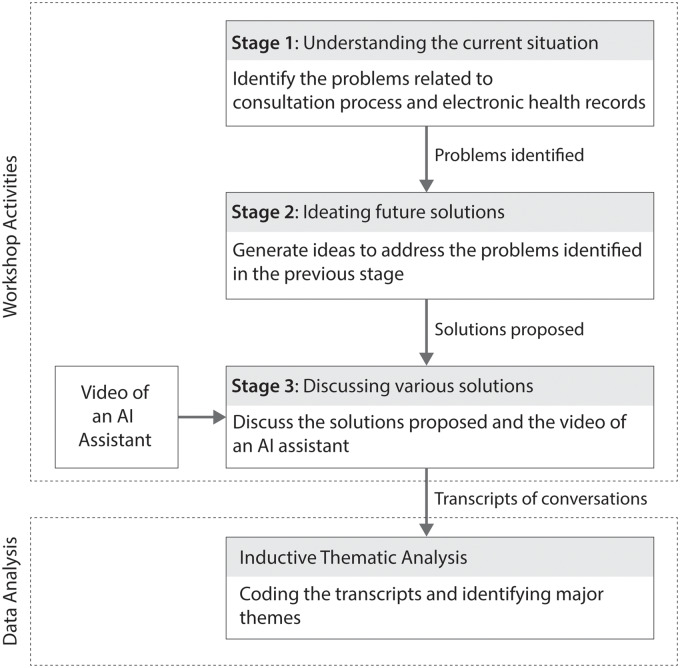
Objective: The study sought to understand the potential roles of a future artificial intelligence (AI) documentation assistant in primary care consultations and to identify implications for doctors, patients, healthcare system, and technology design from the perspective of general practitioners. Materials and Methods: Co-design workshops with general practitioners were conducted. The workshops focused on (1) understanding the current consultation context and identifying existing problems, (2) ideating future solutions to these problems, and (3) discussing future roles for AI in primary care. The workshop activities included affinity diagramming, brainwriting, and video prototyping methods. The workshops were audio-recorded and transcribed verbatim. Inductive thematic analysis of the transcripts of conversations was performed. Results: Two researchers facilitated 3 co-design workshops with 16 general practitioners. Three main themes emerged: professional autonomy, human-AI collaboration, and new models of care. Major implications identified within these themes included (1) concerns with medico-legal aspects arising from constant recording and accessibility of full consultation records, (2) future consultations taking place out of the exam rooms in a distributed system involving empowered patients, (3) human conversation and empathy remaining the core tasks of doctors in any future AI-enabled consultations, and (4) questioning the current focus of AI initiatives on improved efficiency as opposed to patient care. Conclusions: AI documentation assistants will likely to be integral to the future primary care consultations. However, these technologies will still need to be supervised by a human until strong evidence for reliable autonomous performance is available. Therefore, different human-AI collaboration models will need to be designed and evaluated to ensure patient safety, quality of care, doctor safety, and doctor autonomy.
Overview
The claims and statistics of this paper haven’t been checked yet.
Free: it reads the open-access text and checks the first 5 claims that cite a source we can check. Create a free account to check every claim.
Integrity signals
Registry
Cites
Statistics
Figures
Verification
Claims the paper makes
The claims and statistics of this paper haven’t been checked yet.
Free: it reads the open-access text and checks the first 5 claims that cite a source we can check. Create a free account to check every claim.
Claims other papers make about this one
Each is checked against this paper’s own text: does it say what the citing paper says it does?
The source backs part of the claim, not all of it — or backs it for a different population, condition or comparison.
In the citing paper
“Generative AI can also be used to automate routine tasks in healthcare, such as scheduling appointments, processing claims and managing patient records [47].”
From Generative AI in healthcare: an implementation science informed translational path on application, integration and governance (2024) · cites this paper as [47]
Experimental — accuracy not yet measuredThe source backs part of the claim, not all of it — or backs it for a different population, condition or comparison.
In the citing paper
“Strengthening AI-driven clinical practices [28, 85, 91, 95, 98, 99, 115, 120, 148–151, 161] can improve diagnostic support, reduce errors, and optimize care pathways.”
From Opportunities, challenges, and requirements for Artificial Intelligence (AI) implementation in Primary Health Care (PHC): a systematic review (2025) · cites this paper as [85]
Experimental — accuracy not yet measuredThe check wasn’t confident either way, so it gives no verdict — never disputed.
In the citing paper
“There has been a wide range of research on risk prediction in healthcare (e.g., [42,63,86]).”
From Talk2Care: An LLM-based Voice Assistant for Communication between Healthcare Providers and Older Adults (2024) · cites this paper as [63]
Experimental — accuracy not yet measured
Self-check
Percentages, sums and reported differences re-computed from the paper’s own numbers.
The self-check needs the paper’s full text.
Citations
Cites
Using thematic analysis in psychology
Braun, V., & Clarke, V. (2006) · Qualitative Research in Psychology · doi:10.1191/1478088706qp063oa · Cited by 194,414
Tong, A., Sainsbury, P., & Craig, J. (2007) · International Journal for Quality in Health Care · doi:10.1093/intqhc/mzm042 · Cited by 42,509
Dermatologist-level classification of skin cancer with deep neural networks
Esteva, A., Kuprel, B., Novoa, R. A., Ko, J., Swetter, S. M., Blau, H. M., & Thrun, S. (2017) · Nature · doi:10.1038/nature21056 · Cited by 14,362
High-performance medicine: the convergence of human and artificial intelligence
Topol, E. J. (2019) · Nature Medicine · doi:10.1038/s41591-018-0300-7 · Cited by 10,450
Gulshan, V., Peng, L., Coram, M., Stumpe, M. C., Wu, D., Narayanaswamy, A., Venugopalan, S., Widner, K., Madams, T., Cuadros, J., et al. (2016) · JAMA · doi:10.1001/jama.2016.17216 · Cited by 7,697
The Triple Aim: Care, Health, And Cost
Berwick, D. M., Nolan, T. W., & Whittington, J. (2008) · Health Affairs · doi:10.1377/hlthaff.27.3.759 · Cited by 5,136
The second machine age: work, progress, and prosperity in a time of brilliant technologies
(2015) · Choice Reviews Online · doi:10.5860/choice.184834 · Cited by 4,381
From Triple to Quadruple Aim: Care of the Patient Requires Care of the Provider
Bodenheimer, T., & Sinsky, C. (2014) · The Annals of Family Medicine · doi:10.1370/afm.1713 · Cited by 3,462
Artificial intelligence in healthcare
Yu, K.-H., Beam, A. L., & Kohane, I. S. (2018) · Nature Biomedical Engineering · doi:10.1038/s41551-018-0305-z · Cited by 2,817
Doctor-patient communication: a review of the literature
Ong, L. M. L., de Haes, J. C. J. M., Hoos, A. M., & Lammes, F. B. (1995) · Social Science & Medicine · doi:10.1016/0277-9536(94)00155-m · Cited by 2,430
Telehealth for global emergencies: Implications for coronavirus disease 2019 (COVID-19)
Smith, A. C., Thomas, E., Snoswell, C. L., Haydon, H., Mehrotra, A., Clemensen, J., & Caffery, L. J. (2020) · Journal of Telemedicine and Telecare · doi:10.1177/1357633x20916567 · Cited by 1,828
Lakhani, P., & Sundaram, B. (2017) · Radiology · doi:10.1148/radiol.2017162326 · Cited by 1,775
The Second Machine Age: Work, Progress, and Prosperity in a Time of Brilliant Technologies.
West, J. C. (2015) · Psychiatry · doi:10.1080/00332747.2015.1105632 · Cited by 1,398
Design at Work: Cooperative Design of Computer Systems
(2020) · CRC Press eBooks · doi:10.1201/9781003063988 · Cited by 1,233
Unintended consequences of machine learning in medicine
Cabitza, F., Rasoini, R., & Gensini, G. F. (2017) · JAMA · doi:10.1001/jama.2017.7797 · Cited by 1,066
(2019) · Cited by 986
Arndt, B. G., Beasley, J. W., Watkinson, M. D., Temte, J. L., Tuan, W.-J., Sinsky, C. A., & Gilchrist, V. J. (2017) · The Annals of Family Medicine · doi:10.1370/afm.2121 · Cited by 972
Performance Consequences of Automation-Induced 'Complacency'
Parasuraman, R., Molloy, R., & Singh, I. L. (1993) · The International Journal of Aviation Psychology · doi:10.1207/s15327108ijap0301_1 · Cited by 875
Friedberg, M., Chen, P., Van Busum, K., Aunon, F., Pham, C., Caloyeras, J., Mattke, S., Pitchforth, E., Quigley, D., Brook, R., et al. (2014) · RAND Health Quarterly · doi:10.7249/rhq-03-04-01 · Cited by 707
Deep Learning—A Technology With the Potential to Transform Health Care
Hinton, G. (2018) · JAMA · doi:10.1001/jama.2018.11100 · Cited by 667
Patient empowerment: reflections on the challenge of fostering the adoption of a new paradigm
Anderson, R. M., & Funnell, M. M. (2005) · Patient Education and Counseling · doi:10.1016/j.pec.2004.05.008 · Cited by 551
The “inconvenient truth” about AI in healthcare
Panch, T., Mattie, H., & Celi, L. A. (2019) · npj Digital Medicine · doi:10.1038/s41746-019-0155-4 · Cited by 473
Patient Perceptions of Telehealth Primary Care Video Visits
Powell, R. E., Henstenburg, J. M., Cooper, G., Hollander, J. E., & Rising, K. L. (2017) · The Annals of Family Medicine · doi:10.1370/afm.2095 · Cited by 465
Machine Learning and the Profession of Medicine
Darcy, A. M., Louie, A. K., & Roberts, L. W. (2016) · JAMA · doi:10.1001/jama.2015.18421 · Cited by 434
Blease, C., Kaptchuk, T. J., Bernstein, M. H., Mandl, K. D., Halamka, J. D., & DesRoches, C. M. (2019) · Journal of Medical Internet Research · doi:10.2196/12802 · Cited by 346
Artificial Intelligence—The Revolution Hasn’t Happened Yet
Jordan, M. I. (2019) · Harvard Data Science Review · doi:10.1162/99608f92.f06c6e61 · Cited by 259
On the Prospects for a (Deep) Learning Health Care System
Naylor, C. D. (2018) · JAMA · doi:10.1001/jama.2018.11103 · Cited by 250
Mobile health: Four emerging themes of research
Varshney, U. (2014) · Decision Support Systems · doi:10.1016/j.dss.2014.06.001 · Cited by 217
Rocque, R., & Leanza, Y. (2015) · PLOS ONE · doi:10.1371/journal.pone.0139577 · Cited by 202
Liyanage, H., Liaw, S.-T., Jonnagaddala, J., Schreiber, R., Kuziemsky, C., Terry, A. L., & de Lusignan, S. (2019) · Yearbook of Medical Informatics · doi:10.1055/s-0039-1677901 · Cited by 200
Primary Care Physicians’ Use of an Electronic Medical Record System: A Cognitive Task Analysis
Shachak, A., Hadas-Dayagi, M., Ziv, A., & Reis, S. (2009) · Journal of General Internal Medicine · doi:10.1007/s11606-008-0892-6 · Cited by 188
Safety of patient-facing digital symptom checkers
Fraser, H., Coiera, E., & Wong, D. (2018) · The Lancet · doi:10.1016/s0140-6736(18)32819-8 · Cited by 180
Self-citationChallenges of developing a digital scribe to reduce clinical documentation burden
Quiroz, J. C., Laranjo, L., Kocaballi, A. B., Berkovsky, S., Rezazadegan, D., & Coiera, E. (2019) · npj Digital Medicine · doi:10.1038/s41746-019-0190-1 · Cited by 162
Self-citationPerloff, R. M., Bonder, B. R., Ray, G. B., Ray, E. B., & Siminoff, L. A. (2005) · American Behavioral Scientist · doi:10.1177/0002764205283804 · Cited by 149
Coiera, E., Kocaballi, B., Halamka, J., & Laranjo, L. (2018) · npj Digital Medicine · doi:10.1038/s41746-018-0066-9 · Cited by 132
Self-citationHuman agency and responsible computing: Implications for computer system design
Friedman, B., & Kahn, P. H. (1992) · Journal of Systems and Software · doi:10.1016/0164-1212(92)90075-u · Cited by 123
The fate of medicine in the time of AI
Coiera, E. W. (2018) · The Lancet · doi:10.1016/s0140-6736(18)31925-1 · Cited by 99
Self-citationComputerization and the future of primary care: A survey of general practitioners in the UK
Blease, C. R., Bernstein, M. H., Gaab, J., Kaptchuk, T. J., Kossowsky, J., Mandl, K. D., Davis, R. B., & DesRoches, C. M. (2018) · PLoS ONE · doi:10.1371/journal.pone.0207418 · Cited by 99
Can mobile health apps replace GPs? A scoping review of comparisons between mobile apps and GP tasks
Wattanapisit, A., Teo, C. H., Wattanapisit, S., Teoh, E., Woo, W. J., & Ng, C. J. (2020) · BMC Medical Informatics and Decision Making · doi:10.1186/s12911-019-1016-4 · Cited by 64
Artificial intelligence in primary care
Mistry, P. (2019) · British Journal of General Practice · doi:10.3399/bjgp19x705137 · Cited by 59
Design. Think. Make. Break. Repeat. A handbook of methods
Tomitsch, M., Wrigley, C., Borthwick, M., Ahmadpour, N., Frawley, J., Kocaballi, A. B., Núñez-Pacheco, C., & Straker, K. (2018) · QUT ePrints (Queensland University of Technology) · Cited by 47
Self-citationReform and autonomy: perceptions of the Australian general practice community
Marjoribanks, T., & Lewis, J. M. (2003) · Social Science & Medicine · doi:10.1016/s0277-9536(02)00239-3 · Cited by 45
Perceived practice change in Australian doctors as a result of medicolegal concerns
Nash, L. M., Walton, M., Daly, M. G., Kelly, P. J., Walter, G., Ekert, E. H. V., Willcock, S., & Tennant, C. C. (2010) · The Medical Journal of Australia · doi:10.5694/j.1326-5377.2010.tb04066.x · Cited by 40
Self-citationTran, B. D., Chen, Y., Liu, S., & Zheng, K. (2020) · Journal of the American Medical Informatics Association · doi:10.1093/jamia/ocaa020 · Cited by 38
The Evolution of Patient Diagnosis: From Art to Digital Data-Driven Science
Mandl, K. D., & Bourgeois, F. T. (2017) · JAMA · doi:10.1001/jama.2017.15028 · Cited by 31
Virtual primary care: fragmentation or integration?
Wharton, G., Sood, H. S., Sissons, A., & Mossialos, E. A. (2019) · The Lancet Digital Health · doi:10.1016/s2589-7500(19)30152-9 · Cited by 31
Mobile Health Technology for Personalized Primary Care Medicine
Shaw, R. J., Bonnet, J. P., Modarai, F., George, A. E., & Shahsahebi, M. (2015) · The American Journal of Medicine · doi:10.1016/j.amjmed.2015.01.005 · Cited by 24
A network model of activities in primary care consultations
Kocaballi, A. B., Coiera, E., Tong, H. L., White, S. J., Quiroz, J. C., Rezazadegan, F., Willcock, S., & Laranjo, L. (2019) · Journal of the American Medical Informatics Association · doi:10.1093/jamia/ocz046 · Cited by 23
Self-citationMargaret McCartney: Innovation without sufficient evidence is a disservice to all
McCartney, M. (2017) · BMJ · doi:10.1136/bmj.j3980 · Cited by 14
Professional autonomy - is it the future of general practice?
Fraser, J. D. (2006) · PubMed · Cited by 6
Doctors need to give up professional protectionism
Mann, C. (2018) · BMJ · doi:10.1136/bmj.k1757 · Cited by 6
The destiny of general practice: blind fate or 20/20 vision?
Chew, M. (2003) · The Medical Journal of Australia · doi:10.5694/j.1326-5377.2003.tb05419.x · Cited by 3
Birmingham trust and Babylon Health discuss pre-A&E triage app
Mahase, E. (2019) · BMJ · doi:10.1136/bmj.l2354 · Cited by 3
Research works printed but not linked: 2
- Rohrbach, 1969, Creative by rules—method 635, a new technique for solving problems, Absatzwirtschaft, 12, 73
- Gossman, 2020, SOAP Notes
Cited by
Reddy, S. (2024) · Implementation Science · doi:10.1186/s13012-024-01357-9 · Cited by 554
“Generative AI can also be used to automate routine tasks in healthcare, such as scheduling appointments, processing claims and managing patient records [47].”
BackgroundArtificial intelligence technologies and compassion in healthcare: A systematic scoping review
Morrow, E., Zidaru, T., Ross, F., Mason, C., Patel, K. D., Ream, M., & Stockley, R. (2023) · Frontiers in Psychology · doi:10.3389/fpsyg.2022.971044 · Cited by 250
Vo, V., Chen, G., Aquino, Y. S. J., Carter, S. M., Nga, Q., & Woode, M. E. (2023) · Social Science & Medicine · doi:10.1016/j.socscimed.2023.116357 · Cited by 193
AI for managing open innovation: Opportunities, challenges, and a research agenda
Broekhuizen, T., Dekker, H. C., de Faria, P., Firk, S., Nguyen, D. K., & Sofka, W. (2023) · Journal of Business Research · doi:10.1016/j.jbusres.2023.114196 · Cited by 206
Jain, R. M., Garg, N., & Khera, S. N. (2022) · Frontiers in Psychology · doi:10.3389/fpsyg.2022.893691 · Cited by 193
Metadata
- Authors
- Kocaballi, A. B., Ijaz, K., Laranjo, L., Quiroz, J. C., Rezazadegan, D., Tong, H. L., Willcock, S., Berkovsky, S., & Coiera, E.
- Affiliations
- University of Technology Sydney (AU)
- Macquarie University (AU)
- The University of Sydney (AU)
- Swinburne University of Technology (AU)
- Corresponding author
- Kocaballi, A Baki
- ORCID
- Venue
- Journal of the American Medical Informatics Association
- Publisher
- Oxford University Press (OUP)
- Published
- 2020-08-26
- Volume
- 27
- Issue
- 11
- Pages
- 1695-1704
- ISSN
- 1067-5027 (ISSN-L)
- 1527-974X
- PMC
- PMC7671614
- OpenAlex
- W3080958753
- Cited by
- 112
- References
- 53
- Citations by year
- 2026: 17 · 2025: 39 · 2024: 20 · 2023: 15 · 2022: 14 · 2021: 7
- FWCI
- 2.65
- Type
- journal article
- Language
- en
- Open access
- hybrid
- doi.org
- Licence
- Locations
- Journal of the American Medical Informatics Association (publishedVersion, cc-by-nc)
- PubMed Central (publishedVersion, cc-by-nc)
- PubMed (publishedVersion)
- Figshare (submittedVersion, cc-by-nc)
- UTS ePRESS (University of Technology Sydney) (submittedVersion, other-oa)
- Swinburne figshare (Swinburne University of Technology) (submittedVersion)
- The Sydney eScholarship Repository (The University of Sydney) (submittedVersion)
- Funders
- National Health and Medical Research Council (APP1134919)
- Centre for Research Excellence in Digital Health
- Topics
- Health Sciences › Medicine › Health Informatics › Artificial Intelligence in Healthcare and Education
- Health Sciences › Health Professions › Health Information Management › Electronic Health Records Systems
- Health Sciences › Medicine › Public Health, Environmental and Occupational Health › Technology and Human Factors in Education and Health
- Keywords
- artificial intelligence, primary care visits, general practitioners, human-AI collaboration, professional autonomy, medicolegal issues, patient empowerment, future of primary care, co-design
- MeSH terms
- Artificial Intelligence, Attitude of Health Personnel, Attitude to Computers, Decision Making, Computer-Assisted, Documentation, Forecasting, Humans, Primary Health Care, Referral and Consultation, User-Computer Interface, Professional Autonomy, Electronic Health Records, General Practitioners
About these checks
Registry, retraction, Cites and statistics results are computed, not judged, with one exception: a printed reference that no index lists is read once by a model before it counts as a citation error. Claims are extracted by a model and kept only when their quote appears verbatim in the text; each cited source is then checked, with a model’s help, for whether it says what the claim relies on. Those verdicts can be wrong — read the claim’s quote and the cited source before relying on one.
Statistics and arithmetic are recomputed, not judged.
Confidence bands are shown only for fields calibrated on our annotated test set. None is calibrated yet, so no band is shown.
What counts as a claim ›How we measure confidence ›How we check this ›
Are you an author, or do you see a problem with this page? Request a review
Data sources
Bibliographic data: Semantic Scholar, OpenAlex, Crossref.
Contains information from the Semantic Scholar Academic Graph Datasets, made available under the ODC Attribution License (ODC-BY 1.0).
Semantic Scholar’s data is described in: Kinney, R., et al. (2023). The Semantic Scholar Open Data Platform. arXiv:2301.10140.
