

The DOI matches its Crossref record; 33 of the 33 references it cites were found in a registry or an index.
A Plasma-Derived Protein-Metabolite Multiplexed Panel for Early-Stage Pancreatic Cancer
Open accessAbstract
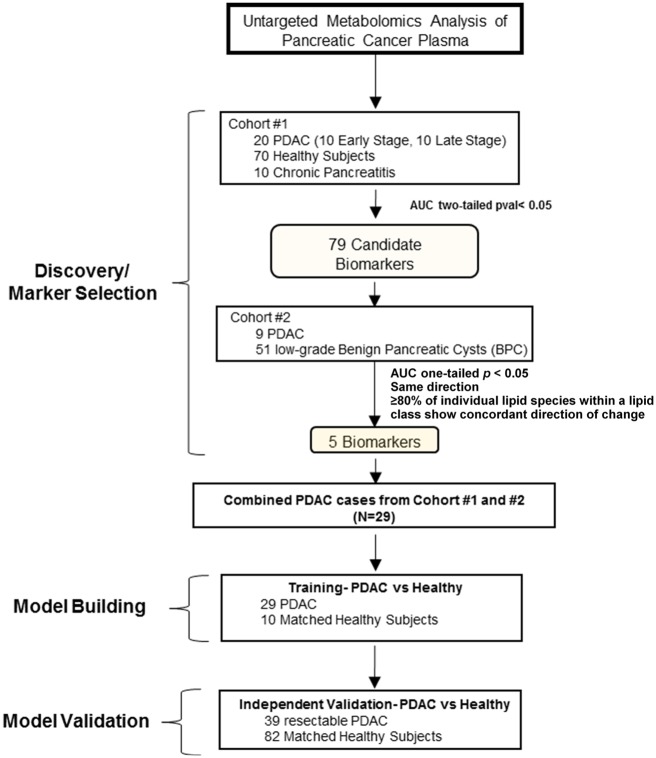
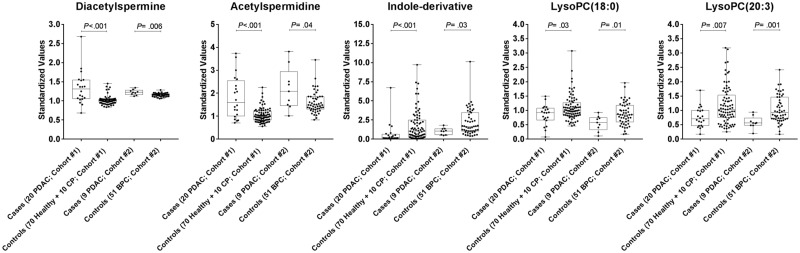
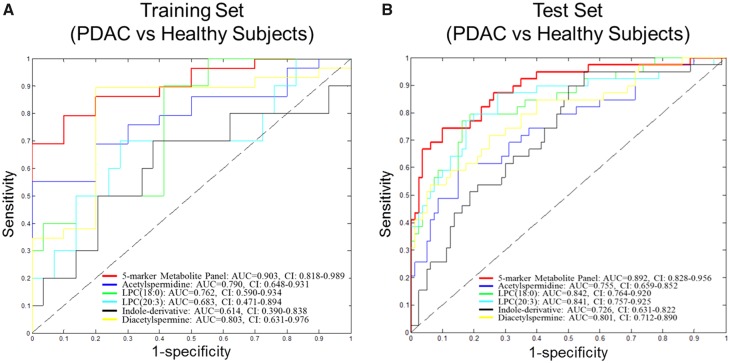
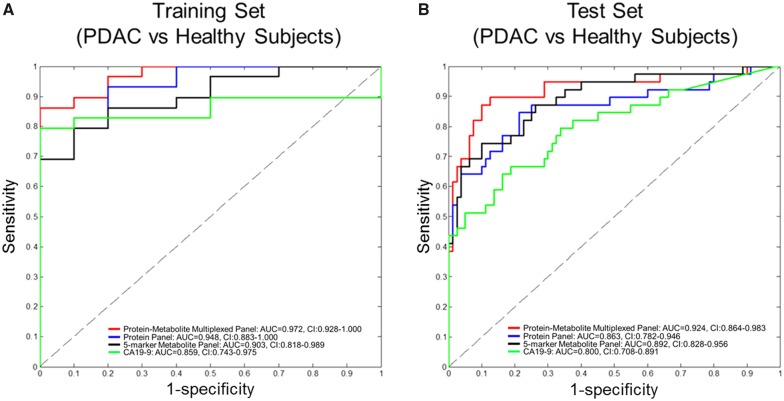
Background: We applied a training and testing approach to develop and validate a plasma metabolite panel for the detection of early-stage pancreatic ductal adenocarcinoma (PDAC) alone and in combination with a previously validated protein panel for early-stage PDAC. Methods: A comprehensive metabolomics platform was initially applied to plasmas collected from 20 PDAC cases and 80 controls. Candidate markers were filtered based on a second independent cohort that included nine invasive intraductal papillary mucinous neoplasm cases and 51 benign pancreatic cysts. Blinded validation of the resulting metabolite panel was performed in an independent test cohort consisting of 39 resectable PDAC cases and 82 matched healthy controls. The additive value of combining the metabolite panel with a previously validated protein panel was evaluated. Results: Five metabolites (acetylspermidine, diacetylspermine, an indole-derivative, and two lysophosphatidylcholines) were selected as a panel based on filtering criteria. A combination rule was developed for distinguishing between PDAC and healthy controls using the Training Set. In the blinded validation study with early-stage PDAC samples and controls, the five metabolites yielded areas under the curve (AUCs) ranging from 0.726 to 0.842, and the combined metabolite model yielded an AUC of 0.892 (95% confidence interval [CI] = 0.828 to 0.956). Performance was further statistically significantly improved by combining the metabolite panel with a previously validated protein marker panel consisting of CA 19–9, LRG1, and TIMP1 (AUC = 0.924, 95% CI = 0.864 to 0.983, comparison DeLong test one-sided P= .02). Conclusions: A metabolite panel in combination with CA19-9, TIMP1, and LRG1 exhibited substantially improved performance in the detection of early-stage PDAC compared with a protein panel alone.
Overview
The claims and statistics of this paper haven’t been checked yet.
Run the check — free, no account needed. It reads the open-access text and checks the sources it cites.
Integrity signals
Registry
Cites
Statistics
Figures
Verification
Claims the paper makes
The claims and statistics of this paper haven’t been checked yet.
Run the check — free, no account needed. It reads the open-access text and checks the sources it cites.
Claims other papers make about this one
Each is checked against this paper’s own text: does it say what the citing paper says it does?
The cited source says what the claim attributes to it.
In the citing paper
“Such biomarker “panels” often build upon CA 19-9 and demonstrate improved performance in early-stage disease compared with CA 19-9 alone.40–43”
From Artificial Intelligence and Early Detection of Pancreatic Cancer: 2020 Summative Review (2021) · cites this paper as [41]
Self-check
Percentages, sums and reported differences re-computed from the paper’s own numbers.
The self-check needs the paper’s full text.
Citations
Cites
Cytoscape: A software Environment for integrated models of biomolecular interaction networks
Shannon, P., Markiel, A., Ozier, O., Baliga, N. S., Wang, J. T., Ramage, D., Amin, N., Schwikowski, B., & Ideker, T. (2003) · Genome Research · doi:10.1101/gr.1239303 · Cited by 51,888
Siegel, R. L., Miller, K. D., & Jemal, A. (2016) · CA: A Cancer Journal for Clinicians · doi:10.3322/caac.21332 · Cited by 16,003
ONCOMINE: A Cancer Microarray Database and Integrated Data-Mining Platform
Rhodes, D. R., Yu, J., Sundaram, S. K., Deshpande, N., Varambally, R., Ghosh, D., Barrette, T. R., Pander, A., & Chinnaiyan, A. M. (2004) · Neoplasia · doi:10.1016/s1476-5586(04)80047-2 · Cited by 3,719
Detection and localization of surgically resectable cancers with a multi-analyte blood test
Cohen, J. D., Li, L., Wang, Y., Thoburn, C., Afsari, B., Danilova, L., Douville, C., Javed, A. A., Wong, F., Mattox, A., et al. (2018) · Science · doi:10.1126/science.aar3247 · Cited by 2,783
Self-citationPancreatitis and the Risk of Pancreatic Cancer
Lowenfels, A. B., Maisonneuve, P., Cavallini, G., Ammann, R., Lankisch, P. G., Andersen, J. R., DiMagno, E. P., Andrén‐Sandberg, Å., & Domellöf, L. (1993) · New England Journal of Medicine · doi:10.1056/nejm199305203282001 · Cited by 1,753
Targeting polyamine metabolism and function in cancer and other hyperproliferative diseases
Casero, R. A., & Marton, L. J. (2007) · Nature Reviews Drug Discovery · doi:10.1038/nrd2243 · Cited by 752
Mayers, J. R., Wu, C. H., Clish, C. B., Kraft, P. L., Torrence, M. E., Fiske, B. P., Yuan, C., Bao, Y., Townsend, M. K., Tworoger, S. S., et al. (2014) · Nature Medicine · doi:10.1038/nm.3686 · Cited by 672
Wang, T., Fahrmann, J., Lee, H., Li, Y.-J., Tripathi, S. C., Yue, C., Zhang, C.-Y., Lifshitz, V., Song, J., Yuan, Y., et al. (2017) · Cell Metabolism · doi:10.1016/j.cmet.2017.11.001 · Cited by 580
Self-citationBadea, L., Herlea, V., Dima, S., Dumitraşcu, T., & Popescu, I. (2008) · PubMed · Cited by 531
CA 19-9: Biochemical and Clinical Aspects
Scarà, S., Bottoni, P., & Scatena, R. (2015) · Advances in Experimental Medicine and Biology · doi:10.1007/978-94-017-7215-0_15 · Cited by 351
Cited by
Sorted by citations
Pancreatic cancer: A review of clinical diagnosis, epidemiology, treatment and outcomes
McGuigan, A. J., Kelly, P. J., Turkington, R. C., Jones, C. A., Coleman, H. G., & McCain, R. S. (2018) · World Journal of Gastroenterology · doi:10.3748/wjg.v24.i43.4846 · Cited by 1,934
Roles of CA19-9 in pancreatic cancer: Biomarker, predictor and promoter
Luo, G., Jin, K., Deng, S., Cheng, H., Fan, Z., Gong, Y., Qian, Y., Huang, Q., Ni, Q., Liu, C., et al. (2021) · Biochimica et Biophysica Acta (BBA) - Reviews on Cancer · doi:10.1016/j.bbcan.2020.188409 · Cited by 446
Yu, S., Li, Y., Liao, Z., Wang, Z., Wang, Z., Li, Y., Qian, L., Zhao, J., Zong, H., Kang, B., et al. (2020) · Gut · doi:10.1136/gutjnl-2019-318860 · Cited by 241
Lead-time trajectory of CA19-9 as an anchor marker for pancreatic cancer early detection
Fahrmann, J. F., Schmidt, C. M., Mao, X., Irajizad, E., Loftus, M., Zhang, J., Patel, N., Vykoukal, J., Dennison, J. B., Long, J. P., et al. (2021) · Gastroenterology · doi:10.1053/j.gastro.2020.11.052 · Cited by 208
Self-citationLRG1: an emerging player in disease pathogenesis
Camilli, C., Hoeh, A. E., Rossi, G. D., Moss, S. E., & Greenwood, J. (2022) · Journal of Biomedical Science · doi:10.1186/s12929-022-00790-6 · Cited by 204
Metadata
- Authors
- Fahrmann, J. F., Bantis, L. E., Capello, M., Scelo, G., Dennison, J. B., Patel, N., Murage, E., Vykoukal, J., Kundnani, D. L., Foretova, L., Fabianova, E., Holcatova, I., Janout, V., Feng, Z., Yip-Schneider, M., Zhang, J., Brand, R., Taguchi, A., Maitra, A., Brennan, P., Max Schmidt, C., & Hanash, S.
- Affiliations
- The University of Texas MD Anderson Cancer Center (US)
- International Agency for Research on Cancer (IARC), Lyon, France
- Department of Cancer Epidemiology and Genetics, Masaryk Memorial Cancer Institute, Brno, Czech Republic
- Regional Authority of Public Health in Banska Bystrica, Banska Bystrica, Slovakia
- Institute of Public Health and Preventive Medicine, 2nd Faculty of Medicine, Charles University, Prague, Czech Republic
- Faculty of Medicine, Palacky University, Olomouc, Czech Republic
- Indiana University Indianapolis (US)
- University of Pittsburgh (US)
- Centre international de recherche sur le cancer (FR)
- Department Surgery, Indiana University School of Medicine, Indianapolis, IN
- Corresponding author
- Hanash, Samir
- ORCID
- Venue
- JNCI: Journal of the National Cancer Institute
- Publisher
- Oxford University Press (OUP)
- Published
- 2018-08-18
- Volume
- 111
- Issue
- 4
- Pages
- 372-379
- ISSN
- 0027-8874 (ISSN-L)
- 1460-2105
- PMC
- PMC6449169
- OpenAlex
- W2885196877
- Cited by
- 115
- References
- 33
- Citations by year
- 2026: 8 · 2025: 12 · 2024: 10 · 2023: 15 · 2022: 16 · 2021: 24 · 2020: 15 · 2019: 14 · 2018: 1
- FWCI
- 5.07
- Type
- journal article
- Language
- en
- Open access
- hybrid
- doi.org
- Licence
- Locations
- JNCI Journal of the National Cancer Institute (publishedVersion, cc-by)
- Europe PMC (PubMed Central) (publishedVersion, cc-by)
- PubMed Central (publishedVersion, cc-by)
- PubMed (publishedVersion)
- IUScholarWorks (Indiana University) (submittedVersion)
- Funders
- National Cancer Institute Early Detection Network
- Pancreatic Cancer Action Network
- Cancer- Lustgarten Foundation (SU2C-AACR-DT25-17)
- National Institutes of Health (IR32CA209366-01, 1R21CA209366-01, 1U01CA200468, 1U01CA196403, R03 CA123546-02)
- National Cancer Institute
- Development of Research Organization of the Ministry of Health of the Czech Republic (MMCI, 00209805, 9422-3, 8090-3)
- Epidemiological Study on Pancreatic Cancer, Regional Authority of Public Health in Banska Bystrica (MZSR2007/17-RUVZBB-02)
- Topics
- Health Sciences › Medicine › Oncology › Pancreatic and Hepatic Oncology Research
- Life Sciences › Biochemistry, Genetics and Molecular Biology › Molecular Biology › Metabolomics and Mass Spectrometry Studies
- Health Sciences › Medicine › Surgery › Pancreatitis Pathology and Treatment
- Keywords
- pancreatic ductal adenocarcinoma, early-stage cancer detection, CA19-9, LRG1, TIMP-1, lysophosphatidylcholine, intraductal papillary mucinous neoplasm, benign pancreatic cysts
- MeSH terms
- Adenocarcinoma, Mucinous, Carcinoma, Papillary, Follow-Up Studies, Humans, Neoplasm Invasiveness, Neoplasm Staging, Pancreatic Neoplasms, Biomarkers, Tumor, Case-Control Studies, Carcinoma, Pancreatic Ductal, Metabolome, Transcriptome
About these checks
Registry, retraction, Cites and statistics results are computed, not judged, with one exception: a printed reference that no index lists is read once by a model before it counts as a citation error. Claims are extracted by a model and kept only when their quote appears verbatim in the text; each cited source is then checked, with a model’s help, for whether it says what the claim relies on. Those verdicts can be wrong — read the claim’s quote and the cited source before relying on one.
Statistics and arithmetic are recomputed, not judged.
Confidence bands are shown only for fields calibrated on our annotated test set. None is calibrated yet, so no band is shown.
What counts as a claim ›How we measure confidence ›How we check this ›
Are you an author, or do you see a problem with this page? Request a review
