

Integrating Probability and Nonprobability Samples for Survey Inference
Open accessThe DOI matches its Crossref record; 38 of the 40 references it cites were found in a registry or an index.
Abstract
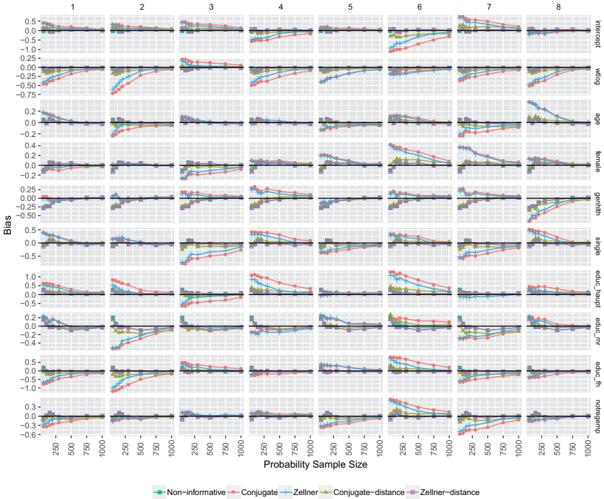
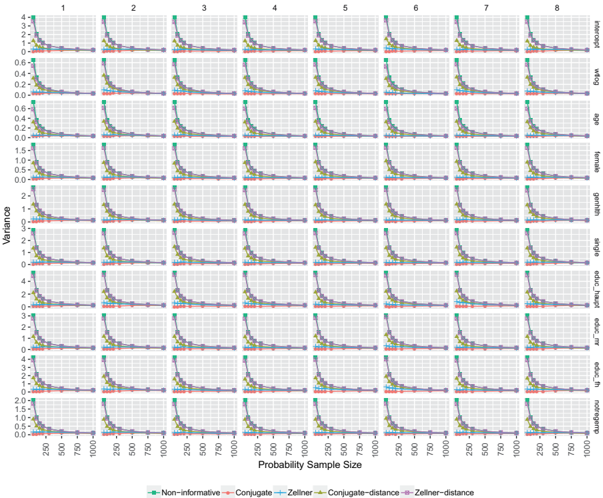
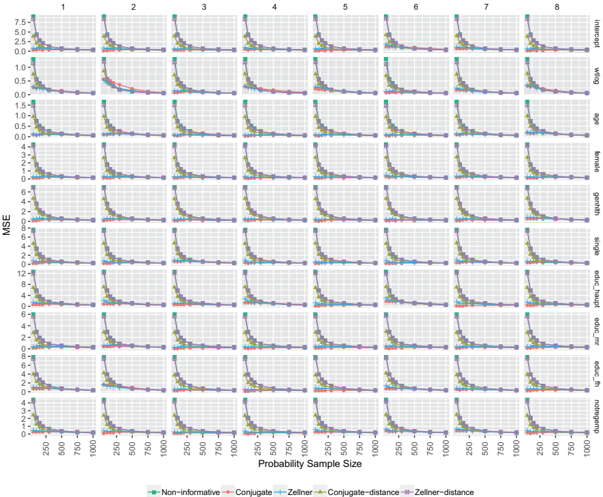
Survey data collection costs have risen to a point where many survey researchers and polling companies are abandoning large, expensive probability-based samples in favor of less expensive nonprobability samples. The empirical literature suggests this strategy may be suboptimal for multiple reasons, among them that probability samples tend to outperform nonprobability samples on accuracy when assessed against population benchmarks. However, nonprobability samples are often preferred due to convenience and costs. Instead of forgoing probability sampling entirely, we propose a method of combining both probability and nonprobability samples in a way that exploits their strengths to overcome their weaknesses within a Bayesian inferential framework. By using simulated data, we evaluate supplementing inferences based on small probability samples with prior distributions derived from nonprobability data. We demonstrate that informative priors based on nonprobability data can lead to reductions in variances and mean squared errors for linear model coefficients. The method is also illustrated with actual probability and nonprobability survey data. A discussion of these findings, their implications for survey practice, and possible research extensions are provided in conclusion.
Overview
The claims and statistics of this paper haven’t been checked yet.
Free: it reads the open-access text and checks the first 5 claims that cite a source we can check. Create a free account to check every claim.
Integrity signals
Registry
Cites
Statistics
Figures
Verification
Claims the paper makes
The claims and statistics of this paper haven’t been checked yet.
Free: it reads the open-access text and checks the first 5 claims that cite a source we can check. Create a free account to check every claim.
Claims other papers make about this one
Each is checked against this paper’s own text: does it say what the citing paper says it does?
The cited source says what the claim attributes to it.
In the citing paper
“Other promising approaches include integrating surveys of varying quality 53,54 , and leveraging the estimated ddc in one outcome to correct bias in others under several scenarios”
From Unrepresentative big surveys significantly overestimated US vaccine uptake (2021) · cites this paper as [53]
Self-check
Percentages, sums and reported differences re-computed from the paper’s own numbers.
The self-check needs the paper’s full text.
Citations
Cites
Ridge regression: Biased estimation for nonorthogonal problems
Hoerl, A. E., & Kennard, R. W. (1970) · Technometrics · doi:10.1080/00401706.1970.10488634 · Cited by 9,648
An Introduction to Multivariate Statistical Analysis
Muirhead, R. J., & Anderson, T. W. (1986) · Journal of Business & Economic Statistics · doi:10.2307/1391399 · Cited by 9,082
An Introduction to Multivariate Statistical Analysis.
Skinner, C. J., & Anderson, T. W. (1985) · Journal of the Royal Statistical Society. Series A (General) · doi:10.2307/2981950 · Cited by 3,245
AN ESSAY TOWARDS SOLVING A PROBLEM IN THE DOCTRINE OF CHANCES
BAYES (1958) · Biometrika · doi:10.1093/biomet/45.3-4.296 · Cited by 2,911
An invariant form for the prior probability in estimation problems
Jeffreys, H. (1946) · Proceedings of the Royal Society of London. Series A. Mathematical and Physical Sciences · doi:10.1098/rspa.1946.0056 · Cited by 2,323 · cited 2×
“The conjugate prior for pðsÞ is a gamma distribution with shape parameter a and rate b: pðsÞ / s (1)e : (3) For a 1⁄4 b 1⁄4 0, this distribution reduces to Jeffrey’s noninformative invariant prior (Jeffreys 1946; Zellner 1971), which can be interpreted as an improper uniform distribution for log r.”
BackgroundRao, J. N. K. (2004) · Encyclopedia of Statistical Sciences · doi:10.1002/0471667196.ess0731 · Cited by 2,049
An Introduction to Bayesian Inference in Econometrics.
Sargan, J. D., & Zellner, A. (1974) · Journal of the Royal Statistical Society. Series A (General) · doi:10.2307/2344559 · Cited by 1,914 · cited 2×
“The conjugate prior for pðsÞ is a gamma distribution with shape parameter a and rate b: pðsÞ / s (1)e : (3) For a 1⁄4 b 1⁄4 0, this distribution reduces to Jeffrey’s noninformative invariant prior (Jeffreys 1946; Zellner 1971), which can be interpreted as an improper uniform distribution for log r.”
BackgroundAn Introduction to Bayesian Inference in Econometrics.
Aigner, D., & Zellner, A. (1972) · Journal of the American Statistical Association · doi:10.2307/2284674 · Cited by 1,653
A Reference Bayesian Test for Nested Hypotheses and its Relationship to the Schwarz Criterion
Kass, R. E., & Wasserman, L. (1995) · Journal of the American Statistical Association · doi:10.1080/01621459.1995.10476592 · Cited by 1,253
Mixtures of g Priors for Bayesian Variable Selection
Liang, F., Paulo, R., Molina, G., Clyde, M. A., & Berger, J. O. (2008) · Journal of the American Statistical Association · doi:10.1198/016214507000001337 · Cited by 1,089
Research works printed but not linked: 7
- AAPOR (2016), Standard Definitions: Final Dispositions of Case Codes and Outcome Rates for Surveys (9th ed.), Lenexa: American Association for Public Opinion Research.
- Blom, A. G., D. Ackermann-Piek, S. C. Helmschrott, C. Cornesse, and J. W. Sakshaug (2017), "The Representativeness of Online Panels: Coverage, Sampling and Weighting," paper pre- sented at the General Online Research Conference, Berlin, Germany.
- DiSogra, C., C. Cobb, E. Chan, and J. Dennis (2012), "Using probability-based online samples to calibrate non-probability opt-in samples," paper presented at the 67th Annual Conference of the American Association for Public Opinion Research (AAPOR).
- Fahimi, M., F. M. Barlas, W. Gross, and R. K. Thomas (2014), "Towards a New Math for Nonprobability Sampling Alternatives," paper presented at the 69th Annual Conference of the American Association for Public Opinion Research (AAPOR), Annaheim, CA.
- Rivers, D., and D. Bailey (2009), "Inference from Matched Samples in the 2008 US National Elections," in JSM Proceedings, Survey Research Methods Section, p. 627-639, Alexandria, VA: American Statistical Association.
- Rubin, D. B. (1985), The Use of Propensity Scores in Applied Bayesian Inference, Bayesian Statistics, 2, 463-472.
- Skinner, C. (1994), "Sample Models and Weights," Proceedings of the Section on Survey Research Methods, American Statistical Association, p. 133142.
Cited by
Menentukan Populasi dan Sampel: Pendekatan Metodologi Penelitian Kuantitatif dan Kualitatif
Subhaktiyasa, P. G. (2024) · Jurnal Ilmiah Profesi Pendidikan · doi:10.29303/jipp.v9i4.2657 · Cited by 1,492
“Kombinasi antara teknik probabilitas dan non-probabilitas dalam beberapa peneltian dapat digunakan untuk mengoptimalkan pengumpulan data (Wiśniowski et al., 2020; Yang & Kim, 2020).”
Unrepresentative big surveys significantly overestimated US vaccine uptake
Bradley, V. C., Kuriwaki, S., Isakov, M., Sejdinovic, D., Meng, X.-L., & Flaxman, S. (2021) · Nature · doi:10.1038/s41586-021-04198-4 · Cited by 248
The impact of eWOM information in social media on the online purchase intention of Generation Z
Ngo, T. T. A., Vuong, B. L., Le, M. D., Nguyen, T. T., Tran, M. M., & Nguyen, Q. K. (2024) · Cogent Business & Management · doi:10.1080/23311975.2024.2316933 · Cited by 194
“…(acharya et al., 2013). this sampling technique is particularly suitable when obtaining a complete population list is unfeasible, as high-lighted by Wiśniowski et al. (2020). the decision to employ convenience sampling allowed the researchers to select participants based on accessibility and…”
Survey sampling design in wave 1 of the Global Flourishing Study
Padgett, R. N., Cowden, R. G., Chattopadhyay, M., Han, Y., Honohan, J., Ritter, Z., Srinivasan, R., Johnson, B. R., & VanderWeele, T. J. (2025) · European Journal of Epidemiology · doi:10.1007/s10654-024-01167-9 · Cited by 142
“Combining probability and non-probability samples increases population coverage [16, 27], and some evidence exists that such hybrid complex sampling designs reduce sampling variability [28, 29].”
Kessler, R. C., Ruhm, C. J., Puac‐Polanco, V., Hwang, I. H., Lee, S., Petukhova, M. V., Sampson, N. A., Ziobrowski, H. N., Zaslavsky, A. M., & Zubizarreta, J. R. (2022) · JAMA Network Open · doi:10.1001/jamanetworkopen.2022.17223 · Cited by 83
Metadata
- Authors
- Wiśniowski, A., Sakshaug, J. W., Perez Ruiz, D. A., & Blom, A. G.
- Affiliations
- University of Manchester (GB)
- University of Mannheim (DE)
- Department of Mathematics, University of Manchester, Alan Turing Building, Oxford Road, Manchester M13 9PL, UK
- Corresponding author
- Wiśniowski, Arkadiusz
- Venue
- Journal of Survey Statistics and Methodology
- Publisher
- Oxford University Press (OUP)
- Published
- 2020-01-27
- Volume
- 8
- Issue
- 1
- Pages
- 120-147
- ISSN
- 2325-0984 (ISSN-L)
- 2325-0992
- OpenAlex
- W2995265274
- Cited by
- 102
- References
- 40
- Citations by year
- 2026: 17 · 2025: 23 · 2024: 16 · 2023: 20 · 2022: 18 · 2021: 5 · 2020: 3
- FWCI
- 5.07
- Type
- journal article
- Language
- en
- Open access
- hybrid
- doi.org
- Licence
- Locations
- Journal of Survey Statistics and Methodology (publishedVersion, cc-by)
- MADOC (University of Mannheim) (acceptedVersion, cc-by)
- Research Explorer (The University of Manchester) (submittedVersion, other-oa)
- Funders
- British Academy / Leverhulme Small Research (SG171279)
- German Institute for Employment Research
- German Research Foundation (SFB884-Z1, SFB884-A8)
- Topics
- Physical Sciences › Mathematics › Statistics and Probability › Survey Sampling and Estimation Techniques
- Social Sciences › Sociology and Political Science › Survey Methodology and Nonresponse
- Physical Sciences › Mathematics › Statistics and Probability › Statistical Methods and Bayesian Inference
- Keywords
- Bayesian inference, informative priors, survey cost reduction, variance reduction, mean squared error, survey inference
About these checks
Registry, retraction, Cites and statistics results are computed, not judged, with one exception: a printed reference that no index lists is read once by a model before it counts as a citation error. Claims are extracted by a model and kept only when their quote appears verbatim in the text; each cited source is then checked, with a model’s help, for whether it says what the claim relies on. Those verdicts can be wrong — read the claim’s quote and the cited source before relying on one.
Statistics and arithmetic are recomputed, not judged.
Confidence bands are shown only for fields calibrated on our annotated test set. None is calibrated yet, so no band is shown.
What counts as a claim ›How we measure confidence ›How we check this ›
Are you an author, or do you see a problem with this page? Request a review
Data sources
Bibliographic data: Semantic Scholar, OpenAlex, Crossref.
Contains information from the Semantic Scholar Academic Graph Datasets, made available under the ODC Attribution License (ODC-BY 1.0).
Semantic Scholar’s data is described in: Kinney, R., et al. (2023). The Semantic Scholar Open Data Platform. arXiv:2301.10140.
