

The DOI matches its Crossref record; 73 of the 73 references it cites were found in a registry or an index.
Domain Expansion and Functional Diversification in Vertebrate Reproductive Proteins
Open accessPublished version of a preprint
Abstract
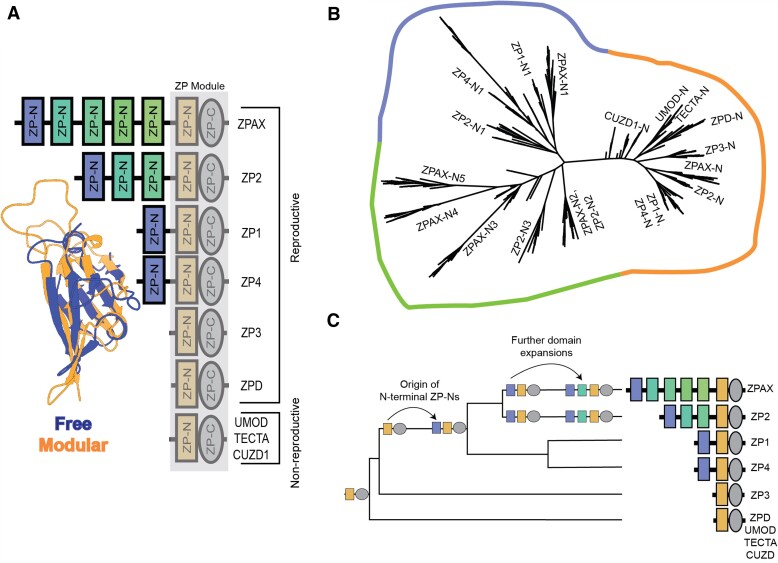
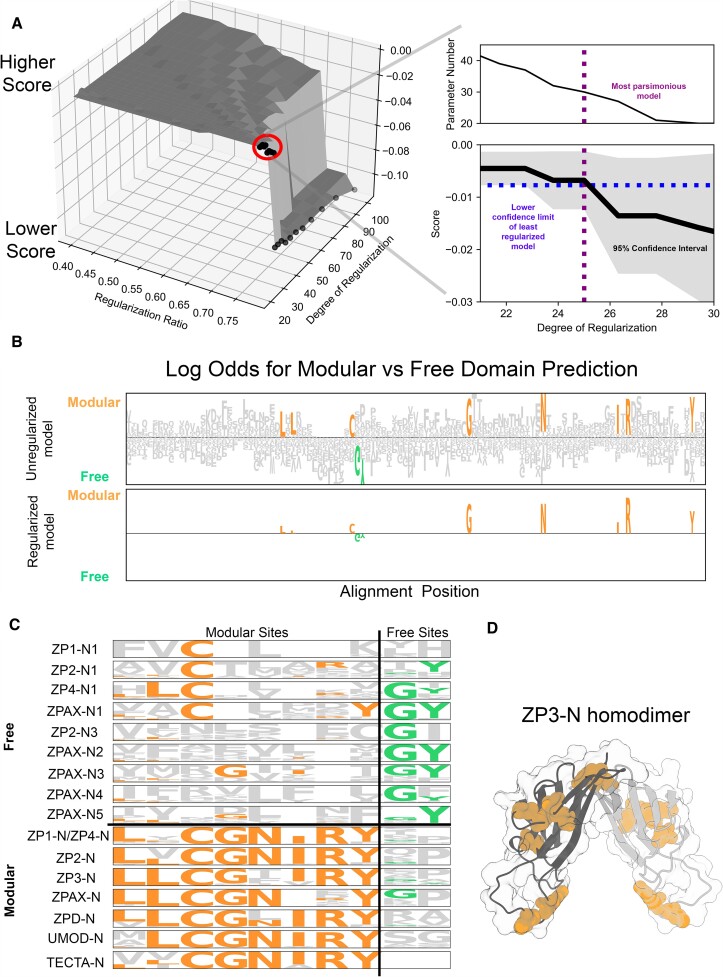
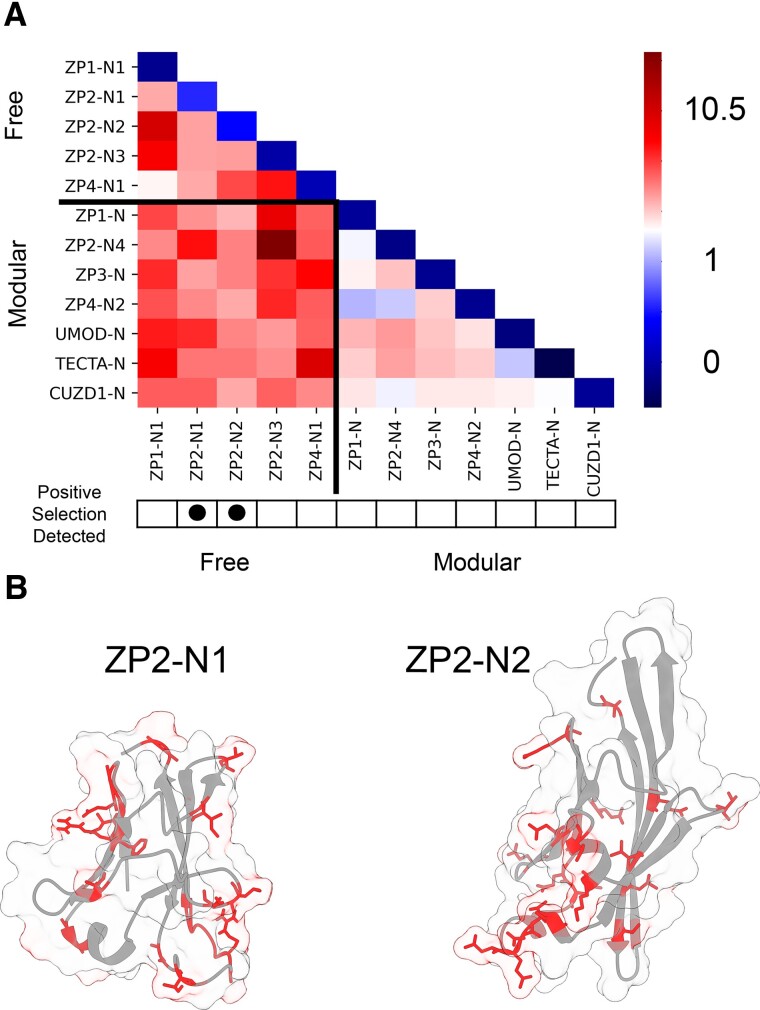
The rapid evolution of fertilization proteins has generated remarkable diversity in molecular structure and function. Glycoproteins of vertebrate egg coats contain multiple zona pellucida (ZP)-N domains (1–6 copies) that facilitate multiple reproductive functions, including species-specific sperm recognition. In this report, we integrate phylogenetics and machine learning to investigate how ZP-N domains diversify in structure and function. The most C-terminal ZP-N domain of each paralog is associated with another domain type (ZP-C), which together form a “ZP module.” All modular ZP-N domains are phylogenetically distinct from nonmodular or free ZP-N domains. Machine learning–based classification identifies eight residues that form a stabilizing network in modular ZP-N domains that is absent in free domains. Positive selection is identified in some free ZP-N domains. Our findings support that strong purifying selection has conserved an essential structural core in modular ZP-N domains, with the relaxation of this structural constraint allowing free N-terminal domains to functionally diversify.
Overview
The claims and statistics of this paper haven’t been checked yet.
Run the check — free, no account needed. It reads the open-access text and checks the sources it cites.
Integrity signals
Registry
Cites
Statistics
Figures
Verification
Claims the paper makes
The claims and statistics of this paper haven’t been checked yet.
Run the check — free, no account needed. It reads the open-access text and checks the sources it cites.
Self-check
Percentages, sums and reported differences re-computed from the paper’s own numbers.
The self-check needs the paper’s full text.
Citations
Cites
Controlling the False Discovery Rate: A Practical and Powerful Approach to Multiple Testing
Benjamini, Y., & Hochberg, Y. (1995) · Journal of the Royal Statistical Society Series B: Statistical Methodology · doi:10.1111/j.2517-6161.1995.tb02031.x · Cited by 109,482
Gapped BLAST and PSI-BLAST: a new generation of protein database search programs
Altschul, S. (1997) · Nucleic Acids Research · doi:10.1093/nar/25.17.3389 · Cited by 73,302
Scikit-learn: Machine Learning in Python
Pedregosa, F., Varoquaux, G., Gramfort, A., Michel, V., Thirion, B., Grisel, O., Blondel, M., Müller, A., Nothman, J., Louppe, G., et al. (2012) · arXiv · doi:10.48550/arxiv.1201.0490 · Cited by 71,016
MAFFT Multiple Sequence Alignment Software Version 7: Improvements in Performance and Usability
Katoh, K., & Standley, D. M. (2013) · Molecular Biology and Evolution · doi:10.1093/molbev/mst010 · Cited by 46,209
UCSF Chimera—A visualization system for exploratory research and analysis
Pettersen, E. F., Goddard, T. D., Huang, C. C., Couch, G. S., Greenblatt, D. M., Meng, E. C., & Ferrin, T. E. (2004) · Journal of Computational Chemistry · doi:10.1002/jcc.20084 · Cited by 45,828
MEGA7: Molecular Evolutionary Genetics Analysis Version 7.0 for Bigger Datasets
Kumar, S., Stecher, G., & Tamura, K. (2016) · Molecular Biology and Evolution · doi:10.1093/molbev/msw054 · Cited by 44,059
Highly accurate protein structure prediction with AlphaFold
Jumper, J., Evans, R., Pritzel, A., Green, T., Figurnov, M., Ronneberger, O., Tunyasuvunakool, K., Bates, R., Žídek, A., Potapenko, A., et al. (2021) · Nature · doi:10.1038/s41586-021-03819-2 · Cited by 43,764
MEGA X: Molecular Evolutionary Genetics Analysis across Computing Platforms
Kumar, S., Stecher, G., Li, M., Knyaz, C., & Tamura, K. (2018) · Molecular Biology and Evolution · doi:10.1093/molbev/msy096 · Cited by 37,529
The Elements of Statistical Learning
Hastie, T., Tibshirani, R., & Friedman, J. (2009) · Springer Series in Statistics · doi:10.1007/978-0-387-84858-7 · Cited by 25,970
Regularization and Variable Selection Via the Elastic Net
Zou, H., & Hastie, T. (2005) · Journal of the Royal Statistical Society Series B: Statistical Methodology · doi:10.1111/j.1467-9868.2005.00503.x · Cited by 20,957
Research works printed but not linked: 4
- Killingbeck, 2018, Current topics in developmental biology, 443
- Schrödinger, 2015, The PyMOL Molecular Graphics System, Version 1.8
- Wassarman, 2016, Current topics in developmental biology, 539
- Wong, 2005, Current topics in developmental biology, 1
Metadata
- Authors
- Rivera, A. M., Wilburn, D. B., & Swanson, W. J.
- Affiliations
- University of Washington (US)
- Corresponding author
- Rivera, Alberto M.
- Venue
- Molecular Biology and Evolution
- Publisher
- Oxford University Press (OUP)
- Published
- 2022-05-01
- Volume
- 39
- Issue
- 5
- ISSN
- 0737-4038 (ISSN-L)
- 1537-1719
- PMC
- PMC9154058
- OpenAlex
- W4280640654
- Cited by
- 6
- References
- 73
- Citations by year
- 2026: 2 · 2025: 3 · 2023: 1
- FWCI
- 0.88
- Type
- journal article
- Language
- en
- Open access
- gold
- doi.org
- Licence
- Locations
- Molecular Biology and Evolution (publishedVersion, cc-by)
- bioRxiv (Cold Spring Harbor Laboratory) (acceptedVersion, cc-by-nc-nd)
- PubMed Central (publishedVersion, cc-by)
- PubMed (publishedVersion)
- Funders
- National Institutes of Health
- Eunice Kennedy Shriver National Institute of Child Health and Human Development (R21HD105025, K99HD090201)
- Topics
- Health Sciences › Medicine › Reproductive Medicine › Reproductive Biology and Fertility
- Life Sciences › Biochemistry, Genetics and Molecular Biology › Physiology › Reproductive biology and impacts on aquatic species
- Life Sciences › Biochemistry, Genetics and Molecular Biology › Genetics › Evolution and Genetic Dynamics
- Keywords
- zona pellucida, domain evolution, functional diversification, positive selection, purifying selection, vertebrate reproduction, protein structure evolution
- MeSH terms
- Zona Pellucida Glycoproteins, Amino Acid Sequence, Animals, Egg Proteins, Vertebrates, Zona Pellucida
About these checks
Registry, retraction, Cites and statistics results are computed, not judged, with one exception: a printed reference that no index lists is read once by a model before it counts as a citation error. Claims are extracted by a model and kept only when their quote appears verbatim in the text; each cited source is then checked, with a model’s help, for whether it says what the claim relies on. Those verdicts can be wrong — read the claim’s quote and the cited source before relying on one.
Statistics and arithmetic are recomputed, not judged.
Confidence bands are shown only for fields calibrated on our annotated test set. None is calibrated yet, so no band is shown.
What counts as a claim ›How we measure confidence ›How we check this ›
Are you an author, or do you see a problem with this page? Request a review
How to cite
Cite CoChat for the checks on this page, and the paper for its own findings.
- This page
- CoChat. (2026). Citation check: Domain Expansion and Functional Diversification in Vertebrate Reproductive Proteins. https://app.cochat.ai/papers/10.1093/molbev/msac105
- The paper
- Rivera, A. M., Wilburn, D. B., & Swanson, W. J. (2022). Domain Expansion and Functional Diversification in Vertebrate Reproductive Proteins. Molecular Biology and Evolution. https://doi.org/10.1093/molbev/msac105
Data sources
Bibliographic data: Semantic Scholar, OpenAlex, Crossref.
Contains information from the Semantic Scholar Academic Graph Datasets, made available under the ODC Attribution License (ODC-BY 1.0).
Semantic Scholar’s data is described in: Kinney, R., et al. (2023). The Semantic Scholar Open Data Platform. arXiv:2301.10140.
