

The DOI matches its Crossref record; 55 of the 55 references it cites were found in a registry or an index.
The Ancestral Shape of the Access Proton Path of Mitochondrial ATP Synthases Revealed by a Split Subunit-a
Open accessPublished version of a preprint
Abstract
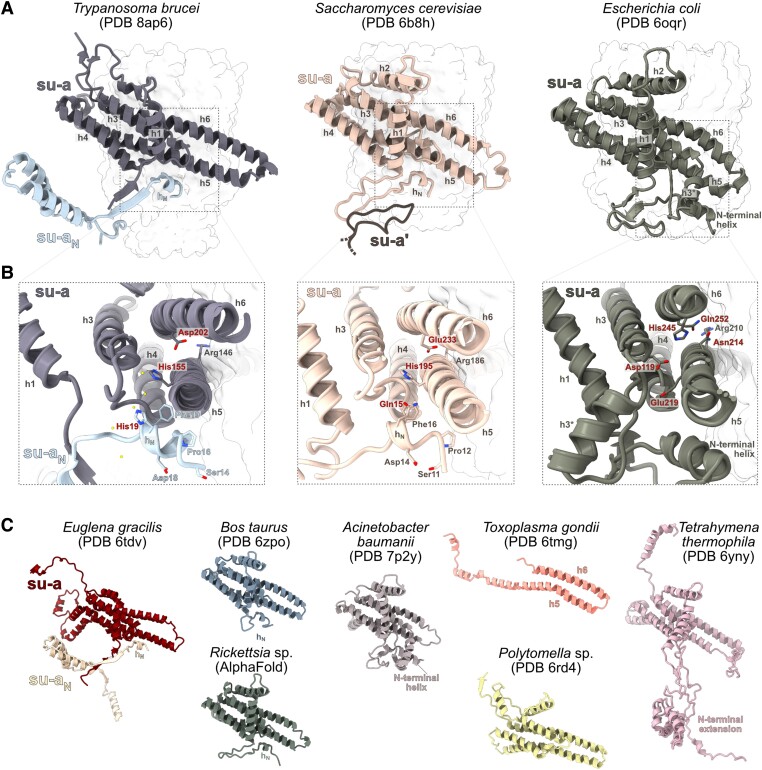
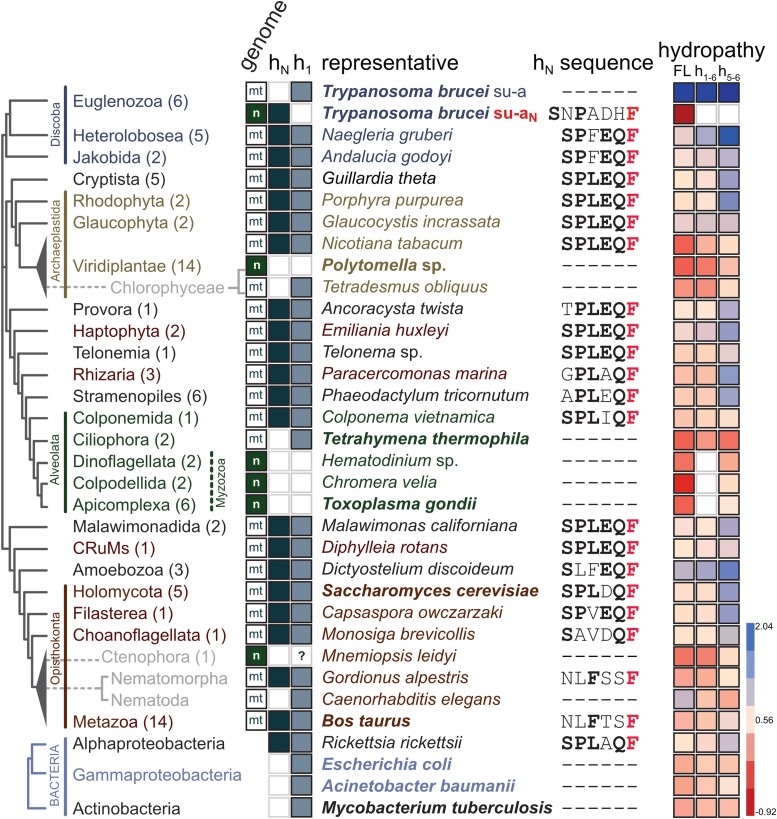
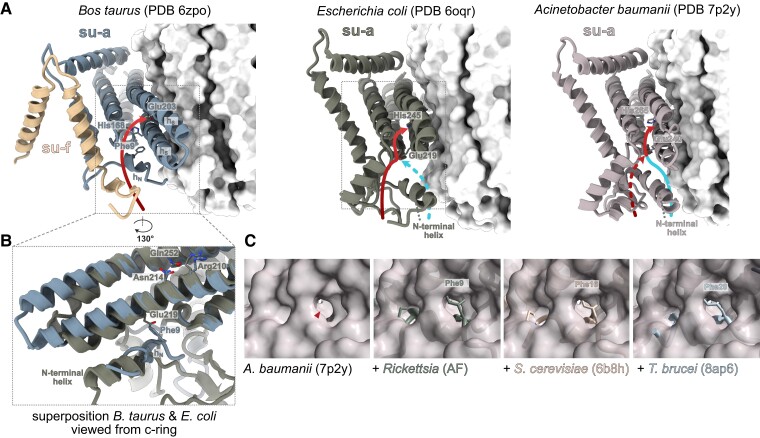
The passage of protons across membranes through F1Fo-ATP synthases spins their rotors and drives the synthesis of ATP. While the principle of torque generation by proton transfer is known, the mechanisms and routes of proton access and release and their evolution are not fully understood. Here, we show that the entry site and path of protons in the lumenal half channel of mitochondrial ATP synthases are largely defined by a short N-terminal α-helix of subunit-a. In Trypanosoma brucei and other Euglenozoa, the α-helix is part of another polypeptide chain that is a product of subunit-a gene fragmentation. This α-helix and other elements forming the proton pathway are widely conserved across eukaryotes and in Alphaproteobacteria, the closest extant relatives of mitochondria, but not in other bacteria. The α-helix blocks one of two proton routes found in Escherichia coli, resulting in a single proton entry site in mitochondrial and alphaproteobacterial ATP synthases. Thus, the shape of the access half channel predates eukaryotes and originated in the lineage from which mitochondria evolved by endosymbiosis.
Overview
The claims and statistics of this paper haven’t been checked yet.
Run the check — free, no account needed. It reads the open-access text and checks the sources it cites.
Integrity signals
Registry
Cites
Statistics
Figures
Verification
Claims the paper makes
The claims and statistics of this paper haven’t been checked yet.
Run the check — free, no account needed. It reads the open-access text and checks the sources it cites.
Self-check
Percentages, sums and reported differences re-computed from the paper’s own numbers.
The self-check needs the paper’s full text.
Citations
Cites
MUSCLE: multiple sequence alignment with high accuracy and high throughput
Edgar, R. C. (2004) · Nucleic Acids Research · doi:10.1093/nar/gkh340 · Cited by 44,662
Highly accurate protein structure prediction with AlphaFold
Jumper, J., Evans, R., Pritzel, A., Green, T., Figurnov, M., Ronneberger, O., Tunyasuvunakool, K., Bates, R., Žídek, A., Potapenko, A., et al. (2021) · Nature · doi:10.1038/s41586-021-03819-2 · Cited by 43,764
A simple method for displaying the hydropathic character of a protein
Kyte, J., & Doolittle, R. F. (1982) · Journal of Molecular Biology · doi:10.1016/0022-2836(82)90515-0 · Cited by 22,843
UCSF ChimeraX: Meeting modern challenges in visualization and analysis
Goddard, T. D., Huang, C. C., Meng, E. C., Pettersen, E. F., Couch, G. S., Morris, J. H., & Ferrin, T. E. (2018) · Protein Science · doi:10.1002/pro.3235 · Cited by 5,267
Potter, S. C., Luciani, A., Eddy, S. R., Park, Y., Lopez, R., & Finn, R. D. (2018) · Nucleic Acids Research · doi:10.1093/nar/gky448 · Cited by 2,607
The HMMTOP transmembrane topology prediction server
Tusnády, G. E., & Simon, I. (2001) · Bioinformatics · doi:10.1093/bioinformatics/17.9.849 · Cited by 1,907
Burki, F., Roger, A. J., Brown, M. W., & Simpson, A. G. B. (2020) · Trends in Ecology & Evolution · doi:10.1016/j.tree.2019.08.008 · Cited by 913
Jones, D. T., Taylor, W. R., & Thornton, J. M. (1994) · Biochemistry · doi:10.1021/bi00176a037 · Cited by 778
Structure and Mechanisms of F-Type ATP Synthases
Kühlbrandt, W. (2019) · Annual Review of Biochemistry · doi:10.1146/annurev-biochem-013118-110903 · Cited by 444
Atomic model for the dimeric F O region of mitochondrial ATP synthase
Guo, H., Bueler, S. A., & Rubinstein, J. L. (2017) · Science · doi:10.1126/science.aao4815 · Cited by 225
Metadata
- Authors
- Wong, J. E., Zíková, A., & Gahura, O.
- Affiliations
- Czech Academy of Sciences (CZ)
- Institute of Parasitology, Biology Centre, Czech Academy of Sciences , České Budějovice , Czech Republic
- Corresponding author
- Gahura, Ondřej
- ORCID
- Gahura, Ondřej
- Venue
- Molecular Biology and Evolution
- Publisher
- Oxford University Press (OUP)
- Published
- 2023-06-01
- Volume
- 40
- Issue
- 6
- ISSN
- 0737-4038 (ISSN-L)
- 1537-1719
- PMC
- PMC10306403
- OpenAlex
- W4381309015
- Cited by
- 3
- References
- 55
- Citations by year
- 2026: 1 · 2025: 1 · 2023: 1
- FWCI
- 0.27
- Type
- journal article
- Language
- en
- Open access
- gold
- doi.org
- Licence
- Locations
- Molecular Biology and Evolution (publishedVersion, cc-by-nc)
- bioRxiv (Cold Spring Harbor Laboratory) (acceptedVersion, cc-by-nc-nd)
- PubMed Central (publishedVersion, cc-by-nc)
- PubMed (publishedVersion)
- Funders
- European Commission (CZ.02.1.01, HORIZON2020)
- Ministerstvo Školství, Mládeže a Tělovýchovy (CZ.02.1.01/0.0/0.0/16_019, 0000759, 16_019/0000759, CZ.02.1.01, CZ.02.1.01/0.0/0.0/16 019/0000759)
- Grantová Agentura České Republiky (CZ.02.1.01/0.0, GJ20-04150Y, CZ.02.1.01/0.0/0.0/ 16_019/0000759, CZ.02.1.01)
- European Regional Development Fund (02.1.01/0.0/0.0, CZ.02, CZ.02.1.01/0.0/0.0/16_019/0000759, CZ.02.1.01, CZ.02.1.01/0.0/0.0, 16_019/0000759, 02.1.01/0.0/0.0/16_019/0000759, /16_019)
- HORIZON EUROPE European Research Council (101044951)
- Topics
- Life Sciences › Biochemistry, Genetics and Molecular Biology › Molecular Biology › ATP Synthase and ATPases Research
- Life Sciences › Biochemistry, Genetics and Molecular Biology › Structural Biology › Enzyme Structure and Function
- Life Sciences › Biochemistry, Genetics and Molecular Biology › Molecular Biology › Mitochondrial Function and Pathology
- Keywords
- F1FO-ATP synthase, mitochondrial ATP synthase, subunit a, N-terminal alpha-helix, gene fragmentation, Trypanosoma brucei, Euglenozoa, Alphaproteobacteria, endosymbiotic origin of mitochondria, Escherichia coli
- MeSH terms
- Adenosine Triphosphate, Escherichia coli, Proton-Translocating ATPases, Protons, Mitochondrial Proton-Translocating ATPases, Eukaryota
About these checks
Registry, retraction, Cites and statistics results are computed, not judged, with one exception: a printed reference that no index lists is read once by a model before it counts as a citation error. Claims are extracted by a model and kept only when their quote appears verbatim in the text; each cited source is then checked, with a model’s help, for whether it says what the claim relies on. Those verdicts can be wrong — read the claim’s quote and the cited source before relying on one.
Statistics and arithmetic are recomputed, not judged.
Confidence bands are shown only for fields calibrated on our annotated test set. None is calibrated yet, so no band is shown.
What counts as a claim ›How we measure confidence ›How we check this ›
Are you an author, or do you see a problem with this page? Request a review
How to cite
Cite CoChat for the checks on this page, and the paper for its own findings.
- This page
- CoChat. (2026). Citation check: The Ancestral Shape of the Access Proton Path of Mitochondrial ATP Synthases Revealed by a Split Subunit-a. https://app.cochat.ai/papers/10.1093/molbev/msad146
- The paper
- Wong, J. E., Zíková, A., & Gahura, O. (2023). The Ancestral Shape of the Access Proton Path of Mitochondrial ATP Synthases Revealed by a Split Subunit-a. Molecular Biology and Evolution. https://doi.org/10.1093/molbev/msad146
Data sources
Bibliographic data: Semantic Scholar, OpenAlex, Crossref.
Contains information from the Semantic Scholar Academic Graph Datasets, made available under the ODC Attribution License (ODC-BY 1.0).
Semantic Scholar’s data is described in: Kinney, R., et al. (2023). The Semantic Scholar Open Data Platform. arXiv:2301.10140.
