

Genome Analysis of Elysia chlorotica Egg DNA Provides No Evidence for Horizontal Gene Transfer into the Germ Line of This Kleptoplastic Mollusc
Open accessThe DOI matches its Crossref record; 40 of the 40 references it cites were found in a registry or an index.
Abstract
The sea slug Elysia chlorotica offers a unique opportunity to study the evolution of a novel function (photosynthesis) in a complex multicellular host. Elysia chlorotica harvests plastids (absent of nuclei) from its heterokont algal prey, Vaucheria litorea. The "stolen" plastids are maintained for several months in cells of the digestive tract and are essential for animal development. The basis of long-term maintenance of photosynthesis in this sea slug was thought to be explained by extensive horizontal gene transfer (HGT) from the nucleus of the alga to the animal nucleus, followed by expression of algal genes in the gut to provide essential plastid-destined proteins. Early studies of target genes and proteins supported the HGT hypothesis, but more recent genome-wide data provide conflicting results. Here, we generated significant genome data from the E. chlorotica germ line (egg DNA) and from V. litorea to test the HGT hypothesis. Our comprehensive analyses fail to provide evidence for alga-derived HGT into the germ line of the sea slug. Polymerase chain reaction analyses of genomic DNA and cDNA from different individual E. chlorotica suggest, however, that algal nuclear genes (or gene fragments) are present in the adult slug. We suggest that these nucleic acids may derive from and/or reside in extrachromosomal DNAs that are made available to the animal through contact with the alga. These data resolve a long-standing issue and suggest that HGT is not the primary reason underlying long-term maintenance of photosynthesis in E. chlorotica. Therefore, sea slug photosynthesis is sustained in as yet unexplained ways that do not appear to endanger the animal germ line through the introduction of dozens of foreign genes.
Overview
The claims and statistics of this paper haven’t been checked yet.
Free: it reads the open-access text and checks the first 5 claims that cite a source we can check. Create a free account to check every claim.
Integrity signals
Registry
Cites
Statistics
Figures
Verification
Claims the paper makes
The claims and statistics of this paper haven’t been checked yet.
Free: it reads the open-access text and checks the first 5 claims that cite a source we can check. Create a free account to check every claim.
Claims other papers make about this one
Each is checked against this paper’s own text: does it say what the citing paper says it does?
The cited source says what the claim attributes to it.
In the citing paper
“Transcriptome and genome sequencing have failed to provide evidence of gene transfer from algae to the sacoglossan sea slug nuclear genome, despite suggestions that this had occurred (see Bhattacharya et al. 2013; Rauch et al. 2015 and references therein).”
From Genomic Insights into Plastid Evolution (2020) · cites this paper as Bhattacharya et al. 2013
Self-check
Percentages, sums and reported differences re-computed from the paper’s own numbers.
The self-check needs the paper’s full text.
Citations
Cites
Basic local alignment search tool
Altschul, S. F., Gish, W., Miller, W., Myers, E. W., & Lipman, D. J. (1990) · Journal of Molecular Biology · doi:10.1006/jmbi.1990.9999 · Cited by 98,669 · cited 9×
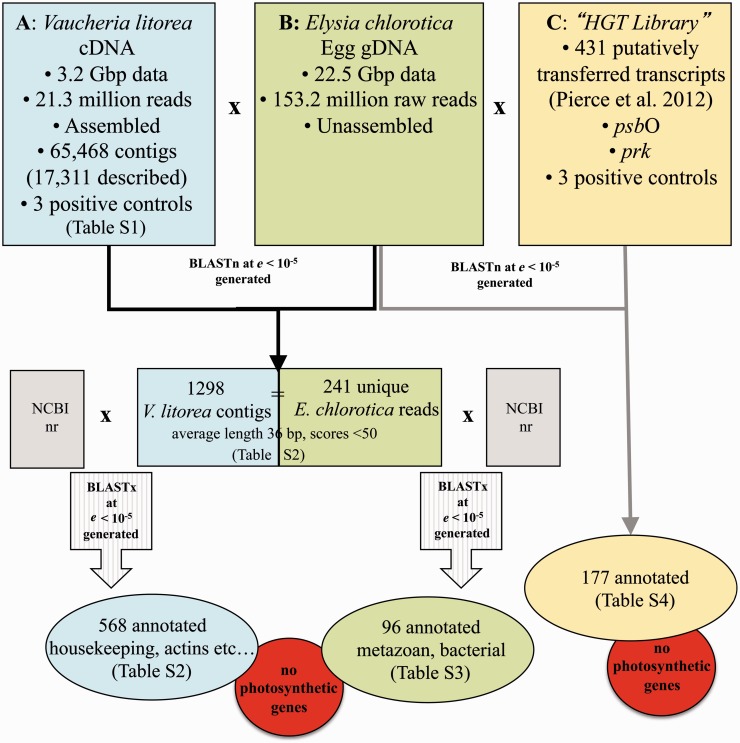
“BLASTn analysis using the assembled V. litorea cDNA sequences as a query against the sea slug egg genome database at an e-value cutoff of 10 5 yielded 1,298 top hits to 241 nonredundant reads from the sea slug (supplementary table S2, Supplementary Material online).”
MethodInfluentialSingle-copy insertion of transgenes in Caenorhabditis elegans
Frøkjær-Jensen, C., Wayne Davis, M., Hopkins, C. E., Newman, B. J., Thummel, J. M., Olesen, S.-P., Grunnet, M., & Jorgensen, E. M. (2008) · Nature Genetics · doi:10.1038/ng.248 · Cited by 1,163 · cited 2×
“1985), often in a mosaic pattern and propagated to daughter cells (Frøkjær-Jensen et al. 2008).”
BackgroundCoordination of gene expression between organellar and nuclear genomes
Woodson, J. D., & Chory, J. (2008) · Nature Reviews Genetics · doi:10.1038/nrg2348 · Cited by 681 · cited 2×
“…no evidence exists for the presence of algal nuclei in the sea slug, and the majority of plastid proteins are encoded in the nuclear genome, in addition to all the nuclear regulatory factors that are targeted to the plastid (Rumpho et al. 2008; Woodson and Chory 2008; Puthiyaveetil et al. 2010).”
BackgroundGenomic footprints of a cryptic plastid endosymbiosis in diatoms
Moustafa, A., Beszteri, B., Maier, U. G., Bowler, C., Valentin, K., & Bhattacharya, D. (2009) · Science · doi:10.1126/science.1172983 · Cited by 422 · cited 1×
“This was based on Basic Local Alignment Search Tool (BLAST) analysis against the nonredundant National Center for Biotechnology Information (NCBI) database and also by using Phylosort, a phylogenomic pipeline designed to identify candidates of gene transfer (Moustafa et al. 2009).”
MethodSelf-citationCyanophora paradoxa Genome Elucidates Origin of Photosynthesis in Algae and Plants
Price, D. C., Chan, C. X., Yoon, H. S., Yang, E. C., Qiu, H., Weber, A. P. M., Schwacke, R., Gross, J., Blouin, N. A., Lane, C., et al. (2012) · Science · doi:10.1126/science.1213561 · Cited by 380 · cited 2×
“The contigs were analyzed using BLASTx (e-value cutoff 10 5) against our comprehensive local database (e.g., Chan et al. 2011; Price et al. 2012).”
MethodSelf-citationExtrachromosomal MicroDNAs and Chromosomal Microdeletions in Normal Tissues
Shibata, Y., Kumar, P., Layer, R., Willcox, S., Gagan, J. R., Griffith, J. D., & Dutta, A. (2012) · Science · doi:10.1126/science.1213307 · Cited by 335 · cited 2×
“2003), and more recently, to distinct gene regions (Shibata et al. 2012).”
BackgroundHolocentric chromosomes: convergent evolution, meiotic adaptations, and genomic analysis
Melters, D. P., Paliulis, L. V., Korf, I. F., & Chan, S. W. L. (2012) · Chromosome Research · doi:10.1007/s10577-012-9292-1 · Cited by 303 · cited 1×
“Recent data suggest that holocentrism may be more widespread than previously thought (Melters et al. 2012).”
BackgroundRumpho, M. E., Worful, J. M., Lee, J., Kannan, K., Tyler, M. S., Bhattacharya, D., Moustafa, A., & Manhart, J. R. (2008) · Proceedings of the National Academy of Sciences · doi:10.1073/pnas.0804968105 · Cited by 264 · cited 10×
“litorea plastid genome (Rumpho et al. 2008) as a query against the egg DNA data.”
BackgroundMethodInfluentialSelf-citationThe making of a photosynthetic animal
Rumpho, M. E., Pelletreau, K. N., Moustafa, A., & Bhattacharya, D. (2011) · Journal of Experimental Biology · doi:10.1242/jeb.046540 · Cited by 180 · cited 4×
“Individual kleptoplastic associations vary widely in terms of specificity of the animal toward its algal prey and in retention time and functionality of the captured plastids (see reviews by Evertsen et al. 2007; Evertsen and Johnsen 2009; Händeler et al. 2009; Wägele et al. 2011; Rumpho et al. 2011; Maeda et al. 2012…”
BackgroundInfluentialSelf-citationBiochemical Diversification through Foreign Gene Expression in Bdelloid Rotifers
Boschetti, C., Carr, A., Crisp, A., Eyres, I., Wang-Koh, Y., Lubzens, E., Barraclough, T. G., Micklem, G., & Tunnacliffe, A. (2012) · PLoS Genetics · doi:10.1371/journal.pgen.1003035 · Cited by 171 · cited 2×
“…from https://academic.oup.com/mbe/article-abstract/30/8/1843/1013309 by guest on 29 July 2018 exception is the recent finding of gene acquisition “from the environment” by bdelloid rotifers that provides this lineage with novel physiological adaptations (Boschetti et al. 2012).”
Background
Research works printed but not linked: 1
- West HH Chloroplast symbiosis and development of the ascoglossan opisthobranch Elysia chlorotica [dissertation] 1979 [Boston (MA)] Northeastern University 1 176
Cited by
Horizontal gene transfer in the acquisition of novel traits by metazoans
Boto, L. (2014) · Proceedings of the Royal Society B: Biological Sciences · doi:10.1098/rspb.2013.2450 · Cited by 204
Environmental bacteriophages: viruses of microbes in aquatic ecosystems
Sime‐Ngando, T. (2014) · Frontiers in Microbiology · doi:10.3389/fmicb.2014.00355 · Cited by 200
“However, recent analysis of the genome of E. chlorotica egg DNA provides no clear evidence of horizontal gene transfer into the germ line of this kleptoplastic mollus, and suggests that algal nuclear genes or gene fragments are present in the adult slug (Bhattacharya et al., 2013).”
Chloroplast evolution, structure and functions
Jensen, P. E., & Leister, D. (2014) · F1000Prime Reports · doi:10.12703/p6-40 · Cited by 169
“However, no evidence for massive LGT has been obtained, and genome- and transcriptome-wide approaches actually argue against it [15,16].”
BackgroundGenomic Insights into Plastid Evolution
Sibbald, S. J., & Archibald, J. M. (2020) · Genome Biology and Evolution · doi:10.1093/gbe/evaa096 · Cited by 161
Origin and Evolution of Plastids and Photosynthesis in Eukaryotes
McFadden, G. I. (2014) · Cold Spring Harbor Perspectives in Biology · doi:10.1101/cshperspect.a016105 · Cited by 111
“2009), and recent transcriptomic approaches now suggest that no successful endosymbiotic gene transfer between alga and slug has occurred (Wagele et al. 2011; Bhattacharya et al. 2013).”
Background
Metadata
- Authors
- Bhattacharya, D., Pelletreau, K. N., Price, D. C., Sarver, K. E., & Rumpho, M. E.
- Affiliations
- Rutgers, The State University of New Jersey (US)
- University of Connecticut (US)
- University of Maine (US)
- Corresponding author
- Rumpho, Mary E.
- Venue
- Molecular Biology and Evolution
- Publisher
- Oxford University Press (OUP)
- Published
- 2013-05-02
- Volume
- 30
- Issue
- 8
- Pages
- 1843-1852
- ISSN
- 0737-4038 (ISSN-L)
- 1537-1719
- PMC
- PMC3708498
- OpenAlex
- W2135349254
- Cited by
- 93
- References
- 40
- Citations by year
- 2026: 5 · 2025: 6 · 2024: 3 · 2023: 3 · 2022: 2 · 2021: 3 · 2020: 5 · 2019: 6 · 2018: 15 · 2017: 9 · 2016: 3 · 2015: 13 · 2014: 14 · 2013: 6
- FWCI
- 5.38
- Type
- journal article
- Language
- en
- Open access
- hybrid
- doi.org
- Licence
- cc-by-nc
- Locations
- Molecular Biology and Evolution (publishedVersion, cc-by-nc)
- Europe PMC (PubMed Central) (publishedVersion, cc-by-nc)
- PubMed Central (publishedVersion, cc-by-nc)
- PubMed (publishedVersion)
- Rutgers University Community Repository (Rutgers University) (submittedVersion)
- Funders
- National Science Foundation (0936884, 0726178)
- University of Connecticut
- Maine Agricultural and Forest Experiment Station
- Topics
- Life Sciences › Agricultural and Biological Sciences › Ecology, Evolution, Behavior and Systematics › Protist diversity and phylogeny
- Life Sciences › Biochemistry, Genetics and Molecular Biology › Genetics › Chromosomal and Genetic Variations
- Life Sciences › Agricultural and Biological Sciences › Animal Science and Zoology › Marine Invertebrate Physiology and Ecology
- Keywords
- Elysia chlorotica, horizontal gene transfer, kleptoplasty, germline, extrachromosomal DNA, sea slugs
- MeSH terms
- Animals, DNA, Germ Cells, Transcription, Genetic, Computational Biology, Gene Transfer, Horizontal, Genomics, Databases, Nucleic Acid, Gastropoda
About these checks
Registry, retraction, Cites and statistics results are computed, not judged, with one exception: a printed reference that no index lists is read once by a model before it counts as a citation error. Claims are extracted by a model and kept only when their quote appears verbatim in the text; each cited source is then checked, with a model’s help, for whether it says what the claim relies on. Those verdicts can be wrong — read the claim’s quote and the cited source before relying on one.
Statistics and arithmetic are recomputed, not judged.
Confidence bands are shown only for fields calibrated on our annotated test set. None is calibrated yet, so no band is shown.
What counts as a claim ›How we measure confidence ›How we check this ›
Are you an author, or do you see a problem with this page? Request a review
How to cite
Cite CoChat for the checks on this page, and the paper for its own findings.
- This page
- CoChat. (2026). Citation check: Genome Analysis of Elysia chlorotica Egg DNA Provides No Evidence for Horizontal Gene Transfer into the Germ Line of This Kleptoplastic Mollusc. https://app.cochat.ai/papers/10.1093/molbev/mst084
- The paper
- Bhattacharya, D., Pelletreau, K. N., Price, D. C., Sarver, K. E., & Rumpho, M. E. (2013). Genome Analysis of Elysia chlorotica Egg DNA Provides No Evidence for Horizontal Gene Transfer into the Germ Line of This Kleptoplastic Mollusc. Molecular Biology and Evolution. https://doi.org/10.1093/molbev/mst084
Data sources
Bibliographic data: Semantic Scholar, OpenAlex, Crossref.
Contains information from the Semantic Scholar Academic Graph Datasets, made available under the ODC Attribution License (ODC-BY 1.0).
Semantic Scholar’s data is described in: Kinney, R., et al. (2023). The Semantic Scholar Open Data Platform. arXiv:2301.10140.
