

Archaeal family B DNA polymerase facilitates lagging strand DNA replication in the Thermococcales
Open accessThe DOI matches its Crossref record; 65 of the 66 references it cites were found in a registry or an index.
Abstract
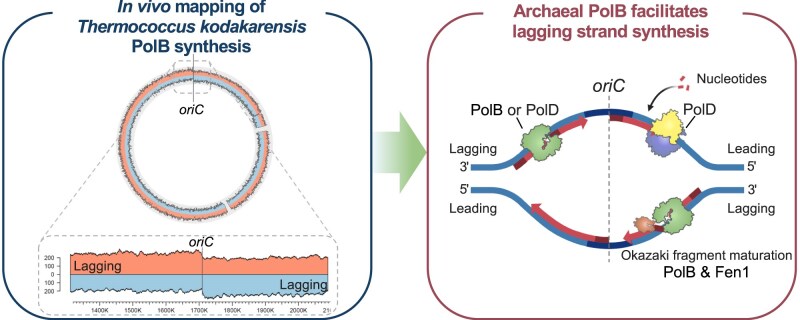
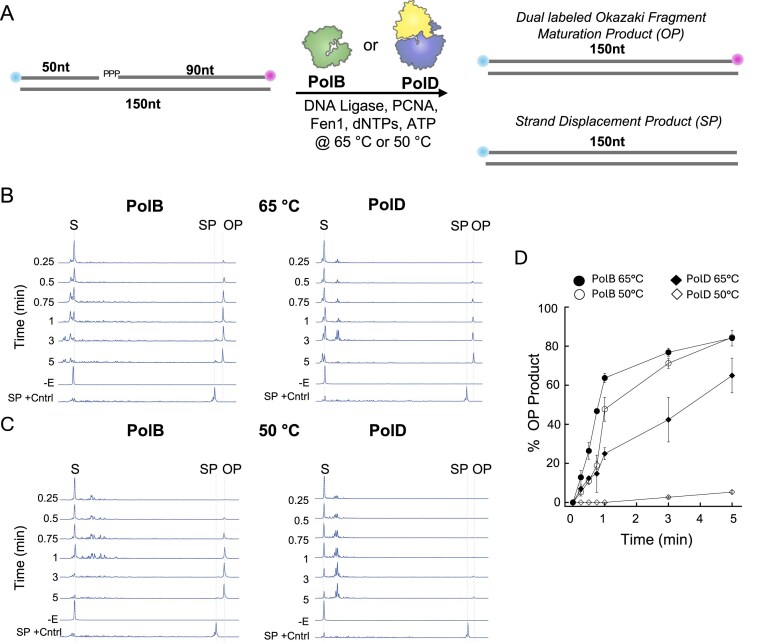
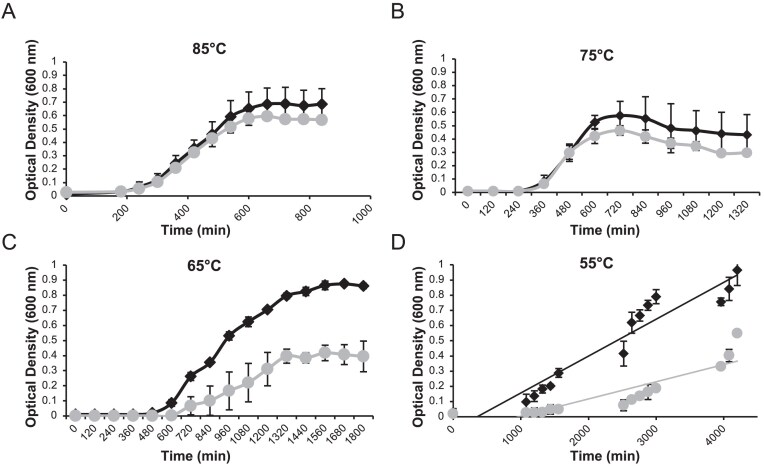
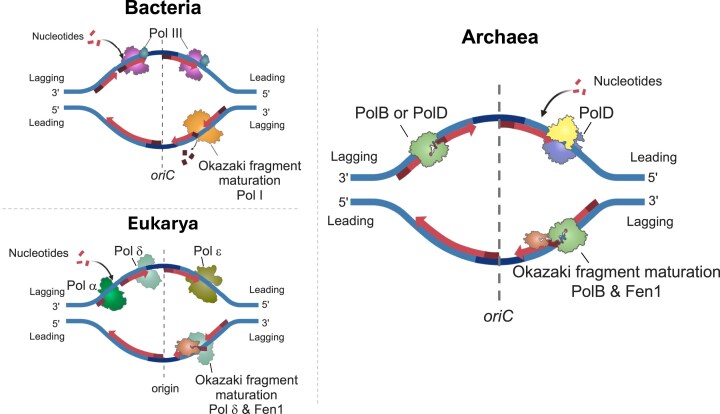
Replicative DNA synthesis is distributed among several DNA polymerases (DNAPs) in both Bacteria and Eukarya. The division of synthesis permits specialized activities of unique DNAPs to facilitate rapid replication in a continuous manner on the leading strand and discontinuous synthesis of the lagging strand with repetitive priming and maturation of Okazaki fragments. Many archaea encode two evolutionarily unrelated DNAPs, PolB and PolD, but how leading and lagging strand synthesis responsibilities are partitioned between each polymerase has yet to be resolved in vivo. In the model archaeon Thermococcus kodakarensis, Pol B is dispensable, demonstrating PolD can independently support replicative synthesis, but does not exclude the possibility that PolB normally participates in key aspects of DNA replication. Here, we combine phenotypic analyses of strains encoding variant DNAPs, high-throughput sequencing, and purified replication assays to establish that PolB actively facilitates lagging strand synthesis in vivo. Pol B outperforms PolD at strand displacement and Okazaki fragment maturation, demonstrating that specialized DNAPs share replicative synthesis duties in most Archaea. Our findings define a foundational division of labor between PolB and PolD in Archaea and establish the use of specialized replicative DNAP activities for strand-specific synthesis across all life.
Overview
The claims and statistics of this paper haven’t been checked yet.
Free: it reads the open-access text and checks the first 5 claims that cite a source we can check. Create a free account to check every claim.
Integrity signals
Registry
Cites
Statistics
Figures
Verification
Claims the paper makes
The claims and statistics of this paper haven’t been checked yet.
Free: it reads the open-access text and checks the first 5 claims that cite a source we can check. Create a free account to check every claim.
Claims other papers make about this one
Each is checked against this paper’s own text: does it say what the citing paper says it does?
The cited source says what the claim attributes to it.
In the citing paper
“rare damage and repair sequencing (RADAR-seq) can be used to sequence rNMPs using PacBio Single Molecule Real-Time (SMRT) sequencing to determine their location and frequency”
From Ribonucleotide errors, RNase HII, and ribonucleotide excision repair (2026) · cites this paper as Liman et al. 2026
Self-check
Percentages, sums and reported differences re-computed from the paper’s own numbers.
The self-check needs the paper’s full text.
Citations
Cites
Yeast DNA Polymerase ε Participates in Leading-Strand DNA Replication
Pursell, Z. F., Isoz, I., Lundström, E.-B., Johansson, E., & Kunkel, T. A. (2007) · Science · doi:10.1126/science.1144067 · Cited by 563
Division of Labor at the Eukaryotic Replication Fork
Nick McElhinny, S. A., Gordenin, D. A., Stith, C. M., Burgers, P. M. J., & Kunkel, T. A. (2008) · Molecular Cell · doi:10.1016/j.molcel.2008.02.022 · Cited by 502 · cited 2×
“In Eukarya, in contrast, the vast bulk of replicative synthesis does not involve either family A or family C DNAPs and is instead driven by three family B DNAPs: Pol α extends RNA primers, while Pol (cid:2) and Pol δ carry out the bulk of leading and lagging strand synthesis, respectively [ 5 , 6 ].”
[15] Chemical synthesis of deoxyoligonucleotides by the phosphoramidite method
Caruthers, M. H., Barone, A. D., Beaucage, S. L., Dodds, D. R., Fisher, E. F., McBride, L. J., Matteucci, M., Stabinsky, Z., & Tang, J.-Y. (1987) · Methods in Enzymology · doi:10.1016/0076-6879(87)54081-2 · Cited by 344 · cited 1×
“) each at a 1.0 μ mol scale with DMT removed using an H-8 synthesizer from Sierra BioSys-tems, Inc., following standard phosphoramidite chemistry [ 37 ].”
InfluentialPolymerase Dynamics at the Eukaryotic DNA Replication Fork
Burgers, P. M. J. (2009) · Journal of Biological Chemistry · doi:10.1074/jbc.r800062200 · Cited by 338
Kesti, T., Flick, K., Keränen, S., Syväoja, J. E., & Wittenberg, C. (1999) · Molecular Cell · doi:10.1016/s1097-2765(00)80361-5 · Cited by 276
Iyer, L. M. (2005) · Nucleic Acids Research · doi:10.1093/nar/gki702 · Cited by 275 · cited 2×
“While families X, Y, and RTs minimally participate in genome replication, families A, B, C, and D encode DNAPs that synthesize the bulk of genomic DNA, and AEPs de novo synthesize DNA replication primers in Archaea and Eukarya [ 8 , 9 ].”
Translesion and Repair DNA Polymerases: Diverse Structure and Mechanism
Yang, W., & Gao, Y. (2018) · Annual Review of Biochemistry · doi:10.1146/annurev-biochem-062917-012405 · Cited by 246 · cited 1×
“While families X, Y, and RTs minimally participate in genome replication, families A, B, C, and D encode DNAPs that synthesize the bulk of genomic DNA, and AEPs de novo synthesize DNA replication primers in Archaea and Eukarya [ 8 , 9 ].”
Unlocking the Sugar “Steric Gate” of DNA Polymerases
Brown, J. A., & Suo, Z. (2011) · Biochemistry · doi:10.1021/bi101915z · Cited by 205 · cited 1×
“…the frequency of ribonucleotide incorporation of PolB by mutationally altering the rNTP versus dNTP discrimination residue termed the steric gate [ 39 ], (ii) eliminate the 3–5 exonuclease activities of PolB in tandem such that ribonucleotide incorporations were not immediately removed, (iii)…”
THE CHROMOSOME OF BACILLUS SUBTILIS. I. THEORY OF MARKER FREQUENCY ANALYSIS
Sueoka, N., & Yoshikawa, H. (1965) · Genetics · doi:10.1093/genetics/52.4.747 · Cited by 201 · cited 1×
“S6 ) [ 49 , 31 ].”
Tracking replication enzymology in vivo by genome-wide mapping of ribonucleotide incorporation
Clausen, A. R., Lujan, S. A., Burkholder, A. B., Orebaugh, C. D., Williams, J. S., Clausen, M. F., Malc, E. P., Mieczkowski, P. A., Fargo, D. C., Smith, D. J., et al. (2015) · Nature Structural & Molecular Biology · doi:10.1038/nsmb.2957 · Cited by 188 · cited 4×
“This pattern of replication polarity at origins has been previously observed in Bacteria and Eukarya and is now observed also in Archaea [ 26 , 28 ].”
Influential
Research works printed but not linked: 1
- Kropp HM, Betz K, Wirth J et al. Crystal structures of ternary complexes of archaeal B-family DNA polymerases. PLoS One. 2017; 12: e0188005. 10.1371/journal.pone.0188005 29211756 PMC5718519 · DOI
Cited by
Ribonucleotide errors, RNase HII, and ribonucleotide excision repair
Cresti, J. R., & Simmons, L. A. (2026) · Critical Reviews in Biochemistry and Molecular Biology · doi:10.1080/10409238.2026.2704628
“While the applications are more broad, rare damage and repair sequencing (RADAR-seq) can be used to sequence rNMPs using PacBio Single Molecule Real-Time (SMRT) sequencing to determine their location and frequency (Zatopek et al. 2019; Liman et al. 2026).”
A hidden archaeal lineage with an ultra-reduced genome retaining only its replicative core
Harada, R., Nishimura, Y., Nomura, M., Yabuki, A., Shiba, K., Inaba, K., Allers, T., Inagaki, Y., & Nakayama, T. (2026) · Current Biology · doi:10.1016/j.cub.2026.09.042 · Cited by 11
Metadata
- Authors
- Liman, G. L. S., Black, M. D., Potapov, V., Burkhart, B. W., Levine, K., Baker, B., Mandley, J. L., Davidson, S. C., Gardner, A. F., Santangelo, T. J., & Zatopek, K. M.
- Affiliations
- New England Biolabs (United States) (US)
- Colorado State University (US)
- Corresponding author
- Santangelo, Thomas J
- Zatopek, Kelly M
- ORCID
- Venue
- Nucleic Acids Research
- Publisher
- Oxford University Press (OUP)
- Published
- 2026-04-23
- Volume
- 54
- Issue
- 8
- ISSN
- 0305-1048 (ISSN-L)
- 1362-4962
- PMC
- PMC13136892
- OpenAlex
- W7160048009
- Cited by
- 2
- References
- 66
- Citations by year
- 2026: 2
- FWCI
- 4.13
- Type
- journal article
- Language
- en
- Open access
- gold
- doi.org
- Licence
- Locations
- Nucleic Acids Research (publishedVersion, cc-by)
- PubMed (publishedVersion)
- PubMed Central (publishedVersion, cc-by)
- Funders
- USA National Aeronautics and Space Administration (#80NSSC23K1354)
- National Institutes of Health (#R35-GM143963)
- National Science Foundation (#2016857)
- Topics
- Life Sciences › Biochemistry, Genetics and Molecular Biology › Molecular Biology › DNA Repair Mechanisms
- Life Sciences › Biochemistry, Genetics and Molecular Biology › Genetics › Bacterial Genetics and Biotechnology
- Life Sciences › Biochemistry, Genetics and Molecular Biology › Molecular Biology › Genomics and Phylogenetic Studies
- Keywords
- lagging strand synthesis, Thermococcus kodakarensis, Thermococcales, Okazaki fragment maturation, strand displacement, leading strand synthesis, DNA replication
- MeSH terms
- DNA, DNA Polymerase III, DNA-Directed DNA Polymerase, DNA Replication, DNA, Archaeal, Thermococcus, Archaeal Proteins, DNA Polymerase beta
About these checks
Registry, retraction, Cites and statistics results are computed, not judged, with one exception: a printed reference that no index lists is read once by a model before it counts as a citation error. Claims are extracted by a model and kept only when their quote appears verbatim in the text; each cited source is then checked, with a model’s help, for whether it says what the claim relies on. Those verdicts can be wrong — read the claim’s quote and the cited source before relying on one.
Statistics and arithmetic are recomputed, not judged.
Confidence bands are shown only for fields calibrated on our annotated test set. None is calibrated yet, so no band is shown.
What counts as a claim ›How we measure confidence ›How we check this ›
Are you an author, or do you see a problem with this page? Request a review
How to cite
Cite CoChat for the checks on this page, and the paper for its own findings.
- This page
- CoChat. (2026). Citation check: Archaeal family B DNA polymerase facilitates lagging strand DNA replication in the Thermococcales. https://app.cochat.ai/papers/10.1093/nar/gkag395
- The paper
- Liman, G. L. S., Black, M. D., Potapov, V., Burkhart, B. W., Levine, K., Baker, B., Mandley, J. L., Davidson, S. C., Gardner, A. F., Santangelo, T. J., & Zatopek, K. M. (2026). Archaeal family B DNA polymerase facilitates lagging strand DNA replication in the Thermococcales. Nucleic Acids Research. https://doi.org/10.1093/nar/gkag395
Data sources
Bibliographic data: Semantic Scholar, OpenAlex, Crossref.
Contains information from the Semantic Scholar Academic Graph Datasets, made available under the ODC Attribution License (ODC-BY 1.0).
Semantic Scholar’s data is described in: Kinney, R., et al. (2023). The Semantic Scholar Open Data Platform. arXiv:2301.10140.
