

The DOI matches its Crossref record; 18 of the 20 references it cites were found in a registry or an index.
A new bioinformatics analysis tools framework at EMBL-EBI
Open accessAbstract
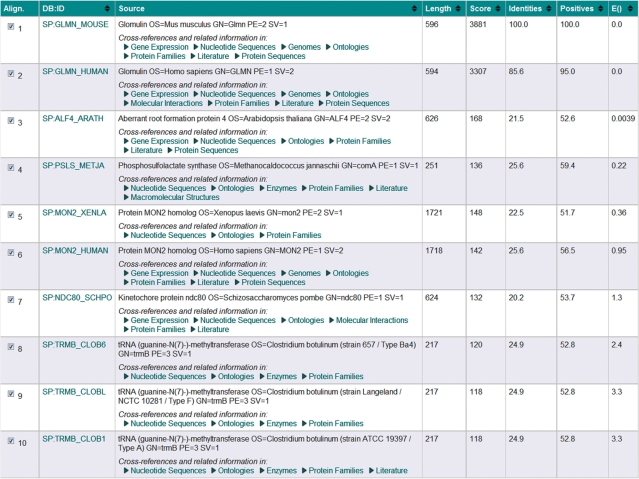
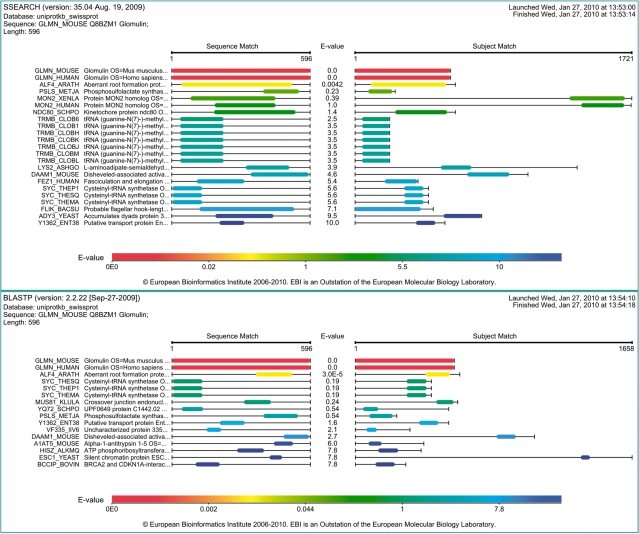
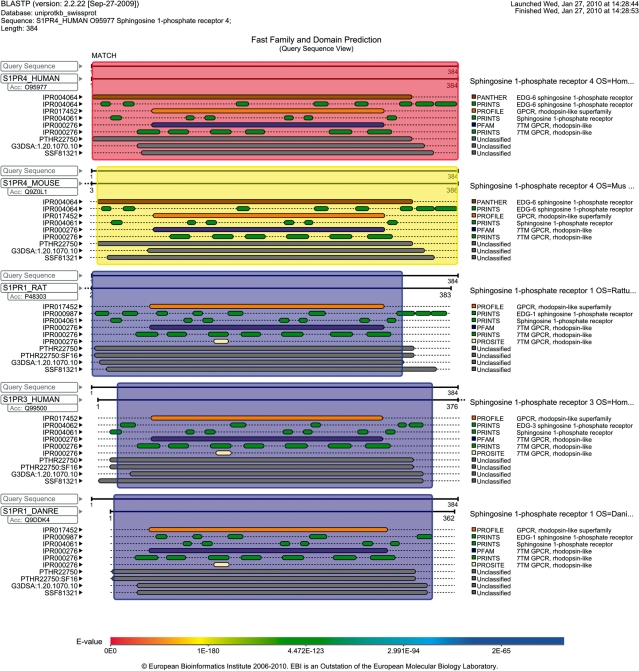
The EMBL-EBI provides access to various mainstream sequence analysis applications. These include sequence similarity search services such as BLAST, FASTA, InterProScan and multiple sequence alignment tools such as ClustalW, T-Coffee and MUSCLE. Through the sequence similarity search services, the users can search mainstream sequence databases such as EMBL-Bank and UniProt, and more than 2000 completed genomes and proteomes. We present here a new framework aimed at both novice as well as expert users that exposes novel methods of obtaining annotations and visualizing sequence analysis results through one uniform and consistent interface. These services are available over the web and via Web Services interfaces for users who require systematic access or want to interface with customized pipe-lines and workflows using common programming languages. The framework features novel result visualizations and integration of domain and functional predictions for protein database searches. It is available at http://www.ebi.ac.uk/Tools/sss for sequence similarity searches and at http://www.ebi.ac.uk/Tools/msa for multiple sequence alignments.
Overview
The claims and statistics of this paper haven’t been checked yet.
Free: it reads the open-access text and checks the first 5 claims that cite a source we can check. Create a free account to check every claim.
Integrity signals
Registry
Cites
Statistics
Figures
Verification
Claims the paper makes
The claims and statistics of this paper haven’t been checked yet.
Free: it reads the open-access text and checks the first 5 claims that cite a source we can check. Create a free account to check every claim.
Claims other papers make about this one
Each is checked against this paper’s own text: does it say what the citing paper says it does?
The check wasn’t confident either way, so it gives no verdict — never disputed.
In the citing paper
“It is possible that we observed low cross-link coverage within the MBD2 -GATAD2A coiled-coil domain because, as the authors of that study noted, this interaction hides at least 1337 A 2 of the solvent-accessible area, potentially hindering BS3 accessibility.”
From Towards elucidating the stability, dynamics and architecture of the nucleosome remodeling and deacetylase complex by using quantitative interaction proteomics (2015) · cites this paper as [31]
Experimental — accuracy not yet measured
Self-check
Percentages, sums and reported differences re-computed from the paper’s own numbers.
The self-check needs the paper’s full text.
Citations
Cites
Gapped BLAST and PSI-BLAST: a new generation of protein database search programs
Altschul, S. (1997) · Nucleic Acids Research · doi:10.1093/nar/25.17.3389 · Cited by 73,302
MUSCLE: multiple sequence alignment with high accuracy and high throughput
Edgar, R. C. (2004) · Nucleic Acids Research · doi:10.1093/nar/gkh340 · Cited by 44,662
Clustal W and Clustal X version 2.0
Larkin, M. A., Blackshields, G., Brown, N. P., Chenna, R., McGettigan, P. A., McWilliam, H., Valentin, F., Wallace, I. M., Wilm, A., Lopez, R., et al. (2007) · Bioinformatics · doi:10.1093/bioinformatics/btm404 · Cited by 28,358
Self-citationImproved tools for biological sequence comparison.
Pearson, W. R., & Lipman, D. J. (1988) · Proceedings of the National Academy of Sciences · doi:10.1073/pnas.85.8.2444 · Cited by 11,227 · cited 3×
“These include sequence similarity search services (http://www.ebi.ac .uk/Tools/similarity.html), such as FASTA (3), BLAST (4,5) and InterProScan (6) and multiple sequence alignment tools (http://www.ebi.ac.uk/Tools/sequence.html), such as ClustalW (7), T-Coffee (8), MUSCLE (9), Kalign (10) and MAFFT (11).”
T-coffee: a novel method for fast and accurate multiple sequence alignment 1 1Edited by J. Thornton
Notredame, C., Higgins, D. G., & Heringa, J. (2000) · Journal of Molecular Biology · doi:10.1006/jmbi.2000.4042 · Cited by 6,852
InterProScan: protein domains identifier
Quevillon, E., Silventoinen, V., Pillai, S., Harte, N., Mulder, N., Apweiler, R., & Lopez, R. (2005) · Nucleic Acids Research · doi:10.1093/nar/gki442 · Cited by 3,015 · cited 3×
“These include sequence similarity search services (http://www.ebi.ac .uk/Tools/similarity.html), such as FASTA (3), BLAST (4,5) and InterProScan (6) and multiple sequence alignment tools (http://www.ebi.ac.uk/Tools/sequence.html), such as ClustalW (7), T-Coffee (8), MUSCLE (9), Kalign (10) and MAFFT (11).”
MethodInterPro: the integrative protein signature database
Hunter, S., Apweiler, R., Attwood, T. K., Bairoch, A., Bateman, A., Binns, D., Bork, P., Das, U., Daugherty, L., Duquenne, L., et al. (2009) · Nucleic Acids Research · doi:10.1093/nar/gkn785 · Cited by 2,107 · cited 2×
“Family and domain functional predictions have been built into the framework, using pre-calculated matches from the InterPro Consortium (14) data.”
MethodSelf-citationMultiple Alignment of DNA Sequences with MAFFT
Katoh, K., Asimenos, G., & Toh, H. (2009) · Methods in Molecular Biology · doi:10.1007/978-1-59745-251-9_3 · Cited by 1,438 · cited 2×
“These include sequence similarity search services (http://www.ebi.ac .uk/Tools/similarity.html), such as FASTA (3), BLAST (4,5) and InterProScan (6) and multiple sequence alignment tools (http://www.ebi.ac.uk/Tools/sequence.html), such as ClustalW (7), T-Coffee (8), MUSCLE (9), Kalign (10) and MAFFT (11).”
BackgroundThe Universal Protein Resource (UniProt) in 2010
The UniProt Consortium (2010) · Nucleic Acids Research · doi:10.1093/nar/gkp846 · Cited by 1,257
KNIME: The Konstanz Information Miner
Berthold, M. R., Cebron, N., Dill, F., Gabriel, T. R., Kötter, T., Meinl, T., Ohl, P., Sieb, C., Thiel, K., & Wiswedel, B. (2008) · Studies in Classification, Data Analysis, and Knowledge Organization · doi:10.1007/978-3-540-78246-9_38 · Cited by 1,251
Cited by
InterProScan 5: genome-scale protein function classification
Jones, P., Binns, D., Chang, H.-Y., Fraser, M., Li, W., McAnulla, C., McWilliam, H., Maslen, J., Mitchell, A., Nuka, G., et al. (2014) · Bioinformatics · doi:10.1093/bioinformatics/btu031 · Cited by 9,301
Self-citationCircular RNAs are a large class of animal RNAs with regulatory potency
Memczak, S., Jens, M., Elefsinioti, A., Torti, F., Krueger, J., Rybak, A., Maier, L., Mackowiak, S. D., Gregersen, L. H., Munschauer, M., et al. (2013) · Nature · doi:10.1038/nature11928 · Cited by 7,990
A landscape of driver mutations in melanoma
Hodis, E., Watson, I. R., Kryukov, G. V., Arold, S. T., Imielinski, M., Theurillat, J.-P., Nickerson, E., Auclair, D., Li, L., Place, C., et al. (2012) · Cell · doi:10.1016/j.cell.2012.06.024 · Cited by 2,610
The IPD and IMGT/HLA database: allele variant databases
Robinson, J., Halliwell, J. A., Hayhurst, J. D., Flicek, P., Parham, P., & Marsh, S. G. E. (2015) · Nucleic Acids Research · doi:10.1093/nar/gku1161 · Cited by 1,740
“Some of these tools were custom written for the IMGT/HLA Database, whereas others were incorporated from the existing set of tools described on the EBI website (18,19).”
MethodAnalysis Tool Web Services from the EMBL-EBI
McWilliam, H., Li, W., Uludag, M., Squizzato, S., Park, Y. M., Buso, N., Cowley, A. P., & Lopez, R. (2013) · Nucleic Acids Research · doi:10.1093/nar/gkt376 · Cited by 1,660
“Most of the analysis tool services are implemented using a job dispatcher framework, JDispatcher (16), which provides a web interface and SOAP & REST Web Services interfaces.”
MethodInfluentialSelf-citation
Metadata
- Authors
- Goujon, M., McWilliam, H., Li, W., Valentin, F., Squizzato, S., Paern, J., & Lopez, R.
- Affiliations
- European Bioinformatics Institute (GB)
- Venue
- Nucleic Acids Research
- Publisher
- Oxford University Press (OUP)
- Published
- 2010-05-03
- Volume
- 38
- Issue
- Web Server
- Pages
- W695-W699
- ISSN
- 0305-1048 (ISSN-L)
- 1362-4962
- PMC
- PMC2896090
- OpenAlex
- W2169150541
- Semantic Scholar
- 80e86c8ca16da71d7ff279619d7b72c82a14f564
- Cited by
- 1,846
- References
- 20
- Citations by year
- 2026: 39 · 2025: 57 · 2024: 114 · 2023: 99 · 2022: 85 · 2021: 64 · 2020: 69 · 2019: 100 · 2018: 146 · 2017: 156 · 2016: 187 · 2015: 164 · 2014: 222 · 2013: 186 · 2012: 131
- FWCI
- 44.40
- Type
- journal article
- Language
- en
- Open access
- gold
- doi.org
- Licence
- Locations
- Nucleic Acids Research (publishedVersion, cc-by-nc)
- PubMed Central (publishedVersion, cc-by-nc)
- PubMed (publishedVersion)
- HighWire Press Open Archive (submittedVersion)
- Funders
- University of Virginia
- European Bioinformatics Institute
- European Molecular Biology Laboratory
- European Commission
- Topics
- Life Sciences › Biochemistry, Genetics and Molecular Biology › Molecular Biology › Genomics and Phylogenetic Studies
- Social Sciences › Decision Sciences › Information Systems and Management › Scientific Computing and Data Management
- Life Sciences › Biochemistry, Genetics and Molecular Biology › Molecular Biology › Genetics, Bioinformatics, and Biomedical Research
- Keywords
- sequence analysis tools, sequence similarity search, multiple sequence alignment, web services, annotation visualization, protein domain prediction, functional prediction, EMBL-EBI, BLAST, InterProScan, ClustalW, muscle, T-Coffee, sequence databases
- MeSH terms
- Software, Sequence Alignment, Sequence Analysis, Computational Biology, Internet, Databases, Nucleic Acid, Databases, Protein
About these checks
Registry, retraction, Cites and statistics results are computed, not judged, with one exception: a printed reference that no index lists is read once by a model before it counts as a citation error. Claims are extracted by a model and kept only when their quote appears verbatim in the text; each cited source is then checked, with a model’s help, for whether it says what the claim relies on. Those verdicts can be wrong — read the claim’s quote and the cited source before relying on one.
Statistics and arithmetic are recomputed, not judged.
Confidence bands are shown only for fields calibrated on our annotated test set. None is calibrated yet, so no band is shown.
What counts as a claim ›How we measure confidence ›How we check this ›
Are you an author, or do you see a problem with this page? Request a review
How to cite
Cite CoChat for the checks on this page, and the paper for its own findings.
- This page
- CoChat. (2026). Citation check: A new bioinformatics analysis tools framework at EMBL-EBI. https://app.cochat.ai/papers/10.1093/nar/gkq313
- The paper
- Goujon, M., McWilliam, H., Li, W., Valentin, F., Squizzato, S., Paern, J., & Lopez, R. (2010). A new bioinformatics analysis tools framework at EMBL-EBI. Nucleic Acids Research. https://doi.org/10.1093/nar/gkq313
Data sources
Bibliographic data: Semantic Scholar, OpenAlex, Crossref.
Contains information from the Semantic Scholar Academic Graph Datasets, made available under the ODC Attribution License (ODC-BY 1.0).
Semantic Scholar’s data is described in: Kinney, R., et al. (2023). The Semantic Scholar Open Data Platform. arXiv:2301.10140.
