

The DOI matches its Crossref record; 22 of the 22 references it cites were found in a registry or an index.
SFmap: a web server for motif analysis and prediction of splicing factor binding sites
Open accessAbstract
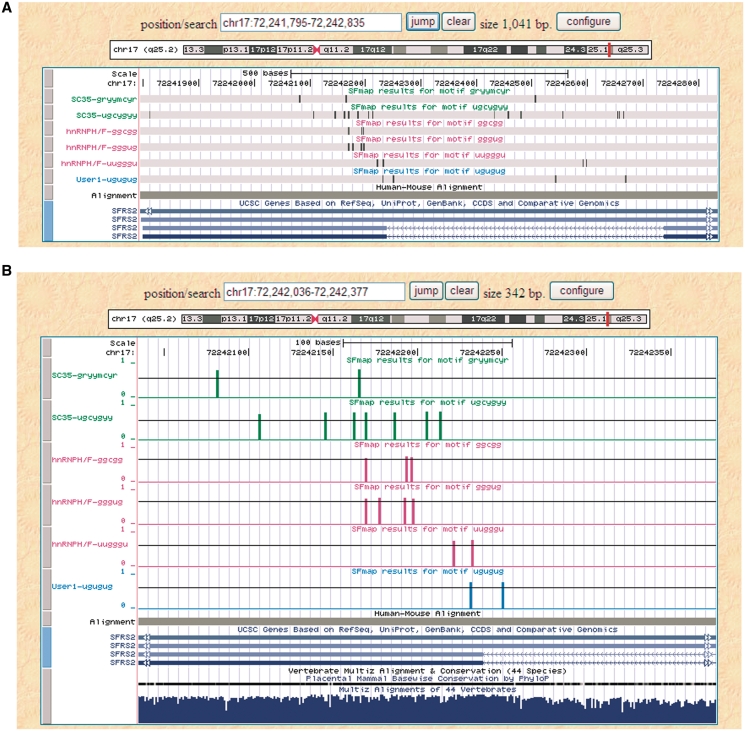
Alternative splicing (AS) is a post-transcriptional process considered to be responsible for the huge diversity of proteins in higher eukaryotes. AS events are regulated by different splicing factors (SFs) that bind to sequence elements on the RNA. SFmap is a web server for predicting putative SF binding sites in genomic data (http://sfmap.technion.ac.il). SFmap implements the COS(WR) algorithm, which computes similarity scores for a given regulatory motif based on information derived from its sequence environment and its evolutionary conservation. Input for SFmap is a human genomic sequence or a list of sequences in FASTA format that can either be uploaded from a file or pasted into a window. SFmap searches within a given sequence for significant hits of binding motifs that are either stored in our database or defined by the user. SFmap results are provided both as a text file and as a graphical web interface.
Overview
The claims and statistics of this paper haven’t been checked yet.
Run the check — free, no account needed. It reads the open-access text and checks the sources it cites.
Integrity signals
Registry
Cites
Statistics
Figures
Verification
Claims the paper makes
The claims and statistics of this paper haven’t been checked yet.
Run the check — free, no account needed. It reads the open-access text and checks the sources it cites.
Claims other papers make about this one
Each is checked against this paper’s own text: does it say what the citing paper says it does?
In the citing paper
“binding sites for many splice factors, including YB-1, SRp20, Sam68, SLM2, SRp40, and multiple hnRNPs (including hnRNP K), were predicted in the near vicinity of the junction site by SpliceAid 2 (30) and SFmap (version 1.8; ref. 31; Fig. 1C).”
From Discovery of a Novel CIP2A Variant (NOCIVA) with Clinical Relevance in Predicting TKI Resistance in Myeloid Leukemias (2021) · cites this paper as [31]
Self-check
Percentages, sums and reported differences re-computed from the paper’s own numbers.
The self-check needs the paper’s full text.
Citations
Cites
<tt>BLAT</tt> —The <tt>BLAST</tt> -Like Alignment Tool
Kent, W. J. (2002) · Genome Research · doi:10.1101/gr.229202 · Cited by 8,480
The UCSC Genome Browser database: update 2011
Fujita, P. A., Rhead, B., Zweig, A. S., Hinrichs, A. S., Karolchik, D., Cline, M., Goldman, M. J., Barber, G. P., Clawson, H., Coelho, A., et al. (2010) · Nucleic Acids Research · doi:10.1093/nar/gkq963 · Cited by 1,843
ESEfinder: a web resource to identify exonic splicing enhancers
Cartegni, L. (2003) · Nucleic Acids Research · doi:10.1093/nar/gkg616 · Cited by 1,593
Mechanisms of alternative splicing regulation: insights from molecular and genomics approaches
Chen, M., & Manley, J. L. (2009) · Nature Reviews Molecular Cell Biology · doi:10.1038/nrm2777 · Cited by 1,284
Cooper, T. A., Wan, L., & Dreyfuss, G. (2009) · Cell · doi:10.1016/j.cell.2009.02.011 · Cited by 1,198
Splicing regulation: From a parts list of regulatory elements to an integrated splicing code
Wang, Z., & Burge, C. B. (2008) · RNA · doi:10.1261/rna.876308 · Cited by 1,127
Systematic Identification and Analysis of Exonic Splicing Silencers
Wang, Z., Rolish, M. E., Yeo, G. W.-M., Tung, V., Mawson, M., & Burge, C. B. (2004) · Cell · doi:10.1016/j.cell.2004.11.010 · Cited by 678
Smith, P. J., Zhang, C., Wang, J., Chew, S. L., Zhang, M. Q., & Krainer, A. R. (2006) · Human Molecular Genetics · doi:10.1093/hmg/ddl171 · Cited by 514
Multiple roles of TDP-43 in gene expression, splicing regulation, and human disease
Buratti, E. (2007) · Frontiers in bioscience · doi:10.2741/2727 · Cited by 493
The UCSC Genome Browser Database: update 2009
Kuhn, R. M., Karolchik, D., Zweig, A. S., Wang, T., Smith, K. E., Rosenbloom, K. R., Rhead, B., Raney, B. J., Pohl, A., Pheasant, M., et al. (2008) · Nucleic Acids Research · doi:10.1093/nar/gkn875 · Cited by 388
Research works printed but not linked: 1
- 2009, Nucleic Acids Research, 38, 1353
Cited by
Sorted by citations
Items 101–102 of 102
Alteration of alternative splicing in the pathogenesis of liver disease
Wang, H. (2017) · theses.fr (ABES) · doi:10.70675/bbd0da03z44bcz4adczaedazc17212ba6ebe
The role of hnRNP H in the splicing response to genotoxic stress
Stein, C. B. (2015) · D-Scholarship@Pitt (University of Pittsburgh)
Metadata
- Authors
- Paz, I., Akerman, M., Dror, I., Kosti, I., & Mandel-Gutfreund, Y.
- Affiliations
- Technion – Israel Institute of Technology (IL)
- Venue
- Nucleic Acids Research
- Publisher
- Oxford University Press (OUP)
- Published
- 2010-05-25
- Volume
- 38
- Issue
- Web Server
- Pages
- W281-W285
- ISSN
- 0305-1048 (ISSN-L)
- 1362-4962
- PMC
- PMC2896136
- OpenAlex
- W1988971922
- Cited by
- 102
- References
- 22
- Citations by year
- 2025: 2 · 2023: 4 · 2022: 6 · 2021: 4 · 2020: 3 · 2019: 9 · 2018: 5 · 2017: 9 · 2016: 10 · 2015: 11 · 2014: 16 · 2013: 6 · 2012: 9
- FWCI
- 2.73
- Type
- journal article
- Language
- en
- Open access
- gold
- doi.org
- Licence
- Locations
- Nucleic Acids Research (publishedVersion, cc-by-nc)
- PubMed Central (publishedVersion, cc-by-nc)
- PubMed (publishedVersion)
- Cold Spring Harbor Laboratory Institutional Repository (Cold Spring Harbor Laboratory) (acceptedVersion)
- HighWire Press Open Archive (submittedVersion)
- Topics
- Life Sciences › Biochemistry, Genetics and Molecular Biology › Molecular Biology › RNA Research and Splicing
- Life Sciences › Biochemistry, Genetics and Molecular Biology › Molecular Biology › Genomics and Phylogenetic Studies
- Life Sciences › Biochemistry, Genetics and Molecular Biology › Molecular Biology › Genomics and Chromatin Dynamics
- Keywords
- alternative splicing, evolutionary conservation, human genome sequence, web server
- MeSH terms
- Algorithms, Binding Sites, Humans, Software, User-Computer Interface, Genome, Human, RNA-Binding Proteins, Alternative Splicing, Sequence Analysis, RNA, Internet
About these checks
Registry, retraction, Cites and statistics results are computed, not judged, with one exception: a printed reference that no index lists is read once by a model before it counts as a citation error. Claims are extracted by a model and kept only when their quote appears verbatim in the text; each cited source is then checked, with a model’s help, for whether it says what the claim relies on. Those verdicts can be wrong — read the claim’s quote and the cited source before relying on one.
Statistics and arithmetic are recomputed, not judged.
Confidence bands are shown only for fields calibrated on our annotated test set. None is calibrated yet, so no band is shown.
What counts as a claim ›How we measure confidence ›How we check this ›
Are you an author, or do you see a problem with this page? Request a review
