

A comparison of RNA-Seq and high-density exon array for detecting differential gene expression between closely related species
Open accessThe DOI matches its Crossref record; 39 of the 39 references it cites were found in a registry or an index.
Abstract
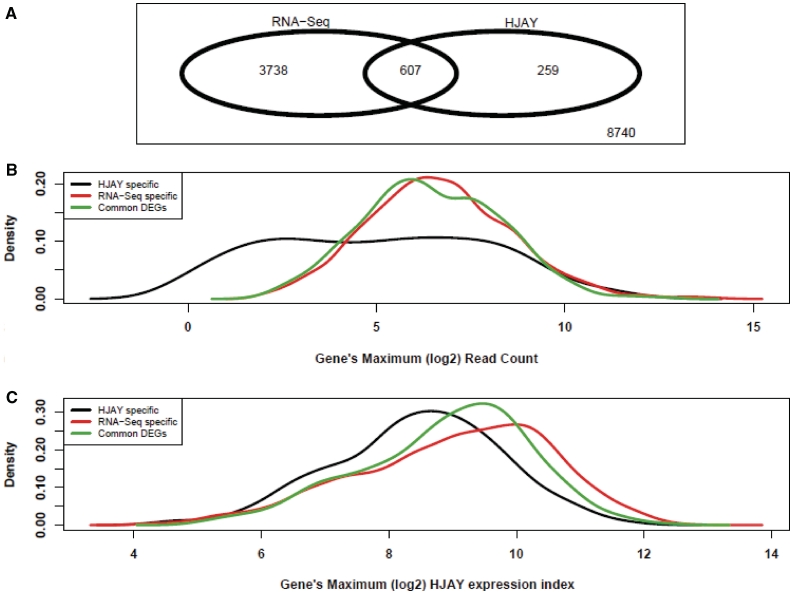
RNA-Seq has emerged as a revolutionary technology for transcriptome analysis. In this article, we report a systematic comparison of RNA-Seq and high-density exon array for detecting differential gene expression between closely related species. On a panel of human/chimpanzee/rhesus cerebellum RNA samples previously examined by the high-density human exon junction array (HJAY) and real-time qPCR, we generated 48.68 million RNA-Seq reads. Our results indicate that RNA-Seq has significantly improved gene coverage and increased sensitivity for differentially expressed genes compared with the high-density HJAY array. Meanwhile, we observed a systematic increase in the RNA-Seq error rate for lowly expressed genes. Specifically, between-species DEGs detected by array/qPCR but missed by RNA-Seq were characterized by relatively low expression levels, as indicated by lower RNA-Seq read counts, lower HJAY array expression indices and higher qPCR raw cycle threshold values. Furthermore, this issue was not unique to between-species comparisons of gene expression. In the RNA-Seq analysis of MicroArray Quality Control human reference RNA samples with extensive qPCR data, we also observed an increase in both the false-negative rate and the false-positive rate for lowly expressed genes. These findings have important implications for the design and data interpretation of RNA-Seq studies on gene expression differences between and within species.
Overview
The claims and statistics of this paper haven’t been checked yet.
Free: it reads the open-access text and checks the first 5 claims that cite a source we can check. Create a free account to check every claim.
Integrity signals
Registry
Cites
Statistics
Figures



Verification
Claims the paper makes
The claims and statistics of this paper haven’t been checked yet.
Free: it reads the open-access text and checks the first 5 claims that cite a source we can check. Create a free account to check every claim.
Self-check
Percentages, sums and reported differences re-computed from the paper’s own numbers.
The self-check needs the paper’s full text.
Citations
Cites
Controlling the False Discovery Rate: A Practical and Powerful Approach to Multiple Testing
Benjamini, Y., & Hochberg, Y. (1995) · Journal of the Royal Statistical Society Series B: Statistical Methodology · doi:10.1111/j.2517-6161.1995.tb02031.x · Cited by 109,482
Mapping and quantifying mammalian transcriptomes by RNA-Seq
Mortazavi, A., Williams, B. A., McCue, K., Schaeffer, L., & Wold, B. (2008) · Nature Methods · doi:10.1038/nmeth.1226 · Cited by 13,696
RNA-Seq: a revolutionary tool for transcriptomics
Wang, Z., Gerstein, M., & Snyder, M. (2009) · Nature Reviews Genetics · doi:10.1038/nrg2484 · Cited by 13,174 · cited 2×
“These results are consistent with other studies reporting that RNA-Seq has a better dynamic range for gene expression levels and increased power to detect DEGs (20).”
BackgroundResultSmyth, G. K. (2004) · Statistical Applications in Genetics and Molecular Biology · doi:10.2202/1544-6115.1027 · Cited by 11,829
Alternative isoform regulation in human tissue transcriptomes
Wang, E. T., Sandberg, R., Luo, S., Khrebtukova, I., Zhang, L., Mayr, C., Kingsmore, S. F., Schroth, G. P., & Burge, C. B. (2008) · Nature · doi:10.1038/nature07509 · Cited by 5,181
RNA-seq: An assessment of technical reproducibility and comparison with gene expression arrays
Marioni, J. C., Mason, C. E., Mane, S. M., Stephens, M., & Gilad, Y. (2008) · Genome Research · doi:10.1101/gr.079558.108 · Cited by 2,771
MAQC Consortium, Shi, L., Shi, L., Reid, L. H., Jones, W. D., Shippy, R., Warrington, J. A., Baker, S. C., Collins, P. J., de Longueville, F., et al. (2006) · Nature Biotechnology · doi:10.1038/nbt1239 · Cited by 2,126 · cited 4×
“Does RNA-Seq also tend to have increased false positives for lowly expressed genes? To address these questions, we compared RNA-Seq and TaqMan qPCR data of two human reference RNA samples in the MAQC project (35).”
BackgroundMethodInfluentialBullard, J. H., Purdom, E., Hansen, K. D., & Dudoit, S. (2010) · BMC Bioinformatics · doi:10.1186/1471-2105-11-94 · Cited by 1,680 · cited 1×
“Nonetheless, the MAQC samples have been used extensively for assessing gene expression platforms and statistical methods of data analysis (35,39).”
MethodSultan, M., Schulz, M. H., Richard, H., Magen, A., Klingenhoff, A., Scherf, M., Seifert, M., Borodina, T., Soldatov, A., Parkhomchuk, D., et al. (2008) · Science · doi:10.1126/science.1160342 · Cited by 1,293
Stem cell transcriptome profiling via massive-scale mRNA sequencing
Cloonan, N., Forrest, A. R. R., Kolle, G., Gardiner, B. B. A., Faulkner, G. J., Brown, M. K., Taylor, D. F., Steptoe, A. L., Wani, S., Bethel, G., et al. (2008) · Nature Methods · doi:10.1038/nmeth.1223 · Cited by 1,035 · cited 1×
“Although our finding appears to contradict the general assumption that RNA-Seq is particularly suitable for analysis of lowly expressed genes as compared with microarrays (23,24), it is not entirely unexpected.”
Result
Cited by
Items 101–146 of 146
Araújo, W. L., Nunes‐Nesi, A., & Williams, T. C. R. (2012) · Frontiers in Plant Science · doi:10.3389/fpls.2012.00210 · Cited by 11
Pérez, D., Richards, M. P., Parker, R. S., Berres, M. E., Wright, A., Sifri, M., Sadler, N., Tatiyaborworntham, N., & Li, N. (2015) · Journal of Agricultural and Food Chemistry · doi:10.1021/acs.jafc.5b05433 · Cited by 9
Hennies, H. C. (2015) · Experimental Dermatology · doi:10.1111/exd.12771 · Cited by 9
LncRNA-mediated orchestrations of alternative splicing in the landscape of breast cancer
Kansara, S., Sawant, P., Kaur, T., Garg, M., & Pandey, A. K. (2024) · Biochimica et Biophysica Acta (BBA) - Gene Regulatory Mechanisms · doi:10.1016/j.bbagrm.2024.195017 · Cited by 8
Exon Array Biomarkers for the Differential Diagnosis of Schizophrenia and Bipolar Disorder
Vawter, M. P., Philibert, R. A., Rollins, B. L., Ruppel, P. L., & OSBORN, T. W. (2017) · Complex Psychiatry · doi:10.1159/000485800 · Cited by 9
A wholly defined Agilent microarray spike-in dataset
Zhu, Q., Miecznikowski, J. C., & Halfon, M. S. (2011) · Bioinformatics · doi:10.1093/bioinformatics/btr135 · Cited by 10
The NTD Nanoscope: potential applications and implementations
Winters-Hilt, S. N., Horton-Chao, E., & Morales, E. (2011) · BMC Bioinformatics · doi:10.1186/1471-2105-12-s10-s21 · Cited by 8
Gao, Y., Hu, K., Yang, J., Wang, S., Li, J., Wu, Q.-L., Wang, Z., Chen, N., Lin, L., & Zhang, L. (2021) · Neuropeptides · doi:10.1016/j.npep.2021.102197 · Cited by 8
Self-citationPlant Genetic Engineering and GM Crops: Merits and Demerits
Parray, J. A., Mir, M. Y., & Shameem, N. (2019) · Springer eBooks · doi:10.1007/978-981-13-8840-8_4 · Cited by 6
Credentialing Individual Samples for Proteogenomic Analysis
Zhao, W., Li, J., Akbani, R., Liang, H., & Mills, G. B. (2018) · Molecular & Cellular Proteomics · doi:10.1074/mcp.ra118.000645 · Cited by 5
Jeng, S., Chi, Y.-C., Ma, M.-C., Chan, S.-H., & Sun, H. S. (2021) · Computational Biology and Chemistry · doi:10.1016/j.compbiolchem.2021.107515 · Cited by 6
Algorithms for differential splicing detection using exon arrays: a comparative assessment
Zimmermann, K., Jentsch, M., Rasche, A., Hummel, M., & Leser, U. (2015) · BMC Genomics · doi:10.1186/s12864-015-1322-x · Cited by 4
Statistical modeling for differential transcriptome analysis using RNA-Seq technology
Miecznikowski, J. C., Liu, S., & Ren, X. (2012) · Journal of Solid Tumors · doi:10.5430/jst.v2n5p33 · Cited by 4
Self-citationH., Z., Sun, G., Zhang, C. W., Wang, Q., Dai, Z., Sun, S., & Pan, Y. (2016) · Cited by 3
Evolution and Development of Language
Miller, D. J., & Konopka, G. (2013) · Wiley eBooks · doi:10.1002/9781118707449.ch9 · Cited by 3
Hubé, F., & Francastel, C. (2015) · Non-Coding RNA · doi:10.3390/ncrna1020127 · Cited by 2
Toxicogenomics – A Drug Development Perspective
Wang, Y., Borlak, J. T., & Tong, W. (2013) · Elsevier eBooks · doi:10.1016/b978-0-12-397336-8.00006-9 · Cited by 5
Hess, M., Wildhagen, H., & Ensminger, I. (2013) · Tree Genetics & Genomes · doi:10.1007/s11295-013-0656-2 · Cited by 4
Application of Transcriptomics in Exposed Human Populations: Benzene as an Example
McHale, C. M., Smith, M. T., & Zhang, L. (2016) · Royal Society of Chemistry eBooks · doi:10.1039/9781782624059-00352 · Cited by 2
García-Pupo, L., Ramírez-Sánchez, J., Ratman, D., Perez-Novo, C. A., Declerck, K., Bosscher, K. D., Markakis, M. N., Beemster, G. T. S., Zaldo, A., Núñez-Figueredo, Y., et al. (2017) · Brain Behavior and Immunity · doi:10.1016/j.bbi.2017.04.002 · Cited by 3
RNA-Sequencing and Methylome Analysis
Ketkar, S., & Kulkarni, S. (2014) · Elsevier eBooks · doi:10.1016/b978-0-12-404748-8.00006-x · Cited by 3
Li, H., Li, S., Li, J., Pan, X., & Nie, H. (2025) · Marine Biotechnology · doi:10.1007/s10126-025-10480-7 · Cited by 1
Dago, D. N., Yao, S. D. M., Nafan, D., Koné, A., Silué, S., Dagnogo, O., Dagnogo, D., Kablan, G. J., LALLIE, H. D., Fofana, I. J., et al. (2019) · Journal of Bioinformatics and Sequence Analysis · doi:10.5897/jbsa2018.0110 · Cited by 1
Gene regulatory network modelling with evolutionary algorithms -an integrative approach
Sîrbu, A. (2011) · Dublin City University Open Access Institutional Repository (Dublin City University) · Cited by 1
Assessment of supervised classification methods for the analysis of RNA-seq data
Abuelqumsan, M. (2018) · theses.fr (ABES) · doi:10.70675/05c649d2zcd6az4432z9e71z2a8a5e89b902 · Cited by 1
SURVEY AND SUMMARY Biases in small RNA deep sequencing data
Raabe, C. A., Tang, T., Brosius, J., & Rozhdestvensky, T. S. (2013)
Patterns of cytosine methylation in the genome of Caenorhabditis elegans
Okamoto, K. (2013) · University of New Hampshire Scholars Repository (University of New Hampshire at Manchester)
Making microarray and RNA-seq gene expression data comparable
Uziela, K. (2012) · Aaltodoc (Aalto University) · Cited by 1
THE NUANCES OF STATISTICALLY ANALYZING NEXT-GENERATION SEQUENCING DATA
Srivastava, S., & Doerge, R. W. (2012) · Conference on Applied Statistics in Agriculture · doi:10.4148/2475-7772.1038
Investigation of the mechanisms mediating genetic associations with atrial fibrillation
Martin, R. I. R. (2015)
Ambient temperature‐directed flowering time regulation : the role of alternative splicing
Verhage, D. S. L. (2017) · doi:10.18174/393113
Identification and analysis of intermediate-size noncoding RNAs in the rhesus macaque fetal brain
Zhu, L., Tan, X., Liu, W., Mao, F., Wu, C., Zhou, J., Liu, X., Lu, S., Ma, K., Yin, B., et al. (2017) · Journal of genetics and genomics/Journal of Genetics and Genomics · doi:10.1016/j.jgg.2017.01.003
Optimized Exon-Exon Junction Library and its Application on Rodents' Brain Transcriptome Analysis
Dou, T., Gao, Y., Chen, C., Xu, M., Fu, M., Zhang, L. N., & Zhou, Y. (2017) · Brazilian Archives of Biology and Technology · doi:10.1590/1678-4324-2016160240
Yang, Z., & Tsui, S. K. (2017) · bioRxiv (Cold Spring Harbor Laboratory) · doi:10.1101/200915
Trans-species Transcriptomic Comparison of in vitro and in vivo Neural Cells
LoVerso, P. R. (2015) · RIT Scholar Works (Rochester Institute of Technology)
Ishimota, M., Kodama, M., AKEMA, S., Fujiwara, C., Koyama, A., Tomiyama, N., & Ohyama, K. (2026) · The Science of The Total Environment · doi:10.1016/j.scitotenv.2026.181349
Caractérisation de la reprogrammation de l'expression des gènes chez les blés allopyloïdes
Chalabi, S. (2014) · theses.fr (ABES) · doi:10.70675/bee96c14z587dz44d5zad96z53a7d6126cec · Cited by 1
Xing, H., & Zhao, Y. (2026) · BMC Genomics · doi:10.1186/s12864-026-13046-6
Liu, K., Lian, H., Jin, Y., Yin, Q., Liu, X., Yang, Z., & Liu, L. (2026) · Microbiological Research · doi:10.1016/j.micres.2026.128752
Décrypter les données omiques : importance du contrôle qualité. Application au cancer de l'ovaire
Sambourg, L. (2013) · theses.fr (ABES) · doi:10.70675/1d91eb8bzbee9z49b6zbccfzeffd6c25336e · Cited by 2
Metadata
- Authors
- Liu, S., Lin, L., Jiang, P., Wang, D., & Xing, Y.
- Affiliations
- University of Iowa (US)
- Corresponding author
- Xing, Yi
- Venue
- Nucleic Acids Research
- Publisher
- Oxford University Press (OUP)
- Published
- 2010-09-22
- Volume
- 39
- Issue
- 2
- Pages
- 578-588
- ISSN
- 0305-1048 (ISSN-L)
- 1362-4962
- PMC
- PMC3025565
- OpenAlex
- W2149517369
- Cited by
- 146
- References
- 39
- Citations by year
- 2026: 3 · 2025: 1 · 2024: 2 · 2022: 2 · 2021: 5 · 2020: 3 · 2019: 9 · 2018: 8 · 2017: 9 · 2016: 8 · 2015: 20 · 2014: 20 · 2013: 19 · 2012: 19
- FWCI
- 7.30
- Type
- journal article
- Language
- en
- Open access
- gold
- doi.org
- Licence
- Locations
- Nucleic Acids Research (publishedVersion, cc-by-nc)
- PubMed Central (publishedVersion, cc-by-nc)
- PubMed (publishedVersion)
- Funders
- National Institutes of Health (RR013986, RR024979)
- National Human Genome Research Institute (R01HG004634)
- National Institute of General Medical Sciences (R01GM088342)
- National Center for Research Resources (RR-013986, P51RR013986, UL1RR024979, RR024979)
- Topics
- Life Sciences › Biochemistry, Genetics and Molecular Biology › Molecular Biology › Genomics and Phylogenetic Studies
- Life Sciences › Biochemistry, Genetics and Molecular Biology › Molecular Biology › Gene expression and cancer classification
- Life Sciences › Biochemistry, Genetics and Molecular Biology › Molecular Biology › Single-cell and spatial transcriptomics
- Keywords
- RNA-seq, differential gene expression, closely related species, lowly expressed genes, false negative rate, false positive rate, gene coverage, qPCR validation
- MeSH terms
- Animals, Cerebellum, Pan troglodytes, Exons, Humans, Macaca mulatta, Reference Standards, RNA, Polymerase Chain Reaction, Sequence Analysis, RNA, Oligonucleotide Array Sequence Analysis, Gene Expression Profiling
About these checks
Registry, retraction, Cites and statistics results are computed, not judged, with one exception: a printed reference that no index lists is read once by a model before it counts as a citation error. Claims are extracted by a model and kept only when their quote appears verbatim in the text; each cited source is then checked, with a model’s help, for whether it says what the claim relies on. Those verdicts can be wrong — read the claim’s quote and the cited source before relying on one.
Statistics and arithmetic are recomputed, not judged.
Confidence bands are shown only for fields calibrated on our annotated test set. None is calibrated yet, so no band is shown.
What counts as a claim ›How we measure confidence ›How we check this ›
Are you an author, or do you see a problem with this page? Request a review
Data sources
Bibliographic data: Semantic Scholar, OpenAlex, Crossref.
Contains information from the Semantic Scholar Academic Graph Datasets, made available under the ODC Attribution License (ODC-BY 1.0).
Semantic Scholar’s data is described in: Kinney, R., et al. (2023). The Semantic Scholar Open Data Platform. arXiv:2301.10140.
