

A comparison of RNA-Seq and high-density exon array for detecting differential gene expression between closely related species
Open accessThe DOI matches its Crossref record; 39 of the 39 references it cites were found in a registry or an index.
Abstract
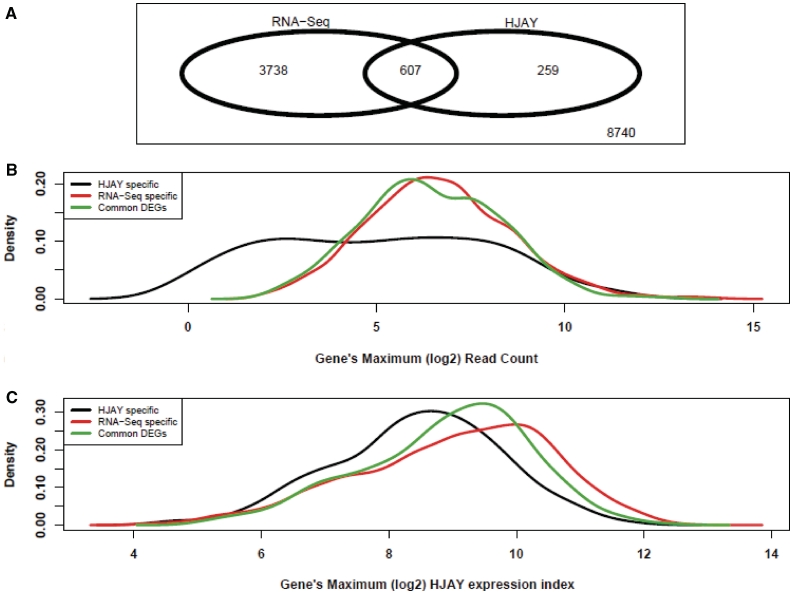
RNA-Seq has emerged as a revolutionary technology for transcriptome analysis. In this article, we report a systematic comparison of RNA-Seq and high-density exon array for detecting differential gene expression between closely related species. On a panel of human/chimpanzee/rhesus cerebellum RNA samples previously examined by the high-density human exon junction array (HJAY) and real-time qPCR, we generated 48.68 million RNA-Seq reads. Our results indicate that RNA-Seq has significantly improved gene coverage and increased sensitivity for differentially expressed genes compared with the high-density HJAY array. Meanwhile, we observed a systematic increase in the RNA-Seq error rate for lowly expressed genes. Specifically, between-species DEGs detected by array/qPCR but missed by RNA-Seq were characterized by relatively low expression levels, as indicated by lower RNA-Seq read counts, lower HJAY array expression indices and higher qPCR raw cycle threshold values. Furthermore, this issue was not unique to between-species comparisons of gene expression. In the RNA-Seq analysis of MicroArray Quality Control human reference RNA samples with extensive qPCR data, we also observed an increase in both the false-negative rate and the false-positive rate for lowly expressed genes. These findings have important implications for the design and data interpretation of RNA-Seq studies on gene expression differences between and within species.
Overview
The claims and statistics of this paper haven’t been checked yet.
Free: it reads the open-access text and checks the first 5 claims that cite a source we can check. Create a free account to check every claim.
Integrity signals
Registry
Cites
Statistics
Figures



Verification
Claims the paper makes
The claims and statistics of this paper haven’t been checked yet.
Free: it reads the open-access text and checks the first 5 claims that cite a source we can check. Create a free account to check every claim.
Self-check
Percentages, sums and reported differences re-computed from the paper’s own numbers.
The self-check needs the paper’s full text.
Citations
Cites
Controlling the False Discovery Rate: A Practical and Powerful Approach to Multiple Testing
Benjamini, Y., & Hochberg, Y. (1995) · Journal of the Royal Statistical Society Series B: Statistical Methodology · doi:10.1111/j.2517-6161.1995.tb02031.x · Cited by 109,482
Mapping and quantifying mammalian transcriptomes by RNA-Seq
Mortazavi, A., Williams, B. A., McCue, K., Schaeffer, L., & Wold, B. (2008) · Nature Methods · doi:10.1038/nmeth.1226 · Cited by 13,696
RNA-Seq: a revolutionary tool for transcriptomics
Wang, Z., Gerstein, M., & Snyder, M. (2009) · Nature Reviews Genetics · doi:10.1038/nrg2484 · Cited by 13,174 · cited 2×
“These results are consistent with other studies reporting that RNA-Seq has a better dynamic range for gene expression levels and increased power to detect DEGs (20).”
BackgroundResultSmyth, G. K. (2004) · Statistical Applications in Genetics and Molecular Biology · doi:10.2202/1544-6115.1027 · Cited by 11,829
Alternative isoform regulation in human tissue transcriptomes
Wang, E. T., Sandberg, R., Luo, S., Khrebtukova, I., Zhang, L., Mayr, C., Kingsmore, S. F., Schroth, G. P., & Burge, C. B. (2008) · Nature · doi:10.1038/nature07509 · Cited by 5,181
RNA-seq: An assessment of technical reproducibility and comparison with gene expression arrays
Marioni, J. C., Mason, C. E., Mane, S. M., Stephens, M., & Gilad, Y. (2008) · Genome Research · doi:10.1101/gr.079558.108 · Cited by 2,771
MAQC Consortium, Shi, L., Shi, L., Reid, L. H., Jones, W. D., Shippy, R., Warrington, J. A., Baker, S. C., Collins, P. J., de Longueville, F., et al. (2006) · Nature Biotechnology · doi:10.1038/nbt1239 · Cited by 2,126 · cited 4×
“Does RNA-Seq also tend to have increased false positives for lowly expressed genes? To address these questions, we compared RNA-Seq and TaqMan qPCR data of two human reference RNA samples in the MAQC project (35).”
BackgroundMethodInfluentialBullard, J. H., Purdom, E., Hansen, K. D., & Dudoit, S. (2010) · BMC Bioinformatics · doi:10.1186/1471-2105-11-94 · Cited by 1,680
Sultan, M., Schulz, M. H., Richard, H., Magen, A., Klingenhoff, A., Scherf, M., Seifert, M., Borodina, T., Soldatov, A., Parkhomchuk, D., et al. (2008) · Science · doi:10.1126/science.1160342 · Cited by 1,293
Stem cell transcriptome profiling via massive-scale mRNA sequencing
Cloonan, N., Forrest, A. R. R., Kolle, G., Gardiner, B. B. A., Faulkner, G. J., Brown, M. K., Taylor, D. F., Steptoe, A. L., Wani, S., Bethel, G., et al. (2008) · Nature Methods · doi:10.1038/nmeth.1223 · Cited by 1,035 · cited 1×
“Although our finding appears to contradict the general assumption that RNA-Seq is particularly suitable for analysis of lowly expressed genes as compared with microarrays (23,24), it is not entirely unexpected.”
ResultIntra- and Interspecific Variation in Primate Gene Expression Patterns
Enard, W., Khaitovich, P., Klose, J., Zöllner, S., Heissig, F., Giavalisco, P., Nieselt-Struwe, K., Muchmore, E., Varki, A., Ravid, R., et al. (2002) · Science · doi:10.1126/science.1068996 · Cited by 845
Parallel Patterns of Evolution in the Genomes and Transcriptomes of Humans and Chimpanzees
Khaitovich, P., Hellmann, I., Enard, W., Nowick, K., Leinweber, M., Franz, H., Weiss, G., Lachmann, M., & Pääbo, S. (2005) · Science · doi:10.1126/science.1108296 · Cited by 592
The UCSC Genome Browser database: update 2010
Rhead, B., Karolchik, D., Kuhn, R. M., Hinrichs, A. S., Zweig, A. S., Fujita, P. A., Diekhans, M., Smith, K. E., Rosenbloom, K. R., Raney, B. J., et al. (2010) · Nucleic Acids Research · doi:10.1093/nar/gkp939 · Cited by 568
Hsu, F., Kent, W. J., Clawson, H., Kuhn, R. M., Diekhans, M., & Haussler, D. (2006) · Bioinformatics · doi:10.1093/bioinformatics/btl048 · Cited by 502
On the utility of pooling biological samples in microarray experiments
Kendziorski, C., Irizarry, R. A., Chen, K.-S., Haag, J. D., & Gould, M. N. (2005) · Proceedings of the National Academy of Sciences · doi:10.1073/pnas.0500607102 · Cited by 499
Transcript length bias in RNA-seq data confounds systems biology
Oshlack, A., & Wakefield, M. J. (2009) · Biology Direct · doi:10.1186/1745-6150-4-14 · Cited by 497 · cited 1×
“Recent work on RNA-Seq has revealed a potential detection bias toward differential expression of genes with long transcripts (36).”
BackgroundElevated gene expression levels distinguish human from non-human primate brains
Cáceres, M., Lachuer, J., Zapala, M. A., Redmond, J. C., Kudo, L., Geschwind, D. H., Lockhart, D. J., Preuss, T. M., & Barlow, C. (2003) · Proceedings of the National Academy of Sciences · doi:10.1073/pnas.2135499100 · Cited by 491
SeqMap: mapping massive amount of oligonucleotides to the genome
Jiang, H., & Wong, W. H. (2008) · Bioinformatics · doi:10.1093/bioinformatics/btn429 · Cited by 471
Comparing the human and chimpanzee genomes: Searching for needles in a haystack
Varki, A., & Altheide, T. K. (2005) · Genome Research · doi:10.1101/gr.3737405 · Cited by 344
Evolution of primate gene expression
Khaitovich, P., Enard, W., Lachmann, M., & Pääbo, S. (2006) · Nature Reviews Genetics · doi:10.1038/nrg1940 · Cited by 341 · cited 1×
“These studies offer important insight into human evolution and diseases (1,3).”
BackgroundExpression profiling in primates reveals a rapid evolution of human transcription factors
Gilad, Y., Oshlack, A., Smyth, G. K., Speed, T. P., & White, K. P. (2006) · Nature · doi:10.1038/nature04559 · Cited by 329
Regional Patterns of Gene Expression in Human and Chimpanzee Brains
Khaitovich, P., Muetzel, B., She, X., Lachmann, M., Hellmann, I., Dietzsch, J., Steigele, S., Do, H.-H., Weiss, G., Enard, W., et al. (2004) · Genome Research · doi:10.1101/gr.2538704 · Cited by 311
Haygood, R., Fedrigo, O., Hanson, B., Yokoyama, K.-D., & Wray, G. A. (2007) · Nature Genetics · doi:10.1038/ng2104 · Cited by 308
Statistical implications of pooling RNA samples for microarray experiments
Peng, X., Wood, C. L., Blalock, E. M., Chen, K. C., Landfield, P. W., & Stromberg, A. J. (2003) · BMC Bioinformatics · doi:10.1186/1471-2105-4-26 · Cited by 298
28-Way vertebrate alignment and conservation track in the UCSC Genome Browser
Miller, W., Rosenbloom, K., Hardison, R. C., Hou, M., Taylor, J., Raney, B., Burhans, R., King, D. C., Baertsch, R., Blankenberg, D., et al. (2007) · Genome Research · doi:10.1101/gr.6761107 · Cited by 279
Sex-specific and lineage-specific alternative splicing in primates
Blekhman, R., Marioni, J. C., Zumbo, P., Stephens, M., & Gilad, Y. (2010) · Genome Research · doi:10.1101/gr.099226.109 · Cited by 267
Uddin, M., Wildman, D. E., Liu, G., Xu, W., Johnson, R. M., Hof, P. R., Kapatos, G., Grossman, L. I., & Goodman, M. (2004) · Proceedings of the National Academy of Sciences · doi:10.1073/pnas.0308725100 · Cited by 238
Human brain evolution: insights from microarrays
Preuss, T. M., Cáceres, M., Oldham, M. C., & Geschwind, D. H. (2004) · Nature Reviews Genetics · doi:10.1038/nrg1469 · Cited by 215
Natural selection on gene expression
Gilad, Y., Oshlack, A., & Rifkin, S. A. (2006) · Trends in Genetics · doi:10.1016/j.tig.2006.06.002 · Cited by 215
Multi-species microarrays reveal the effect of sequence divergence on gene expression profiles
Gilad, Y., Rifkin, S. A., Bertone, P., Gerstein, M., & White, K. P. (2005) · Genome Research · doi:10.1101/gr.3335705 · Cited by 170
Gene Regulation in Primates Evolves under Tissue-Specific Selection Pressures
Blekhman, R., Oshlack, A., Chabot, A. E., Smyth, G. K., & Gilad, Y. (2008) · PLoS Genetics · doi:10.1371/journal.pgen.1000271 · Cited by 158
Metabolic changes in schizophrenia and human brain evolution
Khaitovich, P., Lockstone, H. E., Wayland, M. T., Tsang, T. M., Jayatilaka, S. D., Guo, A. J., Zhou, J., Somel, M., Harris, L. W., Holmes, E., et al. (2008) · Genome Biology · doi:10.1186/gb-2008-9-8-r124 · Cited by 113
Exon arrays provide accurate assessments of gene expression
Kapur, K., Xing, Y., Ouyang, Z., & Wong, W. H. (2007) · Genome Biology · doi:10.1186/gb-2007-8-5-r82 · Cited by 113
Self-citationProbe Selection and Expression Index Computation of Affymetrix Exon Arrays
Xing, Y., Kapur, K., & Wong, W. H. (2006) · PLoS ONE · doi:10.1371/journal.pone.0000088 · Cited by 85
Self-citationUsing DNA microarrays to study gene expression in closely related species
Oshlack, A., Chabot, A. E., Smyth, G. K., & Gilad, Y. (2007) · Bioinformatics · doi:10.1093/bioinformatics/btm111 · Cited by 65
Alternative pre-mRNA splicing switches modulate gene expression in late erythropoiesis
Yamamoto, M. L., Clark, T. A., Gee, S. L., Kang, J.-A., Schweitzer, A. C., Wickrema, A., & Conboy, J. G. (2009) · Blood · doi:10.1182/blood-2008-05-160325 · Cited by 59
Using DNA microarrays to study natural variation
Gilad, Y., & Borevitz, J. (2006) · Current Opinion in Genetics & Development · doi:10.1016/j.gde.2006.09.005 · Cited by 58
MADS+: discovery of differential splicing events from Affymetrix exon junction array data
Shen, S., Warzecha, C. C., Carstens, R. P., & Xing, Y. (2010) · Bioinformatics · doi:10.1093/bioinformatics/btp643 · Cited by 38
Self-citationUsing high-density exon arrays to profile gene expression in closely related species
Lin, L., Liu, S., Brockway, H., Seok, J., Jiang, P., Wong, W. H., & Xing, Y. (2009) · Nucleic Acids Research · doi:10.1093/nar/gkp420 · Cited by 24
Self-citation
Cited by
Dillies, M.-A., Rau, A., Aubert, J., Hennequet-Antier, C., Jeanmougin, M., Servant, N., Keime, C., Marot, G., Castel, D., Estelle, J., et al. (2013) · Briefings in Bioinformatics · doi:10.1093/bib/bbs046 · Cited by 1,298
SEQC/MAQC-III Consortium (2014) · Nature Biotechnology · doi:10.1038/nbt.2957 · Cited by 983
Microarrays, deep sequencing and the true measure of the transcriptome
Malone, J. H., & Oliver, B. (2011) · BMC Biology · doi:10.1186/1741-7007-9-34 · Cited by 548
Evolution of human-specific neural SRGAP2 genes by incomplete segmental duplication
Dennis, M. Y., Nuttle, X., Sudmant, P. H., Antonacci, F., Graves, T. A., Nefedov, M., Rosenfeld, J. A., Sajjadian, S., Malig, M., Kotkiewicz, H., et al. (2012) · Cell · doi:10.1016/j.cell.2012.03.033 · Cited by 407
Li, B., Tsoi, L. C., Swindell, W. R., Gudjonsson, J. E., Tejasvi, T., Johnston, A., Ding, J., Stuart, P. E., Xing, X., Kochkodan, J. J., et al. (2014) · Journal of Investigative Dermatology · doi:10.1038/jid.2014.28 · Cited by 397
Metadata
- Authors
- Liu, S., Lin, L., Jiang, P., Wang, D., & Xing, Y.
- Affiliations
- University of Iowa (US)
- Corresponding author
- Xing, Yi
- Venue
- Nucleic Acids Research
- Publisher
- Oxford University Press (OUP)
- Published
- 2010-09-22
- Volume
- 39
- Issue
- 2
- Pages
- 578-588
- ISSN
- 0305-1048 (ISSN-L)
- 1362-4962
- PMC
- PMC3025565
- OpenAlex
- W2149517369
- Cited by
- 146
- References
- 39
- Citations by year
- 2026: 3 · 2025: 1 · 2024: 2 · 2022: 2 · 2021: 5 · 2020: 3 · 2019: 9 · 2018: 8 · 2017: 9 · 2016: 8 · 2015: 20 · 2014: 20 · 2013: 19 · 2012: 19
- FWCI
- 7.30
- Type
- journal article
- Language
- en
- Open access
- gold
- doi.org
- Licence
- Locations
- Nucleic Acids Research (publishedVersion, cc-by-nc)
- PubMed Central (publishedVersion, cc-by-nc)
- PubMed (publishedVersion)
- Funders
- National Institutes of Health (RR013986, RR024979)
- National Human Genome Research Institute (R01HG004634)
- National Institute of General Medical Sciences (R01GM088342)
- National Center for Research Resources (RR-013986, P51RR013986, UL1RR024979, RR024979)
- Topics
- Life Sciences › Biochemistry, Genetics and Molecular Biology › Molecular Biology › Genomics and Phylogenetic Studies
- Life Sciences › Biochemistry, Genetics and Molecular Biology › Molecular Biology › Gene expression and cancer classification
- Life Sciences › Biochemistry, Genetics and Molecular Biology › Molecular Biology › Single-cell and spatial transcriptomics
- Keywords
- RNA-seq, differential gene expression, closely related species, lowly expressed genes, false negative rate, false positive rate, gene coverage, qPCR validation
- MeSH terms
- Animals, Cerebellum, Pan troglodytes, Exons, Humans, Macaca mulatta, Reference Standards, RNA, Polymerase Chain Reaction, Sequence Analysis, RNA, Oligonucleotide Array Sequence Analysis, Gene Expression Profiling
About these checks
Registry, retraction, Cites and statistics results are computed, not judged, with one exception: a printed reference that no index lists is read once by a model before it counts as a citation error. Claims are extracted by a model and kept only when their quote appears verbatim in the text; each cited source is then checked, with a model’s help, for whether it says what the claim relies on. Those verdicts can be wrong — read the claim’s quote and the cited source before relying on one.
Statistics and arithmetic are recomputed, not judged.
Confidence bands are shown only for fields calibrated on our annotated test set. None is calibrated yet, so no band is shown.
What counts as a claim ›How we measure confidence ›How we check this ›
Are you an author, or do you see a problem with this page? Request a review
Data sources
Bibliographic data: Semantic Scholar, OpenAlex, Crossref.
Contains information from the Semantic Scholar Academic Graph Datasets, made available under the ODC Attribution License (ODC-BY 1.0).
Semantic Scholar’s data is described in: Kinney, R., et al. (2023). The Semantic Scholar Open Data Platform. arXiv:2301.10140.
