

The DOI matches its Crossref record; 6 of the 6 references it cites were found in a registry or an index.
The Reactome pathway Knowledgebase
Open accessAbstract
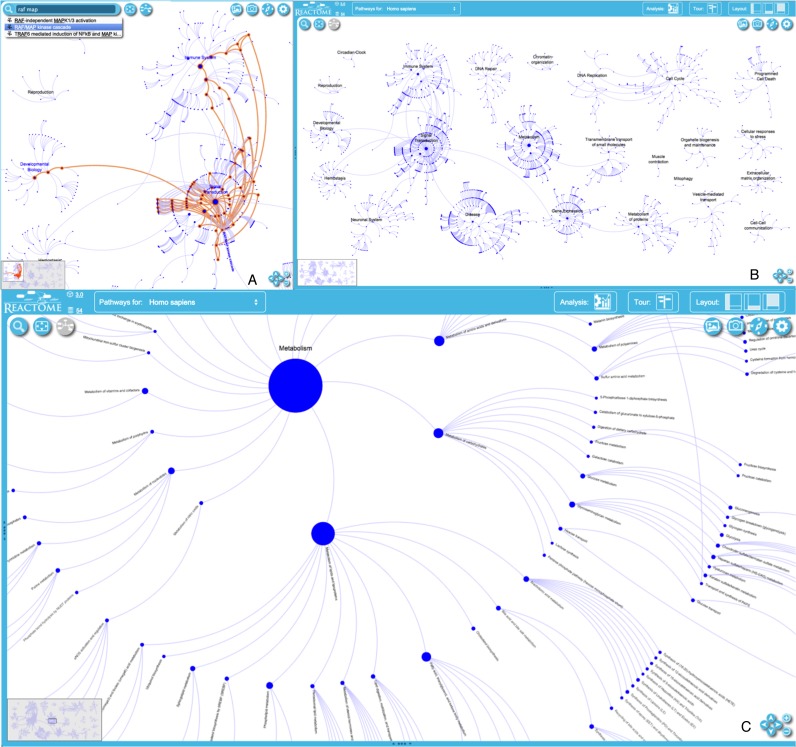
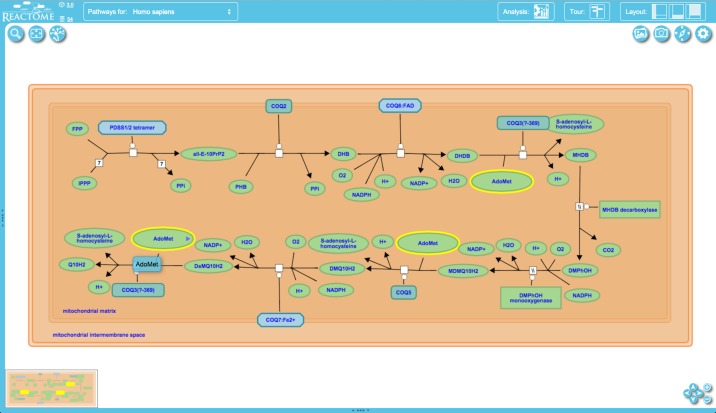
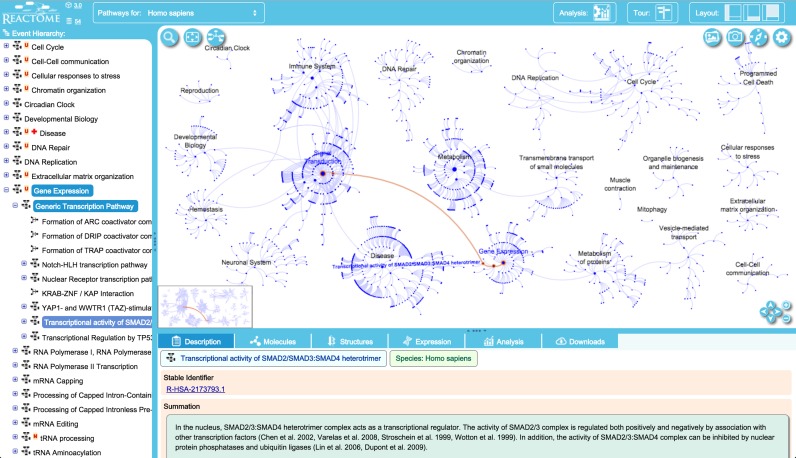
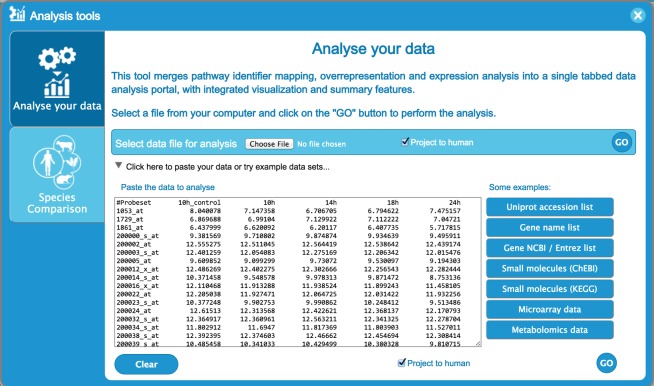
The Reactome Knowledgebase (www.reactome.org) provides molecular details of signal transduction, transport, DNA replication, metabolism and other cellular processes as an ordered network of molecular transformations-an extended version of a classic metabolic map, in a single consistent data model. Reactome functions both as an archive of biological processes and as a tool for discovering unexpected functional relationships in data such as gene expression pattern surveys or somatic mutation catalogues from tumour cells. Over the last two years we redeveloped major components of the Reactome web interface to improve usability, responsiveness and data visualization. A new pathway diagram viewer provides a faster, clearer interface and smooth zooming from the entire reaction network to the details of individual reactions. Tool performance for analysis of user datasets has been substantially improved, now generating detailed results for genome-wide expression datasets within seconds. The analysis module can now be accessed through a RESTFul interface, facilitating its inclusion in third party applications. A new overview module allows the visualization of analysis results on a genome-wide Reactome pathway hierarchy using a single screen page. The search interface now provides auto-completion as well as a faceted search to narrow result lists efficiently.
Overview
The claims and statistics of this paper haven’t been checked yet.
Run the check — free, no account needed. It reads the open-access text and checks the sources it cites.
Integrity signals
Registry
Cites
Statistics
Figures
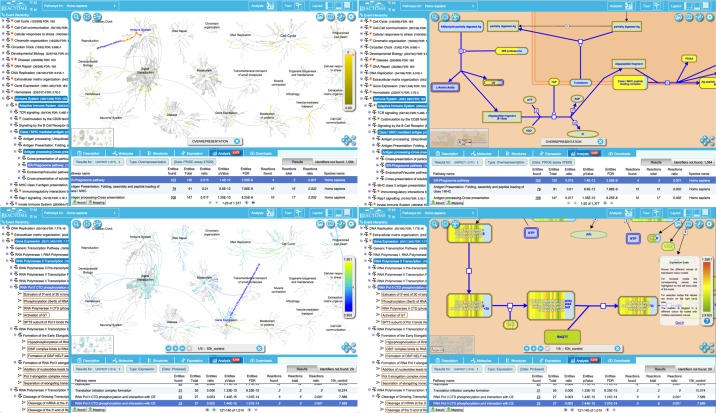
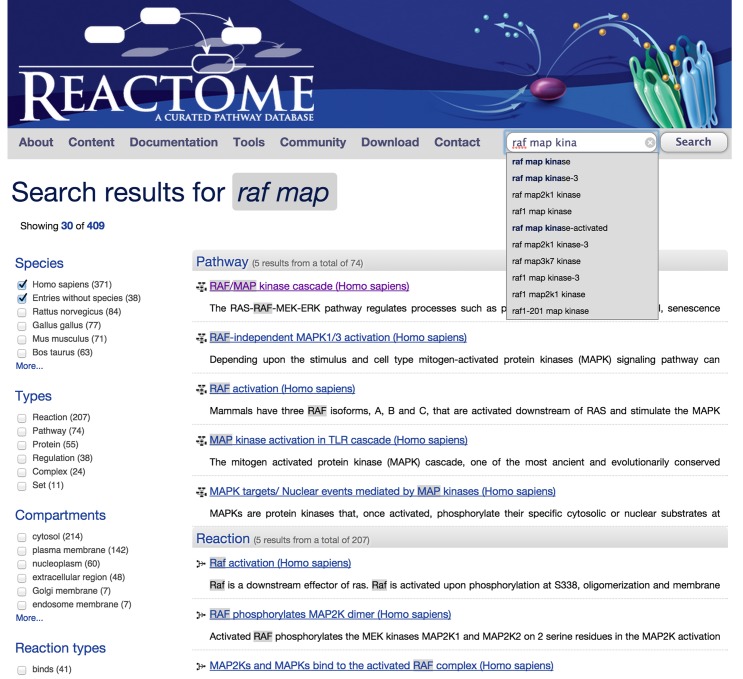
Verification
Claims the paper makes
The claims and statistics of this paper haven’t been checked yet.
Run the check — free, no account needed. It reads the open-access text and checks the sources it cites.
Claims other papers make about this one
Each is checked against this paper’s own text: does it say what the citing paper says it does?
The cited source says what the claim attributes to it.
In the citing paper
“Gene set enrichment analysis21 (Fig. 5c and Supplementary Data 7) reveals that cluster 7 is enriched in genes related to antigen presentation, while the closely related clusters 5 and 6 feature genes related to anti-inflammatory responses (IL-10, IL-4, and IL-13).”
From Single cell RNA sequencing of human microglia uncovers a subset associated with Alzheimer’s disease (2020) · cites this paper as [21]
Self-check
Percentages, sums and reported differences re-computed from the paper’s own numbers.
The self-check needs the paper’s full text.
Citations
Cites
Gene Ontology: tool for the unification of biology
Ashburner, M., Ball, C. A., Blake, J. A., Botstein, D., Butler, H., Cherry, J. M., Davis, A. P., Dolinski, K., Dwight, S. S., Eppig, J. T., et al. (2000) · Nature Genetics · doi:10.1038/75556 · Cited by 43,206
Caspi, R., Billington, R., Ferrer, L., Foerster, H., Fulcher, C. A., Keseler, I. M., Kothari, A., Krummenacker, M., Latendresse, M., Mueller, L. A., et al. (2016) · Nucleic Acids Research · doi:10.1093/nar/gkv1164 · Cited by 3,395
Pancreatic cancer genomes reveal aberrations in axon guidance pathway genes
Initiative, A. P. C. G., Biankin, A. V., Waddell, N., Kassahn, K. S., Gingras, M.-C., Muthuswamy, L. B., Johns, A. L., Miller, D. K., Wilson, P. J., Patch, A.-M., et al. (2012) · Nature · doi:10.1038/nature11547 · Cited by 2,058
Self-citationThe BioPAX community standard for pathway data sharing
Demir, E., Cary, M. P., Paley, S., Fukuda, K., Lemer, C., Vastrik, I., Wu, G., D'Eustachio, P., Schaefer, C., Luciano, J., et al. (2010) · Nature Biotechnology · doi:10.1038/nbt.1666 · Cited by 745
Self-citationLibSBML: an API Library for SBML
Bornstein, B. J., Keating, S. M., Jouraku, A., & Hucka, M. (2008) · Bioinformatics · doi:10.1093/bioinformatics/btn051 · Cited by 373
Controlled vocabularies and semantics in systems biology
Courtot, M., Juty, N., Knüpfer, C., Waltemath, D., Zhukova, A., Dräger, A., Dumontier, M., Finney, A., Golebiewski, M., Hastings, J., et al. (2011) · Molecular Systems Biology · doi:10.1038/msb.2011.77 · Cited by 316
Research works printed but not linked: 4
- Croft, 2014, The Reactome Pathway Knowledgebase, Nucleic Acids Res., 4, D472, 10.1093/nar/gkt1102 · DOI · Paper page
- 10.1093/nar/gku1011 · DOI
- 10.1093/nar/gku1179 · DOI · Paper page
- 10.1161/ATVBAHA.113.301147 · DOI
Cited by
Sorted by citations
Szklarczyk, D., Gable, A. L., Lyon, D., Junge, A., Wyder, S., Huerta-Cepas, J., Simonovic, M., Doncheva, N. T., Morris, J. H., Bork, P., et al. (2019) · Nucleic Acids Research · doi:10.1093/nar/gky1131 · Cited by 17,749
Metascape provides a biologist-oriented resource for the analysis of systems-level datasets
Zhou, Y., Zhou, B., Pache, L., Chang, M., Khodabakhshi, A. H., Tanaseichuk, O., Benner, C., & Chanda, S. K. (2019) · Nature Communications · doi:10.1038/s41467-019-09234-6 · Cited by 14,611
STRING v10: protein–protein interaction networks, integrated over the tree of life
Szklarczyk, D., Franceschini, A., Wyder, S., Forslund, K., Heller, D., Huerta-Cepas, J., Simonovic, M., Roth, A., Santos, A., Tsafou, K. P., et al. (2015) · Nucleic Acids Research · doi:10.1093/nar/gku1003 · Cited by 10,436
The Gene Ontology Resource: 20 years and still GOing strong
The Gene Ontology Consortium (2019) · Nucleic Acids Research · doi:10.1093/nar/gky1055 · Cited by 4,747
Raudvere, U., Kolberg, L., Kuzmin, I., Arak, T., Adler, P., Peterson, H., & Vilo, J. (2019) · Nucleic Acids Research · doi:10.1093/nar/gkz369 · Cited by 5,045
Metadata
- Authors
- Fabregat, A., Sidiropoulos, K., Garapati, P., Gillespie, M., Hausmann, K., Haw, R., Jassal, B., Jupe, S., Korninger, F., McKay, S., Matthews, L., May, B., Milacic, M., Rothfels, K., Shamovsky, V., Webber, M., Weiser, J., Williams, M., Wu, G., Stein, L., Hermjakob, H., & D'Eustachio, P.
- Affiliations
- European Bioinformatics Institute (GB)
- Ontario Institute for Cancer Research (CA)
- New York University (US)
- ORCID
- Venue
- Nucleic Acids Research
- Publisher
- Oxford University Press (OUP)
- Published
- 2015-12-09
- Volume
- 44
- Issue
- D1
- Pages
- D481-D487
- ISSN
- 0305-1048 (ISSN-L)
- 1362-4962
- PMC
- PMC4702931
- OpenAlex
- W1989277387
- Cited by
- 5,605
- References
- 6
- Citations by year
- 2026: 18 · 2025: 133 · 2024: 368 · 2023: 491 · 2022: 738 · 2021: 968 · 2020: 827 · 2019: 667 · 2018: 483 · 2017: 386 · 2016: 265 · 2015: 187
- FWCI
- 153.21
- Type
- journal article
- Language
- en
- Open access
- gold
- doi.org
- Locations
- Nucleic Acids Research (publishedVersion, cc-by)
- Europe PMC (PubMed Central) (publishedVersion, cc-by)
- PubMed Central (publishedVersion, cc-by)
- PubMed (publishedVersion)
- Cold Spring Harbor Laboratory Institutional Repository (Cold Spring Harbor Laboratory) (acceptedVersion)
- HighWire Press Open Archive (submittedVersion)
- Funders
- National Institutes of Health
- National Human Genome Research Institute (U41HG003751, P41HG003751)
- National Institute of General Medical Sciences (U54GM114833)
- Topics
- Life Sciences › Biochemistry, Genetics and Molecular Biology › Molecular Biology › Bioinformatics and Genomic Networks
- Health Sciences › Medicine › Health Informatics › Biomedical Text Mining and Ontologies
- Life Sciences › Biochemistry, Genetics and Molecular Biology › Molecular Biology › Gene Regulatory Network Analysis
- Keywords
- Reactome, signal transduction, metabolic maps, cardiovascular disease, disease annotation, gene expression profiles, somatic mutations
- MeSH terms
- Humans, Proteins, Software, Signal Transduction, Gene Expression, Knowledge Bases, Metabolic Networks and Pathways, Databases, Chemical
About these checks
Registry, retraction, Cites and statistics results are computed, not judged, with one exception: a printed reference that no index lists is read once by a model before it counts as a citation error. Claims are extracted by a model and kept only when their quote appears verbatim in the text; each cited source is then checked, with a model’s help, for whether it says what the claim relies on. Those verdicts can be wrong — read the claim’s quote and the cited source before relying on one.
Statistics and arithmetic are recomputed, not judged.
Confidence bands are shown only for fields calibrated on our annotated test set. None is calibrated yet, so no band is shown.
What counts as a claim ›How we measure confidence ›How we check this ›
Are you an author, or do you see a problem with this page? Request a review
