

Epigenomics in 3D: importance of long-range spreading and specific interactions in epigenomic maintenance
Open accessThe DOI matches its Crossref record; 74 of the 74 references it cites were found in a registry or an index.
Abstract
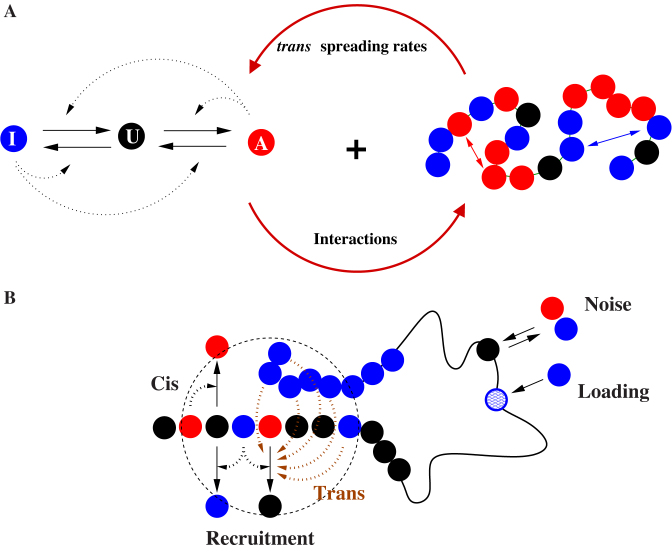
Recent progresses of genome-wide chromatin conformation capture techniques have shown that the genome is segmented into hierarchically organized spatial compartments. However, whether this non-random 3D organization only reflects or indeed contributes-and how-to the regulation of genome function remain to be elucidated. The observation in many species that 3D domains correlate strongly with the 1D epigenomic information along the genome suggests a dynamic coupling between chromatin organization and epigenetic regulation. Here, we posit that chromosome folding may contribute to the maintenance of a robust epigenomic identity via the formation of spatial compartments like topologically-associating domains. Using a novel theoretical framework, the living chromatin model, we show that 3D compartmentalization leads to the spatial colocalization of epigenome regulators, thus increasing their local concentration and enhancing their ability to spread an epigenomic signal at long-range. Interestingly, we find that the presence of 1D insulator elements, like CTCF, may contribute greatly to the stable maintenance of adjacent antagonistic epigenomic domains. We discuss the generic implications of our findings in the light of various biological contexts from yeast to human. Our approach provides a modular framework to improve our understanding and to investigate in details the coupling between the structure and function of chromatin.
Overview
The claims and statistics of this paper haven’t been checked yet.
Free: it reads the open-access text and checks the first 5 claims that cite a source we can check. Create a free account to check every claim.
Integrity signals
Registry
Cites
Statistics
Figures
Verification
Claims the paper makes
The claims and statistics of this paper haven’t been checked yet.
Free: it reads the open-access text and checks the first 5 claims that cite a source we can check. Create a free account to check every claim.
Claims other papers make about this one
Each is checked against this paper’s own text: does it say what the citing paper says it does?
The source backs part of the claim, not all of it — or backs it for a different population, condition or comparison.
In the citing paper
“Indeed, the genome is now known to be hierarchically organized in a series of 3D structures, starting from nucleosome clutches, to chromatin loops, to chromosomal domains called topologically associating domains (TADs), and finally to active or repressive compartments and chromosome territories 15,46,[48][49][50] .”
From Advances in epigenetics link genetics to the environment and disease (2019) · cites this paper as [46]
Experimental — accuracy not yet measuredIn the citing paper
“Mathematical modelling and biological evidence suggest that chromatin heritability requires the establishment of domains of several or even hundreds of kilobases in size [45][46][47] .”
From Advances in epigenetics link genetics to the environment and disease (2019) · cites this paper as [46]
Self-check
Percentages, sums and reported differences re-computed from the paper’s own numbers.
The self-check needs the paper’s full text.
Citations
Cites
A 3D Map of the Human Genome at Kilobase Resolution Reveals Principles of Chromatin Looping
Rao, S. S. P., Huntley, M. H., Durand, N. C., Stamenova, E. K., Bochkov, I. D., Robinson, J. T., Sanborn, A. L., Machol, I., Omer, A. D., Lander, E. S., et al. (2014) · Cell · doi:10.1016/j.cell.2014.11.021 · Cited by 9,212
Understanding Molecular Simulation: From Algorithms to Applications
Frenkel, D., Smit, B., & Ratner, M. A. (1997) · Physics Today · doi:10.1063/1.881812 · Cited by 5,059
Capturing Chromosome Conformation
Dekker, J., Rippe, K., Dekker, M., & Kleckner, N. (2002) · Science · doi:10.1126/science.1067799 · Cited by 3,652
Disruptions of Topological Chromatin Domains Cause Pathogenic Rewiring of Gene-Enhancer Interactions
Lupiáñez, D. G., Kraft, K., Heinrich, V., Krawitz, P., Brancati, F., Klopocki, E., Horn, D., Kayserili, H., Opitz, J. M., Laxova, R., et al. (2015) · Cell · doi:10.1016/j.cell.2015.04.004 · Cited by 2,132 · cited 1×
“Recent studies have shown that disrupting boundaries might lead to concomitant deregulation of 3D chromatin organization, epigenome and genome activity (66).”
BackgroundUnderstanding Molecular Simulation
(2002) · doi:10.1016/b978-0-12-267351-1.x5000-7 · Cited by 2,042
Formation of chromosomal domains by loop extrusion
Fudenberg, G., Imakaev, M., Lu, C., Goloborodko, A., Abdennur, N., & Mirny, L. A. (2016) · Cell Reports · doi:10.1016/j.celrep.2016.04.085 · Cited by 2,003
Three-dimensional folding and functional organization principles of the Drosophila genome
Sexton, T., Yaffe, E., Kenigsberg, E., Bantignies, F., Leblanc, B., Hoichman, M., Parrinello, H., Tanay, A., & Cavalli, G. (2012) · Cell · doi:10.1016/j.cell.2012.01.010 · Cited by 1,983
Phase separation drives heterochromatin domain formation
Strom, A. R., Emelyanov, A. V., Mir, M., Fyodorov, D. V., Darzacq, X., & Karpen, G. H. (2017) · Nature · doi:10.1038/nature22989 · Cited by 1,807
Sanborn, A. L., Rao, S. S. P., Huang, S.-C., Durand, N. C., Huntley, M. H., Jewett, A. I., Bochkov, I. D., Chinnappan, D., Cutkosky, A., Li, J., et al. (2015) · Proceedings of the National Academy of Sciences · doi:10.1073/pnas.1518552112 · Cited by 1,730 · cited 1×
“It would be interesting to experimentally further decipher the role of the spatial folding in that deregulation, for which other mechanisms than self-association, such as the loop-extrusion (67,68) may participate in the regulation of the local compaction.”
BackgroundLiquid droplet formation by HP1α suggests a role for phase separation in heterochromatin
Larson, A. G., Elnatan, D., Keenen, M. M., Trnka, M. J., Johnston, J. B., Burlingame, A. L., Agard, D. A., Redding, S., & Narlikar, G. J. (2017) · Nature · doi:10.1038/nature22822 · Cited by 1,694
Research works printed but not linked: 1
- 3. Allis C., Jenuwein T., Reinberg D. Epigenetics. 2007; NY Cold Spring Harbor Laboratory Press.
Cited by
Advances in epigenetics link genetics to the environment and disease
Cavalli, G., & Heard, E. (2019) · Nature · doi:10.1038/s41586-019-1411-0 · Cited by 1,509
Understanding 3D genome organization by multidisciplinary methods
Jerkovic´, I., & Cavalli, G. (2021) · Nature Reviews Molecular Cell Biology · doi:10.1038/s41580-021-00362-w · Cited by 390
Epigenetic patterns in a complete human genome
Gershman, A., Sauria, M. E. G., Guitart, X., Vollger, M. R., Hook, P. W., Hoyt, S. J., Jain, M., Shumate, A., Razaghi, R., Koren, S., et al. (2022) · Science · doi:10.1126/science.abj5089 · Cited by 297
Two major mechanisms of chromosome organization
Mirny, L. A., Imakaev, M., & Abdennur, N. (2019) · Current Opinion in Cell Biology · doi:10.1016/j.ceb.2019.05.001 · Cited by 230
Transcription organizes euchromatin via microphase separation
Hilbert, L., Sato, Y., Kuznetsova, K., Bianucci, T., Kimurâ, H., Jülicher, F., Honigmann, A., Zaburdaev, V., & Vastenhouw, N. L. (2021) · Nature Communications · doi:10.1038/s41467-021-21589-3 · Cited by 158
From whole-mount to single-cell spatial assessment of gene expression in 3D
Waylen, L. N., Nim, H. T., Martelotto, L. G., & Ramialison, M. (2020) · Communications Biology · doi:10.1038/s42003-020-01341-1 · Cited by 138
Design principles of 3D epigenetic memory systems
Owen, J. A., Osmanović, D., & Mirny, L. (2023) · Science · doi:10.1126/science.adg3053 · Cited by 104
Ghosh, S. K., & Jost, D. (2018) · PLoS Computational Biology · doi:10.1371/journal.pcbi.1006159 · Cited by 101
Self-citationMultiscale modeling of genome organization with maximum entropy optimization
Lin, X., Qi, Y., Latham, A. P., & Zhang, B. (2021) · The Journal of Chemical Physics · doi:10.1063/5.0044150 · Cited by 96
Tortora, M. M. C., Brennan, L. D., Karpen, G. H., & Jost, D. (2023) · Proceedings of the National Academy of Sciences · doi:10.1073/pnas.2211855120 · Cited by 74
Self-citationDesaulniers, D. M., Vasseur, P., Jacobs, A. C., Aguila, M. C., Ertych, N., & Jacobs, M. N. (2021) · International Journal of Molecular Sciences · doi:10.3390/ijms222010969 · Cited by 60
A Review of Mathematical and Computational Methods in Cancer Dynamics
Uthamacumaran, A., & Zenil, H. (2022) · Frontiers in Oncology · doi:10.3389/fonc.2022.850731 · Cited by 52
Physical modeling of the heritability and maintenance of epigenetic modifications
Sandholtz, S. H., MacPherson, Q., & Spakowitz, A. J. (2020) · Proceedings of the National Academy of Sciences · doi:10.1073/pnas.1920499117 · Cited by 49
DNA sequence-dependent formation of heterochromatin nanodomains
Thorn, G. J., Clarkson, C. T., Rademacher, A., Mamayusupova, H., Schotta, G., Rippe, K., & Teif, V. B. (2022) · Nature Communications · doi:10.1038/s41467-022-29360-y · Cited by 48
Salari, H., Stefano, M. D., & Jost, D. (2021) · Genome Research · doi:10.1101/gr.275827.121 · Cited by 47
Self-citationNonequilibrium Theory of Epigenomic Microphase Separation in the Cell Nucleus
Michieletto, D., Colì, D., Marenduzzo, D., & Orlandini, E. (2019) · Physical Review Letters · doi:10.1103/physrevlett.123.228101 · Cited by 44
3D genome folding in epigenetic regulation and cellular memory
Paldi, F., & Cavalli, G. (2025) · Trends in Cell Biology · doi:10.1016/j.tcb.2025.03.001 · Cited by 41
The Epigenetic Machinery in the Life Cycle and Pharmacoepigenetics
Cacabelos, R., Tellado, I., & Cacabelos, P. (2019) · Elsevier eBooks · doi:10.1016/b978-0-12-813939-4.00001-2 · Cited by 37
Predicting genome organisation and function with mechanistic modelling
Chiang, M., Brackley, C. A., Marenduzzo, D., & Gilbert, N. (2021) · Trends in Genetics · doi:10.1016/j.tig.2021.11.001 · Cited by 36
Single cell analysis pushes the boundaries of TAD formation and function
Luppino, J. M., & Joyce, E. F. (2020) · Current Opinion in Genetics & Development · doi:10.1016/j.gde.2020.03.005 · Cited by 30
Chromatin Structure and Dynamics: Focus on Neuronal Differentiation and Pathological Implication
Nothof, S., Magdinier, F., & Van‐Gils, J. (2022) · Genes · doi:10.3390/genes13040639 · Cited by 30
Abdulla, A. Z., Vaillant, C., & Jost, D. (2022) · Nucleic Acids Research · doi:10.1093/nar/gkac702 · Cited by 30
Self-citationEstablishment of heterochromatin in domain-size-dependent bursts
Nickels, J. F., Edwards, A., Charlton, S. J., Mortensen, A. M., Hougaard, S. C. L., Trusina, A., Sneppen, K., & Thon, G. (2021) · Proceedings of the National Academy of Sciences · doi:10.1073/pnas.2022887118 · Cited by 29
Chromatin dynamics controls epigenetic domain formation
Katava, M., Shi, G., & Thirumalai, D. (2022) · Biophysical Journal · doi:10.1016/j.bpj.2022.07.001 · Cited by 29
Magnetic polymer models for epigenetics-driven chromosome folding
Colì, D., Michieletto, D., Marenduzzo, D., & Orlandini, E. (2019) · Physical review. E · doi:10.1103/physreve.100.052410 · Cited by 27
A Liquid State Perspective on Dynamics of Chromatin Compartments
Laghmach, R., Pierro, M. D., & Potoyan, D. A. (2022) · Frontiers in Molecular Biosciences · doi:10.3389/fmolb.2021.781981 · Cited by 25
Phase transitions in heterochromatin organization
Erdel, F. (2023) · Current Opinion in Structural Biology · doi:10.1016/j.sbi.2023.102597 · Cited by 20
3D genome organisation in Drosophila
Moretti, C., Stévant, I., & Ghavi-Helm, Y. (2019) · Briefings in Functional Genomics · doi:10.1093/bfgp/elz029 · Cited by 20
Paldi, F., Szalay, M.-F., Dufau, S., Di Stefano, M., Reboul, H., Jost, D., Bantignies, F., & Cavalli, G. (2026) · Nature Genetics · doi:10.1038/s41588-025-02489-4 · Cited by 18
Self-citationUsing computational modelling to reveal mechanisms of epigenetic Polycomb control
Lövkvist, C., & Howard, M. (2021) · Biochemical Society Transactions · doi:10.1042/bst20190955 · Cited by 18
Heterogeneous interactions and polymer entropy decide organization and dynamics of chromatin domains
Kumari, K., Prakash, J. R., & Padinhateeri, R. (2022) · Biophysical Journal · doi:10.1016/j.bpj.2022.06.008 · Cited by 18
Dynamical modeling of the H3K27 epigenetic landscape in mouse embryonic stem cells
Newar, K., Abdulla, A. Z., Salari, H., Fanchon, É., & Jost, D. (2022) · PLoS Computational Biology · doi:10.1371/journal.pcbi.1010450 · Cited by 16
Self-citationAbdulla, A. Z., Salari, H., Tortora, M. M. C., Vaillant, C., & Jost, D. (2023) · Current Opinion in Genetics & Development · doi:10.1016/j.gde.2023.102033 · Cited by 16
Self-citationMiangolarra, A. M., Saxton, D. S., Yan, Z., Rine, J., & Howard, M. (2024) · Proceedings of the National Academy of Sciences · doi:10.1073/pnas.2403316121 · Cited by 15
Nickels, J. F., Della-Rosa, M. E., Goyeneche, I. M., Charlton, S. J., Sneppen, K., & Thon, G. (2022) · Cell Reports · doi:10.1016/j.celrep.2022.110828 · Cited by 15
Single-cell chromatin state transitions during epigenetic memory formation
Fujimori, T., Thurm, A. R., Gaudin, S., Dunkley, O. R. S., Rios-Martinez, C., Hinks, M. M., Doughty, B. R., Sinha, J., Le, D. J., Hafner, A., et al. (2026) · Science Advances · doi:10.1126/sciadv.aeb0060 · Cited by 14
Physical modeling of the spreading of epigenetic modifications through transient DNA looping
Sandholtz, S. H., Beltran, B. G., & Spakowitz, A. J. (2019) · Journal of Physics A Mathematical and Theoretical · doi:10.1088/1751-8121/ab41d2 · Cited by 13
Melts of nonconcatenated rings in spherical confinement
Pachong, S. M., Chubak, I., Kremer, K., & Smrek, J. (2020) · The Journal of Chemical Physics · doi:10.1063/5.0013929 · Cited by 12
Nonequilibrium polymer models for chromatin
Forte, G., Brackley, C. A., Gilbert, N., & Marenduzzo, D. (2026) · Current Opinion in Genetics & Development · doi:10.1016/j.gde.2025.102426 · Cited by 11
Wakim, J. G., Sandholtz, S. H., & Spakowitz, A. J. (2021) · Biophysical Journal · doi:10.1016/j.bpj.2021.10.019 · Cited by 11
Lanore, A., Lesage, S., Mariani, L., Menon, P. J., Ravassard, P., Cheval, H., Corti, O., Brice, A., & Corvol, J. (2022) · Genes · doi:10.3390/genes13030479 · Cited by 11
Chromosome Structural Mechanics Dictates the Local Spreading of Epigenetic Marks
Sandholtz, S. H., Kannan, D., Beltran, B. G., & Spakowitz, A. J. (2020) · Biophysical Journal · doi:10.1016/j.bpj.2020.08.039 · Cited by 10
A Self‐Organized Liquid Reaction Container for Cellular Memory
Mukherjee, S., Skoruppa, E., Merlitz, H., Sommer, J., & Schießel, H. (2026) · Advanced Science · doi:10.1002/advs.202512500 · Cited by 9
Ramakrishnan, N., Pillai, S. R. B., & Padinhateeri, R. (2022) · PLoS Computational Biology · doi:10.1371/journal.pcbi.1009861 · Cited by 9
The Ising model in swollen vs. compact polymers: Mean-field approach and computer simulations
Papale, A., & Rosa, A. (2018) · The European Physical Journal E · doi:10.1140/epje/i2018-11752-2 · Cited by 8
Dynamical properties of chromatin provide insights into key folding principles
Kadam, S., Sahoo, S., Kumar, P., & Padinhateeri, R. (2025) · Biophysical Journal · doi:10.1016/j.bpj.2025.08.018 · Cited by 7
Confinement Mechanisms for Epigenetic Modifications of Nucleosomes
Nickels, J. F., & Sneppen, K. (2023) · PRX Life · doi:10.1103/prxlife.1.013013 · Cited by 7
Dynamical phase transition in models that couple chromatin folding with histone modifications
Sood, A., Schuette, G., & Zhang, B. (2024) · Physical review. E · doi:10.1103/physreve.109.054411 · Cited by 7
Nonequilibrium switching of segmental states can influence compaction of chromatin
Sahoo, S., Kadam, S., Padinhateeri, R., & Kumar, P. B. S. (2024) · Soft Matter · doi:10.1039/d4sm00274a · Cited by 6
Uthamacumaran, A. (2022) · Biological Cybernetics · doi:10.1007/s00422-022-00935-8 · Cited by 6
The hierarchical packing of euchromatin domains can be described as multiplicative cascades
Noa, A., Kuan, H.-S., Aschmann, V., Zaburdaev, V., & Hilbert, L. (2021) · PLoS Computational Biology · doi:10.1371/journal.pcbi.1008974 · Cited by 6
Cluster size determines morphology of transcription factories in human cellsPreprint
Semeraro, M., Negro, G., Forte, G., Suma, A., Gonnella, G., Cook, P. R., & Marenduzzo, D. (2025) · eLife · doi:10.7554/elife.103955.1 · Cited by 6
Chromatin as a three-dimensional memory machine
Owen, J. A., & Mirny, L. A. (2025) · Current Opinion in Structural Biology · doi:10.1016/j.sbi.2025.103160 · Cited by 4
Oliva-Rico, D., Fabián-Morales, E., Cáceres-Gutiérrez, R. E., Gudiño, A., Cisneros-Soberanis, F., Domínguez, J., Almaraz-Rojas, O., Arriaga-Canon, C., Hernández, C. C., la Rosa, C. D., et al. (2022) · International Journal of Molecular Sciences · doi:10.3390/ijms23063271 · Cited by 4
Epigenetic switching with asymmetric bridging interactions
Skjegstad, L. E. J., Nickels, J. F., Sneppen, K., & Kirkegaard, J. B. (2023) · Biophysical Journal · doi:10.1016/j.bpj.2023.04.019 · Cited by 4
Polymer simulations of chromatin: connecting 3D organization and dynamics to function
Dutta, S., & Padinhateeri, R. (2026) · Current Opinion in Genetics & Development · doi:10.1016/j.gde.2025.102429 · Cited by 3
Nucleosome sliding can influence the spreading of histone modifications
Kadam, S., Bameta, T., & Padinhateeri, R. (2022) · Physical review. E · doi:10.1103/physreve.106.024408 · Cited by 3
Cluster size determines internal structure of transcription factories in human cells
Semeraro, M., Negro, G., Forte, G., Suma, A., Gonnella, G., Cook, P. R., & Marenduzzo, D. (2025) · eLife · doi:10.1101/2023.01.16.524198 · Cited by 3
Huertas, J., Maristany, M. J., Pérez-López, J., & Collepardo‐Guevara, R. (2026) · Current Opinion in Genetics & Development · doi:10.1016/j.gde.2026.102464 · Cited by 3
Epigenetic Memory Achieved Through Chromatin-Induced Phase Separation
Anonymous, Gissinger, J. R., Sneppen, K., & Thon, G. (2026) · PRX Life · doi:10.1103/pbvj-gj48 · Cited by 2
Non-cooperative mechanism for bounded and ultrasensitive chromatin remodeling
Fletcher, A., Zhao, R., & Enciso, G. (2021) · Journal of Theoretical Biology · doi:10.1016/j.jtbi.2021.110946 · Cited by 3
Salari, H., Stefano, M. D., & Jost, D. (2021) · bioRxiv (Cold Spring Harbor Laboratory) · doi:10.1101/2021.05.10.443375 · Cited by 2
Self-citationTheoretical Principles of Enhancer-Promoter Communication in Transcriptional BurstingPreprint
Wang, Z., Zhang, Z., Luo, S., Zhou, T., & Zhang, J. (2022) · bioRxiv (Cold Spring Harbor Laboratory) · doi:10.1101/2022.01.24.477520 · Cited by 2
Role of diffusion and reaction of the constituents in spreading of histone modification marks
Manivannan, V., Inamdar, M. M., & Padinhateeri, R. (2024) · PLoS Computational Biology · doi:10.1371/journal.pcbi.1012235 · Cited by 1
Neural architectures for genomic understanding: Deep dive into epigenome and chromatin structure
Bhargavi, C. P., Chandan, S., Bhavana, S., Kumaraswamy, H. M., Jain, R. S. K., Babu, R. L., & Naika, H. R. (2024) · Elsevier eBooks · doi:10.1016/b978-0-443-27523-4.00015-9 · Cited by 1
Equilibrium phases and phase transitions in multicritical magnetic polymers
Raiola, A., Locatelli, E., Marenduzzo, D., & Orlandini, E. (2025) · Soft Matter · doi:10.1039/d5sm00212e · Cited by 1
Cacabelos, R., Tellado, I., Cacabelos, N., Martínez-Iglesias, O. A., & Naidoo, V. (2025) · Elsevier eBooks · doi:10.1016/b978-0-443-18722-3.00021-9 · Cited by 1
Graded versus ON/OFF control in quantitative gene expression and epigenetic memory
Dean, C., & Howard, M. (2026) · The EMBO Journal · doi:10.1038/s44318-026-00750-y · Cited by 1
Characterising Epigenetic Tipping Points using a Spectral Dimension Reduction Approach
Alarcón, T., Menéndez, J., & Sardanyés, J. (2026) · Bulletin of Mathematical Biology · doi:10.1007/s11538-026-01602-w · Cited by 1
Beads, Springs, and Fields: Particle-Based Versus Continuum Models in Cell Biophysics
Sorichetti, V., Májek, J., Palaia, I., Pérez-Verdugo, F., Vanhille-Campos, C., Hannezo, É., & Šarić, A. (2026) · Annual Review of Condensed Matter Physics · doi:10.1146/annurev-conmatphys-031424-024231 · Cited by 1
Conte, M., Bianco, S., Guha, S., Chiariello, A. M., Esposito, A., Abraham, A., Kundu, S., Vercellone, F., Fontana, A., Pierno, F. D., et al. (2026) · Physical review. E · doi:10.1103/g6k5-nkbd · Cited by 1
Chromosome compartmentalization replacement during stem cell differentiationPreprint
Eidelman, Y. A., Slanina, S. V., Pyatenko, V. S., & Andreev, S. G. (2018) · bioRxiv (Cold Spring Harbor Laboratory) · doi:10.1101/284190 · Cited by 1
Magnetic Polymer Models for Epigenomic Organisation and Phase SeparationPreprint
Colì, D., Michieletto, D., Marenduzzo, D., & Orlandini, E. (2018) · bioRxiv (Cold Spring Harbor Laboratory) · doi:10.1101/379941 · Cited by 1
Metabolic early warning signals of epigenetic tipping points under chromatin modifier competitionPreprint
Alarcón, T., Menéndez, J. A., & Sardanyés, J. (2025) · bioRxiv (Cold Spring Harbor Laboratory) · doi:10.1101/2025.03.24.644914 · Cited by 1
Cluster size determines internal structure of transcription factories in human cellsPreprint
Semeraro, M., Negro, G., Forte, G., Suma, A., Gonnella, G., Cook, P. R., & Marenduzzo, D. (2026) · eLife · doi:10.7554/elife.103955.2 · Cited by 1
Painters in Chromatin : Theoretical models for 3D propagation of epigenetic marks
Abdulla, A. Z. (2022) · theses.fr (ABES) · doi:10.70675/424fbaa1z5a8bz4f6fz9db4z3434f8c9e7fc · Cited by 1
Wang, Z., Luo, S., Chen, M., Zhou, T., & Zhang, J. (2021) · bioRxiv (Cold Spring Harbor Laboratory) · doi:10.1101/2021.05.17.444405
Cluster size determines internal structure of transcription factories in human cellsPreprint
Semeraro, M., Negro, G., Forte, G., Suma, A., Gonnella, G., Cook, P. R., & Marenduzzo, D. (2023) · arXiv (Cornell University) · doi:10.48550/arxiv.2301.06386
Heterogeneity induced block co-polymer segregation in confinementPreprint
Mohanta, D., Dwivedi, M., & Giri, D. (2024) · bioRxiv (Cold Spring Harbor Laboratory) · doi:10.1101/2024.10.31.621393
How chromosome folding records events of a cell’s past
(2026) · Nature Genetics · doi:10.1038/s41588-025-02488-5
Field-induced phase transitions in ferro-antiferromagnetic diblock copolymersPreprint
Raiola, A., Locatelli, E., Marenduzzo, D., & Orlandini, E. (2026) · arXiv (Cornell University) · doi:10.48550/arxiv.2602.22382
Stochastic modeling of epigenetic memory
Bruno, S., & Vecchio, D. D. (2026) · npj Systems Biology and Applications · doi:10.1038/s41540-026-00664-9
Study of Polycomb target genes architecture in Drosophila using multiplexed optical microscopy
Gurgo, J. (2021) · theses.fr (ABES) · doi:10.70675/76851c7cze064z4a84zad9az9bff13a50553
Chromatin architecture dictates epigenetic memoryPreprint
Zhao, Z., & Lin, J. (2026) · bioRxiv (Cold Spring Harbor Laboratory) · doi:10.64898/2026.04.08.717143
Field-induced phase transitions in ferro-antiferromagnetic diblock copolymers
Raiola, A., Locatelli, E., Marenduzzo, D., & Orlandini, E. (2026) · The Journal of Chemical Physics · doi:10.1063/5.0331524
†, K. N., Abdulla, A. Z., Salari, H., Fanchon, E., & Jost, D. (2022) · doi:10.1371/journal.pcbi.1010450.r003
Self-citation
Metadata
- Authors
- Jost, D., & Vaillant, C.
- Affiliations
- Institut polytechnique de Grenoble (FR)
- École Normale Supérieure de Lyon (FR)
- Corresponding author
- Jost, Daniel
- Vaillant, Cédric
- Venue
- Nucleic Acids Research
- Publisher
- Oxford University Press (OUP)
- Published
- 2018-01-22
- Volume
- 46
- Issue
- 5
- Pages
- 2252-2264
- ISSN
- 0305-1048 (ISSN-L)
- 1362-4962
- PMC
- PMC5861409
- OpenAlex
- W2793915876
- Cited by
- 84
- References
- 74
- Citations by year
- 2026: 15 · 2025: 8 · 2024: 7 · 2023: 7 · 2022: 17 · 2021: 14 · 2020: 5 · 2019: 7 · 2018: 4
- FWCI
- 2.67
- Type
- journal article
- Language
- en
- Open access
- gold
- doi.org
- Licence
- Locations
- Nucleic Acids Research (publishedVersion, cc-by-nc)
- PubMed Central (publishedVersion, cc-by-nc)
- PubMed (publishedVersion)
- HAL (submittedVersion, cc-by-nc)
- HAL (submittedVersion)
- Funders
- Agence National de la Recherche (ANR-15-CE12-00006-EpiDevoMath)
- Fondation pour la Recherche Médicale (DEI20151234396)
- Topics
- Life Sciences › Biochemistry, Genetics and Molecular Biology › Molecular Biology › Genomics and Chromatin Dynamics
- Life Sciences › Biochemistry, Genetics and Molecular Biology › Molecular Biology › Epigenetics and DNA Methylation
- Life Sciences › Biochemistry, Genetics and Molecular Biology › Molecular Biology › Chromatin Remodeling and Cancer
- Keywords
- 3D genome organization, topologically associating domains, chromosome folding, chromatin compartments
- MeSH terms
- Acetylation, Algorithms, Animals, Chromatin, Gene Expression Regulation, Histones, Humans, Methylation, Models, Genetic, Genome, Epigenesis, Genetic, Epigenomics
About these checks
Registry, retraction, Cites and statistics results are computed, not judged, with one exception: a printed reference that no index lists is read once by a model before it counts as a citation error. Claims are extracted by a model and kept only when their quote appears verbatim in the text; each cited source is then checked, with a model’s help, for whether it says what the claim relies on. Those verdicts can be wrong — read the claim’s quote and the cited source before relying on one.
Statistics and arithmetic are recomputed, not judged.
Confidence bands are shown only for fields calibrated on our annotated test set. None is calibrated yet, so no band is shown.
What counts as a claim ›How we measure confidence ›How we check this ›
Are you an author, or do you see a problem with this page? Request a review
Data sources
Bibliographic data: Semantic Scholar, OpenAlex, Crossref.
Contains information from the Semantic Scholar Academic Graph Datasets, made available under the ODC Attribution License (ODC-BY 1.0).
Semantic Scholar’s data is described in: Kinney, R., et al. (2023). The Semantic Scholar Open Data Platform. arXiv:2301.10140.
