

The DOI matches its Crossref record; 50 of the 50 references it cites were found in a registry or an index.
IW-Scoring: an Integrative Weighted Scoring framework for annotating and prioritizing genetic variations in the noncoding genome
Open accessPublished version of a preprint
Abstract
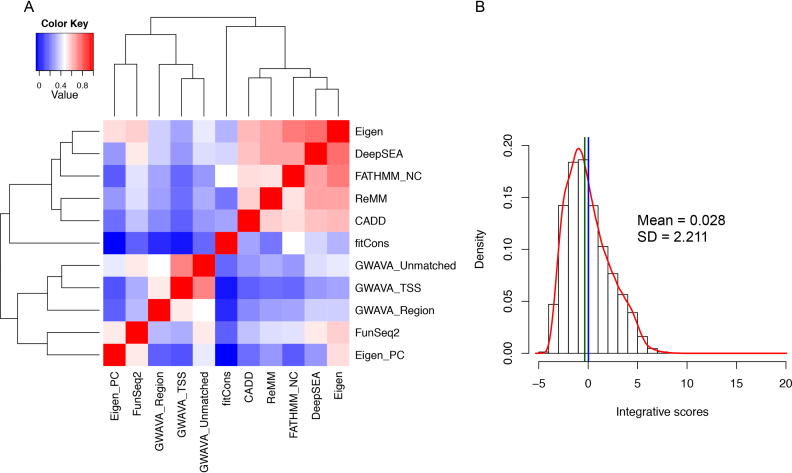
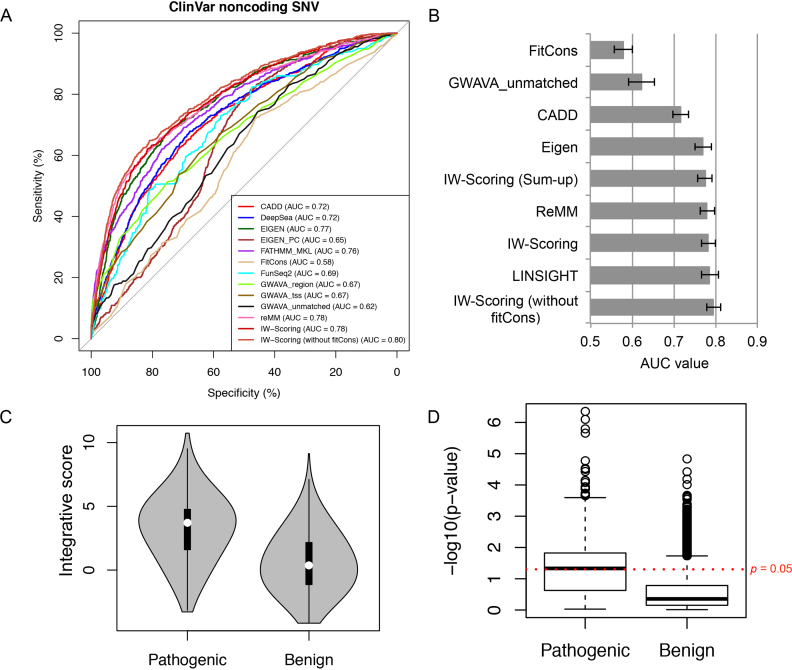
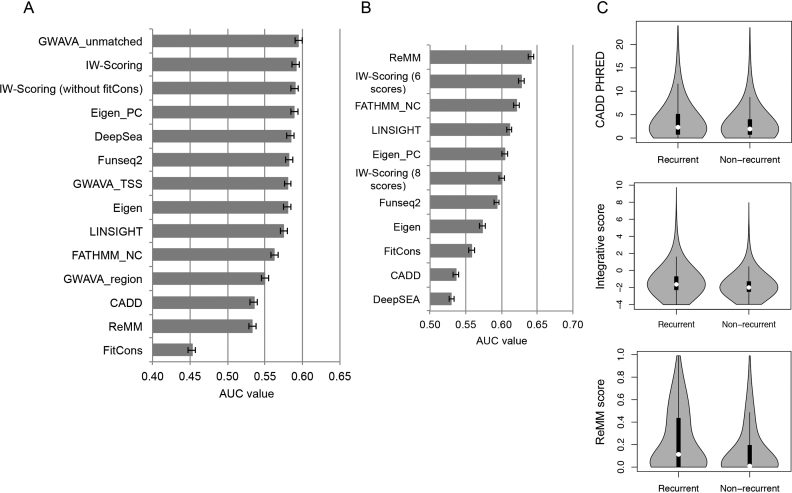
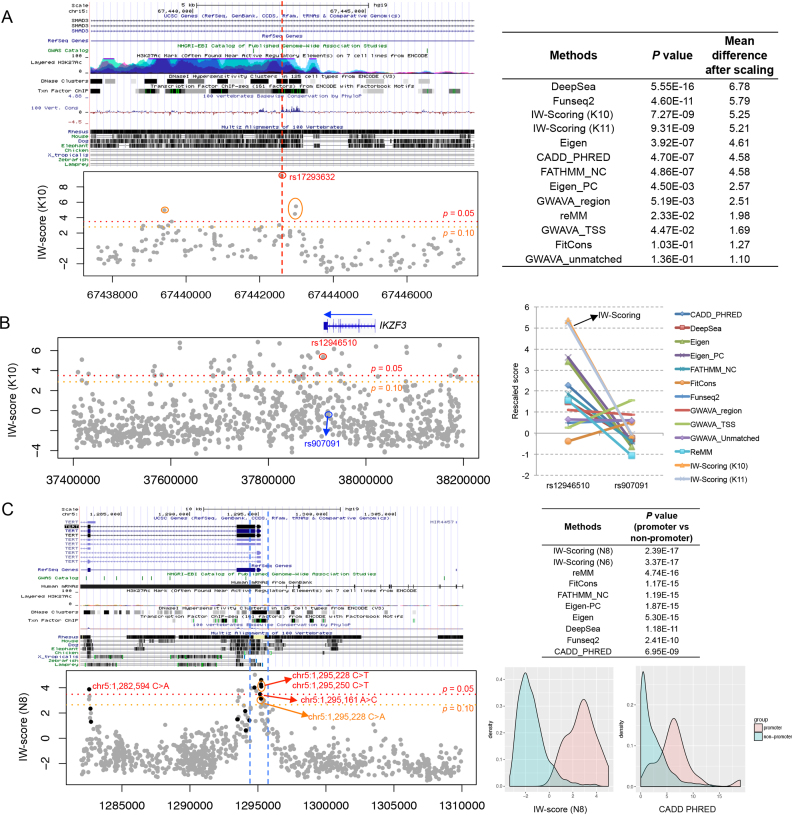
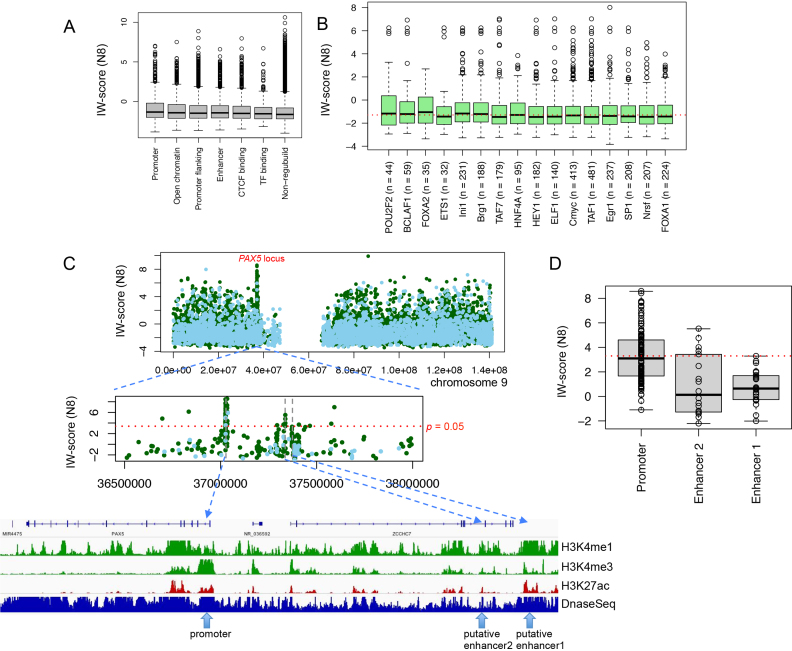
The vast majority of germline and somatic variations occur in the noncoding part of the genome, only a small fraction of which are believed to be functional. From the tens of thousands of noncoding variations detectable in each genome, identifying and prioritizing driver candidates with putative functional significance is challenging. To address this, we implemented IW-Scoring, a new Integrative Weighted Scoring model to annotate and prioritise functionally relevant noncoding variations. We evaluate 11 scoring methods, and apply an unsupervised spectral approach for subsequent selective integration into two linear weighted functional scoring schemas for known and novel variations. IW-Scoring produces stable high-quality performance as the best predictors for three independent data sets. We demonstrate the robustness of IW-Scoring in identifying recurrent functional mutations in the TERT promoter, as well as disease SNPs in proximity to consensus motifs and with gene regulatory effects. Using follicular lymphoma as a paradigmatic cancer model, we apply IW-Scoring to locate 11 recurrently mutated noncoding regions in 14 follicular lymphoma genomes, and validate 9 of these regions in an extension cohort, including the promoter and enhancer regions of PAX5. Overall, IW-Scoring demonstrates greater versatility in identifying trait- and disease-associated noncoding variants. Scores from IW-Scoring as well as other methods are freely available from http://www.snp-nexus.org/IW-Scoring/.
Overview
The claims and statistics of this paper haven’t been checked yet.
Free: it reads the open-access text and checks the first 5 claims that cite a source we can check. Create a free account to check every claim.
Integrity signals
Registry
Cites
Statistics
Figures

Verification
Claims the paper makes
The claims and statistics of this paper haven’t been checked yet.
Free: it reads the open-access text and checks the first 5 claims that cite a source we can check. Create a free account to check every claim.
Self-check
Percentages, sums and reported differences re-computed from the paper’s own numbers.
The self-check needs the paper’s full text.
Citations
Cites
An integrated encyclopedia of DNA elements in the human genome
The ENCODE Project Consortium (2012) · Nature · doi:10.1038/nature11247 · Cited by 18,072
pROC: an open-source package for R and S+ to analyze and compare ROC curves
Robin, X., Turck, N., Hainard, A., Tiberti, N., Lisacek, F., Sanchez, J.-C., & Müller, M. (2011) · BMC Bioinformatics · doi:10.1186/1471-2105-12-77 · Cited by 13,697 · cited 1×
“The performance of each scoring method differentiating functional from non-functional variants was assessed using the average receiver operating characteristic (ROC) curves and the area under curve (AUC) using pROC R package (33).”
MethodShrestha, S., & Offer, S. M. (2016) · Medical Epigenetics · doi:10.1159/000444713 · Cited by 8,914
Ensemble methods in machine learning
Dietterich, T. G. (2000) · Lecture Notes in Computer Science · doi:10.1007/3-540-45014-9_1 · Cited by 8,408
An integrated map of genetic variation from 1,092 human genomes
The 1000 Genomes Project Consortium (2012) · Nature · doi:10.1038/nature11632 · Cited by 7,711 · cited 1×
“For the training set, we extracted all variants from the 1000 Genomes Project data set (28) that were not present in dbNSFP (29) v3.”
MethodIntegrative analysis of 111 reference human epigenomes
Roadmap Epigenomics Consortium, Kundaje, A., Meuleman, W., Ernst, J., Bilenky, M., Yen, A., Heravi-Moussavi, A., Kheradpour, P., Zhang, Z., Wang, J., et al. (2015) · Nature · doi:10.1038/nature14248 · Cited by 6,368 · cited 4×
“(2) Data rescaling: we use the training data set as a reference for all queried variants to be rescaled to.”
BackgroundMethodInfluentialSelf-citationA general framework for estimating the relative pathogenicity of human genetic variants
Kircher, M., Witten, D. M., Jain, P., O'Roak, B. J., Cooper, G. M., & Shendure, J. (2014) · Nature Genetics · doi:10.1038/ng.2892 · Cited by 6,183 · cited 16×
“Next, noncoding functional scores of 11 different scoring systems derived from eight studies, including CADD v1.”
BackgroundMethodInfluentialClinVar: public archive of interpretations of clinically relevant variants
Landrum, M. J., Lee, J. M., Benson, M., Brown, G., Chao, C., Chitipiralla, S., Gu, B., Hart, J., Hoffman, D., Hoover, J., et al. (2016) · Nucleic Acids Research · doi:10.1093/nar/gkv1222 · Cited by 2,758 · cited 1×
“These data sets included noncoding variants from the ClinVar database (31) version 2016/11/01 and National Human Genome Research Institute (NHGRI)-EBI GWAS Catalog (http://www.”
MethodAmelia II: A Program for Missing Data
Honaker, J., King, G., & Blackwell, M. (2011) · Journal of Statistical Software · doi:10.18637/jss.v045.i07 · Cited by 2,552 · cited 1×
“We imputed missing values in the rescaled scoring matrix using the Amelia R package (30).”
MethodAn atlas of active enhancers across human cell types and tissues
The FANTOM Consortium, Andersson, R., Gebhard, C., Miguel-Escalada, I., Hoof, I., Bornholdt, J., Boyd, M., Chen, Y., Zhao, X., Schmidl, C., et al. (2014) · Nature · doi:10.1038/nature12787 · Cited by 2,550 · cited 3×
“(4) Weight estimation via eigendecomposition: the estimated weights for the individual scoring systems were calculated using the eigendecomposition of the covariance matrix.”
BackgroundMethod
Cited by
Genome-wide Association Analysis in Humans Links Nucleotide Metabolism to Leukocyte Telomere Length
Li, C., Stoma, S., Lotta, L. A., Warner, S., Albrecht, E., Allione, A., Arp, P. P., Broer, L., Buxton, J. L., Da Silva Couto Alves, A., et al. (2020) · The American Journal of Human Genetics · doi:10.1016/j.ajhg.2020.02.006 · Cited by 162
“For non-coding variants, we performed integrated analysis with SNP Nexus IW scoring.(40) Transcriptomic Data Integration (1) With summary statistics, we performed a gene-level analysis,”
MethodOperational excellence in a green supply chain for environmental management: A case study
Kazançoğlu, Y., Sağnak, M., Kayıkçı, Y., & Mangla, S. K. (2020) · Business Strategy and the Environment · doi:10.1002/bse.2451 · Cited by 74
Zhang, S., He, Y., Liu, H., Zhai, H., Huang, D., Yi, X., Dong, X., Wang, Z., Zhao, K., Zhou, Y., et al. (2019) · Nucleic Acids Research · doi:10.1093/nar/gkz774 · Cited by 58
“We compared our composite models with integrated tools and two existing ensemble methods (PRVCS (11) and IW-Scoring (12)) using above six independent testing datasets.”
MethodSelf-citationAbbas, S. R., Abbas, Z., Zahir, A., & Lee, S. W. (2025) · Briefings in Bioinformatics · doi:10.1093/bib/bbaf329 · Cited by 30
“Figure 8 compares the current focus and future potential across six key directions in genomic research and ML [14, 146– 149].”
Ostinelli, G., Vijay, J., Vohl, M., Grundberg, E., & Tchernof, A. (2021) · Molecular and Cellular Endocrinology · doi:10.1016/j.mce.2021.111220 · Cited by 32
“We prioritized variants in high LD using scoring algorithms such as RegulomeDB (Boyle et al., 2012; Dong and Boyle, 2019) and IW scoring system (Wang et al., 2018).”
MethodInfluential
Metadata
- Authors
- Wang, J., Dayem Ullah, A. Z., & Chelala, C.
- Affiliations
- Queen Mary University of London (GB)
- Centre for Molecular Oncology, Barts Cancer Institute, Queen Mary University of London, Charterhouse Square, London EC1M 6BQ, UK
- Corresponding author
- Wang, Jun
- Venue
- Nucleic Acids Research
- Publisher
- Oxford University Press (OUP)
- Published
- 2018-01-30
- Volume
- 46
- Issue
- 8
- Pages
- e47-e47
- ISSN
- 0305-1048 (ISSN-L)
- 1362-4962
- PMC
- PMC5934661
- OpenAlex
- W2951354947
- Cited by
- 35
- References
- 50
- Citations by year
- 2026: 2 · 2025: 4 · 2024: 1 · 2023: 4 · 2022: 6 · 2021: 6 · 2020: 6 · 2019: 5 · 2018: 1
- FWCI
- 2.75
- Type
- journal article
- Language
- en
- Open access
- gold
- doi.org
- Licence
- Locations
- Nucleic Acids Research (publishedVersion, cc-by)
- bioRxiv (Cold Spring Harbor Laboratory) (acceptedVersion, cc-by-nc-nd)
- Europe PMC (PubMed Central) (publishedVersion, cc-by)
- PubMed Central (publishedVersion, cc-by)
- PubMed (publishedVersion)
- Queen Mary Research Online (Queen Mary University of London) (submittedVersion, cc-by)
- Funders
- Cancer Research UK (C16420/A18066)
- Barts and The London Charity (MGU0344)
- Topics
- Life Sciences › Biochemistry, Genetics and Molecular Biology › Genetics › Genomics and Rare Diseases
- Life Sciences › Biochemistry, Genetics and Molecular Biology › Genetics › Genetic Associations and Epidemiology
- Life Sciences › Biochemistry, Genetics and Molecular Biology › Molecular Biology › Genomics and Chromatin Dynamics
- Keywords
- non-coding variants, variant prioritization, variant annotation, weighted scoring model, spectral clustering, TERT promoter mutation, follicular lymphoma, recurrent mutations, disease-associated SNPs, regulatory motifs, somatic mutations
- MeSH terms
- Whole Genome Sequencing, Humans, Lymphoma, Follicular, Models, Genetic, Mutation, Neoplasms, Promoter Regions, Genetic, Regulatory Sequences, Nucleic Acid, Genetic Variation, Genome, Human, Telomerase, Computational Biology, Polymorphism, Single Nucleotide, DNA, Intergenic, Databases, Nucleic Acid, Genome-Wide Association Study
About these checks
Registry, retraction, Cites and statistics results are computed, not judged, with one exception: a printed reference that no index lists is read once by a model before it counts as a citation error. Claims are extracted by a model and kept only when their quote appears verbatim in the text; each cited source is then checked, with a model’s help, for whether it says what the claim relies on. Those verdicts can be wrong — read the claim’s quote and the cited source before relying on one.
Statistics and arithmetic are recomputed, not judged.
Confidence bands are shown only for fields calibrated on our annotated test set. None is calibrated yet, so no band is shown.
What counts as a claim ›How we measure confidence ›How we check this ›
Are you an author, or do you see a problem with this page? Request a review
How to cite
Cite CoChat for the checks on this page, and the paper for its own findings.
- This page
- CoChat. (2026). Citation check: IW-Scoring: an Integrative Weighted Scoring framework for annotating and prioritizing genetic variations in the noncoding genome. https://app.cochat.ai/papers/10.1093/nar/gky057
- The paper
- Wang, J., Dayem Ullah, A. Z., & Chelala, C. (2018). IW-Scoring: an Integrative Weighted Scoring framework for annotating and prioritizing genetic variations in the noncoding genome. Nucleic Acids Research. https://doi.org/10.1093/nar/gky057
Data sources
Bibliographic data: Semantic Scholar, OpenAlex, Crossref.
Contains information from the Semantic Scholar Academic Graph Datasets, made available under the ODC Attribution License (ODC-BY 1.0).
Semantic Scholar’s data is described in: Kinney, R., et al. (2023). The Semantic Scholar Open Data Platform. arXiv:2301.10140.
