

The DOI matches its Crossref record; 31 of the 32 references it cites were found in a registry or an index.
PolyASite 2.0: a consolidated atlas of polyadenylation sites from 3′ end sequencing
Open accessAbstract
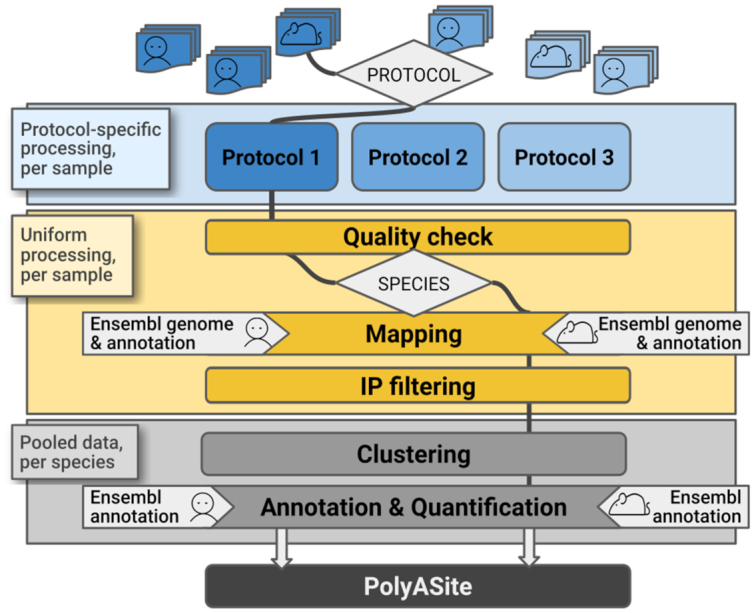
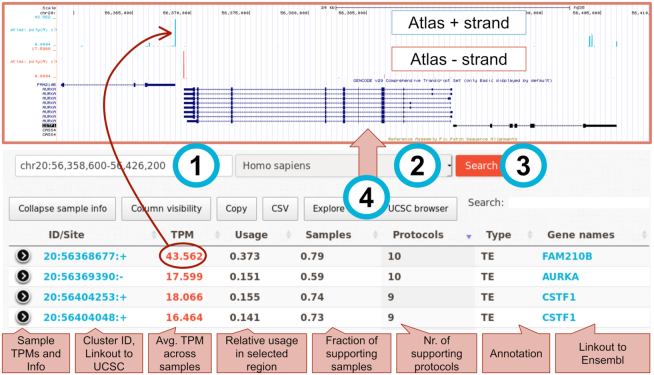
Generated by 3' end cleavage and polyadenylation at alternative polyadenylation (poly(A)) sites, alternative terminal exons account for much of the variation between human transcript isoforms. More than a dozen protocols have been developed so far for capturing and sequencing RNA 3' ends from a variety of cell types and species. In previous studies, we have used these data to uncover novel regulatory signals and cell type-specific isoforms. Here we present an update of the PolyASite (https://polyasite.unibas.ch) resource of poly(A) sites, constructed from publicly available human, mouse and worm 3' end sequencing datasets by enforcing uniform quality measures, including the flagging of putative internal priming sites. Through integrated processing of all data, we identified and clustered sites that are closely spaced and share polyadenylation signals, as these are likely the result of stochastic variations in processing. For each cluster, we identified the representative - most frequently processed - site and estimated the relative use in the transcriptome across all samples. We have established a modern web portal for efficient finding, exploration and export of data. Database generation is fully automated, greatly facilitating incorporation of new datasets and the updating of underlying genome resources.
Overview
The claims and statistics of this paper haven’t been checked yet.
Run the check — free, no account needed. It reads the open-access text and checks the sources it cites.
Integrity signals
Registry
Cites
Statistics
Figures
Verification
Claims the paper makes
The claims and statistics of this paper haven’t been checked yet.
Run the check — free, no account needed. It reads the open-access text and checks the sources it cites.
Claims other papers make about this one
Each is checked against this paper’s own text: does it say what the citing paper says it does?
The cited source says what the claim attributes to it.
In the citing paper
“To reduce the risk of picking genes in which the perceived APA is driven by 3′ bias in the GTEx RNA-seq data, we required that the genes also exhibited differential distal polyadenylation in cell-type-matched experiments from the PolyASite 2.0 database42.”
From Predicting RNA-seq coverage from DNA sequence as a unifying model of gene regulation (2025) · cites this paper as [42]
The check wasn’t confident either way, so it gives no verdict — never disputed.
In the citing paper
“For example, RWDD1 exhibits biased usage of the distal-most PAS in brain42 (Fig. 2e; see Extended Data Fig. 3b for additional examples).”
From Predicting RNA-seq coverage from DNA sequence as a unifying model of gene regulation (2025) · cites this paper as [42]
Experimental — accuracy not yet measured
Self-check
Percentages, sums and reported differences re-computed from the paper’s own numbers.
The self-check needs the paper’s full text.
Citations
Cites
Leinonen, R., Sugawara, H., & Shumway, M. F. (2010) · Nucleic Acids Research · doi:10.1093/nar/gkq1019 · Cited by 2,872
Sandberg, R., Neilson, J. R., Sarma, A., Sharp, P. A., & Burge, C. B. (2008) · Science · doi:10.1126/science.1155390 · Cited by 1,349
A large-scale analysis of mRNA polyadenylation of human and mouse genes
Tian, B. (2005) · Nucleic Acids Research · doi:10.1093/nar/gki158 · Cited by 970
Cunningham, F., Achuthan, P., Akanni, W., Allen, J., Amode, M. R., Armean, I. M., Bennett, R., Bhai, J., Billis, K., Boddu, S., et al. (2019) · Nucleic Acids Research · doi:10.1093/nar/gky1113 · Cited by 925
The UCSC Genome Browser database: 2019 update
Haeussler, M., Zweig, A. S., Tyner, C., Speir, M. L., Rosenbloom, K. R., Raney, B. J., Lee, C. M., Lee, B. T., Hinrichs, A. S., Gonzalez, J. N., et al. (2018) · Nucleic Acids Research · doi:10.1093/nar/gky1095 · Cited by 879
Patterns of Variant Polyadenylation Signal Usage in Human GenesPreprint
Beaudoing, E., Freier, S. M., Wyatt, J. R., Claverie, J., & Gautheret, D. (2000) · Genome Research · doi:10.1101/gr.10.7.1001 · Cited by 676
A quantitative atlas of polyadenylation in five mammalsPreprint
Derti, A., Garrett-Engele, P. W., MacIsaac, K. D., Stevens, R. C., Sriram, S., Chen, R., Rohl, C. A., Johnson, J. M., & Babak, T. (2012) · Genome Research · doi:10.1101/gr.132563.111 · Cited by 663
Ji, Z., Lee, J. Y., Pan, Z., Jiang, B., & Tian, B. (2009) · Proceedings of the National Academy of Sciences · doi:10.1073/pnas.0900028106 · Cited by 609
Edmonds, M., Vaughan, M. H., & Nakazato, H. (1971) · Proceedings of the National Academy of Sciences · doi:10.1073/pnas.68.6.1336 · Cited by 510
Alternative cleavage and polyadenylation in health and disease
Gruber, A. J., & Zavolan, M. (2019) · Nature Reviews Genetics · doi:10.1038/s41576-019-0145-z · Cited by 493
Self-citationFormation, regulation and evolution of Caenorhabditis elegans 3′UTRs
Jan, C. H., Friedman, R. C., Ruby, J. G., & Bartel, D. P. (2010) · Nature · doi:10.1038/nature09616 · Cited by 485
Analysis of alternative cleavage and polyadenylation by 3′ region extraction and deep sequencing
Hoque, M., Ji, Z., Zheng, D., Luo, W., Li, W., You, B., Park, J. Y., Yehia, G., & Tian, B. (2012) · Nature Methods · doi:10.1038/nmeth.2288 · Cited by 456
Complex and dynamic landscape of RNA polyadenylation revealed by PAS-Seq
Shepard, P. J., Choi, E., Lu, J., Flanagan, L. A., Hertel, K. J., & Shi, Y. (2011) · RNA · doi:10.1261/rna.2581711 · Cited by 440
Ubiquitously transcribed genes use alternative polyadenylation to achieve tissue-specific expressionPreprint
Lianoglou, S., Garg, V., Yang, J. L., Leslie, C. S., & Mayr, C. (2013) · Genes & Development · doi:10.1101/gad.229328.113 · Cited by 402
Ozsolak, F., Kapranov, P., Foissac, S., Kim, S. W., Fishilevich, E., Monaghan, A. P., John, B., & Milos, P. M. (2010) · Cell · doi:10.1016/j.cell.2010.11.020 · Cited by 400
Martin, G., Gruber, A. R., Keller, W., & Zavolan, M. (2012) · Cell Reports · doi:10.1016/j.celrep.2012.05.003 · Cited by 366
Self-citationReyes, A., & Huber, W. (2018) · Nucleic Acids Research · doi:10.1093/nar/gkx1165 · Cited by 290
Fu, Y., Sun, Y., Li, Y., Li, J., Rao, X., Chen, C., & Xu, A. (2011) · Genome Research · doi:10.1101/gr.115295.110 · Cited by 273
A multi-split mapping algorithm for circular RNA, splicing, trans-splicing and fusion detection
Hoffmann, S., Otto, C., Doose, G., Andrea Tanzer, A., Langenberger, D., Christ, S., Kunz, M., Holdt, L. M., Teupser, D., Hackermüller, J., et al. (2014) · Genome biology · doi:10.1186/gb-2014-15-2-r34 · Cited by 270
Ji, Z., & Tian, B. (2009) · PLoS ONE · doi:10.1371/journal.pone.0008419 · Cited by 264
Spies, N., Burge, C. B., & Bartel, D. P. (2013) · Genome Research · doi:10.1101/gr.156919.113 · Cited by 217
Gruber, A. J., Schmidt, R., Gruber, A. J., Martin, G., Ghosh, S., Belmadani, M., Keller, W., & Zavolan, M. (2016) · Genome Research · doi:10.1101/gr.202432.115 · Cited by 213
Self-citationDeciphering the role of RNA-binding proteins in the post-transcriptional control of gene expression
Kishore, S., Luber, S., & Zavolan, M. (2010) · Briefings in Functional Genomics · doi:10.1093/bfgp/elq028 · Cited by 186
Self-citationWidespread intronic polyadenylation diversifies immune cell transcriptomes
Singh, I., Lee, S., Sperling, A. S., Samur, M., Tai, Y., Fulciniti, M., Munshi, N. C., Mayr, C., & Leslie, C. S. (2018) · Nature Communications · doi:10.1038/s41467-018-04112-z · Cited by 160
Ogorodnikov, A., Levin, M., Tattikota, S. M., Tokalov, S. V., Hoque, M., Scherzinger, D., Marini, F., Poetsch, A., Binder, H., Macher-Göppinger, S., et al. (2018) · Nature Communications · doi:10.1038/s41467-018-07580-5 · Cited by 103
Discovery of physiological and cancer-related regulators of 3′ UTR processing with KAPAC
Gruber, A. J., Schmidt, R., Ghosh, S., Martin, G., Gruber, A. J., van Nimwegen, E., & Zavolan, M. (2018) · Genome biology · doi:10.1186/s13059-018-1415-3 · Cited by 75
Self-citationHwang, H., Park, C. Y., Goodarzi, H., Fak, J. J., Mele, A., Moore, M. J., Saito, Y., & Darnell, R. B. (2016) · Cell Reports · doi:10.1016/j.celrep.2016.03.023 · Cited by 72
Quantification of stochastic noise of splicing and polyadenylation in Entamoeba histolytica
Hon, C.-C., Weber, C., Sismeiro, O., Proux, C., Koutero, M., Deloger, M., Das, S., Agrahari, M., Dillies, M., Jagla, B., et al. (2012) · Nucleic Acids Research · doi:10.1093/nar/gks1271 · Cited by 70
Similarities and differences of polyadenylation signals in human and fly
Retelska, D., Iseli, C., Bücher, P., Jongeneel, C. V., & Naef, F. (2006) · BMC Genomics · doi:10.1186/1471-2164-7-176 · Cited by 68
Terminal exon characterization with TECtool reveals an abundance of cell-specific isoforms
Gruber, A. J., Gypas, F., Riba, A., Schmidt, R., & Zavolan, M. (2018) · Nature Methods · doi:10.1038/s41592-018-0114-z · Cited by 24
Self-citationPOS-1 Promotes Endo-mesoderm Development by Inhibiting the Cytoplasmic Polyadenylation of neg-1 mRNA
Elewa, A., Shirayama, M., Kaymak, E., Harrison, P. F., Powell, D., Du, Z., Chute, C. D., Woolf, H., Yi, D., Ishidate, T., et al. (2015) · Developmental Cell · doi:10.1016/j.devcel.2015.05.024 · Cited by 23
Cited by
Sorted by citations
Beyond the RNA-dependent function of LncRNA genes
Ali, T., & Grote, P. (2020) · eLife · doi:10.7554/elife.60583 · Cited by 282
Predicting RNA-seq coverage from DNA sequence as a unifying model of gene regulation
Linder, J., Srivastava, D., Yuan, H., Agarwal, V., & Kelley, D. R. (2025) · Nature Genetics · doi:10.1038/s41588-024-02053-6 · Cited by 265
TDP-43 condensation properties specify its RNA-binding and regulatory repertoire
Hallegger, M., Chakrabarti, A. M., Lee, F. C. Y., Lee, B. L., Amalietti, A. G., Odeh, H. M., Copley, K. E., Rubien, J. D., Portz, B., Kuret, K., et al. (2021) · Cell · doi:10.1016/j.cell.2021.07.018 · Cited by 239
High-throughput total RNA sequencing in single cells using VASA-seq
Salmén, F., Jonghe, J. D., Kamiński, T. S., Alemany, A., Parada, G. E., Verity-Legg, J., Yanagida, A., Kohler, T. N., Battich, N., van den Brekel, F., et al. (2022) · Nature Biotechnology · doi:10.1038/s41587-022-01361-8 · Cited by 244
A spatially resolved brain region- and cell type-specific isoform atlas of the postnatal mouse brain
Joglekar, A., Prjibelski, A., Mahfouz, A., Collier, P., Lin, S., Schlusche, A. K., Marrocco, J., Williams, S. R., Haase, B., Hayes, A., et al. (2021) · Nature Communications · doi:10.1038/s41467-020-20343-5 · Cited by 229
Metadata
- Authors
- Herrmann, C. J., Schmidt, R., Kanitz, A., Artimo, P., Gruber, A. J., & Zavolan, M.
- Affiliations
- University of Basel (CH)
- SIB Swiss Institute of Bioinformatics (CH)
- University of Oxford (GB)
- Corresponding author
- Zavolan, Mihaela
- Venue
- Nucleic Acids Research
- Publisher
- Oxford University Press (OUP)
- Published
- 2019-10-16
- Volume
- 48
- Issue
- D1
- Pages
- D174-D179
- ISSN
- 0305-1048 (ISSN-L)
- 1362-4962
- PMC
- PMC7145510
- OpenAlex
- W2980708325
- Cited by
- 196
- References
- 32
- Citations by year
- 2026: 18 · 2025: 21 · 2024: 33 · 2023: 36 · 2022: 37 · 2021: 40 · 2020: 10 · 2019: 1
- FWCI
- 7.28
- Type
- journal article
- Language
- en
- Open access
- gold
- doi.org
- Licence
- Locations
- Nucleic Acids Research (publishedVersion, cc-by-nc)
- PubMed Central (publishedVersion, cc-by-nc)
- PubMed (publishedVersion)
- KOPS (University of Konstanz) (submittedVersion, cc-by-nc)
- edoc (University of Basel) (submittedVersion)
- Funders
- Swiss National Science Foundation (31003A_170216, 51NF40_141735)
- Topics
- Life Sciences › Biochemistry, Genetics and Molecular Biology › Molecular Biology › RNA Research and Splicing
- Life Sciences › Biochemistry, Genetics and Molecular Biology › Molecular Biology › Genomics and Phylogenetic Studies
- Life Sciences › Biochemistry, Genetics and Molecular Biology › Molecular Biology › RNA regulation and disease
- Keywords
- polyadenylation sites, alternative polyadenylation, 3' end sequencing, mRNA isoforms, site clustering, web portal
- MeSH terms
- Animals, Humans, Poly A, Caenorhabditis elegans, Sequence Analysis, RNA, Polyadenylation, Databases, Nucleic Acid, Mice
About these checks
Registry, retraction, Cites and statistics results are computed, not judged, with one exception: a printed reference that no index lists is read once by a model before it counts as a citation error. Claims are extracted by a model and kept only when their quote appears verbatim in the text; each cited source is then checked, with a model’s help, for whether it says what the claim relies on. Those verdicts can be wrong — read the claim’s quote and the cited source before relying on one.
Statistics and arithmetic are recomputed, not judged.
Confidence bands are shown only for fields calibrated on our annotated test set. None is calibrated yet, so no band is shown.
What counts as a claim ›How we measure confidence ›How we check this ›
Are you an author, or do you see a problem with this page? Request a review
