

The signal processing architecture underlying subjective reports of sensory awareness
Open accessThe DOI matches its Crossref record; 69 of the 69 references it cites were found in a registry or an index.
Abstract
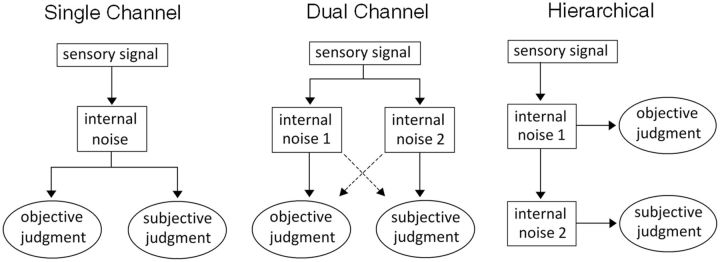
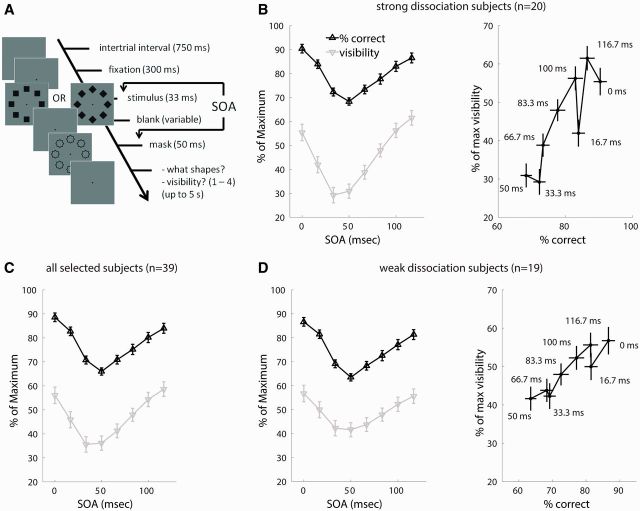
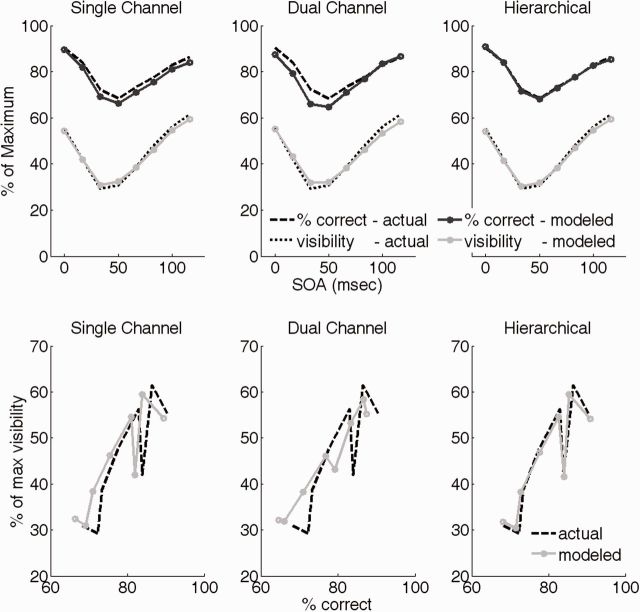
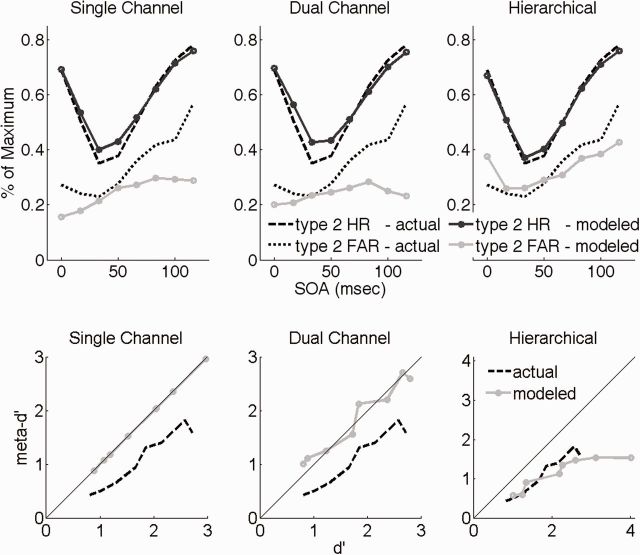
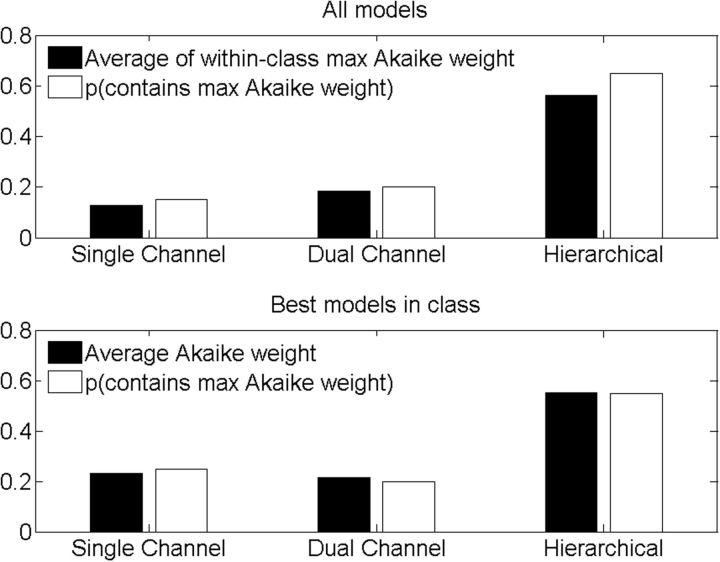
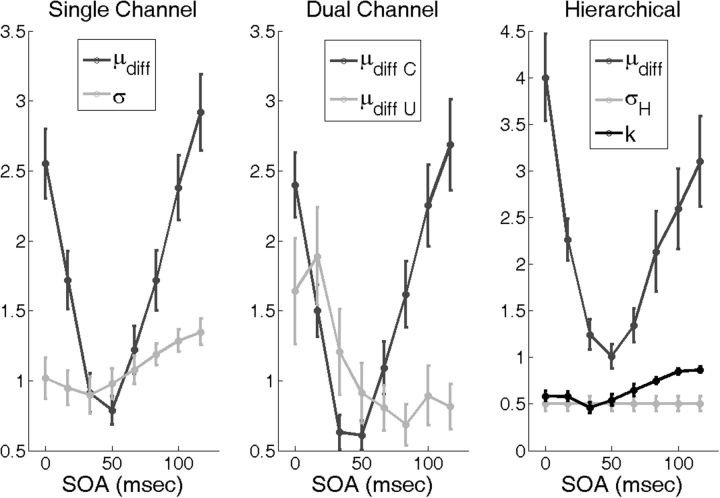
What is the relationship between perceptual information processing and subjective perceptual experience? Empirical dissociations between stimulus identification performance and subjective reports of stimulus visibility are crucial for shedding light on this question. We replicated a finding that metacontrast masking can produce such a dissociation (Lau and Passingham, 2006), and report a novel finding that this paradigm can also dissociate stimulus identification performance from the efficacy with which visibility ratings predict task performance. We explored various hypotheses about the relationship between perceptual task performance and visibility rating by implementing them in computational models and using formal model comparison techniques to assess which ones best captured the unusual patterns in the data. The models fell into three broad categories: Single Channel models, which hold that task performance and visibility ratings are based on the same underlying source of information; Dual Channel models, which hold that there are two independent processing streams that differentially contribute to task performance and visibility rating; and Hierarchical models, which hold that a late processing stage generates visibility ratings by evaluating the quality of early perceptual processing. Taking into account the quality of data fitting and model complexity, we found that Hierarchical models perform best at capturing the observed behavioral dissociations. Because current theories of visual awareness map well onto these different model structures, a formal comparison between them is a powerful approach for arbitrating between the different theories.
Overview
The claims and statistics of this paper haven’t been checked yet.
Free: it reads the open-access text and checks the first 5 claims that cite a source we can check. Create a free account to check every claim.
Integrity signals
Registry
Cites
Statistics
Figures
Verification
Claims the paper makes
The claims and statistics of this paper haven’t been checked yet.
Free: it reads the open-access text and checks the first 5 claims that cite a source we can check. Create a free account to check every claim.
Self-check
Percentages, sums and reported differences re-computed from the paper’s own numbers.
The self-check needs the paper’s full text.
Citations
Cites
Optimization by Simulated Annealing
Kirkpatrick, S., Gelatt, C. D., & Vecchi, M. P. (1983) · Science · doi:10.1126/science.220.4598.671 · Cited by 45,134
Model selection and multimodel inference: a practical information-theoretic approach.
Guthery, F. S., Burnham, K. P., & Anderson, D. R. (2003) · The Journal of Wildlife Management · doi:10.2307/3802723 · Cited by 41,495
Brainard, D. H. (1997) · Spatial Vision · doi:10.1163/156856897x00357 · Cited by 19,702
Detection Theory: A User's Guide
Macmillan, N. A., & Creelman, C. D. (1991) · Cited by 5,415
Ratcliff, R. (1978) · Psychological Review · doi:10.1037/0033-295x.85.2.59 · Cited by 4,513
The Neural Basis of Decision Making
Gold, J. I., & Shadlen, M. N. (2007) · Annual Review of Neuroscience · doi:10.1146/annurev.neuro.29.051605.113038 · Cited by 3,764 · cited 1×
“Gorea and Sagi (2000) found that when stimuli that are easy and difficult to perceive are interleaved randomly, subjects do not judge stimulus classes with separate criteria, but rather use a single, nonoptimal criterion for both.”
A process dissociation framework: Separating automatic from intentional uses of memory
Jacoby, L. L. (1991) · Journal of Memory and Language · doi:10.1016/0749-596x(91)90025-f · Cited by 3,696
Milner, A. D., & Goodale, M. A. (2002) · Vision and Mind · doi:10.7551/mitpress/7111.003.0023 · Cited by 3,331
The Diffusion Decision Model: Theory and Data for Two-Choice Decision Tasks
Ratcliff, R., & McKoon, G. (2008) · Neural Computation · doi:10.1162/neco.2008.12-06-420 · Cited by 3,059
Detection theory: A user's guide
Lories, G. (1993) · Behavioural Processes · doi:10.1016/0376-6357(93)90083-4 · Cited by 2,835
Cited by
Items 101–153 of 153
Yeon, J., Shekhar, M., & Rahnev, D. (2020) · doi:10.17605/osf.io/pn283 · Cited by 3
Azizi, Z. R., Zabbah, S., Jahanitabesh, A., & Ebrahimpour, R. (2021) · bioRxiv (Cold Spring Harbor Laboratory) · doi:10.1101/2021.06.20.449145 · Cited by 3
Suprathreshold perceptual decisions constrain models of confidencePreprint
Locke, S. M., Landy, M. S., & Mamassian, P. (2021) · PsyArXiv (OSF Preprints) · doi:10.31234/osf.io/p6395 · Cited by 3
Similar computational noise for perceptual decision making with confidence, expectation, and rewardPreprint
Zheng, Y., Xue, K., Shekhar, M., & Rahnev, D. (2024) · PsyArXiv (OSF Preprints) · doi:10.31234/osf.io/ydx6z · Cited by 3
Xue, K., Shekhar, M., & Rahnev, D. (2024) · Research Square · doi:10.21203/rs.3.rs-5510856/v1 · Cited by 3
Segregated Co-activation Patterns in the Emergence of Decision Confidence During Visual Perception
Jaeger, C., Glim, S., Dimulescu, C., Ries, A., Sorg, C., & Wohlschläger, A. M. (2020) · Frontiers in Systems Neuroscience · doi:10.3389/fnsys.2020.557693 · Cited by 2
Confidence-accuracy dissociations in perceptual decision making
Rahnev, D. (2026) · Vision Research · doi:10.1016/j.visres.2026.108831 · Cited by 2
Yeon, J., Shekhar, M., & Rahnev, D. (2018) · bioRxiv (Cold Spring Harbor Laboratory) · doi:10.1101/439463 · Cited by 2
Uncertain Precision: Neurobiological and Physiological Correlates of Conservative Confidence BiasPreprint
Allen, M., Hauser, T. U., Schwarzkopf, D. S., Dolan, R. J., & Rees, G. E. (2022) · bioRxiv (Cold Spring Harbor Laboratory) · doi:10.1101/2022.08.01.502365 · Cited by 2
Derrien, D., Garric, C., Sergent, C., & Chokron, S. (2025) · Cognitive Neuropsychology · doi:10.1080/02643294.2025.2570940 · Cited by 1
Metacognition and metacognitive monitoring in aging
Pournaghdali, A., Cheng, G. L., Cosentino, S., & Eich, T. S. (2026) · Psychonomic Bulletin & Review · doi:10.3758/s13423-026-02968-7 · Cited by 1
Type-1 and type-2 decisions feature computational noise of similar magnitude
Zheng, Y., Xue, K., Shekhar, M., & Rahnev, D. (2026) · Communications Psychology · doi:10.1038/s44271-026-00454-3 · Cited by 1
dynConfiR: An R package for sequential sampling models of decision confidence
Hellmann, S., Zehetleitner, M., & Rausch, M. (2026) · Behavior Research Methods · doi:10.3758/s13428-026-03013-0 · Cited by 1
Spatiotemporal neural correlates of confidence in perceptual decision making
Gherman, S. (2017) · Enlighten: Theses (The University of Glasgow) · Cited by 1
The Pragmatics of Confidence in Perceptual and Value-based Choice
Folke, N. E. T. (2018) · Apollo (University of Cambridge) · doi:10.17863/cam.22112 · Cited by 1
Rausch, M., Hellmann, S., & Zehetleitner, M. (2017) · PsyArXiv (OSF Preprints) · doi:10.31234/osf.io/dmwa4 · Cited by 1
statConfR: An R Package for Static Models of Decision Confidence and MetacognitionPreprint
Rausch, M., & Hellmann, S. (2024) · PsyArXiv (OSF Preprints) · doi:10.31234/osf.io/dk6mr · Cited by 1
dynConfiR: The R package for sequential sampling models of decision confidencePreprint
Hellmann, S., Zehetleitner, M., & Rausch, M. (2024) · PsyArXiv (OSF Preprints) · doi:10.31234/osf.io/e354s · Cited by 1
Metacognition of value-based decisions
Armand, O. (2024) · Electronic Theses of LMU Munich (Ludwig-Maximilians-Universität München) · doi:10.5282/edoc.34689 · Cited by 1
Neural correlates of performance monitoring during discrete and continuous tasks
Pereira, M. (2018) · Infoscience (Ecole Polytechnique Fédérale de Lausanne) · doi:10.5075/epfl-thesis-8269
Dell’Italia, J. (2019) · eScholarship (California Digital Library)
Probabilistic models of audiovisual perceptual decision making
Meijer, D. (2019) · University of Birmingham Institutional Research Archive (University of Birmingham)
Modelling and Measuring the Predictive Brain
Whyte, C. J. (2020) · The Sydney eScholarship Repository (The University of Sydney)
Lau, H. C. (2022) · Oxford University Press eBooks · doi:10.1093/oso/9780198856771.003.0007
Self-citationLau, H. C. (2022) · Oxford University Press eBooks · doi:10.1093/oso/9780198856771.003.0004
Self-citationZheng, Z., Trübutschek, D., Huang, S., Cai, Y., & Melloni, L. (2024) · PsyArXiv (OSF Preprints) · doi:10.31234/osf.io/9dysm
Confidence for intrusion errors during the attentional blink depends on target-defining features
Junker, M., & Habib, R. (2024) · Consciousness and Cognition · doi:10.1016/j.concog.2024.103725
Xue, K., Shekhar, M., & Rahnev, D. (2024) · PsyArXiv (OSF Preprints) · doi:10.31234/osf.io/67ufv
statConfR: An R Package for Static Models of Decision Confidence and MetacognitionPreprint
Rausch, M., Meyen, S., & Hellmann, S. (2024) · PsyArXiv (OSF Preprints) · doi:10.31234/osf.io/dk6mr_v1
Beyond the Type 2 Level: Evidence for Functional Dissociations and Meta-Metacognitive InsightPreprint
Cavalan, Q., de Gardelle, V., & Vergnaud, J. (2025) · SSRN Electronic Journal · doi:10.2139/ssrn.5220942
dynConfiR: An R package for sequential sampling models of decision confidencePreprint
Hellmann, S., Zehetleitner, M., & Rausch, M. (2025) · PsyArXiv (OSF Preprints) · doi:10.31234/osf.io/e354s_v2
Type-1 and Type-2 decisions feature computational noise of similar magnitudePreprint
Zheng, Y., Xue, K., Shekhar, M., & Rahnev, D. (2024) · PsyArXiv (OSF Preprints) · doi:10.31234/osf.io/ydx6z_v1
Decisions are based on less information than metacognitive judgments in multialternative contexts.
Comay, N. A., Solovey, G., & Barttfeld, P. (2026) · Journal of Experimental Psychology Learning Memory and Cognition · doi:10.1037/xlm0001532
Barbosa, I. M. (2023) · LA Referencia (Red Federada de Repositorios Institucionales de Publicaciones Científicas)
Implicit Learning and Metacognition: A Computational, Behavioral, And Neural Analysis
Schorn, J. M. (2023) · eScholarship (California Digital Library)
Perceptual decision making, and the construction of confidence
Calder-Travis, J. (2020) · Oxford University Research Archive (ORA) (University of Oxford) · doi:10.5287/ora-vjk8edkmg
Visual confidence accurately tracks increasing internal noise with eccentricity in peripheral visionPreprint
Li, L., & Landy, M. S. (2026) · bioRxiv (Cold Spring Harbor Laboratory) · doi:10.64898/2026.01.28.702447
Symbiotic Minds: A Neuroeducational Map of AI and Natural Intelligence
Verma, K. L., Pathak, V., & Aich, T. K. (2026) · Journal of Neuroeducation · doi:10.1344/joned.v6i2.51915
Impact of aging on human decision-making in ecological conditions
Aubert, J. D. S. (2023) · theses.fr (ABES) · doi:10.70675/f7143113zd412z4b5fza432z1032ef6ea209
The Role of Metacognition in Occupational Pursuits : Evidence from Laboratory Experiments
Cavalan, Q. (2023) · theses.fr (ABES) · doi:10.70675/7fb86a89zd36fz4d73zae75zb74f435a571f
Sanchez, R. (2023) · theses.fr (ABES) · doi:10.70675/5502e145z7be0z4855za34bz425051aad5cb
Confidence Judgments Reflect the Standard Error of Noisy Evidence Samples Across DomainsPreprint
West, R. K., Sewell, D. K., & Scheibehenne, B. (2026) · bioRxiv (Cold Spring Harbor Laboratory) · doi:10.64898/2026.04.20.719573
Disentangling the origins of confidence in speeded perceptual judgments through multimodal imagingPreprint
Wirthlin, M., Pereira, M., & Faivre, N. (2020) · OSF Preprints (OSF Preprints)
The many faces of confidence: sensitivity and meta-confidence in economic decision-making
Cavalan, Q. (2026) · Theory and Decision · doi:10.1007/s11238-026-10144-5
Building worlds of your own: the functional role of metacognitive bias in metacognition
Romanazzi, D., Pasini, A., Tarasi, L., & Romei, V. (2026) · Frontiers in Psychology · doi:10.3389/fpsyg.2026.1792782
Quantifying the information about uncertainty in neural population codesPreprint
Wang, X., Dayan, P., & Bays, P. M. (2026) · bioRxiv (Cold Spring Harbor Laboratory) · doi:10.64898/2026.07.13.738167
Bias-aware versus bias-blind confidence in humans and machinesPreprint
Song, B., & Rahnev, D. (2026) · bioRxiv (Cold Spring Harbor Laboratory) · doi:10.64898/2026.08.11.744086
Retrospective attention reveals a decaying theta rhythm in conscious access to a preceding stimulus
Yun, S., Kim, Y., Jeong, J., & Kim, Y. (2026) · iScience · doi:10.1016/j.isci.2026.117484
West, R. K., Harrison, W. J., Matthews, N., Mattingley, J. B., & Sewell, D. K. (2023) · doi:10.1371/journal.pcbi.1011245.r002
Metadata
- Authors
- Maniscalco, B., & Lau, H.
- Affiliations
- National Institutes of Health (US)
- University of California, Los Angeles (US)
- Corresponding author
- Maniscalco, Brian
- Venue
- Neuroscience of Consciousness
- Publisher
- Oxford University Press (OUP)
- Published
- 2016-01-01
- Volume
- 2016
- Issue
- 1
- ISSN
- 2057-2107 (ISSN-L)
- PMC
- PMC4972343
- OpenAlex
- W2335867627
- Cited by
- 133
- References
- 69
- Citations by year
- 2026: 8 · 2025: 7 · 2024: 15 · 2023: 17 · 2022: 13 · 2021: 15 · 2020: 18 · 2019: 10 · 2018: 10 · 2017: 15 · 2016: 4
- FWCI
- 8.27
- Type
- journal article
- Language
- en
- Open access
- gold
- doi.org
- Licence
- Locations
- Neuroscience of Consciousness (publishedVersion, cc-by-nc)
- Europe PMC (PubMed Central) (publishedVersion, cc-by-nc)
- PubMed Central (publishedVersion, cc-by-nc)
- PubMed (publishedVersion)
- Funders
- National Institutes of Health
- Topics
- Life Sciences › Neuroscience › Cognitive Neuroscience › Visual perception and processing mechanisms
- Social Sciences › Arts and Humanities › Philosophy › Philosophy and Theoretical Science
- Social Sciences › Psychology › Experimental and Cognitive Psychology › Multisensory perception and integration
- Keywords
- visual awareness, metacontrast masking, stimulus identification, perceptual consciousness, dual-channel model, hierarchical models, single-channel model, model comparison, computational models of perception
About these checks
Registry, retraction, Cites and statistics results are computed, not judged, with one exception: a printed reference that no index lists is read once by a model before it counts as a citation error. Claims are extracted by a model and kept only when their quote appears verbatim in the text; each cited source is then checked, with a model’s help, for whether it says what the claim relies on. Those verdicts can be wrong — read the claim’s quote and the cited source before relying on one.
Statistics and arithmetic are recomputed, not judged.
Confidence bands are shown only for fields calibrated on our annotated test set. None is calibrated yet, so no band is shown.
What counts as a claim ›How we measure confidence ›How we check this ›
Are you an author, or do you see a problem with this page? Request a review
Data sources
Bibliographic data: Semantic Scholar, OpenAlex, Crossref.
Contains information from the Semantic Scholar Academic Graph Datasets, made available under the ODC Attribution License (ODC-BY 1.0).
Semantic Scholar’s data is described in: Kinney, R., et al. (2023). The Semantic Scholar Open Data Platform. arXiv:2301.10140.
