

The signal processing architecture underlying subjective reports of sensory awareness
Open accessThe DOI matches its Crossref record; 69 of the 69 references it cites were found in a registry or an index.
Abstract
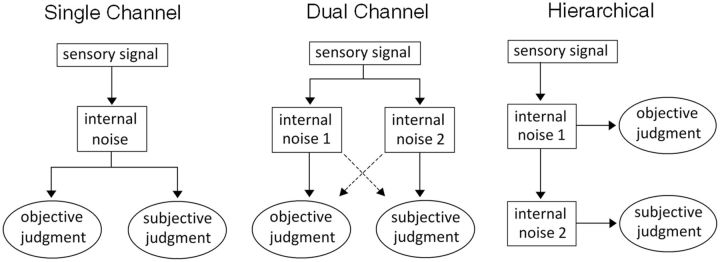
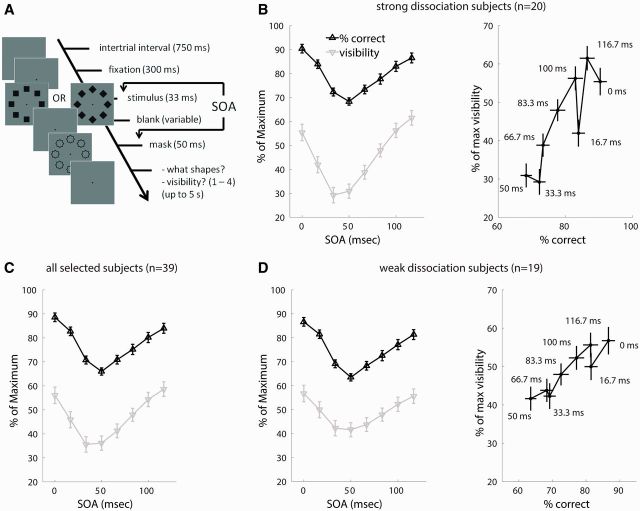
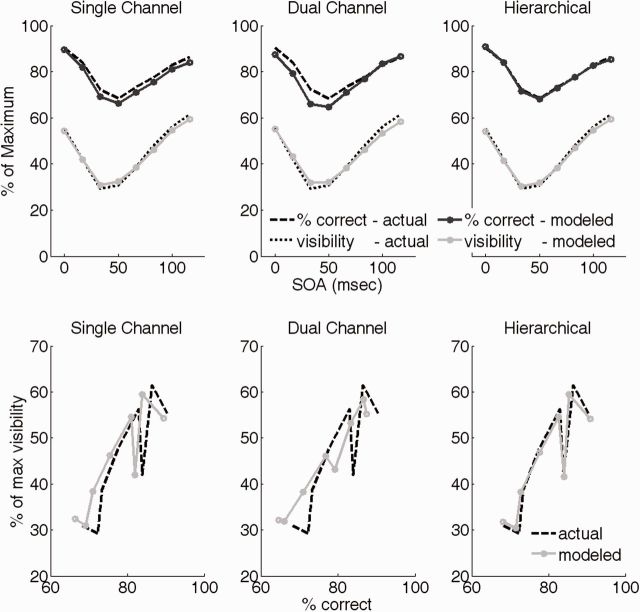
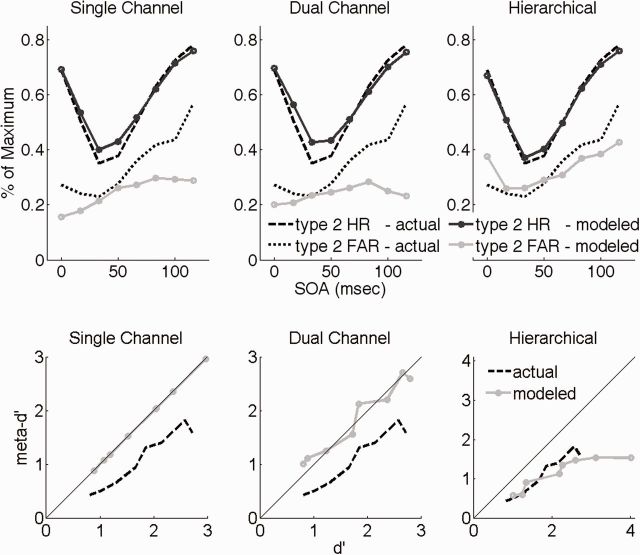
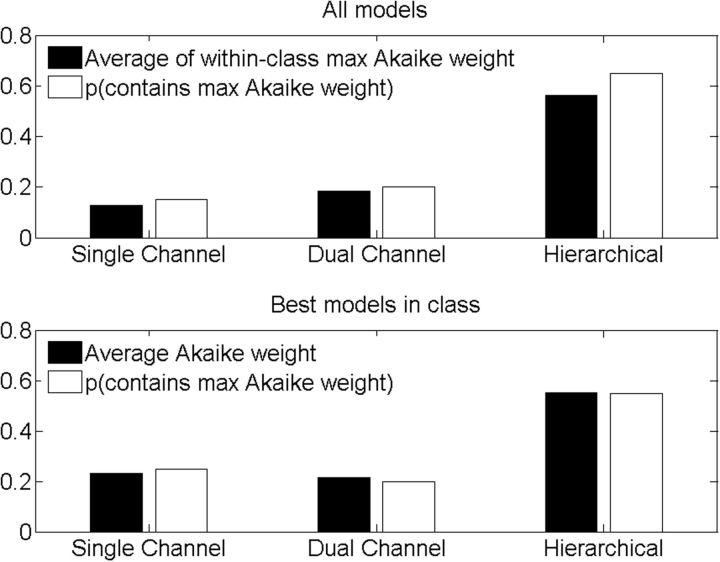
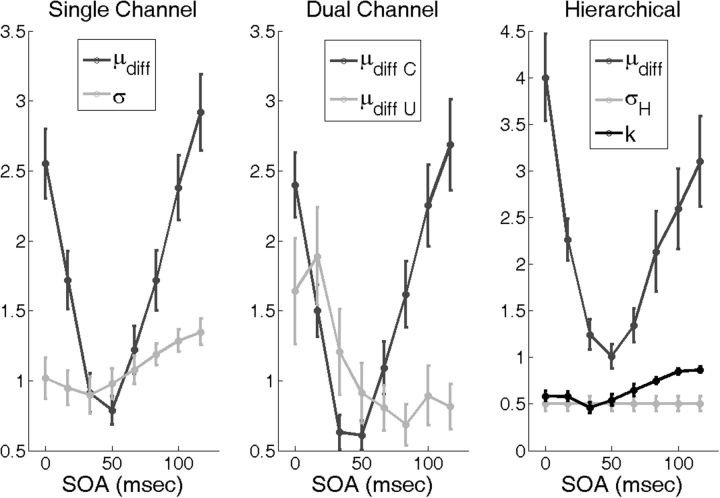
What is the relationship between perceptual information processing and subjective perceptual experience? Empirical dissociations between stimulus identification performance and subjective reports of stimulus visibility are crucial for shedding light on this question. We replicated a finding that metacontrast masking can produce such a dissociation (Lau and Passingham, 2006), and report a novel finding that this paradigm can also dissociate stimulus identification performance from the efficacy with which visibility ratings predict task performance. We explored various hypotheses about the relationship between perceptual task performance and visibility rating by implementing them in computational models and using formal model comparison techniques to assess which ones best captured the unusual patterns in the data. The models fell into three broad categories: Single Channel models, which hold that task performance and visibility ratings are based on the same underlying source of information; Dual Channel models, which hold that there are two independent processing streams that differentially contribute to task performance and visibility rating; and Hierarchical models, which hold that a late processing stage generates visibility ratings by evaluating the quality of early perceptual processing. Taking into account the quality of data fitting and model complexity, we found that Hierarchical models perform best at capturing the observed behavioral dissociations. Because current theories of visual awareness map well onto these different model structures, a formal comparison between them is a powerful approach for arbitrating between the different theories.
Overview
The claims and statistics of this paper haven’t been checked yet.
Free: it reads the open-access text and checks the first 5 claims that cite a source we can check. Create a free account to check every claim.
Integrity signals
Registry
Cites
Statistics
Figures
Verification
Claims the paper makes
The claims and statistics of this paper haven’t been checked yet.
Free: it reads the open-access text and checks the first 5 claims that cite a source we can check. Create a free account to check every claim.
Self-check
Percentages, sums and reported differences re-computed from the paper’s own numbers.
The self-check needs the paper’s full text.
Citations
Cites
Optimization by Simulated Annealing
Kirkpatrick, S., Gelatt, C. D., & Vecchi, M. P. (1983) · Science · doi:10.1126/science.220.4598.671 · Cited by 45,134
Model selection and multimodel inference: a practical information-theoretic approach.
Guthery, F. S., Burnham, K. P., & Anderson, D. R. (2003) · The Journal of Wildlife Management · doi:10.2307/3802723 · Cited by 41,495
Brainard, D. H. (1997) · Spatial Vision · doi:10.1163/156856897x00357 · Cited by 19,702
Detection Theory: A User's Guide
Macmillan, N. A., & Creelman, C. D. (1991) · Cited by 5,415
Ratcliff, R. (1978) · Psychological Review · doi:10.1037/0033-295x.85.2.59 · Cited by 4,513
The Neural Basis of Decision Making
Gold, J. I., & Shadlen, M. N. (2007) · Annual Review of Neuroscience · doi:10.1146/annurev.neuro.29.051605.113038 · Cited by 3,764 · cited 1×
“Gorea and Sagi (2000) found that when stimuli that are easy and difficult to perceive are interleaved randomly, subjects do not judge stimulus classes with separate criteria, but rather use a single, nonoptimal criterion for both.”
A process dissociation framework: Separating automatic from intentional uses of memory
Jacoby, L. L. (1991) · Journal of Memory and Language · doi:10.1016/0749-596x(91)90025-f · Cited by 3,696
Milner, A. D., & Goodale, M. A. (2002) · Vision and Mind · doi:10.7551/mitpress/7111.003.0023 · Cited by 3,331
The Diffusion Decision Model: Theory and Data for Two-Choice Decision Tasks
Ratcliff, R., & McKoon, G. (2008) · Neural Computation · doi:10.1162/neco.2008.12-06-420 · Cited by 3,059
Detection theory: A user's guide
Lories, G. (1993) · Behavioural Processes · doi:10.1016/0376-6357(93)90083-4 · Cited by 2,835
Cited by
A higher-order theory of emotional consciousness
LeDoux, J. E., & Brown, R. (2017) · Proceedings of the National Academy of Sciences · doi:10.1073/pnas.1619316114 · Cited by 690
Self-Evaluation of Decision-Making: A General Bayesian Framework for Metacognitive Computation
Fleming, S. M., & Daw, N. D. (2017) · Psychological Review · doi:10.1037/rev0000045 · Cited by 584
“…and Lau found that a signal detection model in which confidence is derived from a noisy hierarchical representation of evidence supporting a choice provided a better fit to rating data than alternatives in which evidence for choices and confidence evolved in parallel (Maniscalco & Lau, 2016).”
BackgroundSuboptimality in perceptual decision making
Rahnev, D., & Denison, R. N. (2018) · Behavioral and Brain Sciences · doi:10.1017/s0140525x18000936 · Cited by 342
The subjective experience of emotion: a fearful view
LeDoux, J. E., & Hofmann, S. G. (2018) · Current Opinion in Behavioral Sciences · doi:10.1016/j.cobeha.2017.09.011 · Cited by 268
“While other methods of reporting that do not require verbal report have been proposed [16–18], these also depend on introspection [15].”
BackgroundPerceptual confidence neglects decision-incongruent evidence in the brain
Peters, M. A. K., Thesen, T., Ko, Y. D., Maniscalco, B., Carlson, C., Davidson, M., Doyle, W., Kuzniecky, R., Devinsky, O., Halgren, E., et al. (2017) · Nature Human Behaviour · doi:10.1038/s41562-017-0139 · Cited by 252
“One could argue that this dissociation may be trivial, since it is generally accepted that metacognitive representations arise later than those underlying perceptual decisions 38,39 and may decay over time 40 .”
Self-citationPrestimulus EEG Power Predicts Conscious Awareness But Not Objective Visual Performance
Benwell, C. S. Y., Tagliabue, C. F., Veniero, D., Cecere, R., Savazzi, S., & Thut, G. (2017) · eneuro · doi:10.1523/eneuro.0182-17.2017 · Cited by 202
Multivoxel neurofeedback selectively modulates confidence without changing perceptual performance
Cortese, A., Amano, K., Koizumi, A., Kawato, M., & Lau, H. (2016) · Nature Communications · doi:10.1038/ncomms13669 · Cited by 157
Self-citationLegrand, N., Nikolova, N., Correa, C., Brændholt, M., Stuckert, A., Kildahl, N., Vejlø, M., Fardo, F., & Allen, M. (2022) · Biological Psychology · doi:10.1016/j.biopsycho.2021.108239 · Cited by 152
Taschereau‐Dumouchel, V., Kawato, M., & Lau, H. C. (2019) · Molecular Psychiatry · doi:10.1038/s41380-019-0520-3 · Cited by 142
Self-citationConfidence controls perceptual evidence accumulation
Balsdon, T., Wyart, V., & Mamassian, P. (2020) · Nature Communications · doi:10.1038/s41467-020-15561-w · Cited by 137
The global workspace needs metacognition
Shea, N., & Frith, C. D. (2019) · Trends in Cognitive Sciences · doi:10.1016/j.tics.2019.04.007 · Cited by 130
“idence for and against the decision [50,51,56]).”
Sources of Metacognitive Inefficiency
Shekhar, M., & Rahnev, D. (2021) · Trends in Cognitive Sciences · doi:10.1016/j.tics.2020.10.007 · Cited by 119
Evidence accumulation relates to perceptual consciousness and monitoring
Pereira, M., Mégevand, P., Tan, M. X., Chang, W., Wang, S., Rezai, A. R., Seeck, M., Corniola, M. V., Momjian, S., Bernasconi, F., et al. (2021) · Nature Communications · doi:10.1038/s41467-021-23540-y · Cited by 117
The nature of metacognitive inefficiency in perceptual decision making.
Shekhar, M., & Rahnev, D. (2021) · Psychological Review · doi:10.1037/rev0000249 · Cited by 111
Sensory noise increases metacognitive efficiency
Bang, J. W., Shekhar, M., & Rahnev, D. (2019) · Journal of Experimental Psychology: General · doi:10.1037/xge0000511 · Cited by 94
Higher order thoughts in action: consciousness as an unconscious re-description process
Timmermans, B., Schilbach, L., Pasquali, A., & Cleeremans, A. (2012) · Philosophical Transactions of the Royal Society B: Biological Sciences · doi:10.1098/rstb.2011.0421 · Cited by 87
Confidence in masked orientation judgments is informed by both evidence and visibility
Rausch, M., Hellmann, S., & Zehetleitner, M. (2017) · Attention Perception & Psychophysics · doi:10.3758/s13414-017-1431-5 · Cited by 86
The predictive global neuronal workspace: a formal active inference model of visual consciousness
Whyte, C. J., & Smith, R. (2021) · Progress in Neurobiology · doi:10.1016/j.pneurobio.2020.101918 · Cited by 84
The Predictive Global Neuronal Workspace: A Formal Active Inference Model of Visual Consciousness
Whyte, C. J., & Smith, R. (2020) · doi:10.1101/2020.02.11.944611 · Cited by 84
Shekhar, M., & Rahnev, D. (2024) · Journal of Experimental Psychology General · doi:10.1037/xge0001524 · Cited by 83
Disentangling the origins of confidence in speeded perceptual judgments through multimodal imaging
Pereira, M., Faivre, N., Iturrate, I., Wirthlin, M., Serafini, L., Martin, S., Desvachez, A., Blanke, O., Van De Ville, D., & Millán, J. D. R. (2020) · Proceedings of the National Academy of Sciences · doi:10.1073/pnas.1918335117 · Cited by 72
Confidence reflects a noisy decision reliability estimate
Boundy-Singer, Z. M., Ziemba, C. M., & Goris, R. L. T. (2022) · Nature Human Behaviour · doi:10.1038/s41562-022-01464-x · Cited by 71
Carruthers, P., & Williams, D. M. (2022) · Cognition · doi:10.1016/j.cognition.2022.105117 · Cited by 71
“…is inherent in the decision process itself (van den Berg, Anandalingam, et al. (2016); Khalvati, Kiani, & Rao, 2021), and those who find that it involves an additional second stage of processing that is second-order or hierarchical in nature (Fleming & Daw, 2017; Maniscalco & Lau, 2016).”
BackgroundModeling perceptual confidence and the confidence forced-choice paradigm.
Mamassian, P., & de Gardelle, V. (2022) · Psychological Review · doi:10.1037/rev0000312 · Cited by 70
“We note that one prior study investigating visibility ratings in a metacontrasting masking paradigm has discarded such a “dual-channel model” (Maniscalco & Lau, 2016).”
BackgroundMethodHow experimental procedures influence estimates of metacognitive ability
Rahnev, D., & Fleming, S. M. (2019) · Neuroscience of Consciousness · doi:10.1093/nc/niz009 · Cited by 69
Simultaneous modeling of choice, confidence, and response time in visual perception.
Hellmann, S., Zehetleitner, M., & Rausch, M. (2023) · Psychological Review · doi:10.1037/rev0000411 · Cited by 67
Consensus Goals in the Field of Visual Metacognition
Rahnev, D., Balsdon, T., Charles, L., de Gardelle, V., Denison, R., Desender, K., Faivre, N., Filevich, E., Fleming, S. M., Jehee, J., et al. (2022) · Perspectives on Psychological Science · doi:10.1177/17456916221075615 · Cited by 63
“An important distinction in current models is that between single-pathway, dual-pathway, and hierarchical models (Fleming & Daw, 2017; Maniscalco & Lau, 2016).”
InfluentialSelf-citationSure I'm Sure: Prefrontal Oscillations Support Metacognitive Monitoring of Decision Making
Wokke, M. E., Cleeremans, A., & Ridderinkhof, K. R. (2017) · The Journal of Neuroscience · doi:10.1523/jneurosci.1612-16.2016 · Cited by 63
Visual metacognition: Measures, models, and neural correlates.
Rahnev, D. (2021) · American Psychologist · doi:10.1037/amp0000937 · Cited by 61
Reverse engineering of metacognition
Guggenmos, M. (2022) · eLife · doi:10.7554/elife.75420 · Cited by 62
Comparing theories of consciousness: why it matters and how to do it
Del Pin, S. H., Skóra, Z., Sandberg, K., Overgaard, M., & Wierzchoń, M. (2021) · Neuroscience of Consciousness · doi:10.1093/nc/niab019 · Cited by 58
Rausch, M., Zehetleitner, M., Steinhauser, M., & Maier, M. E. (2020) · NeuroImage · doi:10.1016/j.neuroimage.2020.116963 · Cited by 58
Action information contributes to metacognitive decision-making
Wokke, M. E., Achoui, D., & Cleeremans, A. (2020) · Scientific Reports · doi:10.1038/s41598-020-60382-y · Cited by 56
Samaha, J., & Postle, B. R. (2017) · Proceedings of the Royal Society B: Biological Sciences · doi:10.1098/rspb.2017.2035 · Cited by 54
Evidence for metacognitive bias in perception of voluntary action
Charles, L., Chardin, C., & Haggard, P. (2019) · Cognition · doi:10.1016/j.cognition.2019.104041 · Cited by 51
Song, J., Loyal, S., & Lond, B. J. (2021) · Frontiers in Psychology · doi:10.3389/fpsyg.2020.607577 · Cited by 50
Towards a common conceptual space for metacognition in perception and memory
Mazancieux, A., Pereira, M., Faivre, N., Mamassian, P., Moulin, C. J. A., & Souchay, C. (2023) · Nature Reviews Psychology · doi:10.1038/s44159-023-00245-1 · Cited by 48
Examining the robustness of the relationship between metacognitive efficiency and metacognitive bias
Xue, K., Shekhar, M., & Rahnev, D. (2021) · Consciousness and Cognition · doi:10.1016/j.concog.2021.103196 · Cited by 45
Dou, W., Arango, L. J. M., Castaneda, O. G., Arellano, L., Mcintyre, E., Yballa, C., & Samaha, J. (2024) · Psychological Science · doi:10.1177/09567976241246561 · Cited by 45
Separable neural signatures of confidence during perceptual decisions
Balsdon, T., Mamassian, P., & Wyart, V. (2021) · eLife · doi:10.7554/elife.68491 · Cited by 45
Priors and payoffs in confidence judgments
Locke, S. M., Gaffin-Cahn, E., Hosseinizaveh, N., Mamassian, P., & Landy, M. S. (2020) · Attention, Perception, & Psychophysics · doi:10.3758/s13414-020-02018-x · Cited by 41
Performance Monitoring for Sensorimotor Confidence: A Visuomotor Tracking Study
Locke, S. M., Mamassian, P., & Landy, M. S. (2019) · Cognition · doi:10.1016/j.cognition.2020.104396 · Cited by 40
Minimal exposure durations reveal visual processing priorities for different stimulus attributes
Lanfranco, R. C., Canales‐Johnson, A., Rabagliati, H., Cleeremans, A., & Carmel, D. (2024) · Nature Communications · doi:10.1038/s41467-024-52778-5 · Cited by 37
Lund, A. E., Corrêa, C. M. C., Fardo, F., Fleming, S. M., & Allen, M. (2025) · Journal of Experimental Psychology Learning Memory and Cognition · doi:10.1037/xlm0001462 · Cited by 35
Esser, S., Lustig, C., & Haider, H. (2021) · Psychological Research · doi:10.1007/s00426-021-01594-3 · Cited by 34
Metacognitive resources for adaptive learning⋆
Cortese, A. (2022) · Neuroscience Research · doi:10.1016/j.neures.2021.09.003 · Cited by 33
Responses improve the accuracy of confidence judgements in memory tasks.
Siedlecka, M., Skóra, Z., Paulewicz, B., Fijałkowska, S., Timmermans, B., & Wierzchoń, M. (2019) · Journal of Experimental Psychology Learning Memory and Cognition · doi:10.1037/xlm0000608 · Cited by 36
Zou, F., & Kwok, S. C. (2022) · Journal of Cognitive Neuroscience · doi:10.1162/jocn_a_01838 · Cited by 33
Towards characterizing the canonical computations generating phenomenal experience
Peters, M. A. K. (2022) · Neuroscience & Biobehavioral Reviews · doi:10.1016/j.neubiorev.2022.104903 · Cited by 36
Lee, A. L. F., de Gardelle, V., & Mamassian, P. (2021) · Psychonomic Bulletin & Review · doi:10.3758/s13423-020-01869-7 · Cited by 32
“…metacognition have detailed the link between one perceptual decision and its associated confidence (e.g., Kepecs et al., 2008; Kiani & Shadlen, 2009; Maniscalco & Lau, 2016; Zylberberg et al., 2012), offering new theoretical frameworks to study confidence (Fleming & Daw, 2017; Pouget et al., 2016).”
BackgroundTranscranial magnetic stimulation to visual cortex induces suboptimal introspection
Peters, M. A. K., Fesi, J., Amendi, N., Knotts, J. D., Lau, H., & Ro, T. (2017) · Cortex · doi:10.1016/j.cortex.2017.05.017 · Cited by 32
Self-citationHow experimental procedures influence estimates of metacognitive ability
Rahnev, D., & Fleming, S. M. (2019) · Neuroscience of Consciousness · doi:10.1093/nc/niz010 · Cited by 31
Yeon, J., Shekhar, M., & Rahnev, D. (2020) · Scientific Reports · doi:10.1038/s41598-020-77820-6 · Cited by 30
Should metacognition be measured by logistic regression?
Rausch, M., & Zehetleitner, M. (2017) · Consciousness and Cognition · doi:10.1016/j.concog.2017.02.007 · Cited by 30
Suprathreshold perceptual decisions constrain models of confidence
Locke, S. M., Landy, M. S., & Mamassian, P. (2022) · PLoS Computational Biology · doi:10.1371/journal.pcbi.1010318 · Cited by 30
McIntosh, R. D., Moore, A., Liu, Y., & Sala, S. D. (2022) · Royal Society Open Science · doi:10.1098/rsos.191727 · Cited by 28
Temporal attention causes systematic biases in visual confidence
Recht, S., Mamassian, P., & de Gardelle, V. (2019) · Scientific Reports · doi:10.1038/s41598-019-48063-x · Cited by 28
Resilience of perceptual metacognition in a dual-task paradigm
Konishi, M., Compain, C., Berberian, B., Sackur, J., & de Gardelle, V. (2020) · Psychonomic Bulletin & Review · doi:10.3758/s13423-020-01779-8 · Cited by 27
Normal observers show no evidence for blindsight in facial emotion perception
Rajananda, S., Zhu, J., & Peters, M. A. K. (2020) · Neuroscience of Consciousness · doi:10.1093/nc/niaa023 · Cited by 27
Know Thyself: Well-Being and Subjective Experience.
LeDoux, J. E., Brown, R., Pine, D. S., & Hofmann, S. G. (2018) · PubMed Central · Cited by 28
Peters, M. A. K. (2022) · Oxford University Press eBooks · doi:10.1093/acrefore/9780190264086.013.371 · Cited by 26
The Neural Substrates of Conscious Perception without Performance Confounds
Morales, J., Odegaard, B., & Maniscalco, B. (2022) · Neuroscience and Philosophy · doi:10.7551/mitpress/12611.003.0015 · Cited by 25
Self-citationDefending subjective inflation: an inference to the best explanation
Knotts, J. D., Michel, M., & Odegaard, B. (2020) · Neuroscience of Consciousness · doi:10.1093/nc/niaa025 · Cited by 25
Optimal metacognitive decision strategies in signal detection theory
Maniscalco, B., Charles, L., & Peters, M. A. K. (2024) · Psychonomic Bulletin & Review · doi:10.3758/s13423-024-02510-7 · Cited by 27
Self-citationA window of subliminal perception
Sandberg, K., Pin, S. H. D., Overgaard, M. S., & Bibby, B. M. (2022) · Behavioural Brain Research · doi:10.1016/j.bbr.2022.113842 · Cited by 24
Measures of metacognitive efficiency across cognitive models of decision confidence.
Rausch, M., Hellmann, S., & Zehetleitner, M. (2026) · Psychological Methods · doi:10.1037/met0000634 · Cited by 25
Challenging the Bayesian confidence hypothesis in perceptual decision-making
Xue, K., Shekhar, M., & Rahnev, D. (2024) · Proceedings of the National Academy of Sciences · doi:10.1073/pnas.2410487121 · Cited by 23
Modelling visibility judgments using models of decision confidence
Rausch, M., Hellmann, S., & Zehetleitner, M. (2021) · Attention Perception & Psychophysics · doi:10.3758/s13414-021-02284-3 · Cited by 23
Ruby, E., Maniscalco, B., & Peters, M. A. K. (2018) · Consciousness and Cognition · doi:10.1016/j.concog.2018.04.009 · Cited by 23
Self-citationExpressions for Bayesian confidence of drift diffusion observers in fluctuating stimuli tasks
Calder-Travis, J., Bogacz, R., & Yeung, N. (2023) · Journal of Mathematical Psychology · doi:10.1101/2020.02.25.965384 · Cited by 21
Winter, C. J., & Peters, M. A. K. (2022) · Attention, Perception, & Psychophysics · doi:10.3758/s13414-021-02358-2 · Cited by 17
Acting, seeing, and conscious awareness
Passingham, R. E., & Lau, H. C. (2017) · Neuropsychologia · doi:10.1016/j.neuropsychologia.2017.06.012 · Cited by 18
Self-citationHuman-like dissociations between confidence and accuracy in convolutional neural networks
Shekhar, M., & Rahnev, D. (2024) · PLoS Computational Biology · doi:10.1371/journal.pcbi.1012578 · Cited by 17
Regression methods for metacognitive sensitivity
Kristensen, S. B., Sandberg, K., & Bibby, B. M. (2019) · Journal of Mathematical Psychology · doi:10.1016/j.jmp.2019.102297 · Cited by 16
Suboptimality in Perceptual Decision MakingPreprint
Rahnev, D., & Denison, R. N. (2016) · bioRxiv (Cold Spring Harbor Laboratory) · doi:10.1101/060194 · Cited by 16
Common computations for metacognition and meta-metacognition
Zheng, Y., Recht, S., & Rahnev, D. (2023) · Neuroscience of Consciousness · doi:10.1093/nc/niad023 · Cited by 15
The functional role of conscious sensation of movement
Grünbaum, T., & Christensen, M. S. (2024) · Neuroscience & Biobehavioral Reviews · doi:10.1016/j.neubiorev.2024.105813 · Cited by 15
Dienes, Z. P. (2024) · Psychology of Consciousness Theory Research and Practice · doi:10.1037/cns0000399 · Cited by 15
Quantifying metacognitive thresholds using signal-detection theoryPreprint
Sherman, M. T., Seth, A. K., & Barrett, A. B. (2018) · bioRxiv (Cold Spring Harbor Laboratory) · doi:10.1101/361543 · Cited by 15
West, R. K., Harrison, W. J., Matthews, N. L., Mattingley, J. B., & Sewell, D. K. (2023) · PLoS Computational Biology · doi:10.1371/journal.pcbi.1011245 · Cited by 13
Confidence response times: Challenging postdecisional models of confidence
Chen, S., & Rahnev, D. (2023) · Journal of Vision · doi:10.1167/jov.23.7.11 · Cited by 11
The Misunderstood Higher-Order Approach to ConsciousnessPreprint
Brown, R., Lau, H. C., & LeDoux, J. E. (2019) · PsyArXiv (OSF Preprints) · doi:10.31234/osf.io/xpy8h · Cited by 11
Self-citationA low-dimensional approximation of optimal confidence
Denmat, P. L., Verguts, T., & Desender, K. (2024) · PLoS Computational Biology · doi:10.1371/journal.pcbi.1012273 · Cited by 8
On why we lack confidence in some signal-detection-based analyses of confidence
Arnold, D. H., Johnston, A., Adie, J. M., & Yarrow, K. (2023) · Consciousness and Cognition · doi:10.1016/j.concog.2023.103532 · Cited by 10
Expressions for Bayesian confidence of drift diffusion observers in dynamic stimuli tasksPreprint
Calder-Travis, J. M., Bogacz, R., & Yeung, N. (2020) · doi:10.17605/osf.io/tk3vp · Cited by 8
How experimental procedures influence estimates of metacognitive abilityPreprint
Rahnev, D., & Fleming, S. M. (2019) · PsyArXiv (OSF Preprints) · doi:10.31234/osf.io/u6q4p · Cited by 8
The precision test of metacognitive sensitivity and confidence criteria
Arnold, D. H., Clendinen, M., Johnston, A., Lee, A., & Yarrow, K. (2024) · Consciousness and Cognition · doi:10.1016/j.concog.2024.103728 · Cited by 7
Fung, H., Shekhar, M., Xue, K., Rausch, M., & Rahnev, D. (2025) · Consciousness and Cognition · doi:10.1016/j.concog.2025.103942 · Cited by 7
Confidence Tracks Consciousness *
Morales, J., & Lau, H. C. (2022) · Cambridge University Press eBooks · doi:10.1017/9781108768085.007 · Cited by 7
Self-citationCrucial Role of the Prefrontal Cortex in Conscious Perception
Lew, S., & Lau, H. C. (2017) · Elsevier eBooks · doi:10.1016/b978-0-12-803676-1.00006-4 · Cited by 7
Self-citationPournaghdali, A., Schwartz, B. L., & Soto, F. A. (2025) · Journal of Cognition · doi:10.5334/joc.442 · Cited by 6
Samaha, J., & Postle, B. R. (2017) · PsyArXiv (OSF Preprints) · doi:10.31234/osf.io/c8ze3 · Cited by 6
statConfR: An R Package for Static Models of Decision Confidence and Metacognition
Rausch, M., Meyen, S., & Hellmann, S. (2025) · The Journal of Open Source Software · doi:10.21105/joss.06966 · Cited by 5
Rong, Y., & Peters, M. A. K. (2023) · Open Mind · doi:10.1162/opmi_a_00100 · Cited by 5
The Strength of the Mind: Essays on Consciousness and Introspection
Morales, J. (2018) · Columbia Academic Commons (Columbia University) · doi:10.7916/d82249sw · Cited by 5
Taschereau‐Dumouchel, V., Chiba, T., Koizumi, A., Kawato, M., & Lau, H. C. (2020) · bioRxiv (Cold Spring Harbor Laboratory) · doi:10.1101/2020.04.03.021956 · Cited by 5
Self-citationWhen awareness outstrips performance: critical tests of subjective inflation under inattentionPreprint
Tian, K. J., Maniscalco, B., Epstein, M. L., Shen, A., Castaneda, O. G., Kurosawa, T., Motzer, J. A., Olsson, E., Russell, E. E., Walsh, M., et al. (2025) · bioRxiv (Cold Spring Harbor Laboratory) · doi:10.1101/2025.07.03.661972 · Cited by 5
Self-citationUsing artificial neural networks to reveal the human confidence computation
Shekhar, M., Fung, H., Saxena, K., Rafiei, F., & Rahnev, D. (2025) · PLoS Computational Biology · doi:10.1371/journal.pcbi.1013827 · Cited by 5
How brains build higher order representations of uncertainty
Peters, M. A. K., & Asrari, H. A. (2026) · Philosophy and the Mind Sciences · doi:10.33735/phimisci.2026.12269 · Cited by 3
Ruby, E., Maniscalco, B., Lau, H. C., & Peters, M. A. K. (2017) · bioRxiv (Cold Spring Harbor Laboratory) · doi:10.1101/198218 · Cited by 3
Self-citation
Metadata
- Authors
- Maniscalco, B., & Lau, H.
- Affiliations
- National Institutes of Health (US)
- University of California, Los Angeles (US)
- Corresponding author
- Maniscalco, Brian
- Venue
- Neuroscience of Consciousness
- Publisher
- Oxford University Press (OUP)
- Published
- 2016-01-01
- Volume
- 2016
- Issue
- 1
- ISSN
- 2057-2107 (ISSN-L)
- PMC
- PMC4972343
- OpenAlex
- W2335867627
- Cited by
- 133
- References
- 69
- Citations by year
- 2026: 8 · 2025: 7 · 2024: 15 · 2023: 17 · 2022: 13 · 2021: 15 · 2020: 18 · 2019: 10 · 2018: 10 · 2017: 15 · 2016: 4
- FWCI
- 8.27
- Type
- journal article
- Language
- en
- Open access
- gold
- doi.org
- Licence
- Locations
- Neuroscience of Consciousness (publishedVersion, cc-by-nc)
- Europe PMC (PubMed Central) (publishedVersion, cc-by-nc)
- PubMed Central (publishedVersion, cc-by-nc)
- PubMed (publishedVersion)
- Funders
- National Institutes of Health
- Topics
- Life Sciences › Neuroscience › Cognitive Neuroscience › Visual perception and processing mechanisms
- Social Sciences › Arts and Humanities › Philosophy › Philosophy and Theoretical Science
- Social Sciences › Psychology › Experimental and Cognitive Psychology › Multisensory perception and integration
- Keywords
- visual awareness, metacontrast masking, stimulus identification, perceptual consciousness, dual-channel model, hierarchical models, single-channel model, model comparison, computational models of perception
About these checks
Registry, retraction, Cites and statistics results are computed, not judged, with one exception: a printed reference that no index lists is read once by a model before it counts as a citation error. Claims are extracted by a model and kept only when their quote appears verbatim in the text; each cited source is then checked, with a model’s help, for whether it says what the claim relies on. Those verdicts can be wrong — read the claim’s quote and the cited source before relying on one.
Statistics and arithmetic are recomputed, not judged.
Confidence bands are shown only for fields calibrated on our annotated test set. None is calibrated yet, so no band is shown.
What counts as a claim ›How we measure confidence ›How we check this ›
Are you an author, or do you see a problem with this page? Request a review
Data sources
Bibliographic data: Semantic Scholar, OpenAlex, Crossref.
Contains information from the Semantic Scholar Academic Graph Datasets, made available under the ODC Attribution License (ODC-BY 1.0).
Semantic Scholar’s data is described in: Kinney, R., et al. (2023). The Semantic Scholar Open Data Platform. arXiv:2301.10140.
