

The DOI matches its Crossref record; 10 of the 10 references it cites were found in a registry or an index.
Endovascular embolization by a magnetic microfiberbot
Open accessAbstract
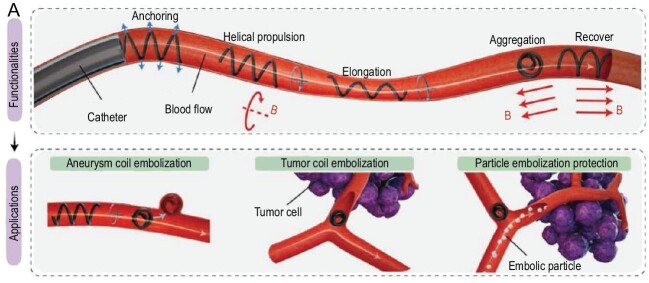
The evolving landscape of embolization therapy for treating cerebral aneurysms and brain tumors represents a pivotal stride towards enhancing the efficacy and safety of minimally invasive treatments [1]. Conventional endovascular embolization methods [2], characterized by the manual maneuvering of catheters through the vascular system, present notable limitations in steerability and precision, compounded by the potential health risks associated with prolonged exposure to radiation for surgeons. In a significant publication in Science Robotics, a collaborative team led by Professors Jianfeng Zang, Guangming Tao and Guang-Zhong Yang has pioneered a breakthrough in robotic embolization [3]. Their work introduces magnetic soft microfiber robots (Fig. 1), promising to revolutionize this field by directly tackling existing challenges with their innovative design. Microfiberbots, with their helical geometry and customizable diameter, introduce an innovative approach to navigating the tortuous and confined pathways of the vascular system. Their design allows for compatibility with existing catheterization techniques, thereby enhancing clinical applicability. The application of remote magnetic fields to steer these microfiberbots within blood vessels signifies a monumental leap in achieving targeted delivery of embolic agents with unprecedented precision and control. This remotely controllable operation not only augments the steerability and maneuverability of embolization procedures but also minimizes the radiation exposure to surgeons, fostering a safer procedural environment. Conventional fiber fabrication methodologies, such as electrospinning, Magnetic soft microfiberbots for robotic embolization. wet-spinning and melt-spinning, commonly involve single fluidic flow of precursor materials before the final formation. The multimaterial fiber thermal drawing methodology [4,5], adopted to fabricate the magnetic microfibers, enables the continuous co-flow of the inner magnetic composite core and outer sacrificial thermoplastic polymer cladding. The outer polymer layer permits not only the consistent magnetic fiber fabrication but also the ultrathin features via the effective suppression of fluidic instability [6]. Moreover, such multimaterial fibers can convey diverse operational functionalities such as laser transmission [7], electrical ablation and microfluidic delivery [8,9]. Further incorporation of machine intelligence into the system permits fiberbots that can navigate, steer, perceive, learn and solve during interventions [10]. The significance of this work lies not only in its immediate application to the field of embolization but also in its potential to redefine the parameters of what is achievable in minimally invasive surgical treatments. The enhanced steerability, reliable maneuverability and on-demand shape-morphing capabilities of the microfiberbots facilitate precise occlusion of blood flow to targeted lesions, offering a promising adjunct or alternative to traditional catheter-based embolization techniques. The demonstrated in vitro and in vivo efficacy of these microfiberbots in embolizing aneurysms and tumors underlines the practical viability and potential transformative impact of this technology on patient outcomes and surgical safety. However, the journey from bench to bedside is fraught with challenges that need to be meticulously addressed to realize the full potential of this technology. The considerations for clinical translation highlighted in the article, including the customization of the microfiberbot's diameter for varying aneurysm sizes, the biocompatibility of materials, and the development of advanced positioning and tracking systems, underscore the multifaceted nature of bringing such innovations to clinical practice. Moreover, the exploration of strategies to expedite thrombus formation, such as the coating of microfiberbots with thrombin or iron oxide nanoparticles for radio frequency (RF)-induced hyperthermia, illustrates the ongoing efforts to enhance the efficacy and efficiency of embolization procedures. In conclusion, while the development of magnetic soft microfiber robots represents a groundbreaking advancement in the field of robotic embolization, the realization of their full clinical potential necessitates further research and innovation. The exploration of biocompatible materials, precise control mechanisms and efficient thrombus formation techniques will be critical in overcoming the existing barriers to clinical adoption. As this technology matures, it holds the promise of revolutionizing the treatment of cerebral aneurysms and brain tumors, ushering in a new era of safer, more precise and minimally invasive therapeutic interventions. Conflict of interest statement. None declared.
Overview
The claims and statistics of this paper haven’t been checked yet.
Free: it reads the open-access text and checks the first 5 claims that cite a source we can check. Create a free account to check every claim.
Integrity signals
Registry
Cites
Statistics
Figures
Verification
Claims the paper makes
The claims and statistics of this paper haven’t been checked yet.
Free: it reads the open-access text and checks the first 5 claims that cite a source we can check. Create a free account to check every claim.
Claims other papers make about this one
Each is checked against this paper’s own text: does it say what the citing paper says it does?
The source backs part of the claim, not all of it — or backs it for a different population, condition or comparison.
In the citing paper
“At a larger scale, magnetic field-based technologies are transforming endovascular and neurovascular interventions [153,154,155,156,157,158,159,160].”
From The Heart’s Electromagnetic Field in Emotions, Empathy and Human Connection: Biosensor-Derived Insights into Heart–Brain Axis Mechanisms and a Basis for Novel BioMagnetoTherapies (2026) · cites this paper as [158]
Experimental — accuracy not yet measuredThe source backs part of the claim, not all of it — or backs it for a different population, condition or comparison.
In the citing paper
“Soft robots, steerable catheters, and magnetic microbots allow non-traumatic vascular navigation, targeted drug or clot therapies, and on-demand embolization [153,155,156,157,158,159,160] with MRI-guided magnetic navigation enhancing visualization and safety [17,155,156].”
From The Heart’s Electromagnetic Field in Emotions, Empathy and Human Connection: Biosensor-Derived Insights into Heart–Brain Axis Mechanisms and a Basis for Novel BioMagnetoTherapies (2026) · cites this paper as [158]
Experimental — accuracy not yet measuredThe source backs part of the claim, not all of it — or backs it for a different population, condition or comparison.
In the citing paper
“Early pilots confirm feasibility, though issues of device visibility, retrieval, chronic biocompatibility, and workflow integration require further investigation [153,155,156,157,158,159,160].”
From The Heart’s Electromagnetic Field in Emotions, Empathy and Human Connection: Biosensor-Derived Insights into Heart–Brain Axis Mechanisms and a Basis for Novel BioMagnetoTherapies (2026) · cites this paper as [158]
Experimental — accuracy not yet measured
Self-check
Percentages, sums and reported differences re-computed from the paper’s own numbers.
The self-check needs the paper’s full text.
Citations
Cites
Thermally drawn advanced functional fibers: New frontier of flexible electronics
Yan, W., Dong, C., Xiang, Y., Jiang, S., Leber, A., Loke, G., Xu, W., Hou, C., Zhou, S., Chen, M., et al. (2020) · Materials Today · doi:10.1016/j.mattod.2019.11.006 · Cited by 263
Magnetic soft microfiberbots for robotic embolization
Liu, X., Wang, L., Xiang, Y., Liao, F., Li, N., Li, J., Wang, J., Wu, Q., Zhou, C., Yang, Y., et al. (2024) · Science Robotics · doi:10.1126/scirobotics.adh2479 · Cited by 213
Intracranial aneurysms: Review of current science and management
Tóth, G., & Cerejo, R. (2018) · Vascular Medicine · doi:10.1177/1358863x18754693 · Cited by 158
Endovascular Embolization: Review of Currently Available Embolization Agents
Leyon, J. J., Littlehales, T., Rangarajan, B., Hoey, E. T. D., & Ganeshan, A. (2013) · Current Problems in Diagnostic Radiology · doi:10.1067/j.cpradiol.2013.10.003 · Cited by 106
Multifunctional Fiber‐Enabled Intelligent Health Agents
Chen, M., Li, P., Wang, R., Xiang, Y., Huang, Z., Qiao, Y., He, M., Liu, J., Wang, J., Su, M., et al. (2022) · Advanced Materials · doi:10.1002/adma.202200985 · Cited by 94
Wearable and interactive multicolored photochromic fiber display
Li, P., Wang, Y., He, X., Cui, Y., Ouyang, J., Ouyang, J., He, Z., Hu, J., Liu, X., Wei, H., et al. (2024) · Light Science & Applications · doi:10.1038/s41377-024-01383-8 · Cited by 90
Floating magnetic microrobots for fiber functionalization
Barbot, A., Tan, H., Power, M., Florent Seichepine, A., & Yang, G. (2019) · Science Robotics · doi:10.1126/scirobotics.aax8336 · Cited by 80
In-Fiber Structured Particles and Filament Arrays from the Perspective of Fluid Instabilities
Xu, B., Ma, S., Xiang, Y., et al. (2020) · Advanced Fiber Materials · doi:10.1007/s42765-019-00024-9 · Cited by 34
Flexible fiberbotic laser scalpels: Material and fabrication challenges
Zou, Y., Ren, Z., Xiang, Y., Liu, C., Gao, A., Huang, S., Yang, L., Hou, C., Guo, H., Yang, G., et al. (2024) · Matter · doi:10.1016/j.matt.2024.01.007 · Cited by 23
Flexible and robust low-loss selenium-based multimaterial infrared fibers towards CO2 laser ablation
Zou, Y., Liu, C., Ren, Z., et al. (2022) · iScience · doi:10.1016/j.isci.2022.105167 · Cited by 14
Cited by
Palantzas, A., & Anagnostouli, M. (2026) · Sensors · doi:10.3390/s26051738 · Cited by 1
Metadata
- Authors
- Zhang, S., Yang, W., & Ge, J.
- Affiliations
- Chinese Academy of Medical Sciences & Peking Union Medical College (CN)
- Corresponding author
- Ge, Junbo
- Venue
- National Science Review
- Publisher
- Oxford University Press (OUP)
- Published
- 2024-04-03
- Volume
- 11
- Issue
- 5
- Pages
- nwae117-nwae117
- ISSN
- 2053-714X (ISSN-L)
- 2095-5138
- PMC
- PMC11031214
- OpenAlex
- W4393929794
- Cited by
- 2
- References
- 10
- Citations by year
- 2026: 1 · 2025: 1
- FWCI
- 0.29
- Type
- journal article
- Language
- en
- Open access
- gold
- doi.org
- Licence
- Locations
- National Science Review (publishedVersion, cc-by)
- PubMed Central (publishedVersion, cc-by)
- PubMed (publishedVersion)
- Topics
- Physical Sciences › Physics and Astronomy › Condensed Matter Physics › Micro and Nano Robotics
- Physical Sciences › Engineering › Biomedical Engineering › Soft Robotics and Applications
- Health Sciences › Medicine › Clinical Neurology › Intracranial Aneurysms: Treatment and Complications
- Keywords
- soft robotics, intracranial aneurysm, brain tumors, thermal drawing, minimally invasive surgery, radiation dose reduction, shape morphing
About these checks
Registry, retraction, Cites and statistics results are computed, not judged, with one exception: a printed reference that no index lists is read once by a model before it counts as a citation error. Claims are extracted by a model and kept only when their quote appears verbatim in the text; each cited source is then checked, with a model’s help, for whether it says what the claim relies on. Those verdicts can be wrong — read the claim’s quote and the cited source before relying on one.
Statistics and arithmetic are recomputed, not judged.
Confidence bands are shown only for fields calibrated on our annotated test set. None is calibrated yet, so no band is shown.
What counts as a claim ›How we measure confidence ›How we check this ›
Are you an author, or do you see a problem with this page? Request a review
How to cite
Cite CoChat for the checks on this page, and the paper for its own findings.
- This page
- CoChat. (2026). Citation check: Endovascular embolization by a magnetic microfiberbot. https://app.cochat.ai/papers/10.1093/nsr/nwae117
- The paper
- Zhang, S., Yang, W., & Ge, J. (2024). Endovascular embolization by a magnetic microfiberbot. National Science Review. https://doi.org/10.1093/nsr/nwae117
Data sources
Bibliographic data: Semantic Scholar, OpenAlex, Crossref.
Contains information from the Semantic Scholar Academic Graph Datasets, made available under the ODC Attribution License (ODC-BY 1.0).
Semantic Scholar’s data is described in: Kinney, R., et al. (2023). The Semantic Scholar Open Data Platform. arXiv:2301.10140.
